

Jury Clears Afroman of Defamation for Mocking Cops Who Raided His House
Ohio sheriff's deputies raided Afroman's house in 2022 based on a bogus tip, then sued the rapper after he released music videos mocking the deputies.
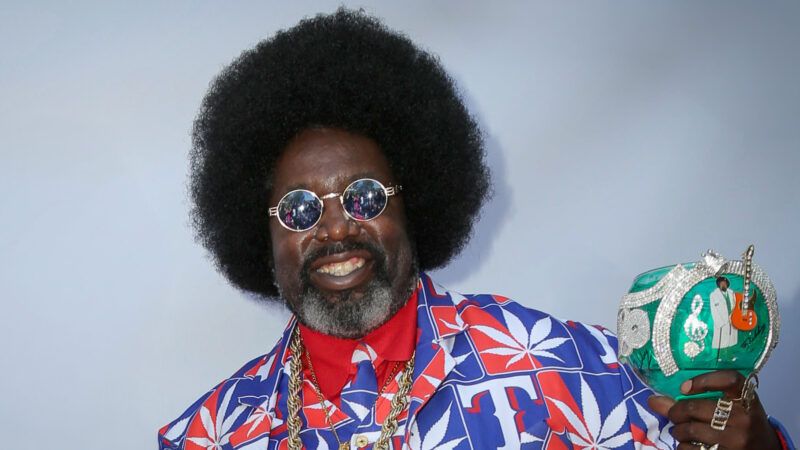
An Ohio jury on Wednesday found the rapper Afroman not liable for defaming the sheriff's deputies who raided his house nearly four years ago.
The verdict is a free speech victory for Joseph Foreman, a.k.a. Afroman, best known for his 2000 hit "Because I Got High." Over the course of a three-day civil trial that captured social media attention, Afroman, who appeared in court dressed in an American flag-print suit, insisted that he had a First Amendment right to make fun of the deputies who kicked down his door and pawed through his belongings. Afroman released several music videos about the incident using surveillance footage of the raid.
"I got freedom of speech. After they run around my house with guns and kick down my door, I got the right to kick a can in my back yard, use my freedom of speech, and turn my bad times into a good time, yes I do," Afroman told jurors on Tuesday. "And I think I'm a sport for doing so, because I don't go to their house, kick down their doors [and] then try to play the victim and sue them."
The sheriff's deputies, meanwhile, were reduced in court to watching full-length music videos of Afroman mocking them and testifying about how the rapper had called them "dipshits" and made claims to sleeping with their wives.
The American Civil Liberties Union (ACLU) of Ohio, which filed an amicus brief in support of Afroman, applauded the verdict.
"We're very pleased with this outcome, and we think the jury got it right. Robust protection for free speech requires leaving room for speakers to give their opinions in strong, florid, or figurative terms without fear of criminal or civil consequences," says David Carey, deputy legal director of the ACLU of Ohio. "All the more so with speech involving criticism of government officials and their actions. Juries exercising common sense and considering the full context and actual meaning of a speaker's words are a critical part of that system."
Adams County, Ohio, sheriff's deputies executed a search warrant on Afroman's house in 2022. According to a search warrant, Afroman was suspected of drug possession, drug trafficking, and kidnapping. The deputies were searching for evidence of outlandish claims from a confidential informant that the house contained a basement dungeon.
Body camera footage of the raid showed the deputies—after the initial excitement of busting down the front door—ambling through Afroman's house, rifling through his clothes and CDs, and trying to find false walls and secret rooms. But the hourslong search turned up no evidence to corroborate the claim of a basement dungeon. Part of the problem may have been that, as Afroman's record label told Vice, the house did not have a basement.
Afroman was never charged with a crime.
Deputies did, however, seize more than $5,000 in cash, which they were ultimately forced to return. (The returned amount was $400 short, which an investigation later determined was due to a counting error by deputies.)
An aggrieved Afroman then used surveillance footage of the raid and cellphone video taken by his wife in two music videos, "Lemon Pound Cake" and "Will You Help Me Repair My Door." He also sold merchandise with images of the deputies and used the footage to promote his products and tours.
Rather than taking their lumps and moving on, seven Adams County sheriff's deputies sued Afroman in 2023, claiming that the musician used their personas for commercial purposes without permission, causing them to suffer "embarrassment, ridicule, emotional distress, humiliation, and loss of reputation."
An Ohio county judge tossed out the deputies' claims of invasion of privacy by misappropriation and unauthorized commercial use, finding that, "while their quality and appropriateness may be questioned, [Afroman's] artistic and musical renderings have substantial and creative content which outweighs any adverse effect on the plaintiffs in terms of their right of publicity."
However, the judge allowed three of the officers' other claims—false light, unreasonable publicity of private lives, and defamation—to survive, finding that many of Afroman's comments on the deputies appeared to be statements of fact rather than opinion. For example, Afroman posted on social media that deputies wanted to kill him, that one of them stole money from him, and that another deputy was a lesbian.
Those claims went to trial this week, but the deputies, who were seeking $3.9 million, struggled to show that Afroman's mockery was something that a reasonable person would take as statements of fact, rather than hip-hop hyperbole.
For example, Adams County officer Randolph Walters Jr. testified that a music video in which Afroman says he had sex with Walters' wife painted him in a false light and caused him "tremendous pain."
"But we all know that's not true, right?" David Osborne, Afroman's lawyer, replied.
"I don't know," Walters said.
After a long pause, Osborne responded, "You don't know if your wife's cheating on you or not?"
Robert Klingler, the attorney for the deputies, said during closing arguments that the First Amendment didn't protect Afroman from making false and malicious statements.
"Mr. Foreman doesn't get to wrap himself in the American flag and say you can't touch me, I can say what I want, no matter how untrue it is, no matter how much pain it causes people, because I have freedom of speech," Klingler said. "He can't do that."
However, the jury disagreed.
To recap, these Adam County Sheriff's deputies raided Afroman's house on a bogus tip and got mocked for it, sued Afroman for using his own surveillance footage to ridicule them, testified and cried in open court about how much Afroman's music videos hurt their feelings, and then lost. This is an incredible sequence of events, a truly Drake-like example of self-ownage and the Streisand effect.
It's worth remembering, as Afroman repeatedly pointed out on the stand, that the state initiated violence against him first, and he responded with artistic speech. It may have been vulgar speech, intended to insult and publicly demean its targets, but the fact that it was brutally effective is secondary to the fact that it was launched in response to, and in criticism of, government force. The deputies seem to mainly object to discovering that the state's monopoly on violence doesn't extend to diss tracks, and the jury rightly saw that government officials can't claim both the power to break into a rapper's house and stop him from making music about it.




