
Department of Homeland Security
Prosecutors Admit the DHS Account of an ICE Shooting Was Based on Lies
The department's pattern of dishonesty supports a presumption of irregularity.
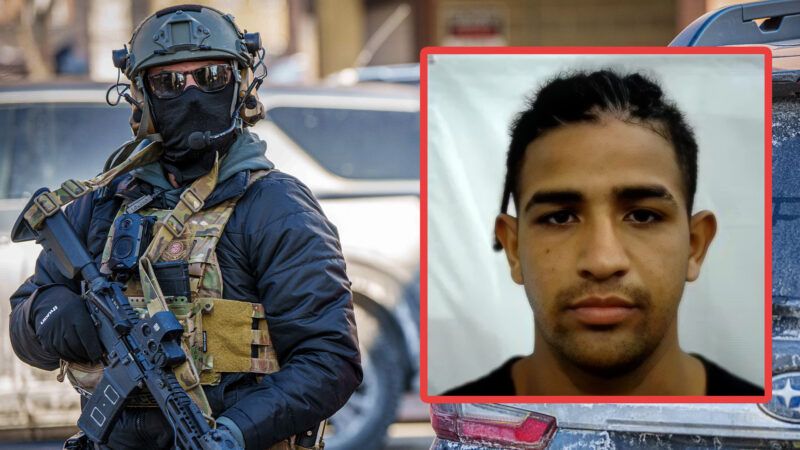
When immigration agents manhandle or shoot someone, the Department of Homeland Security (DHS) always has a ready explanation. If that person was carrying a holstered handgun, he was "brandishing" the weapon, making it clear that he "wanted to do maximum damage and massacre law enforcement." If that person was driving a car, she was engaged in "domestic terrorism" because she "weaponized her vehicle to conduct an act of violence against a law enforcement officer and the public." If that person was a gardener, he weaponized his weed trimmer.
In the case of Julio C. Sosa-Celis, an unauthorized U.S. resident from Venezuela who was shot in the leg by an Immigration and Customs Enforcement (ICE) agent in Minneapolis on January 14, the official story was similar. The DHS claimed Sosa-Celis "violently" assaulted the agent, who simultaneously was "ambushed and attacked" by two other Venezuelan nationals. Those men allegedly "came out of a nearby apartment" and "attacked the law enforcement officer with a snow shovel and broom handle." The agent "was ambushed and attacked by three individuals who beat him with snow shovels and the handles of brooms," DHS Secretary Kristi Noem said in the same press release, multiplying the weaponized implements. "Fearing for his life, the officer fired a defensive shot" in response to "an attempted murder."
That account, like the others, fell apart upon examination. But in this case, the government itself conceded that the initial story was a lie.
The story already had evolved by the time the government filed assault charges against Sosa-Celis and Alfredo A. Aljorna, who allegedly joined the attack that supposedly preceded the shooting. The man whom the DHS had described as a third assailant, Gabriel Hernandez Ledezma, notably was not charged. Instead he was shipped off to a detention center in Texas.
Hernandez Ledezma thought that happened because he was "a key witness" to the shooting whose account "undermines the federal government's narrative of what occurred." His explanation seems plausible in light of what happened with that narrative.
According to an FBI agent's affidavit, the ICE agent who eventually shot Sosa-Celis was struggling with Aljorna when Sosa-Celis grabbed a broomstick and began hitting the agent in the face with it. Another man, unnamed in the affidavit, allegedly struck the agent with a snow shovel. Then Aljorna allegedly grabbed the broomstick. The agent, who had suffered a gash on his hand while defending himself, was "exhausted, alone, on the ground and in fear" when he drew his pistol and fired one round at Aljorna and Sosa-Celis as they fled toward an apartment building.
The ICE agent was joined by colleagues, who lobbed tear gas at the building, forcing Aljorna and Sosa-Celis to exit. After they were apprehended, it turned out that Sosa-Celis had suffered "a non-life-threatening gunshot wound to his upper right thigh."
That was what the FBI agent said had happened, based on reports from the ICE agent and one of his colleagues. But according to Daniel N. Rosen, the U.S. attorney for Minnesota, it was not true. "Newly discovered evidence in this matter is materially inconsistent with the allegations" against Aljorna and Sosa-Celis, Rosen told U.S. District Judge Paul A. Magnuson last Thursday. The next day, Magnuson granted Rosen's request to dismiss the charges with prejudice, meaning they cannot be filed again.
"Video evidence has revealed that sworn testimony provided by two separate officers appears to have made untruthful statements," Acting ICE Director Todd Lyons said on Friday. "Both officers have been immediately placed on administrative leave pending the completion of a thorough internal investigation. Lying under oath is a serious federal offense. The U.S. Attorney's Office is actively investigating these false statements."
Lyons added that "ICE remains fully committed to transparency, accountability, and the fair enforcement of our nation's immigration laws." Yet the government has not identified the ICE agents who "made untruthful statements." Nor has it released the "video evidence" that undermined their accounts or explained what actually happened that day.
This episode is part of a pattern. "In case after case" across the country, Reason's C.J. Ciaramella noted in October, the DHS has shown "a willingness to put false information out to the public and never correct it."
Despite that history of dishonesty, I confess that I initially did not see anything amiss in the official account of why Sosa-Celis was shot, even though it happened a week after bystander video cast doubt on the initial justification for killing Minneapolis protester Renee Good. But although the shooting of Sosa-Celis sounded like a straightforward case of self-defense against multiple assailants, it turns out that Noem was simply parroting the self-interested claims of her underlings, as she did after Good's death and would do again after Alex Pretti, another Minneapolis protester, was fatally shot on January 24.
"For many," The New York Times notes, "the repeated emergence of evidence that undermines official accounts has cast doubt on almost anything the government says about immigration enforcement." That is "especially" true, the Times suggests, for "those already skeptical of the Trump administration's deportation agenda." But at this point, even Americans who support President Donald Trump's mass deportation campaign may be starting to see that it is reckless to take Noem at her word.
The treatment of Sosa-Celis reflects "the Trump administration's rush to defend ICE officers before they understand the facts," Deborah Fleischaker, who served as ICE chief of staff and DHS executive secretary during the Biden administration, told the Times. "The rush to charge the victim in this case is sadly in line with the administration's never-back-down, more-is-more ethos." Fleischaker added that it "diminishes even further the trust and respect that should or will be granted the government moving forward."
Federal courts traditionally are guided by "the presumption of regularity," meaning they credit the government's factual representations unless there is substantial evidence contradicting them. Whatever the legal implications of the Trump administration's tendency to embrace false narratives, the DHS has shown it deserves no such presumption in the court of public opinion. A presumption of irregularity would be a better rule of thumb.
