
Disarming Millions of Americans Simply Because They Use Marijuana Is Unconstitutional, a SCOTUS Brief Says
The Liberty Justice Center is urging the Supreme Court to uphold a 5th Circuit decision rejecting the claim that cannabis consumers have no Second Amendment rights.
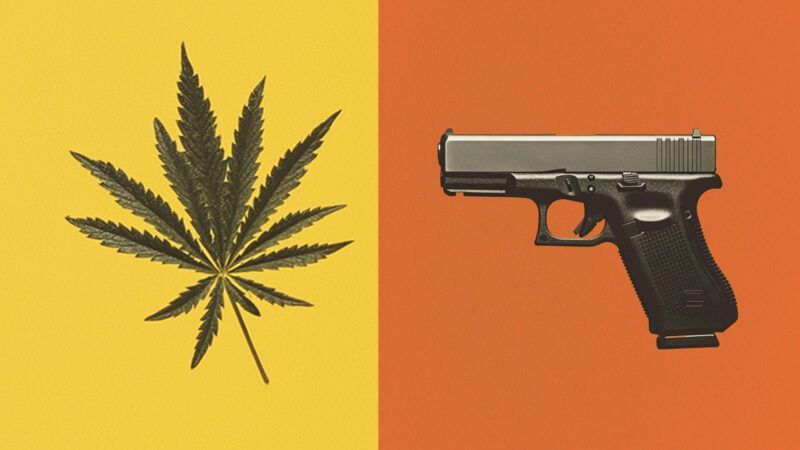
Judging from federal survey data, nearly a quarter of Americans 18 or older used marijuana in 2024, while 16 percent reported using it during the previous month. Those numbers suggest that somewhere between 43 million and 62 million Americans are disqualified from gun ownership because of their cannabis consumption, even if they live in one of the 40 states that have legalized marijuana for medical or recreational use. Marijuana users who nevertheless try to exercise the Second Amendment right to keep and bear arms are committing up to four federal felonies.
In United States v. Hemani, a case the Supreme Court is scheduled to hear on March 2, the Trump administration is asking the justices to uphold that policy, which it says is perfectly reasonable and constitutional. Not so, the Liberty Justice Center (LJC) says in a new brief urging the Court to reject the notion that cannabis consumers pose a danger that justifies disarming them simply because they use a federally prohibited drug. The LJC argues that "treating all cannabis users—nearly one-fifth of the adult population—as presumptively dangerous criminals is incompatible with historical tradition, modern societal norms, and this Court's own framework for Second Amendment analysis."
Under 18 USC 922(g)(3), the original version of which Congress enacted in 1968, an "unlawful user" of "any controlled substance" commits a felony punishable by up to 15 years in prison if he receives or possesses a firearm. The same conduct can qualify as three additional felonies, meaning a cannabis consumer who obtains a firearm theoretically could be sent to prison for nearly half a century. As I explain in my new book, Beyond Control, the people subject to those stiff penalties include millions of Americans who pose no plausible threat to public safety.
That situation, the IJC brief notes, is especially puzzling in light of marijuana reforms that started with decriminalization of low-level possession in the 1970s and culminated in state legalization of recreational use, which began in 2012. Today, 24 states, accounting for most of the U.S. population, allow recreational use—a policy supported by a large majority of Americans.
Those Americans include President Donald Trump, who endorsed a 2024 ballot initiative that would have legalized recreational marijuana in Florida. But although Trump recently ordered the "expeditious" reclassification of marijuana under the Controlled Substances Act, that change does not affect the status of cannabis consumers under federal gun laws. And despite Trump's support for legalization in Florida, his administration maintains that even people who consume marijuana in compliance with state law, including patients who use it for symptom relief as well as recreational users, thereby surrender their Second Amendment rights.
The case before the Supreme Court involves Ali Hemani, a Texas man who was charged with violating Section 922(g)(3) after an FBI search of his home discovered a Glock 19 pistol, about two ounces of marijuana, and less than a gram of cocaine. The Trump administration is asking the justices to reinstate the gun charge against Hemani, which a federal judge dismissed in a ruling that the U.S. Court of Appeals for the 5th Circuit upheld last year.
That outcome was dictated by the 5th Circuit's 2024 decision in United States v. Connelly, which held that it was inconsistent with the Second Amendment to prosecute a marijuana user under Section 922(g)(3) "based solely on her 'habitual or occasional drug use.'" Such a prosecution, the 5th Circuit concluded, would not be "consistent with this Nation's historical tradition of firearm regulation"—the Second Amendment test established by the Supreme Court's 2022 decision in New York State Rifle & Pistol Association v. Bruen.
The Trump administration wants the Supreme Court to overturn Connelly and reject the 5th Circuit's conclusion that "there is no historical justification for disarming a sober citizen not presently under an impairing influence." But the LJC says the 5th Circuit got it right.
"The Connelly panel faithfully applied the Bruen framework and analyzed the historical tradition of disarming the mentally ill, dangerous individuals, and the intoxicated—the government's justifications for §922(g)(3)—to reach its conclusion that disarming
sober persons is unconstitutional," LJC attorneys Ryan Morrison and Jesse Leon say. The 5th Circuit rejected the claim that cannabis consumers, even when sober, resemble "the mentally ill." It also thought they were not analogous to the categories of individuals, such as Catholics and English Loyalists, who historically were deemed "dangerous." And the appeals court concluded that laws prohibiting people from publicly carrying or discharging firearms while intoxicated were not "relevantly similar" to Section 922(g)(3).
While the Biden administration favored that last supposed analog, it is notably absent from the government's brief in Hemani. It is not hard to see why: The laws aimed at drunken gun handling were much narrower than Section 922(g)(3), which disarms cannabis consumers even in private and even when they are sober. Section 922(g)(3) is more akin to a categorical ban on gun possession by drinkers—a policy that would clearly fail the Bruen test. But the analogy that the Trump administration prefers, which equates cannabis consumers with "habitual drunkards" who historically could be confined to workhouses as "vagrants," seems even less relevant.
Unlike Section 922(g)(3), such confinement required a judicial determination, did not address gun rights specifically, and targeted a subset of especially problematic drug users. The government's brief aims to obscure that last difficulty by inaccurately claiming that Section 922(g)(3) applies only to "habitual drug users," who it argues are equivalent to "habitual drunkards." But the statute makes no such distinction, and neither have federal courts.
Under federal regulations, the Justice Department notes, a gun owner or buyer violates Section 922(g)(3) if he has used an illegal drug "recently enough to indicate that [he] is actively engaged in such conduct." Federal courts have said "a temporal nexus is required between the drug use and the firearm possession," it says. "Courts now examine the 'pattern and recency' of the defendant's drug use in determining if there is a temporal nexus between the possession of the firearm and drug use." But they "do not require contemporaneous use."
The Bureau of Alcohol, Tobacco, Firearms, and Explosives recently proposed a revised definition of "unlawful user." Under that rule, "a person is not an unlawful user of a controlled substance if the person has ceased regularly unlawfully using the substance, or if the person's unlawful use is isolated or sporadic or does not otherwise demonstrate a pattern of ongoing use." Even with that change, someone who consumes marijuana once a day, once a week, or even once a month would still be disqualified from owning a gun.
Still, Morrison and Leon say, "persons with background check denials based on single admissions of drug use, a single failed drug test in the last year, or a single misdemeanor drug conviction would now be able to purchase a firearm." They suggest "it is paradoxical for the government to simultaneously believe that a person who sporadically uses cannabis is safe enough to purchase a firearm despite a negative background check result, but that same person could be subject to prosecution for that purchase."
As the 5th Circuit saw it, the relevant question is not whether drug use is "ongoing" but whether there is evidence that it makes a particular person dangerous, as would be the case if he had a habit of handling guns while intoxicated. Several other federal appeals courts, including the 3rd Circuit, the 8th Circuit, the 10th Circuit, and the 11th Circuit, likewise have held that marijuana use, by itself, is not enough to demonstrate a danger that would justify disarming someone.
With good reason, Morrison and Leon say, since cannabis consumption is "not inherently dangerous to the public." They cite a 2019 study of Colorado and Washington, the first two states to legalize recreational marijuana, that found "essentially no long-term shifts in crime rates because of legalization." More generally, they note, "there is a marked lack of evidence—statistical or anecdotal—of cannabis use alone making Americans significantly more violent or dangerous," despite three decades of experience with medical and recreational legalization.
"Applying [Section 922(g)(3)] to all cannabis users without regard for their intoxication means that the nearly 50 million American adults who used cannabis in the last year—one fifth of the national population—are [deemed] dangerous criminals who should be disarmed," Morrison and Leon write. "In reality, they are cashiers, waiters, construction workers, nurses, teachers, doctors, lawyers, and individuals of every stripe [who] enjoy the effects of cannabis as innocently as many of their countrymen enjoy alcohol."
When "the government fails to show that an individual cannabis user poses an inherent danger, the nation's historical tradition of regulating who can possess a firearm does not support disarmament," Morrison and Leon conclude. "When a fifth of the country's population admits to using cannabis, and public opinion is broadly accepting of its use, the government must show more before burdening an individual's right to keep a firearm for their own defense. The Founders could not have imagined a scenario where the state could disarm tens of millions of people because they like to use intoxicating substances."
The LJC's position is notable because the organization historically has taken on causes, such as free trade, free speech, educational choice, Second Amendment rights, and freedom from mandatory union fees, that appeal to conservatives as well as libertarians. But so far, Hemani has not attracted any briefs from the National Rifle Association (NRA) or other leading gun rights groups.
For many years, the NRA avoided taking a position on Section 922(g)(3) as applied to state-legal marijuana consumers. But a few years ago, it took the plunge, saying "it would be unjust for the federal government to punish or deprive a person of a constitutional right for using a substance their state government has, as a matter of public policy, legalized."
Given that position, you might expect the NRA to join the LJC in urging the Supreme Court to embrace the 5th Circuit's reasoning in Connelly. That would be consistent with the NRA's opposition to the federal ban on gun possession by people convicted of nonviolent felonies, which is similarly arbitrary and historically ungrounded.
The NRA may yet jump in. But in addition to wariness of siding with drug users, there is another aspect of this case that could give pause to Second Amendment advocates. The search that resulted in the gun charge against Hemani was part of an investigation of his alleged ties to Iran's Islamic Revolutionary Guard Corps. Although that investigation did not produce enough evidence to support terrorism charges, the allegations help explain why the Trump administration picked this particular case as a test of Section 922(g)(3).
The government's brief plays up the terrorism angle, which could help sway the justices to uphold Section 922(g)(3) as applied to Hemani. If that happens, the Supreme Court will miss an opportunity to clarify the constitutionality of categorical bans that disarm millions of peaceful Americans for no good reason.
