

Cop-Assisted Extortion of DWI Arrestees in New Mexico Included Getting Them Drunk
A recent guilty plea reveals a new wrinkle in a long-running corruption scheme that involved bribing police officers to make drunk driving cases disappear.
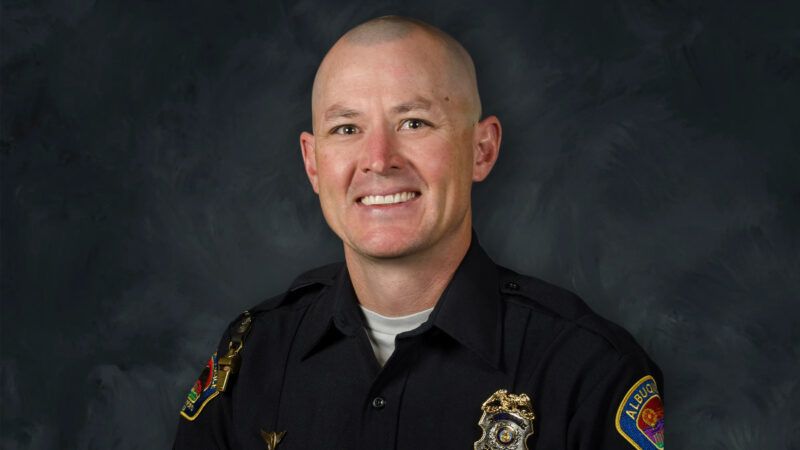
For three decades, Albuquerque defense attorney Thomas Clear bribed police officers to make drunk driving cases against his clients disappear. The cops typically did that by deliberately failing to show up at administrative hearings, pretrial interviews, or judicial proceedings, allowing Clear to move for dismissal of the charges. The latest guilty plea in that wide-ranging corruption case reveals a new wrinkle: Sometimes Clear's paralegal, Rick Mendez, or his associates would "orchestrate" DWI arrests by getting people drunk and arranging for a corrupt cop to nab them after they hit the road.
Lt. Justin Hunt, who was employed by the Albuquerque Police Department (APD) for more than 20 years, retired in February 2024 amid the FBI's investigation of the bribery scheme that federal prosecutors have dubbed the "DWI Enterprise." This week, he pleaded guilty to extortion "under color of official right," meaning he used his position to help Clear extract money from clients eager to avoid the consequences of a DWI arrest—profits that Clear would then share with Hunt.
Hunt is part of the biggest law enforcement scandal in New Mexico's history. He is one of two dozen people—including Albuquerque police officers, Bernalillo County sheriff's deputies, and a New Mexico State Police sergeant known as "the face of DWI enforcement" because he was featured in a state ad campaign against drunk driving—who have been implicated in the bribery scheme so far. Half of them have pleaded guilty, including Clear and Mendez.
"For many of the cases on which I accepted payment in exchange for not performing my official duties, I conducted the DWI arrest in conformity with APD policies and procedures," Hunt says in his plea agreement. "The illegal conduct—that being me receiving benefits or payments from CLEAR and MENDEZ—would occur after I conducted the otherwise legitimate DWI arrest." But he adds that he, Clear, and Mendez "also developed another method of operating the scheme."
Here is how Hunt says that other method worked. Mendez "would orchestrate the traffic stop, thereby allowing me to conduct the DWI arrest, with the expectation that I would then be paid or receive a benefit to not appear as required." Mendez and "other co-conspirators" would "go out drinking with a particular target." After the target "had consumed alcohol and was heavily intoxicated," Hunt says, "I would then conduct a traffic stop on the target's vehicle and arrest them for DWI."
In May 2014, for example, Mendez took a man identified as "C.F." out for his birthday. Mendez, C.F., "and others" ended up at a strip club, where Mendez bought C.F. drinks. Once C.F. "was preparing to drive after consuming a large amount of alcohol," Mendez alerted Hunt, who stopped C.F.'s car after he left the strip club's parking lot. Hunt arrested C.F. for DWI, and C.F. subsequently hired Clear to represent him.
In his police report, Hunt "purposefully omitted the information" he had received from Mendez. He also did not mention that Mendez was in the car when C.F. was arrested. After C.F. was charged with DWI, Hunt "intentionally failed to appear at required criminal settings and the [Motor Vehicle Division] hearing," thereby "guaranteeing dismissal of the criminal case" and enabling C.F. to get back his driver's license, which had been revoked following his arrest.
In return for his assistance, Hunt received "wheels, tires, and a lift kit" for his Jeep. On other occasions, Hunt was paid in cash for helping Clear drum up business.
Clear and Mendez, in short, decided to stop waiting for people to drive drunk on their own initiative. Whatever points you might give them for creativity, Mendez, who apparently thought a DWI arrest was a fine birthday gift, does not seem like a very good friend. And the description of his efforts to manufacture DWI cases adds a new facet to a story that was already troubling in several ways.
We already knew that corrupt cops like Hunt were willing to let drunk drivers off the hook in exchange for money, potentially endangering public safety by protecting arrestees from penalties that might have encouraged them to think twice before driving while intoxicated. We also knew that prosecutors ended up dropping hundreds of DWI cases because they involved officers who were deemed untrustworthy after they were implicated in the scandal, which likewise surely did not make the roads any safer. There was also evidence that some of the allegedly intoxicated drivers nabbed by bribe-hungry cops were actually sober, which if true was unjust as well as counterproductive. Hunt's account compounds the outrage, revealing that Clear's operation created new hazards by directly fostering drunk driving.
Hunt's plea agreement suggests how this racket persisted for so long. Hunt, who joined the APD as a sworn officer in 2003, served in the department's DWI unit, where corruption was endemic, from 2011 to 2014. After he left the unit, Hunt continued to help Clear by tipping off Mendez about potential threats to Clear's lucrative business strategy.
In November 2023, for example, Albuquerque's Civilian Police Oversight Agency received a letter from a local court official who said Officer Honorio Alba Jr., a member of the DWI unit who would later admit that he took bribes from Clear, reportedly had pulled over a speeding, flagrantly drunk driver and, instead of filing charges, referred him to a specific local defense attorney. Hunt says he discussed the complaint with Mendez "in an attempt to assist ALBA from having adverse action taken against him."
At that point, the FBI was already looking into corruption within the DWI unit. The previous month, the FBI had discussed the investigation with Albuquerque Police Chief Harold Medina, who says that was his first clue to the rampant corruption. But intervention by supervisors like Hunt apparently helped keep the "DWI Enterprise" going before it was finally revealed by the FBI.
Hunt was a lieutenant assigned to southeast Albuquerque. The senior Albuquerque police officers implicated in the scandal also include Commander Mark Landavazo, who was placed on administrative leave in February 2024 and fired the following August; Deputy Commander Gustavo Gomez, who was placed on administrative leave in October 2024 and fired last March; Lt. Kyle Curtis, who retired in January 2025 after he was placed on administrative leave; and Lt. Matthew Chavez, who was placed on administrative leave the same day as Curtis and terminated last March.
Landavazo, Gomez, Chavez, and Curtis, like Hunt, had previously served in the DWI unit. Prosecutors say former members of the unit helped protect Clear's operation as they moved up in the department. Landavazo was especially well positioned to do that because he was in charge of the APD's internal affairs division. Gomez was Landavazo's internal affairs deputy.
Medina, who joined the APD in 1995 and has run or helped run the department since 2017, promoted both men. He says he had no inkling of the pervasive and persistent corruption until he was briefed on the FBI's investigation in October 2023.
Despite his avowed cluelessness, Medina, who has repeatedly promised to "make sure that we get to the bottom of this," wants to take credit for revealing the bribery that was happening under his nose for decades. "We uncovered the DWI scandal," he told a local TV station month, saying it was "a low point" to see "people I worked with for 20 years" were "involved in that." He expressed "disappointment" that "individuals that I believed in, I worked with" had "given up their integrity and lost everything, all the honor of their career," simply "for money."




