
How the FCC Became the Speech Police
The constitutionally anomalous status of broadcasting invites government meddling.
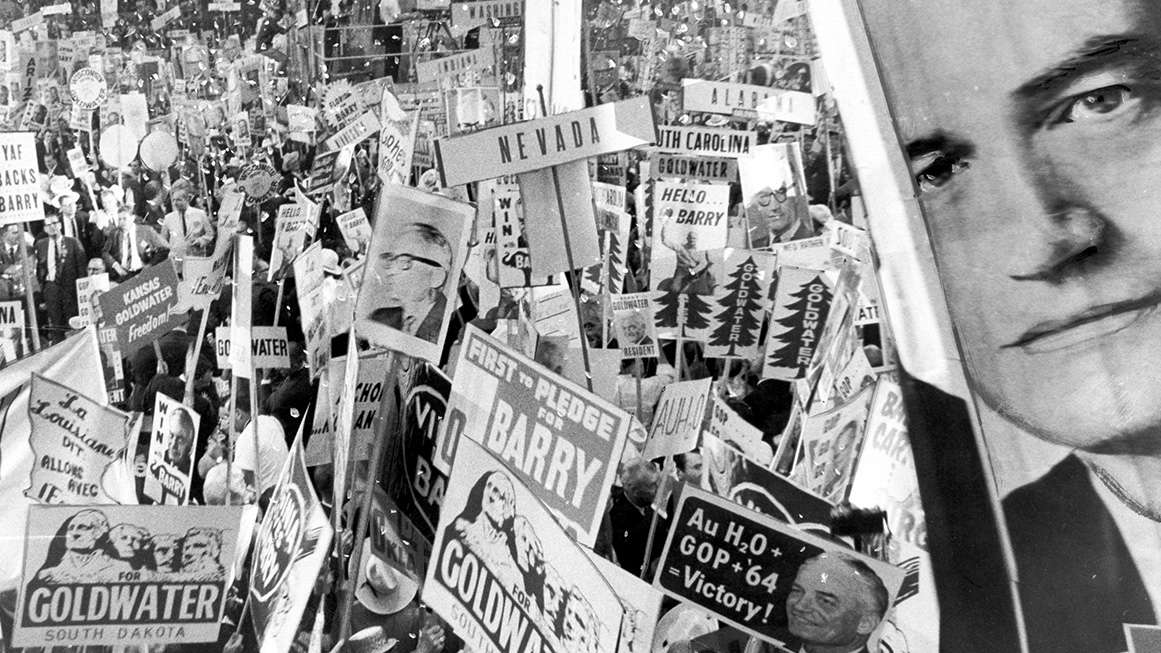
In 1964, journalist Fred J. Cook published Barry Goldwater: Extremist of the Right, a 186-page attack on the Republican candidate in that year's presidential election. As economist Thomas W. Hazlett notes in his history of broadcast regulation, the Democratic National Committee (DNC) "arranged for Grove Press to publish the book," which portrayed Goldwater as "so extreme that he cuts a positively ridiculous figure." The general public bought 44,000 copies. The DNC bought 72,000.
Conservative criticism of Cook's book resulted in a landmark Supreme Court decision that upheld federal regulation of broadcast speech—a power that several presidents had used to target their political opponents. Although the Reagan administration repudiated that illiberal tradition, President Donald Trump has revived it, as illustrated by the 2025 suspension of Jimmy Kimmel, the ongoing transformation of CBS News, and Trump's habitual threats against TV stations that air news coverage he views as unfair or unbalanced.
The Supreme Court blessed the legal rationale for such meddling in a case that started with a right-wing evangelist's reaction to Cook's critique of Goldwater. A few weeks after Goldwater lost to President Lyndon B. Johnson in a historic landslide, Billy James Hargis railed against Cook during his Christian Crusade radio show.
The man who "wrote the book to smear and destroy Barry Goldwater," Hargis said, was "a professional mudslinger" who had defended accused Soviet spy Alger Hiss in The Nation. Hargis called that magazine "one of the most scurrilous publications of the left," saying it had "championed many communist causes over many years." Hargis also noted that Cook "was fired from the New York World-Telegram after he made a false charge publicly on television against an unnamed official of the New York City government."
Cook asked WGCB, a Pennsylvania radio station that had aired the show, for an opportunity to rebut the preacher's criticism. The station's conservative owner, the Rev. John M. Norris, was amenable, provided Cook paid for the airtime at the same rate that Hargis had been charged. That was not good enough for Cook, who complained to the Federal Communications Commission (FCC), which agreed that he had a right to free airtime.
Norris refused to comply with the FCC's order, which he argued was inconsistent with the First Amendment. Not so, the U.S. Supreme Court unanimously ruled in the 1969 case Red Lion Broadcasting v. FCC. The Court described the FCC's nascent policy regarding "personal attacks" like Hargis' comments about Cook as an outgrowth of the long-established "Fairness Doctrine," which required broadcasters to cover public issues in an even-handed manner. Both policies, it said, were firmly grounded in the agency's statutory responsibility to ensure that broadcasters serve "the public interest."
The justices thought it was plainly absurd to suggest that regulating the content of radio and TV programming impinged on freedom of speech or freedom of the press. "Although broadcasting is clearly a medium affected by a First Amendment interest, differences in the characteristics of new media justify differences in the First Amendment standards applied to them," Justice Byron White wrote in the Court's opinion. "Because of the scarcity of radio frequencies, the Government is permitted to put restraints on licensees in favor of others whose views should be expressed on this unique medium."
That "scarcity" rationale for regulating broadcast content, which never made much sense, has not aged well. And the FCC itself abandoned the Fairness Doctrine in 1987 after concluding that it had a chilling effect on speech—a danger that the Supreme Court had deemed too speculative to consider in Red Lion.
Trump nevertheless thinks broadcasters have a legal obligation to be fair. "When 97 percent of the stories [about me] are bad," he told reporters in September, "it's no longer free speech." When TV networks "take a great story" and "make it bad," he added, "I think that's really illegal." Because broadcasters are "getting free airwaves from the United States government," Trump thinks, they should lose their licenses if their programming is biased against him and his supporters.
In November, an ABC News reporter's unwelcome questions at a White House press conference provoked another threat to yank broadcast licenses. "I think the license should be taken away from ABC," Trump said, "because your news is so fake and it's so wrong."
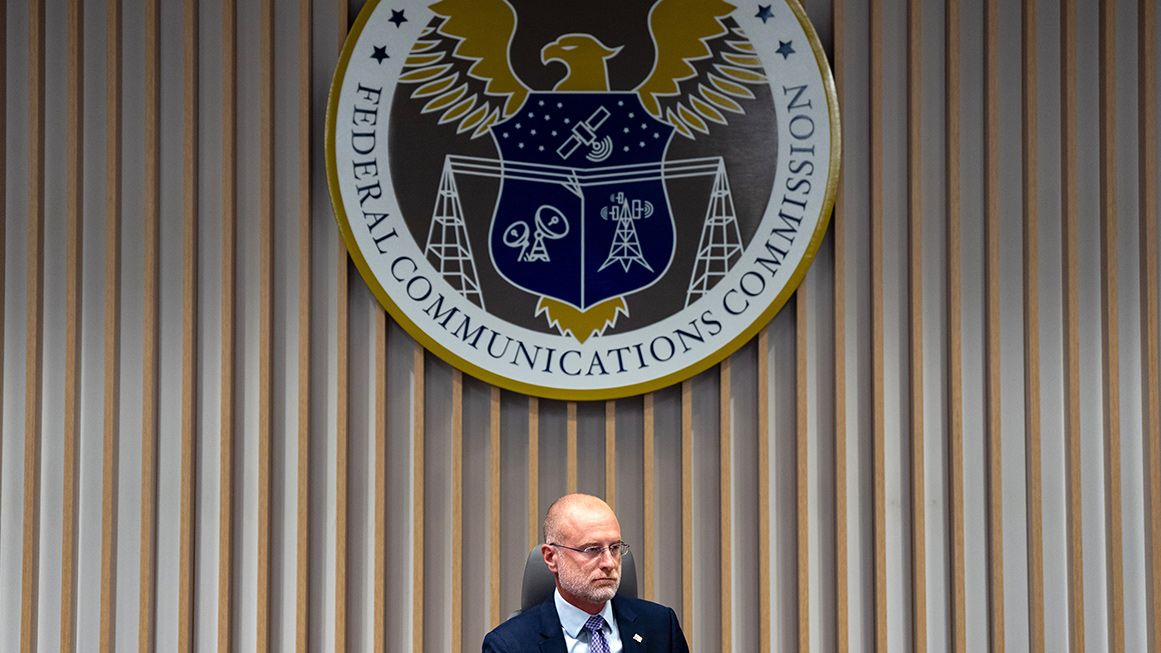
Brendan Carr, an avowed First Amendment champion whom Trump appointed to run the FCC, sees correcting anti-Trump bias as an important part of his job. That understanding of the FCC's mission explains why Carr seriously entertained the possibility that CBS committed "broadcast news distortion" by editing a 60 Minutes interview with then–Vice President Kamala Harris in a way that made her seem slightly more cogent. It explains why Carr bragged about requiring changes to journalistic practices at CBS as a condition for approving Skydance Media's acquisition of Paramount, the network's parent company. Carr's conception of "the public interest" was also at the root of his most flagrant attempt to exert control over broadcast content: the regulatory threats that preceded ABC's suspension of Jimmy Kimmel Live! in September.
With some notable exceptions, Republicans have applauded Carr's campaign against left-leaning TV programming. But judging from the history of federal meddling in this area, they may ultimately regret the precedents he is setting. Instead of building weapons that could one day be deployed against them, conservatives should question the puzzling legal status of broadcast speech, which allows government interference that would be clearly unconstitutional in any other medium.
'A Twofold Duty'
As White told the story in Red Lion, government licensing of broadcasters was manifestly necessary. Prior to the Radio Act of 1927, he said, "the allocation of frequencies was left entirely to the private sector, and the result was chaos. It quickly became apparent that broadcast frequencies constituted a scarce resource whose use could be regulated and rationalized only by the Government. Without government control, the medium would be of little use because of the cacaphony [sic] of competing voices, none of which could be clearly and predictably heard."
There was something fishy about this explanation from the beginning, since all resources—including the ink and paper used to produce books and newspapers, the materials that comprise printing presses, and the land occupied by publishers—are scarce in the economic sense. The solution to that sort of scarcity is legally enforceable property rights, and something similar could have avoided the "chaos" that White described.
"The fact that only a finite amount of spectrum use was allowed for traditional broadcasting, without more, did not require intrusive regulation," John W. Berresford, then an attorney with the FCC's Media Bureau, noted in a 2005 research paper. "Merely an allocation system, defining and awarding exclusive rights to use certain frequencies, would have sufficed to 'choose from among the many who apply.' Like any allocation system, this one would need clearly defined rights, a police force, and a dispute resolution system for allegations of interference, unauthorized operations, and other misconduct."
Congress nevertheless seized upon the scarcity rationale to charge the Federal Radio Commission, the FCC's predecessor, with awarding and renewing broadcast licenses based on its assessment of "public interest, convenience, or necessity." And beginning in the late 1920s, the commission held that "public interest requires ample play for the free and fair competition of opposing views," a principle it said applied to "all discussions of issues of importance to the public."
That policy, White explained, imposed "a twofold duty" on broadcasters: They "must give adequate coverage to public issues," and "coverage must be fair in that it accurately reflects the opposing views." Both "must be done at the broadcaster's own expense if sponsorship is unavailable."
On its face, the Fairness Doctrine seemed inconsistent with the Communications Act of 1934, which says "nothing in this Act shall be understood or construed to give the [FCC] the power of censorship over the radio communications or signals transmitted by any radio station, and no regulation or condition shall be promulgated or fixed by the Commission which shall interfere with the right of free speech by means of radio communication." But the Supreme Court did not see that language as an impediment to mandating balance in "the public interest," which it viewed as promoting rather than restricting freedom of speech.
As White noted, the broadcasters who challenged the Fairness Doctrine argued that "if political editorials or personal attacks will trigger an obligation in broadcasters to afford the opportunity for expression to speakers who need not pay for time and whose views are unpalatable to the licensees, then broadcasters will be irresistibly forced to self-censorship and their coverage of controversial public issues will be eliminated or at least rendered wholly ineffective." While "such a result would indeed be a serious matter," he wrote, "that possibility is at best speculative." Or so the FCC said, and White accepted that representation at face value.
White conceded that government attempts to suppress or promote particular views via broadcast regulation "would raise more serious First Amendment issues." But he saw no evidence of such interference.
The justice's rosy assessment was dubious even then. During Franklin D. Roosevelt's administration, the historian David Beito notes, the FCC "relied on early precursors of the fairness doctrine to chill dissenting voices." By the end of the 1930s, "anti-Roosevelt commentators had largely vanished from network radio."
The Kennedy administration likewise used the FCC to "selectively enforce regulations for radio stations airing right-wing programs," as the historian Paul Matzko has detailed, and the pattern continued under Johnson. "Our massive strategy," Democratic publicist Bill Ruder later acknowledged, "was to use the Fairness Doctrine to challenge and harass right-wing broadcasters and hope that the challenges would be so costly to them that they would be inhibited and decide it was too expensive to continue."
The very case that White was considering offered further evidence that FCC regulation could be used to punish disfavored viewpoints. In a May 1964 piece for The Nation titled "Radio Right: Hate Clubs of the Air," Hazlett notes, Fred Cook "argued that radio pundits, including Hargis, were fomenting a climate of hate that had contributed to the assassination of President Kennedy." In that article, Cook said "one recourse for liberal forces" would be "to demand free time to counter some of the radical Right's free-swinging charges"—the strategy that Cook pursued with WGCB later that year.
Meanwhile, DNC official Wendell Phillips, who encouraged Cook to write that piece, had launched a campaign along the same lines against "extreme right-wing broadcasting" that he described as "irrationally hostile to the President and his programs." As Fred W. Friendly, who was president of CBS News at the time, would later observe, the aim was "simply to harass radio stations by getting officials and organizations that had been attacked by extremist radio commentators to request reply time, citing the Fairness Doctrine." By November 1964, Hazlett reports, Phillips' initiative had resulted in more than 1,000 complaint letters, resulting in "some 1,678 hours of free airtime."
'Deep Intrusion'
Two decades later, the FCC compiled a "voluminous factual record" that substantiated the danger White had considered "at best speculative." In a 1985 report, the commission cited evidence that "the fairness doctrine, in operation, actually inhibits the presentation of controversial issues of public importance to the detriment of the public and in degradation of the editorial prerogatives of broadcast journalists." The doctrine's "economic burdens," the report noted, included the cost of responding to complaints as well as the cost of providing free airtime, both of which deterred the sort of robust coverage the policy was supposed to help ensure.
The commission concluded that the Fairness Doctrine, which it would formally renounce two years later, "no longer serves the public interest." It said "the interest of the public in viewpoint diversity" was "fully served by the multiplicity of voices in the marketplace today," including independent TV stations, cable and satellite TV, VCRs, and print outlets. The FCC noted that the Fairness Doctrine "unnecessarily restricts the journalistic freedom of broadcasters" and "creates the opportunity for intimidation of broadcasters by government officials." It cited examples of "attempts to coerce broadcast journalists" by both the Johnson and Nixon administrations.
During the latter administration, Chuck Colson, director of the White House's newly created Office of Public Liaison, pressured network executives to rein in coverage and commentary viewed as unfavorable to President Richard Nixon. With Nixon's approval and "some cooperation from top FCC officials," Hazlett notes, Colson threatened to "challenge license renewals by asserting violations of the Fairness Doctrine." The threats seemed to have some impact, especially at CBS, which cut down a report on the Watergate break-in toward the end of Nixon's 1972 campaign and "announced it would no longer follow presidential statements with immediate news analysis by network correspondents."
The FCC's 1985 report also argued that "the constitutionality of the fairness doctrine is suspect." Red Lion, it noted, explicitly did not consider the doctrine's potentially counterproductive impact. Furthermore, the decision was "necessarily premised upon the broadcasting marketplace as it existed more than sixteen years ago." And five years after that ruling, the Court unanimously rejected a Florida statute that gave political candidates a "right of reply" in newspapers, which was similar to the mandate upheld in Red Lion.
In Miami Herald Publishing v. Tornillo, the Court recognized that "political and electoral coverage would be blunted or reduced" by such a requirement because a "government-enforced right of access inescapably 'dampens the vigor and limitsthe variety of public debate.'" The justices explicitly rejected the argument that Florida's mandate could be justified by "vast accumulations of unreviewable power in the modern media empires." That claim was similar to Vice President Spiro Agnew's complaints about the TV networks during the Nixon administration, which Trump echoes today.
The contrast between Red Lion and Tornillo hinges on the idea that broadcast speech merits less protection under the First Amendment than speech in every other medium. But as the FCC noted in 1985, some critics of the Fairness Doctrine argued that its constitutionality "should be evaluated under the general constitutional standards that apply to the print media." The commission thought "the courts may well be persuaded that the transformation in the communications marketplace justifies the adoption of a standard that accords the same degree of constitutional protection to broadcast journalists as currently applies to journalists of other media."
The courts still have not embraced that position. But Supreme Court Justice Clarence Thomas has repeatedly questioned the constitutionally anomalous status of broadcast speech. "The text of the First Amendment makes no distinctions among print, broadcast, and cable media, but we have done so," he noted in 1996, criticizing the logic of both Red Lion and FCC v. Pacifica Foundation, the 1978 decision that upheld the agency's bewildering ban on "broadcast indecency."
In FCC v. Fox Television Stations, a 2009 case involving the latter policy, Thomas said the federal government's "deep intrusion into the First Amendment rights of broadcasters, which the Court has justified based only on the nature of the medium, is problematic on two levels." Instead of "looking to first principles to evaluate the constitutional question," he noted, "the Court relied on a set of transitory facts, e.g., the 'scarcity of radio frequencies,' to determine the applicable First Amendment standard." And "even if this Court's disfavored treatment of broadcasters under the First Amendment could have been justified at the time of Red Lion and Pacifica,"Thomas argued, "dramatic technological advances have eviscerated the factual assumptions underlying those decisions."
To support the latter proposition, Thomas cited Berresford's 2005 FCC paper, which noted that "the Scarcity Rationale, based on the scarcity of channels, has been severely undermined by plentiful channels," including the proliferation of radio and TV stations; cable TV, "whose growth in number of channels has dwarfed traditional broadcasters"; "players of video cassettes, compact disks and DVDs"; and "the recent accessibility of all the content on the Internet." Berresford concluded that the scarcity rationale, "if it ever had any validity, is invalid in today's media marketplace."
Two decades later, that assessment has only been strengthened by the explosion in online news and opinion outlets, social media, video platforms, podcasting, and streaming TV. To consumers, the exact route by which content reaches them is a matter of indifference. But according to the Supreme Court, it is constitutionally crucial—a judgment that is more baffling today than ever before.
'A Giant Fake News Scam'
The demise of the Fairness Doctrine catalyzed an efflorescence of political speech on talk radio in the 1990s, enabling the rise of Rush Limbaugh and many other conservative commentators. But it left in place a nebulous FCC rule against "broadcast news distortion," which Carr seems keen to enforce.
That policy, first articulated in 1969, applies when there is "evidence showing that [a] broadcast news report was deliberately intended to mislead viewers or listeners," the FCC says. "Broadcasters are only subject to enforcement if it can be proven that they have deliberately distorted a factual news report," which "must involve a significant event and not merely a minor or incidental aspect of the news report." The commission "makes a crucial distinction between deliberate distortion and mere inaccuracy or difference of opinion," which "are not actionable."
Given those requirements, the October 2024 complaint that the pro-Trump Center for American Rights (CAR) filed against WCBS, the network-owned CBS station in New York City, should have been dead on arrival. CAR echoed Trump's complaints about a 60 Minutes interview with Harris, his Democratic opponent in that year's presidential election, that had aired on October 7.
During the exchange highlighted by CAR, the interviewer, Bill Whitaker, suggested that Israeli Prime Minister Benjamin Netanyahu was "not listening" to the Biden administration's concerns about the war in Gaza and had "rebuffed just about all of your administration's entreaties." Here is how Harris responded: "Well, Bill, the work that we have done has resulted in a number of movements in that region by Israel that were very much prompted by, or a result of, many things, including our advocacy for what needs to happen in the region. And we're not going to stop doing that. We are not going to stop pursuing what is necessary for the United States to be clear about where we stand on the need for this war to end."
On October 6, Face the Nation promoted the Harris interview with a clip that included the first sentence. The interview as aired on 60 Minutes the next day used the last sentence.
Harris did not come across as especially forthright, articulate, or intelligent in either version, although the one that 60 Minutes showed was a bit more concise. But as Trump saw it, the decision to use the last sentence instead of the first one amounted to "Election Interference." It was an "UNPRECEDENTED SCANDAL" and "a giant Fake News Scam" that was "totally illegal." By editing the interview to make Harris "look better," he said, CBS had committed an offense so egregious that the FCC should "TAKE AWAY THE CBS LICENSE"—by which he presumably meant the broadcast licenses held by network-owned stations like WCBS.
CAR's FCC complaint did not go quite that far. But it averred that "CBS engaged in news distortion by editing its news program to such a great extent that the general public cannot know what answer the Vice President actually gave to a question of great importance on a matter of national security policy."
The complaint did not allege facts that would support the conclusion that CBS was guilty of "news distortion" as the FCC has defined it. So it is not surprising that the FCC concluded, in a letter issued four days before Trump took office, that "the allegations are insufficient to rise to the level of an actionable enforcement matter."
On the same day, the FCC rejected another "news distortion" complaint from CAR. That one claimed ABC's moderation of the September 10 presidential debate between Trump and Harris showed "broadcaster favoritism" and failed to provide "objective news coverage." The FCC said the complaint "fails to meet the high threshold for opening a 'news distortion' matter" because it "relies almost entirely on allegations of an editorial nature and conclusory statements" without "extrinsic evidence of intentional malfeasance."
Outgoing FCC Chairwoman Jessica Rosenworcel noted that both complaints aimed to "weaponize the licensing authority of the FCC in a way that is fundamentally at odds with the First Amendment." In rejecting them, she said, the commission upheld the principle that "the FCC should not be the President's speech police" or "journalism's censor-in-chief."
Two days after Carr succeeded Rosenworcel, the FCC reinstated both the CBS complaint and the ABC complaint. In both cases, it said "the previous order was issued prematurely based on an insufficient investigatory record." Since the FCC says it "will only investigate claims that include evidence showing that [a] broadcast news report was deliberately intended to mislead viewers or listeners," that position was puzzling.
"There is nothing here for the FCC to investigate," wrote Robert Corn-Revere, chief counsel at the Foundation for Individual Rights and Expression, referring to the CBS complaint. "CBS stands accused of committing journalism. Every day, from the smallest newspaper to the largest network, reporters and editors must make sense of and condense the information they collect—including quotes from politicians and other newsmakers—to tell their stories concisely and understandably. That task necessarily requires editing, including selecting what quotes to use. If the cockamamie theory underlying this FCC 'investigation' had any merit, every newsroom in America would be a crime scene."
As part of its probe, the FCC asked CBS for the full transcript of the Harris interview, which confirmed that the show's producers were telling the truth when they said the 60 Minutes version used the "same question" and the "same answer" as the Face the Nation excerpt but "a different portion of the response." Yet as of late July, Carr said the investigation was still pending.
'It Is Time for a Change'
Meanwhile, the FCC was considering the proposed merger of Paramount, which owned CBS, with Skydance Media. The $8 billion deal, which required the FCC's approval because it entailed the transfer of broadcast licenses, got the agency's blessing on July 24. That was just a few weeks after Paramount agreed to a $16 million settlement of a laughable lawsuit in which Trump argued that the Harris interview had violated Texas and federal law, causing him at least $20 billion in damages.
Carr insisted those two developments were unrelated. But even without the appearance of extortion, the conditions that the FCC attached to the Paramount sale were troubling enough. "Americans no longer trust the legacy national news media to report fully, accurately, and fairly," Carr said in a press release. "It is time for a change. That is why I welcome Skydance's commitment to make significant changes at the once storied CBS broadcast network."
The changes included "written commitments to ensure that the new company's programming embodies a diversity of viewpoints from across the political and ideological spectrum," Carr explained. "Skydance will also adopt measures that can root out the bias that has undermined trust in the national news media. These commitments, if implemented, would enable CBS to operate in the public interest and focus on fair, unbiased, and fact-based coverage. Doing so would begin the process of earning back Americans' trust."
Skydance agreed to appoint an "ombudsman" who would "receive and evaluate any complaints of bias or other concerns involving CBS." It later picked Kenneth Weinstein, former president of the right-wing Hudson Institute, for the job. And in October, Skydance bought The Free Press for $150 million and appointed the outlet's founder, Bari Weiss, as editor in chief of CBS News. Weiss, a former New York Times opinion staffer who rose to fame by denouncing the newspaper's political correctness, was expected to help CBS achieve the "diversity" that Carr wanted.
Skydance, which said it aimed to attract centrist viewers with "news that is balanced and fact-based," may have had sound business reasons for making these changes. But it was striking that Carr had no compunction about using his powers to push CBS in that direction.
That attitude stood in sharp contrast with views Carr had previously expressed. "The FCC does not have a roving mandate to police speech in the name of the 'public interest,'" he wrote in 2019 after Rosenworcel pushed an FCC crackdown on e-cigarette ads. As a minority commissioner during the Biden administration, Carr likewise rejected the idea that the agency should "operate as the nation's speech police" by following the DNC's recommendations for "new regulations on the use of AI-generated political speech." When Democrats urged the FCC to reject the transfer of a Miami radio license because they objected to the new owner's ideology, Carr said the agency should not be "using our regulatory process to censor political opinions."
Carr offered a similar take when two Democratic lawmakers pressured cable companies and streaming services to stop carrying Fox News, Newsmax, and One America News Network, which they described as leading sources of "misinformation." He condemned the "chilling transgression of the free speech rights that every media outlet in this country enjoys," saying "a newsroom's decision about what stories to cover and how to frame them should be beyond the reach of any government official."
All of those cases involved attempted speech policing by Democrats. Carr seems to think the same rules do not apply when Republicans use the FCC to influence TV programming. In other words, the principles he appeared to be defending back then were not really principles at all.
'The Easy Way or the Hard Way'
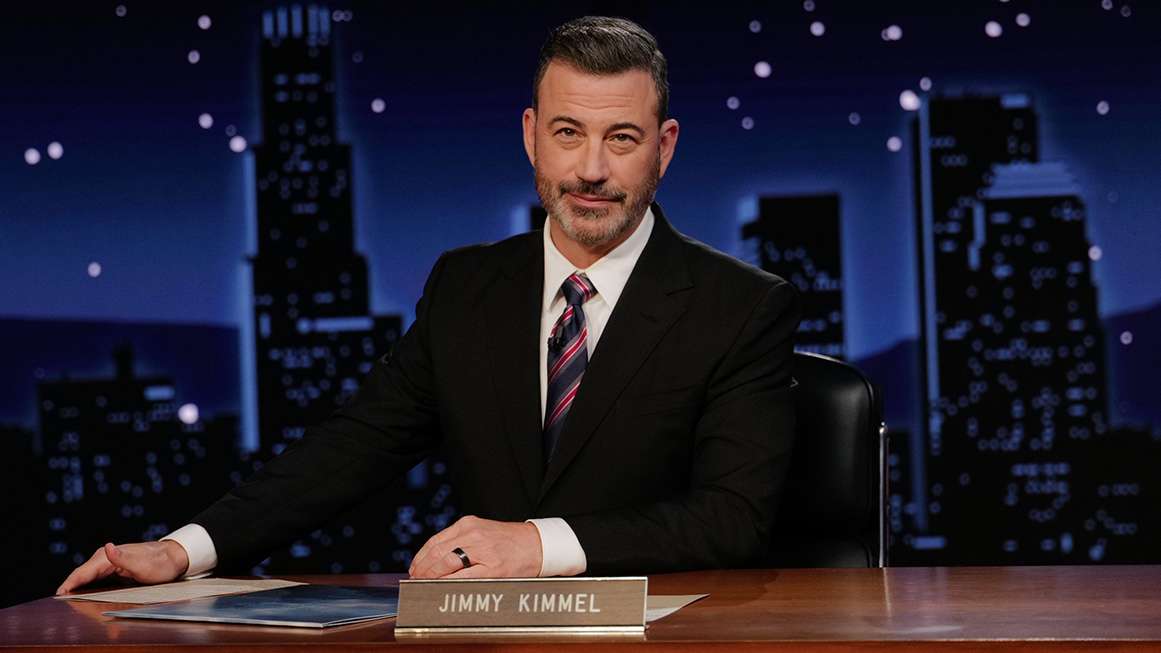
If there was any doubt that Carr's avowed devotion to freedom of speech was politically contingent, he erased it by publicly threatening to punish broadcasters if they insisted on carrying a late-night talk show that offended him. Carr was responding to Jimmy Kimmel's ill-informed remarks about the man who assassinated conservative activist Charlie Kirk on September 10. During the opening monologue of his ABC show the following Monday, Kimmel said "the MAGA gang" was "desperately trying to characterize this kid who murdered Charlie Kirk as anything other than one of them."
Kimmel erroneously implied that the assassin was a Trump supporter, when in fact he seems to have killed Kirk out of anger at his right-wing views. In an interview with podcaster Benny Johnson two days later, Carr said the "talentless" comedian's "really, really sick" comment appeared to be part of "a very concerted effort to try to lie to the American people" about "one of the most significant, newsworthy, public-interest acts that we've seen in a long time." He warned that there are "actions we can take on licensed broadcasters" that aired Kimmel's show.
Carr said it was "past time" for "these licensed broadcasters" to "push back" on Disney, which owns ABC, "and say, 'Listen, we are going to preempt, we are not going to run Kimmel anymore until you straighten this out, because we licensed broadcaster[s] are running the possibility of fines or license revocations from the FCC if we continue to run content that ends up being a pattern of news distortion.'"
It was not just Disney that "needs to see some change here," Carr emphasized, saying "the individual licensed stations that are taking their content" should "step up and say, 'This garbage,' to the extent that's what comes down the pipe in the future, 'isn't something that we think serves the needs of our local communities.' But this sort of status quo is obviously not acceptable."
Carr's threat was not subtle. "We can do this the easy way or the hard way," he said. "These companies can find ways to change conduct and take action, frankly, on Kimmel, or there's going to be additional work for the FCC ahead." Carr noted "calls for Kimmel to be fired," adding that "you could certainly see a path forward for suspension over this." He reiterated that "the FCC is going to have remedies that we could look at," since "we may ultimately be called to be a judge on that."
Nexstar, which owns or partners with 32 ABC stations, apparently got the message. Hours after Carr's comments, the company announced that it would preempt Jimmy Kimmel Live! "for the foreseeable future beginning with tonight's show." Sinclair, which operates 38 ABC affiliates, settled on the same solution. ABC also fell in line, saying it was "indefinitely" suspending Kimmel's show.
Kimmel returned to the air the following week. That Tuesday, ABC resumed production of his show, which Sinclair and Nexstar stations started airing again three days later. Sinclair, for its part, insisted that its "decision to preempt this program was independent of any government interaction or influence." But the alacrity with which Nexstar, Sinclair, and ABC implemented the penalty that Carr had recommended suggests they were keen to avoid trouble with the FCC.
Carr's bullying was too much for Sen. Ted Cruz (R–Texas), a Trump ally who is by no means a Kimmel fan. Although "it might feel good right now to threaten Jimmy Kimmel," Cruz said, "we will regret it" when the same tactics are "used to silence every conservative in America." When the Democrats retake the White House, "they will use this power, and they will use it ruthlessly," Cruz warned. "It is unbelievably dangerous for government to put itself in the position of saying, 'We're going to decide what speech we like and what we don't, and we're going to threaten to take you off air if we don't like what you're saying.'"
Such censorial pressure sits uneasily with the principles that Kirk himself espoused. "My wish for the left is that you will become liberal again," he said during an Oxford Union appearance a few months before his death. "Free speech is a liberal value….You should be allowed to say outrageous things. You should be allowed to say contrarian things….That is the bedrock of a liberal democracy."
'They're Not Allowed To Do That'
Carr's rationale for weighing in on Kimmel's show was highly implausible. Even leaving aside the question of whether Kimmel "deliberately intended" to mislead his viewers (as opposed to uncritically accepting a politically convenient narrative), it is quite a stretch to treat a comedian's monologue as a "broadcast news report."
That is not the only stretch Carr is contemplating. "We have a rule on the book that interprets the 'public interest' standard [and] says news distortion is prohibited," he told Johnson. "Over the years, the FCC has stepped back from enforcing it, and I don't think it's been to the benefit of anybody." Broadcast licenses entail "an obligation to operate in the public interest," he explained, and "we've been trying to reinvigorate the public interest."
Carr's broad understanding of the FCC's mission jibes with Trump's grievances. "You have a network and you have evening shows, and all they do is hit Trump," the president complained in September. "They're licensed. They're not allowed to do that."
Trump made similar noises during his first administration, saying "network news has become so partisan, distorted and fake that licenses must be challenged and, if appropriate, revoked." But Ajit Pai, who chaired the FCC during Trump's first term, rejected that suggestion in no uncertain terms.
"I believe in the First Amendment," Pai said. "The FCC under my leadership will stand for the First Amendment, and under the law the FCC does not have the authority to revoke a license of a broadcast station based on the content of a particular newscast."
This time around, Trump has picked an FCC chairman with no such constitutional compunctions. In fact, Carr seems eager to embrace what he once derided as "a roving mandate to police speech in the name of the 'public interest.'"
The surest way to avoid such meddling—now or in the future, regardless of which party controls the executive branch—is to renounce, once and for all, the notion that "the public interest" trumps broadcasters' First Amendment rights. Government licensing of newspapers, websites, or streaming services would be a constitutional nonstarter, inviting politically motivated interference with freedom of speech. Government licensing of broadcasters poses similar perils, as Trump and Carr seem determined to demonstrate.




