
Reason.com - Free Minds and Free Markets
Reason logo Reason logo
  • Latest
  • Magazine
    • Current Issue
    • Archives
    • Subscribe
    • Crossword
  • Video
    • Reason TV
    • The Reason Roundtable
    • Just Asking Questions
    • Free Media
    • The Reason Interview
  • Podcasts
    • All Shows
    • The Reason Roundtable
    • The Reason Interview With Nick Gillespie
    • The Soho Forum Debates
    • Just Asking Questions
  • Volokh
  • Newsletters
  • Donate
    • Donate Online
    • Donate Crypto
    • Ways To Give To Reason Foundation
    • Torchbearer Society
    • Planned Giving
  • Subscribe
    • Reason Plus Subscription
    • Gift Subscriptions
    • Print Subscription
    • Subscriber Support

Login Form

Create new account
Forgot password
Reason logo

Reason's Annual Webathon is underway! Donate today to see your name here.

Reason is supported by:
Dan Frazee

Donate

Supreme Court

Amy Coney Barrett's Case for Originalism Falls Short

The Supreme Court justice’s new book fails to practice the historical fidelity it preaches.
Damon Root | 9.16.2025 7:00 AM

Share on FacebookShare on XShare on RedditShare by emailPrint friendly versionCopy page URL Add Reason to Google
Media Contact & Reprint Requests
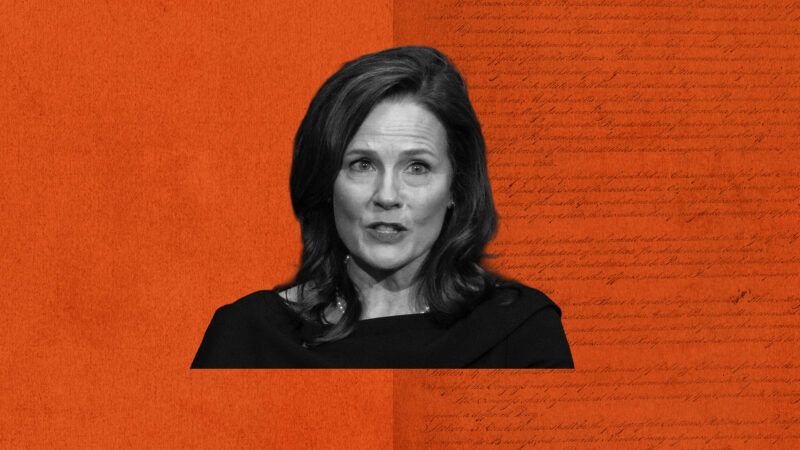
Supreme Court Justice Amy Coney Barrett | Illustration: Eddie Marshall | Brian Cahn | ZUMAPRESS | Newscom
(Illustration: Eddie Marshall | Brian Cahn | ZUMAPRESS | Newscom)

U.S. Supreme Court Justice Amy Coney Barrett's new book, Listening to the Law: Reflections on the Court and Constitution, offers a readable, if sometimes uneven, mix of memoir and manifesto. To her credit, Barrett directly addresses a number of controversial topics that are sure to interest most readers, including abortion and the death penalty. At the same time, however, her broader case for her preferred judicial philosophy leaves something to be desired.

You’re reading Injustice System from Damon Root and Reason. Get more of Damon’s commentary on constitutional law and American history.

This field is for validation purposes and should be left unchanged.

Barrett's preferred judicial philosophy is originalism. Here's how she describes it:

Does interpreting the Constitution today require us to understand its historical meaning? Is it even possible to do so? And assuming that we can determine what the document meant when it was originally adopted, how can we apply it to the problems of the modern world? Though none of these questions is easy, I think the answer to all of them is yes.

So far, so good, at least as far as popular definitions go. But things quickly go wrong once Barrett tries to illustrate how the Supreme Court has fallen short of originalism by supposedly substituting its own views for the original constitutional text.

Her key example of this alleged judicial malfeasance is the case of Lochner v. New York (1905), in which the Supreme Court struck down a state economic regulation on the grounds that it violated the right to economic liberty that was secured by the Fourteenth Amendment. "Courts owe deference to legislative majorities in determining how to handle economic and social problems," Barrett writes in opposition to Lochner. The Supreme Court "must not infringe on the democratic process by entrenching issues that the Constitution leaves open."

Barrett thus favorably invokes, and cites, the Lochner dissent written by Justice Oliver Wendell Holmes Jr., who thought the Supreme Court had no business second-guessing the decisions of state regulators and should instead adopt a thoroughgoing posture of judicial deference.

For an originalist, the central question raised by Lochner is whether or not the Fourteenth Amendment, as originally understood, protects an unenumerated right to economic liberty.

According to the Holmes-Barrett view, the Fourteenth Amendment does not.

But the historical evidence says otherwise. According to the principal author of section one of the Fourteenth Amendment, Rep. John Bingham (R–Ohio), "the provisions of the Constitution guaranteeing rights, privileges, and immunities" include "the constitutional liberty…to work in an honest calling and contribute by your toil in some sort to the support of yourself, to the support of your fellow men, and to be secure in the enjoyment of the fruits of your toil."

Furthermore, as I've previously noted, "even those who opposed the passage of the 14th Amendment agreed that it was designed to protect economic liberty from overreaching state regulation—indeed, that was a big reason why they opposed the amendment in the first place." When both the friends and foes of a constitutional provision agree in real time about what it meant, their agreement counts as important historical evidence for the provision's original public meaning. In this case, such evidence supports the position of the Lochner majority and undermines the position of the Lochner dissent.

Alas, Barrett's book doesn't mention any of this relevant historical material. Instead, she basically just echoes Holmes's ahistorical dissent and leaves it at that.

That's too bad. As Barrett herself put it, "interpreting the Constitution today require[s] us to understand its historical meaning." Yet Barrett neglects to do that very thing in one of the main cases she invokes to support her position.

Self-described originalists do not, to say the least, do their side any favors when they fail so conspicuously to practice what they preach.

Start your day with Reason. Get a daily brief of the most important stories and trends every weekday morning when you subscribe to Reason Roundup.

This field is for validation purposes and should be left unchanged.

NEXT: California's Tech Regulations Could Strangle AI Innovation for the Whole Country

Damon Root is a senior editor at Reason and the author of A Glorious Liberty: Frederick Douglass and the Fight for an Antislavery Constitution (Potomac Books). His next book, Emancipation War: The Fall of Slavery and the Coming of the Thirteenth Amendment (Potomac Books), will be published in June 2026.

Supreme Court14th AmendmentHistoryConstitutionLaw & GovernmentRegulation
Share on FacebookShare on XShare on RedditShare by emailPrint friendly versionCopy page URL Add Reason to Google
Media Contact & Reprint Requests

Show Comments (36)

Webathon 2025: Dec. 2 - Dec. 9 Thanks to 650 donors, we've reached $467,526 of our $400,000 $600,000 goal!

Reason Webathon 2023

All Donations NOW Being Matched! Donate Now

Latest

Virginia's New Blue Trifecta Puts Right-To-Work on the Line

C. Jarrett Dieterle | 12.6.2025 7:00 AM

Ayn Rand Denounced the FCC's 'Public Interest' Censorship More Than 60 Years Ago

Robby Soave | From the January 2026 issue

Review: Progressive Myths Rebuts the Left's Histrionic Takes

Jack Nicastro | From the January 2025 issue

French Study on mRNA COVID-19 Vaccines Finds a Drop in Severe COVID—and No Increase in Deaths

Ronald Bailey | 12.5.2025 4:25 PM

Warner Bros. Accepts Netflix's $83 Billion Bid, but Antitrust Threats Still Loom

Jack Nicastro | 12.5.2025 3:36 PM

Recommended

  • About
  • Browse Topics
  • Events
  • Staff
  • Jobs
  • Donate
  • Advertise
  • Subscribe
  • Contact
  • Media
  • Shop
  • Amazon
Reason Facebook@reason on XReason InstagramReason TikTokReason YoutubeApple PodcastsReason on FlipboardReason RSS Add Reason to Google

© 2025 Reason Foundation | Accessibility | Privacy Policy | Terms Of Use

This site is protected by reCAPTCHA and the Google Privacy Policy and Terms of Service apply.

r

HELP EXPAND REASON’S JOURNALISM

Reason is an independent, audience-supported media organization. Your investment helps us reach millions of people every month.

Yes, I’ll invest in Reason’s growth! No thanks
r

I WANT TO FUND FREE MINDS AND FREE MARKETS

Every dollar I give helps to fund more journalists, more videos, and more amazing stories that celebrate liberty.

Yes! I want to put my money where your mouth is! Not interested
r

SUPPORT HONEST JOURNALISM

So much of the media tries telling you what to think. Support journalism that helps you to think for yourself.

I’ll donate to Reason right now! No thanks
r

PUSH BACK

Push back against misleading media lies and bad ideas. Support Reason’s journalism today.

My donation today will help Reason push back! Not today
r

HELP KEEP MEDIA FREE & FEARLESS

Back journalism committed to transparency, independence, and intellectual honesty.

Yes, I’ll donate to Reason today! No thanks
r

STAND FOR FREE MINDS

Support journalism that challenges central planning, big government overreach, and creeping socialism.

Yes, I’ll support Reason today! No thanks
r

PUSH BACK AGAINST SOCIALIST IDEAS

Support journalism that exposes bad economics, failed policies, and threats to open markets.

Yes, I’ll donate to Reason today! No thanks
r

FIGHT BAD IDEAS WITH FACTS

Back independent media that examines the real-world consequences of socialist policies.

Yes, I’ll donate to Reason today! No thanks
r

BAD ECONOMIC IDEAS ARE EVERYWHERE. LET’S FIGHT BACK.

Support journalism that challenges government overreach with rational analysis and clear reasoning.

Yes, I’ll donate to Reason today! No thanks
r

JOIN THE FIGHT FOR FREEDOM

Support journalism that challenges centralized power and defends individual liberty.

Yes, I’ll donate to Reason today! No thanks
r

BACK JOURNALISM THAT PUSHES BACK AGAINST SOCIALISM

Your support helps expose the real-world costs of socialist policy proposals—and highlight better alternatives.

Yes, I’ll donate to Reason today! No thanks
r

STAND FOR FREEDOM

Your donation supports the journalism that questions big-government promises and exposes failed ideas.

Yes, I’ll donate to Reason today! No thanks
r

FIGHT BACK AGAINST BAD ECONOMICS.

Donate today to fuel reporting that exposes the real costs of heavy-handed government.

Yes, I’ll donate to Reason today! No thanks