

Could Classical Liberalism Win Big in Germany?
In the country’s first post-Merkel election, Germany’s Free Democratic Party could once again be a "kingmaker."
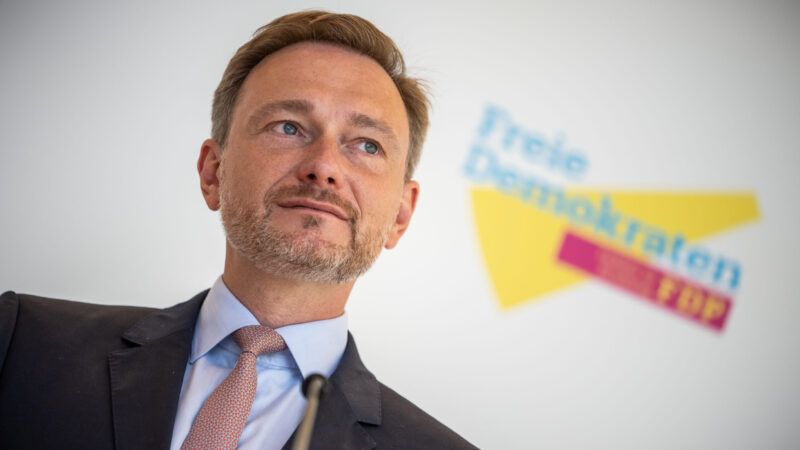
A double-digit election result for a fiscally conservative, socially liberal political party may ring strange to the American ear. But it's something that Germany's Free Democratic Party (FDP) and leader Christian Lindner pulled off in 2017. He hopes to repeat the feat when the country goes to the polls this Sunday.
In this election, Germany will have to define itself in the absence of long-serving Chancellor Angela Merkel of the Christian Democratic Party (CDU). Merkel announced in 2018 that she wouldn't seek a fifth term as Germany's leader, leaving the country's political future foggy. In an unusually open field, Lindner and the Free Democrats could emerge as major players.
Because Germany is a federal parliamentary republic, its political parties must forge a coalition government that represents a majority of members of parliament after every election. There are currently six major parties in parliament. Merkel's CDU, which forms an alliance with the Christian Social Union (CSU) of Bavaria, is conservative and centrist. The Social Democratic Party (SPD) corresponds most closely with America's progressive Democrats. The Alternative für Deutschland (AfD) is a right-wing populist party that was established in 2013. The FDP is liberal in the European sense, favoring free markets and the protection of civil liberties. Die Linke (the Left) is a democratic socialist party. Germany's Greens ideologically mirror the so-named American party, though they enjoy much greater support and representation.
The CDU/CSU faction has the largest presence in the German parliament and has produced the three longest-serving chancellors in post-war Germany. The SPD has also produced three, albeit shorter tenured, post-war chancellors. But as Deutsche Welle wrote in 2013, "no other party in Germany has governed as long as the Free Democrats," which is often called a "kingmaker" in German politics despite never producing an elected chancellor. Until 2013, the FDP had formed part of the coalition government for 52 of 64 years since World War II.
In the 2013 federal election, the FDP received just 4.8 percent of the vote, down from 14.6 percent in 2009—and short of the 5 percent threshold needed to enter parliament. The FDP went from a record high result to a record low in just one election cycle. The party lost all representation in parliament for the first time in its history. "Starting tomorrow the FDP needs to be rethought," said Lindner after the defeat. He took over as the FDP's chairman after the election, the youngest person to hold that position.
The FDP sought to shed its unflattering image as "the party of better earners" (or worse, the "party of Porsche drivers"). It painted itself as an exception in Germany's increasingly polarized political field and began to craft more marketable messaging on economic and social issues. "We will occupy the political middle that the CDU, SPD and Greens have left unoccupied," Lindner wrote in a post-election book.
Lindner's charisma was instrumental in the FDP's rebranding effort. He drew attention—and praise—for a pro-entrepreneurship rant in 2015. "If one succeeds, one ends up in the sights of the Social Democratic redistribution machinery," he chastened an SPD heckler. "If one fails, one can be sure of derision and mockery." The video was viewed by millions and landed Lindner on the front page of German newspapers, often favorably. The Berlin Tagesspiegel hailed him as a welcome contrast to the "persistent fog of alternative-less Merkelism." He made an image out of being pro-tech, pro-startup, and a firebrand in Germany's typically stolid political process. In the leadup to the 2017 federal election, his trendy black-and-white campaign posters even got BuzzFeed's attention.
The FDP rallied in 2017, earned 10.7 percent of the vote, and reentered the German parliament with 80 members out of 709 total. It saw the second-largest upswing from the 2013 election, behind only the AfD.
Now polling in the double-digits ahead of Sunday's election, the FDP's performance could exceed its 2017 showing. Some FDP politicians see the party as uniquely positioned to address the priorities of young people and speak to Germany's pandemic-era woes.
One of those politicians, Andreas Pinkwart, serves as the minister for Economic Affairs, Digitization, Innovation, and Energy in North Rhine-Westphalia (NRW), Germany's most populous and prosperous state. Having joined the FDP in 1980, Pinkwart now works in the government of NRW Minister-President Armin Laschet, the CDU/CSU's post-Merkel candidate for chancellor.
"The Free Democratic Party, under the leadership of Christian Lindner, changed a lot by addressing the young people in different kinds of their daily life issues," says Pinkwart.
In his view, the FDP offers a unique approach to education, digitization, small businesses, and pensions. By rooting itself in classical liberal economics, the party seeks to create a more fiscally sustainable Germany for the country's young. The FDP has also made great strides in its innovation-based approach to the environment, says Pinkwart: "We are not the better Greens—but today environmental and climate issues are important subjects in our program and our daily policy."
On many of these issues, the FDP "is much closer to the interests of the young people, and therefore if you look to polls, under the age of 30, most of the young voters would like to vote for the Greens or for the liberals, but not for the others. So conservatives have 9 percent under 30," he says. "It's a real shift of the voters' interests."
Though Germany's next chancellor will not be a member of the FDP—the SPD currently leads in polls, followed by the CDU/CSU, and then the Greens—the party could play a critical role in the coalition government that this election produces.
There are many ways the FDP could find itself in the government, since opinion polls indicate that no two-party arrangement would have the numbers necessary to take power. The FDP (represented by yellow in this chart) could be part of a "traffic light" coalition, along with the SPD (red) and the Greens. It might form a "Jamaica" coalition, named after the colors of the Caribbean nation's flag, if it collaborated with the CDU/CSU (black) and the Greens. There could also be a black-red-yellow "Germany" coalition if the FDP teamed up with the SPD and CDU/CSU.
That being said, Lindner has expressed that just about the only thing his party, the SPD, and the Greens could agree on is legalizing marijuana. The FDP is also unlikely to align with the left-wing Die Linke or the right-wing AfD, neither of which has been part of a federal government coalition before.
As Pinkwart explains, the FDP's prospects could be especially fruitful if the CDU/CSU's Laschet is elected chancellor. "We could build a real close, trusting relationship between Armin Laschet and Christian Lindner," he says. "They worked closely together in the state of North Rhine-Westphalia in the state parliament over the years…there is a rich field of common trust and interest on important issues."
Under Lindner's leadership, the FDP has been unwilling to compromise in coalition talks. In 2017, German politicians tried to forge a Jamaica coalition, and nearly 60 percent of German voters backed it. But the parties "still had 237 conflicts after 50 days," Lindner recounted in an interview with ARD-Brennpunkt, a German news show.
Lindner walked out after over a month of talks, refusing to build a coalition with the CDU/CSU and the Greens. "It is better not to govern than to govern badly," he infamously said.
Germany's 2021 race is too close to call. But as The Economist writes, "In one of the most open elections the country has known, polling suggests that it will be difficult to form a coalition without the FDP." Lindner is gunning to be the country's next finance minister and has stipulated that FDP participation in a coalition is contingent on respect for "the constitutional debt brake" and no new tax increases. Those concessions would be costly for whichever party takes the helm.
But through pandemic ups and downs, Pinkwart says German voters have come to value his party's liberal principles. "Before the pandemic, we had a high level of freedom in our society…normally the people said, 'Why should we vote for freedom? We have freedom,'" he explains. "But in the pandemic, they learned that freedom is not guaranteed for everyone."
"The Free Democratic Party stepped in, not by saying there is no pandemic, like the right-wing parties did," Pinkwart continues. "Saying, 'yes, we have the pandemic, we have to react in the right way, but the government and the administration have to take care and treat the people in a fair and democratic way.'"
On its path out of the Merkel years, much remains unclear about Germany's future. In the face of that uncertainty, though, Pinkwart says, "The FDP will be a good partner for a better Europe, a stronger Europe, but also a stronger trans-Atlantic relationship."




