

Clarence Thomas Declares War on Big Tech
Like a number of other modern conservatives, Thomas seems to think that Twitter and other tech companies are effectively censoring right-of-center views.
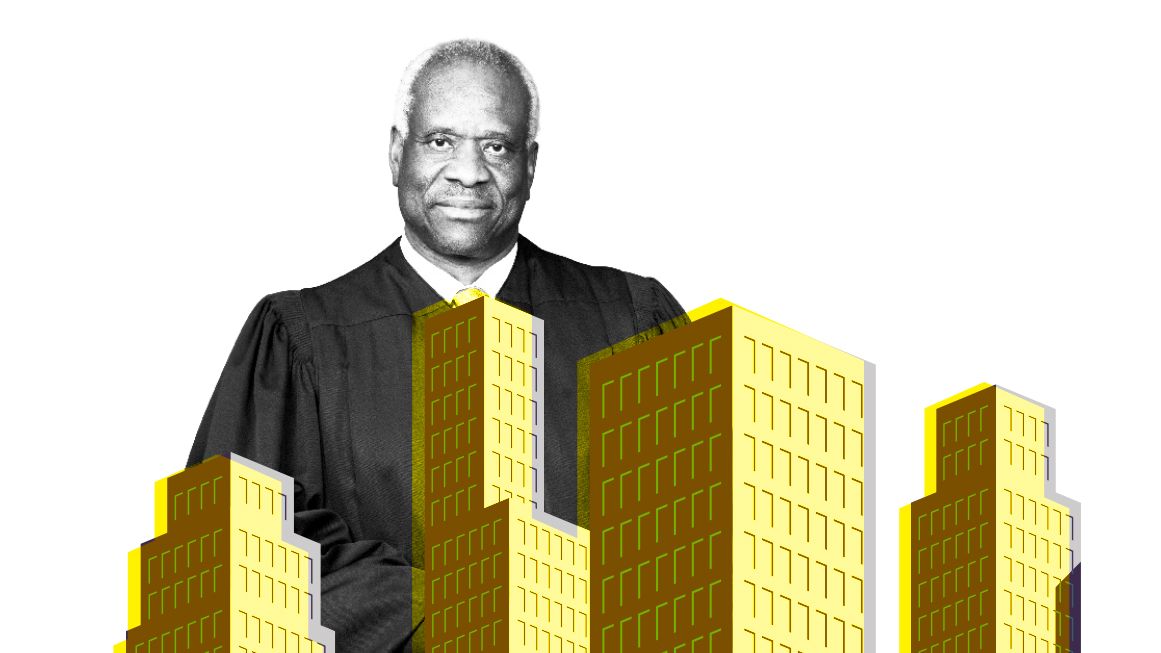
In 2003, Reason named Clarence Thomas one of the magazine's "35 Heroes of Freedom" because the Supreme Court justice had proven himself "a reliable defender of freedom of speech in such diverse contexts as advertising, broadcasting, and campaign contributions." Alas, Thomas' recent statements in support of greater government control over "digital platforms" such as Twitter and Facebook have somewhat tarnished his First Amendment bona fides.
In April, Thomas joined his fellow justices in ridding the Supreme Court of a lingering legal dispute over the propriety of then–President Donald Trump's decision to block various critics on Twitter. With Trump out of the Oval Office, the Court said in Biden v. Knight First Amendment Institute (formerly Trump v. Knight First Amendment Institute), the case was now moot.
Thomas agreed but did not let the matter rest there. In a solo concurrence, he lamented what he called the "unprecedented…concentrated control of so much speech in the hands of a few private parties." Yes, Trump prevented "several people from interacting with his messages," Thomas wrote. But Twitter "removed him from the entire platform, thus barring all Twitter users from interacting with his messages." For Thomas, the takeaway was as troubling as it was obvious. "As Twitter made clear," he wrote, "the right to cut off speech lies most powerfully in the hands of private digital platforms."
The justice then delivered what amounted to a regulatory call to arms against those platforms. "Part of the solution" to the "problem" of "private, concentrated control over online content and platforms available to the public," Thomas wrote, may be found in "two legal doctrines" that "limit the right of a private company to exclude."
The first doctrine, he explained, involved "common carriers," such as railroads and telegraphs, which have historically been required "to serve all comers." The second involved "places of public accommodation" or amusement, such as inns, restaurants, and theaters, which have generally been forbidden from denying service to certain categories of people. "The similarities between some digital platforms and common carriers or places of accommodation," Thomas wrote, "may give legislators strong arguments for similarly regulating digital platforms."
But these arguments may not be quite as strong as Thomas thinks. For one thing, today's social media enterprises neither look nor act much like traditional common carriers. Unlike a telegraph company, for instance, Twitter and Facebook not only move information from place to place but curate it and moderate it, resulting in all sorts of varied and even personalized user experiences. What is more, the platforms let users curate and moderate their own unique experiences, leading to a vast array of online associations and communities. All of which qualifies as expressive activity, which is shielded by the First Amendment.
Thomas' public accommodation theory also has its faults. To be sure, state and federal law do prohibit most businesses from refusing service based on a customer's race, religion, sex, sexual orientation, or certain other legally protected categories. But it is not illegal (yet) to deny service based on a customer's comments about politics, which is what Thomas is ultimately objecting to here.
Like a number of other modern conservatives, Thomas seems to think that Twitter and other tech companies are effectively censoring right-of-center views. But Twitter is a private entity with First Amendment protections of its own and is thus under no obligation to share its soapbox. Thomas' approach, by contrast, would trespass the Constitution by forcing the company to play host to speech that it does not want to be associated with.
Thomas' arguments came about in a mooted case in which he wrote only for himself. Still, it would be a mistake to dismiss them as a fringe legal stance. The justice has a record of staking out lonely positions that later become entrenched in law. His critics underestimate him at their peril.
Take campaign finance. In McConnell v. Federal Election Commission (2003), Thomas wrote alone to fault his colleagues in the majority for largely approving the Bipartisan Campaign Reform Act of 2002, which, among other things, banned corporate- and union-funded "electioneering communications" that mentioned a candidate by the name in the run-up to an election. Seven years later, in Citizens United v. Federal Election Commission (2010), the Court cited Thomas' McConnell opinion while striking down the same "electioneering communications" ban. He knows a thing or two about playing the legal long game.
Thomas also wields considerable influence in the broader conservative world, where interested parties are no doubt paying close attention to the present case. In other words, get ready for a host of new laws and lawsuits that cite Thomas' words in support of greater regulatory crackdowns on tech companies.
And do not be surprised when federal judges start citing him too. As Jeff Kosseff, author of The Twenty-Six Words That Created the Internet (Cornell University Press), remarked on Twitter, "I do think that Thomas's statement increases the chances that at least two judges on a randomly chosen circuit court panel will rule in favor of must-carry rules for social media platforms." The legal conflict over government control of social media is just starting to heat up.
Thomas is surely correct about one thing. "We will soon have no choice," he wrote, "but to address how our legal doctrines apply to highly concentrated, privately owned information infrastructure such as digital platforms." One way or another, Big Tech will eventually collide with government regulators at the Supreme Court.




