

Sen. Ron Wyden: Conservatives Are 'Totally Wrong' About Political Neutrality Under Section 230
"Section 230 has nothing to do with neutrality. Nothing. Zip. There is absolutely no weight to that argument," Wyden says. He oughta know. He wrote the damn thing.
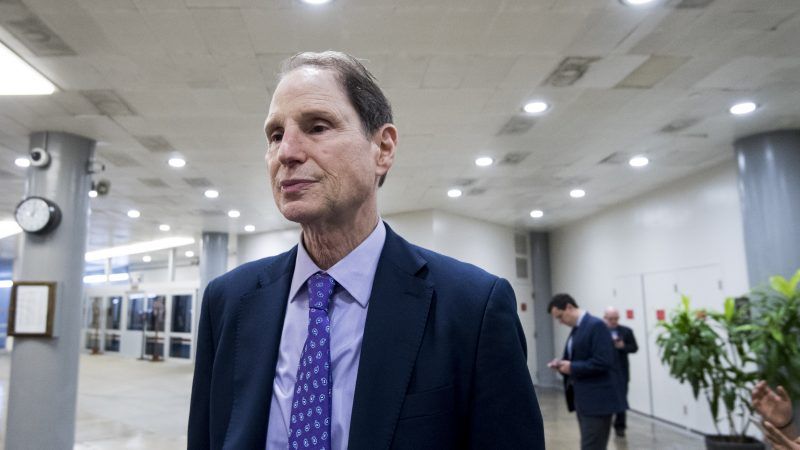
The debate over free speech on the internet has turned everything "tursy-turvy" says Sen. Ron Wyden (D–Ore.).
"I'm up against a group of big-government Republicans who seem to think the right answer is to push the private sector—users and consumers and shareholders and managers—push them aside and, in-effect, deputize the federal government as speech police in violation of the First Amendment," Wyden tells Reason.
Let's back up all the way back to 1996 when the internet was barely an infant. It was that year when a younger version of Wyden was one of co-authors of Section 230 of the Communications Decency Act. It is all of one sentence long; just 26 words promising that online platforms will not be held liable for content provided by users or other publishers. And it is, as Wyden described it on Tuesday, "about the most libertarian law on the books."
But it's also under attack these days, largely from conservatives unhappy with how Facebook, Twitter, and other social media sites have been policing content—including everything from reducing the visibility of some posts, to temporary or permanent bans on controversial figures trafficking in conspiracy theories and outright racism. Sen. Josh Hawley (R–Mo.) has taken the lead by introducing a bill to amend Section 230 under the pretense of fighting tech companies' supposed "bias" against Republicans. His bill would eliminate Section 230 liability protections from online platforms judged not to be operating in a "politically neutral" manner.
"With Section 230, tech companies get a sweetheart deal that no other industry enjoys: complete exemption from traditional publisher liability in exchange for providing a forum free of political censorship," Hawley said when he introduced the bill last week. Since then, the notion that Section 230 has always included an implicit "deal" requiring platforms take a neutral political stance has become a talking point in some parts of the political right.
What does Wyden, the author of Section 230, think of that claim?
"Totally wrong," says Wyden. "Section 230 has nothing to do with neutrality. Nothing. Zip. There is absolutely no weight to that argument."
What the law does imply, according to Wyden, is that conservative blogs and websites can put their point of view out into the marketplace, "where users and consumers will make judgments about it." In other words, you have a right to speech online, but not a right to get your speech hosted on anyone else's website. The same is true for liberal perspectives online. "It's about making sure that all the voices get heard," Wyden says.
Conservatives like Hawley—and some of the newly emergent illiberal or "post-liberal" voices on the right—feel like their voices aren't being heard. They blame tech companies like Facebook and Google for this so-called "censorship." Under Hawley's bill, the misleadingly-titled "Ending Support for Internet Censorship Act," online platforms would have to hand over intellectual property to the federal government and would have to face a panel of partisan political appointees who would certify that the platform was operating in a "politically neutral" way.
As Reason's Elizabeth Nolan Brown wrote last week, the bill is essentially an attempt at resurrecting the old Fairness Doctrine—"a policy that was roundly denounced by conservatives for its chilling effect on free speech and its propensity to further marginalize non-mainstream voices—and apply this cursed policy paradigm to anything online."
Conservatives rushing ahead with a plan to put the federal government in charge of online speech makes about as much sense as if liberals thought it would be a good idea to have President Donald Trump and Attorney General William Barr policing websites, says Wyden.
He's also worried about how rolling back Section 230 would help entrench some of the very same tech companies that conservatives see as villains.
"This was an important law for the little guy when we wrote it, and it arguably is even more important today," Wyden says. Big tech companies like Facebook benefited from the freedom provided by Section 230 when they were starting up, Wyden said, but now that they have become dominant players online, they are trying to "pull up the ladder" behind them, he says.
"Frankly, if somebody rolled back some of Section 230, it helps the big technology people, like Facebook, hold off their small competitors," Wyden argues.
Where Wyden does believe the federal government should get more involved is on the debate over privacy and data. He's called for the Federal Trade Commission (FTC) to hold Facebook founder and CEO Mark Zuckerberg personally liable for his company's data breaches. In our interview, Wyden said he believed Zuckerberg had lied "on several occasions" about Facebook's privacy policies. "I do believe that the CEO should be held personally liable if they are found to have repeated misrepresented" those policies, said Wyden, who drew a parallel to how the government treats top executives at major financial institutions differently from small bankers.
In other words, Wyden's view is that the federal government should play a strong enforcement role when it comes to online privacy, but that it should have a fully hands-off policy when it comes to regulating speech online. It's an argument that not only libertarians but also conservatives and liberals interested in a free and open internet could agree with.
But the illiberal right—for which Hawley is acting as a sort of "spokesman in the Senate," according to Washington Free Beacon Editor Matthew Continetti—wants more government control over all online speech. Hawley's bill would require tech companies to get re-certified by the FTC as "politically neutral" every two years, effectively giving every new presidential administration a de facto veto over online speech. If that's not censorship, it's certainly brushing right up against it—and if you think too much of American society is already politicized, just wait until the fate of the internet is tied to the outcome of every presidential election.
It's easy to see why Wyden feels like the ground is shifting under his feet. For decades, he's been something of a rarity in Washington; a progressive Democratic with self-described "libertarian chromosomes" who has stood against executive power grabs and been a tireless advocate for free speech, especially online. Now, some of his across-the-aisle allies who used to share a skepticism of government power are missing in action, replaced by moralizing authoritarians who don't even seem to understand the obvious consequences of what they are proposing.
"For the life of me," Wyden says, "I can't understand how [rolling back Section 230] has become a big part of a political party that used to believe in less government."




