
Women Are Better Armed Than Ever
The technology of self-defense is more widely distributed than in the past.


The technology of self-defense is more widely distributed than in the past.
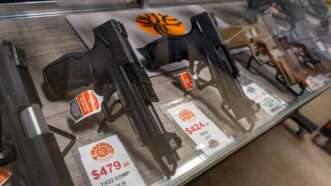
Challenging his conviction for illegal gun possession, Curtis Squire argues that the Commerce Clause cannot justify bans on intrastate, noncommercial conduct.
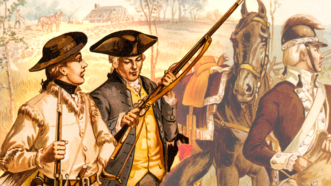
Given the Second Amendment's history, several briefs argue, a gun's suitability for militia service suggests Americans have a right to possess it.

The case hinges on the distinction between "unusual" weapons and arms in common use for lawful purposes.

Meanwhile, the top court of Massachusetts considers whether the state can deny carry permits to applicants who are deemed "unsuitable."
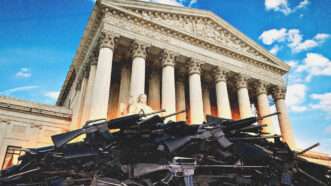
The Supreme Court has agreed to hear a pair of cases involving rifle restrictions imposed by Connecticut and Cook County, Illinois.

A SCOTUS petition argues that the practice, which allows a judicial finding of dangerousness based on a preponderance of the evidence, violates the Fifth Amendment.

When Congress eliminated taxes on suppressors, short-barreled rifles, and short-barreled shotguns, it also eliminated the constitutional justification for regulating them.

Limited evidence of effectiveness combined with privacy concerns raises questions about the sensors.

An old drug conviction could still stop you from waxing eyebrows, cutting hair, or giving massages.

In a decision written by a Joe Biden nominee, the appeals court addresses a long-simmering issue that the Supreme Court will consider during its next term.

The ATF is reconsidering some of its dumber regulations as the feds sue states with restrictive gun laws.

After upholding the Second Amendment rights of drug users and carry permit holders, the justices will address the constitutionality of "assault weapon" bans.

Assistant Attorney General Harmeet Dhillon argues that both laws are unconstitutional because they prohibit arms in common use for lawful purposes.

The case could settle the long-simmering issue of whether the Second Amendment covers commonly owned but politically disfavored rifles.

A new chapter in the never-ending battle between centralized power and local control.

The American Long Rifle was accurate at long distances, unlike British smoothbores.
The government cannot force private property owners to allow guns on their land. But the Supreme Court rightly ruled today that it also cannot impose a presumption of exclusion.

The decision means similar laws in other states likewise violate the Second Amendment, and it casts doubt on the constitutionality of location-specific gun bans that cover a lot of territory.

The Supreme Court's decision in United States v. Hemani could open the door to relief for cannabis consumers convicted of illegal gun possession.

The decision is a modest but welcome step toward rectifying the injustice of criminalizing conduct that violates no one’s rights.

Even under the Supreme Court's highly elastic understanding of that clause, Thomas says, such laws do not qualify as regulation of interstate commerce.
The Supreme Court's unanimous decision in Hemani.

The unanimous decision upholding the gun rights of cannabis consumers is striking given the Supreme Court's long history of accommodating the war on drugs.

A landmark win for the right to keep and bear arms in United States v. Hemani.

In a unanimous opinion, the court ruled that it is unconstitutional for officers to stop and frisk someone based solely on suspicion that the person is carrying a gun.

A legislative effort to eliminate gun-free zones on public college campuses has died. But for its student sponsor, the fight isn’t over yet.

Three Second Amendment groups say the law violates the right to own arms in common use for self-defense and other lawful purposes.

Even as the Justice Department files lawsuits aimed at vindicating gun rights, it undermines them in other cases.

The civil liberties group, which long maintained that there is no constitutional right to arms, sang a different tune at the Supreme Court this year.

Assistant Attorney General Harmeet Dhillon argues that both laws violate the Second Amendment by banning arms in common use for lawful purposes.

From immigration and guns to executive power, transgender athletes, and mail-in ballots, these are the Supreme Court cases to watch out for in May and June.

Plus: The Alito retirement rumors keep swirling.

If I can build a functional, unregistered handgun in less than two hours, so can you.

At best, the authorities will show up after the threat has already occurred.
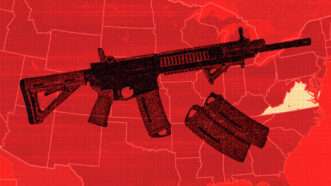
The ban, which targets guns based on criteria that make little sense, seems vulnerable to a challenge under the Supreme Court's Second Amendment precedents.

Some gun-rights activists are blaming immigrants, but the real culprits are Virginia Democrats.

A Supreme Court case illustrates the potential for trans-partisan alliances between critics of gun control and critics of the war on drugs.

Alexander Ledvina was convicted of violating a federal law at the center of a Second Amendment case that the Supreme Court is considering.

Most of the justices seemed unsatisfied by the Trump administration's argument that the law is constitutional as applied to a Texas marijuana user.

"We see this as an important civil liberties issue," says an ACLU lawyer.

The Second Amendment protects your right to carry a gun at a protest.

The right to bear arms is inherently anti-authoritarian at a time when Trump wields authority.

The prosecutor's threat renewed concerns about the Trump administration's commitment to protecting Second Amendment rights.
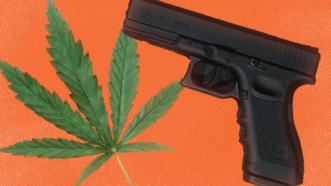
Drug policy reformers and Second Amendment advocates team up in a case before the Supreme Court.
NRA Amicus Brief Argues that Ban Fails Bruen Test
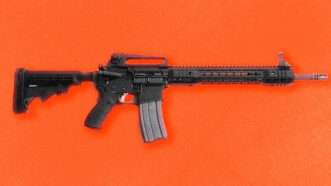
They’re not getting the whole “shall not be infringed” part of the U.S. and Virginia constitutions.

The department now describes the threat as "several civilians" who were "yelling and blowing whistles."
Celebrate your independence with a subscription to Reason magazine, your most trusted source of honest, insightful news and analysis.




