The topic for the 11th Annual Harlan Institute-Ashbrook Virtual Supreme Court competition is Students for Fair Admission v. UNC. This week, twenty-six teams of high school students presented oral arguments in the semifinal round. The teams were superb. Truly, these high school students could compete in any law school moot court competition. The Round of 8 will be held in two weeks.
WHEREAS in 1957's Sweezy v. New Hampshire, the Supreme Court of the United States observed that "[t]he essentiality of freedom in the community of American universities is almost self-evident. No one should underestimate the vital role in a democracy that is played by those who guide and train our youth. To impose any strait jacket upon the intellectual leaders in our colleges and universities would imperil the future of our Nation. . . . Teachers and students must always remain free to inquire, to study and to evaluate, to gain new maturity and understanding; otherwise, our civilization will stagnate and die."; and
WHEREAS ten years later in Keyishian v. Board of Regents, the Supreme Court further declared that academic freedom "is a special concern of the First Amendment, which does not tolerate laws that cast a pall of orthodoxy over the classroom."; and
WHEREAS in Healy v. James, the Supreme Court stated that "the precedents of this Court leave no room for the view that, because of the acknowledged need for order, First Amendment protections should apply with less force on college campuses than in the community at large. Quite to the contrary, 'the vigilant protection of constitutional freedoms is nowhere more vital than in the community of American schools.'"; and
WHEREAS in West Virginia State Board of Education v. Barnette, the Supreme Court held that the First Amendment prohibits the government from compelling an individual to engage in speech, proclaiming that "if there is any fixed star in our constitutional constellation, it is that no official, high or petty, can prescribe what shall be orthodox in politics, nationalism, religion, or other matters of opinion or force citizens to confess by word or act their faith therein."; and
WHEREAS many colleges and universities require or invite current and/or prospective faculty to demonstrate their commitment to diversity, equity, and inclusion (DEI), often through a written statement that factors into hiring, reappointment, evaluation, promotion, or tenure decisions; and
WHEREAS vague or ideologically motivated DEI statement policies can too easily function as litmus tests for adherence to prevailing ideological views on DEI, penalize faculty or applicants for holding dissenting opinions on matters of public concern, and, as the Supreme Court warned against in Keyishian, "cast a pall of orthodoxy" over our public college and university campuses; and
Wilson v. Hussman, decided yesterday by Judge Lawrence Piersol (D.S.D.) deals with a civil case brought over an alleged rape of a child on the Pine Ridge Indian Reservation; the rape allegedly occurred when plaintiff was 8 and 9 years old, around 1978 or 1979. A federal statute, enacted Sept. 16, 2022, changed the statute of limitations for such offenses, and the version in the main text of 18 U.S.C. § 2255 appears to entirely waive any time limits for such lawsuits:
… (a) In general.—Any person who, while a minor, was a victim of a violation of section 1589, 1590, 1591, 2241(c), 2242, 2243, 2251, 2251A, 2252, 2252A, 2260, 2421, 2422, or 2423 of this title and who suffers personal injury as a result of such violation, regardless of whether the injury occurred while such person was a minor, may sue in any appropriate United States District Court and shall recover the actual damages such person sustains or liquidated damages in the amount of $150,000, and the cost of the action, including reasonable attorney's fees and other litigation costs reasonably incurred. The court may also award punitive damages and such other preliminary and equitable relief as the court determines to be appropriate.
(b) Statute of limitations.—There shall be no time limit for the filing of a complaint commencing an action under this section.
But the actual public law that enacted the statute also provides (as noted here),
SEC. 3. EFFECTIVE DATE; APPLICABILITY.
This Act and the amendments made by this Act shall—
(1) take effect on the date of enactment of this Act; and (2) apply to—
(A) any claim or action that, as of the date described in paragraph (1), would not have been barred under section 2255(b) of title 18, United States Code, as it read on the day before the date of enactment of this Act; and
(B) any claim or action arising after the date of enactment of this Act. Approved September 16, 2022.
In Wilson, Judge Piersol concluded that plaintiff's claim is barred by the public law, even if that bar is not reflected in the main text of the U.S. Code version:
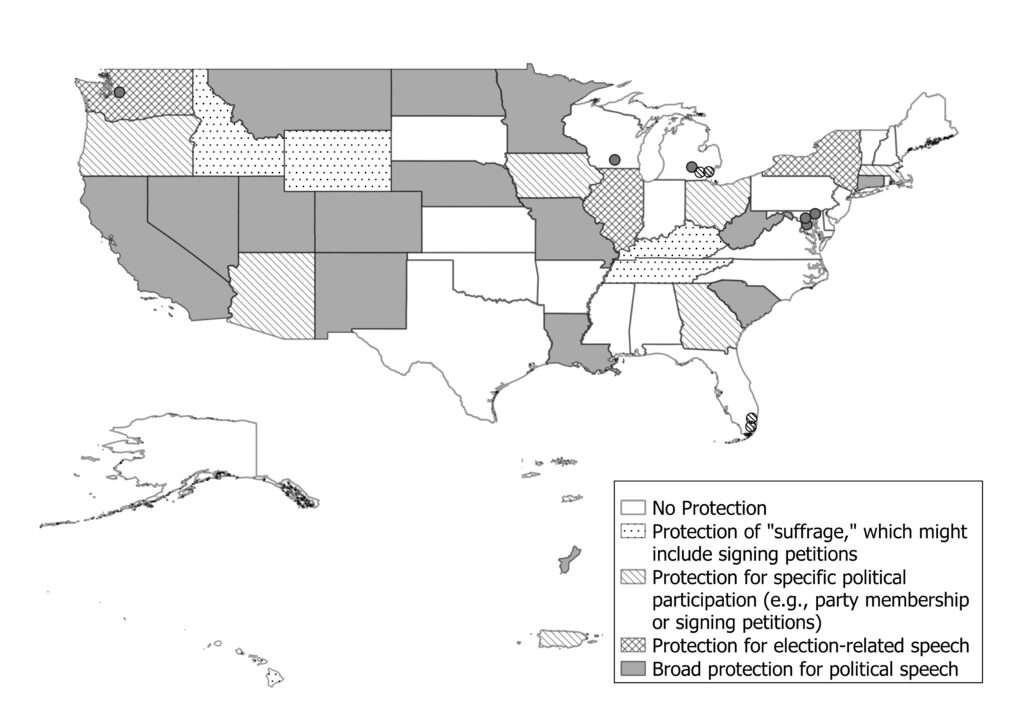
About half of Americans live in jurisdictions that protect some private employee speech or political activity from employer retaliation. Of course, that means about half don't. Which jurisdictions are correct? And, if private employers should generally be barred from firing, disciplining, or perhaps even declining to hire workers based on their speech, which sorts of speech should be protected? …
As I hope I've made clear, laws limiting private-employer-imposed speech restrictions might be a cure that's worse than the disease. They might unduly interfere with employers' associational rights (though not generally in an unconstitutional way). They might unfairly require employers to keep paying employees who are more trouble than they are worth. They might make it harder for employers to dismiss employees even for eminently legitimate reasons unrelated to the employee speech. And of course, they might increase the amount of offensive and harmful speech by making such speech less costly for the speakers (though the same can be said of free speech rights generally).
At the same time, private employer speech restrictions genuinely do threaten to undermine democratic self-government, the marketplace of ideas, self-expression, and the development of autonomous citizens, much like many governmental speech restrictions do.
On Tuesday, the Supreme Court will hear arguments in Gonzales v. Google, a case raising whether Section 230 protects Big Tech from federal laws against aiding terrorism—and possibly also state laws against tech censorship.
In 2015, Nohemi Gonzalez—a 23-year-old American studying in Paris—was gunned down by Islamic State (ISIS) terrorists while dining at La Belle Equipe bistro. The U.S. Supreme Court will consider these wrenching facts of Gonzales v. Google on Feb. 21. Bound up with Nohemi's fate is the fate of Section 230.
That 1996 federal statute privileges Big Tech, excusing it from laws that constrain newspapers and other old-style communication. But does it relieve Big Tech from complying with all laws affecting communication? For example, those against aiding terrorism?
Nohemi's relatives and estate have sued Google—the owner of YouTube—for algorithmically encouraging followers of ISIS to view ISIS videos, in violation of the law against assisting terrorism. Google responds that Section 230 gives it sweeping immunity. It claims to be privileged for a host of abuses, including aiding terrorism and censoring Americans.
Big Tech thus takes a big interpretation of Section 230. The statute and the Constitution, however, suggest Big Tech has overplayed its hand.
The statutory problem is textual. According to Google and the rest of Big Tech, YouTube enjoys protection as a "publisher" under Section 230(c)(1) for its "editorial functions," whether in sharing and recommending videos or in blocking them. But that's not what the section says.
It says such companies shall not be "treated as the publisher" of information provided by others. So Google, comically, is seeking to be treated as a publisher under a section that says it shall not be treated as a publisher. Its argument proves too much.
The context confirms the narrowness of the text. The section was a response to cases such as Stratton Oakmont v. Prodigy, a defamation case in which Prodigy was held to be "a publisher rather than a distributor." A key element in defamation cases is to show that the defendant is the publisher of the defamation. Section 230(c)(1) protected against such suits by saying the companies should not be "treated as the publisher" of information supplied by others.
This leads to the sensible conclusion that YouTube and Google should not find any shelter in Section 230 for supporting terrorism. Being a publisher is not an element of a case for aiding terrorism, so Section 230(c)(1) gives them no cover.
The piece goes on to explain that "if the Supreme Court accepts Big Tech's big rewriting, the decision in Gonzales v. Google could privilege Big Tech both as to terrorism and censorship." Hamburger argues this misreads Section 230 and that the statute is unconstitutional:
Section 230 is especially unconstitutional because it privileges electronic communication over print and in-person communication, thereby subjecting these older modes to discriminatory restraints. This is speaker discrimination, which the Supreme Court rightly held unconstitutional in Citizens United v. FCC.
The speaker discrimination, moreover, comes with viewpoint discrimination. Newspapers tend to have more local or regional perspectives than do Big Tech companies. So, by privileging electronic carriers, Section 230 favors their relatively national and international views and disadvantages the localized views of more traditional modes of communication.
Hamburger's concern is both terrorism and censorship:
The perverse beauty of Gonzales v. Google, from the Big Tech perspective, is that Big Tech could secure Supreme Court support for the big interpretation in a case that does not involve censorship. Terrorism could be a backdoor for censorship to sneak in unobserved.
Nohemi's murder was utterly unjustified. So is the big interpretation of Section 230. It contravenes the statute's text. It departs from the concerns underlying the act's adoption. It privileges big tech to aid terrorism and impose censorship. And the statute is unconstitutional.
Both federal and state law include protections, including some in the common law of tort, for speech that advances public policy or the interests of the public. Scores of statutes protect employee whistleblowing, or disclosing illegal or harmful conduct, or claiming other employee rights—for example, reporting discrimination or complaining of violations of the wage and hour laws…. [A]bout half the states protect some kinds of political speech or association by private sector employees (especially that which takes place off-duty and is closely connected to the electoral process). The number and breadth of those laws on their face is surprising; yet they haven't generated a lot of cases, in part because they are not well known and are more or less hemmed in by deference to employer interests and prerogatives.
Crucially, all of these private employee speech protections … take the form of exceptions to the background rule of employment-at-will—that is, the employer's prerogative, absent a contract providing for job security, to terminate employment at any time and for any reason or no reason at all, though not for a reason that is specifically prohibited by law. There are many such prohibited reasons, or wrongful discharge exceptions to employment-at-will, including the speech protections just reviewed as well as the large and still-growing body of employment discrimination law.
But the background rule of employment-at-will undercuts every one of those protections. For employees who suspect or believe that their discharge was in fact wrongful under the law of the land, they first have to identify the wrongful motive (which the employer usually strives to conceal) in order to figure out what claim to file in what forum. Then the burden is on the employee to navigate the obstacle course of adjudication or litigation, and to prove an unlawful motive on the part of the employer, who controls almost all of the relevant documents and employs most of the witnesses….
Imprisoned Russian opposition leader Ilya Yashin explains why the West should avoid ascribing collective guilt to Russians. He's right on both moral and pragmatic grounds.
Russian opposition leader Ilya Yashin was recently sentenced to 8.5 years in prison for using his YouTube channel to publicize evidence of the Russian military's atrocities in Ukraine. Time recently published a message Yashin wrote to the world, from behind bars (English version here, Russian here). In it Yashin warns us against ascribing collective guilt for the war to Russians as a group. Doing so is morally wrong, and also likely to bolster Vladimir Putin's grip on power. Such imputations of collective guilt have become increasingly common, reflected most notably in widespread refusal to grant refuge to Russians fleeing Putin's regime, on the theory that they share responsibility for its actions.
We would do well to heed Yashin's warning against this way of thinking:
Soon, a year will have passed since the start of the war unleashed by the Kremlin against Ukraine. It has taken thousands of lives, destroyed entire cities, and turned millions of families into refugees. Vladimir Putin, the one responsible for this tragedy, has become a true symbol of evil, reviled around the world. But it also seems that, more and more often, the Russian people are treated as enemies. The main accusation against the Russians: You did not resist the aggressive policies of your government, and that makes you accomplices to war crimes.
My name is Ilya Yashin, a Russian opposition politician, whom the Kremlin has kept in prison since the middle of last summer. I've been sentenced to 8.5 years of incarceration, because I publicly spoke out against the war in Ukraine. But today I want to say a few words in defense of my nation.
First: We did resist. Since the start of the war and throughout 2022, the police in Russia arrested almost 20,000 opponents of the war. According to human rights groups, protests have taken place almost every day in different cities since February 24, 2022, and only 18 of those days have passed without arrests and detentions…..
Second: People are fleeing Putin. In the past year, some 1 to 1.5 million people have left Russia [the English version says 700,000, relying on an October 2022 article that, among other things, cannot take account of those who fled since then]. The majority of them have emigrated, not wanting to be involved in military aggression. I want to call attention to the fact that at least twice as many people have fled as have been drafted for military service. Yes, you can blame those who chose to escape instead of choosing the path of resistance, prison, and torture. But the fact is that hundreds of thousands of my countrymen left their homes behind, refusing to become murderers on the orders of the government.
Third: Those who remain in Russia are living as hostages. Many of them don't support the war, but remain silent, afraid of repression…..
I appeal to the international community to choose wisdom. Do not demean Russians, as that kind of rhetoric will only strengthen Putin's grip on power. By shifting the blame for war crimes from the Kremlin junta onto my fellow citizens, you are easing the Putin regime's moral and political burden…. I see that as a serious mistake….
I believe Russians might become allies of the free world in resisting tyranny. Extend a hand to my fellow countrymen.
[I have in some places revised Time's translation to better reflect the Russian original; I am a native speaker of Russian, and thus in a position to make such judgment calls].
As Yashin suggests, ascriptions of collective guilt are wrong in themselves - conflating the innocent with the guilty. In addition, they play into the hands of the regime's propaganda by lending credibility to its claims that the West is hostile to Russians, as such.
His argument can be extended in a few ways.
First, I wonder how many of those who fault Russians for not protesting enough, would themselves be willing to do so if they were in Russia right now, and speaking out meant risking a lengthy prison sentence, like the one Yashin got? We should be wary of imposing standards on others that we would not live up to ourselves, if we were in their place.
Second, as I have argued time and again from the beginning of the war, both moral and pragmatic considerations counsel in favor of opening our doors to Russians fleeing the regime, just as we - to a large extent - have done for Ukrainian refugees (I cannot easily be accused of neglecting the cause of the latter). The large-scale exodus Yashin refers to occurred despite the fact that the only refuges available to most of these people are poor and often unstable countries such as Kazakhstan and Turkey. Many more might come if able to go to richer and freer Western democracies. Thus, more would be freed from oppression, and the "brain drain" and loss of manpower imposed on Putin's regime would be larger. To the extent that theories of collective guilt are used to justify barring Russian migrants, they are having a deeply pernicious effect.
Finally, projecting a less negative attitude towards the Russian people is in the long-term interest of both Ukraine and the West. Military action may enable Ukraine to expel Russian troops from its territory and end the immediate threat of conquest. But the long-term threat posed by Russia will only dissipate if Putin's authoritarian nationalist regime is replaced by a much more liberal one that abjures oppression and conquest. Such an outcome is far from guaranteed. But, at the margin, it will be easier to achieve if Russians do not see the liberal democratic world as enemies who hate them indiscriminately. While helping Ukraine defeat Putin on the battlefield, we should also reach out to Russians who might eventually put an end to his regime at home.
None of this means Putin alone bears the sole blame for the war and its evils. Obviously, he has many collaborators, including some who are responsible for horrific atrocities. Those people deserve condemnation and - where possible - punishment. But we should distinguish between them and the population, at large. Indeed, punishment for war crimes is another goal that - most likely - can only be achieved through a liberalization of Russia. So long as the present regime remains in power, little can be done to bring the highest-level war criminals to justice.
I criticized theories of collective guilt in greater detail here, including addressing claims that ordinary citizens of unjust authoritarian regimes deserve blame if they approve of the government's policies.
It is worth noting that it is very difficult to tell what percentage of Russians actually support the government and its war, given that survey respondents have strong incentives to give pro-government answers for fear of punishment under the draconian censorship laws enacted last year, which make it a crime to even refer to the conflict as a "war" (as opposed to a "special military operation," the official Kremlin euphemism). But the combination of the mass exodus and the government's resort to draconian repression suggest that there is a lot more opposition than may be visible on the surface. If the overwhelming majority of Russians really did support Putin's war, the regime would have no need to engage in repression on this scale, nor would we see such massive emigration.
Yashin may be too optimistic about the extent of popular opposition to Putin. But Westerners who claim an overwhelming majority support the war are also likely in error.
NOTE: Despite having the same first name, Ilya Yashin is no relation of mine. The name is a common one.
In Gardner v. McKenney, McKenney (the mother) and Gardner (the father) had joint custody, but mother sought to be appointed the primary custodian, and to "render an order 'preclud[ing] [Gardner] from renting out the children's bedrooms at their primary residences as short term rentals.'" The Texas Court of Appeals affirmed that yesterday, in an opinion by Justice Thomas Baker, joined by Justices Edward Smith and Rosa Lopez Theofanis:
Mindful that the trial judge is "best able to observe and assess the witnesses' demeanor and credibility" and sense the "forces, powers, and influences" that may not be apparent from merely reading the record on appeal, we conclude that there is sufficient evidence from which the trial court could exercise its discretion, and that the court's exercise of discretion in rendering the room-rental provision of the order was reasonable…
McKenney testified that she believed the issue of strangers staying in K.L.G.'s bedroom and sleeping in her bed when she was not there was important to the teenager, who had noticed that her things had been rifled through when she was gone. McKenney explained that the children's closets and cabinets had no locks and that she was concerned for the physical and emotional well-being of her children based on the risks associated with the ongoing COVID-19 pandemic and the possibility that strangers might leave cameras in the bedrooms or take things. There was considerable evidence about K.L.G.'s ongoing mental and emotional issues, for which she was currently undergoing partial hospitalization and about which the parties did not always agree on the best course of treatment.
Gardner confirmed that he had rented out the children's rooms for nearly 100 days in a single year—the same year that encompassed K.L.G.'s suicide attempt and many behavioral concerns as well as estrangement between K.L.G. and Gardner. While Gardner testified that the room rentals did not "bother" K.L.G., that the children know they are "welcome" to lock anything up in his closet that they do not want left out when he rents out their rooms, and that the children enjoy the "extra money" he gives them for renting out their rooms, the trial court could have found such testimony not credible or outweighed by the teenagers' needs for stability in each of their two homes, to include not having to remember to lock things up each time they transfer to their mother's home, especially considering K.L.G.'s significant and ongoing emotional and mental issues. The trial court also could have reasonably inferred that the parent-child relationship and the children's awareness of the parties' custody disputes constrained the children from telling their father how they felt about having their rooms rented out.
For the past few years, I have watched with some apprehension the explosion of legalized gambling in the United States. Casinos have sprouted up in places that did not previously allow gambling. And online sports gambling has proliferated, such that almost every commercial break during the Super Bowl plugged a betting app. Much of this shift can be traced back to a single Supreme Court decision: Murphy v. NCAA (2018). At the time, I thought this federalism case was not a difficult call: Congress cannot prohibit a state from legalizing sports betting. The vote was 7-2. Justice Ginsburg dissented on fairly narrow grounds concerning severability. The consequences, however, extended far beyond the Garden State.
Charles Lane's column in the Washington Post summed up my thinking:
When historians evaluate the Supreme Court's impact on early 21st-century America, they will no doubt focus on the 2015 decision legalizing same-sex marriage or the overthrow of Roe v. Wade last year.
Now, 36 states and D.C. permit bets on the NFL, MLB, NBA — you name it. Leagues that once shunned betting as a threat to their integrity cheerfully accept legal sportsbooks as official "partners."
Whether or not you bet, there's no escape from advertising by companies such as FanDuel and DraftKings. With bewildering speed, a language once intelligible only to Las Vegas habitues — "parlay," "over-under" — has gone mainstream.
This year's Super Bowl was the first played in a state — Arizona — with legal sports gambling. A service that tracks the location of online sports betting transactions found that 100,000 of the 100 million "pings" to sports betting apps that it traced nationwide on Sunday came from State Farm Stadium or nearby, according to the Wall Street Journal. It's not yet known how much people wagered on the contest via legal sportsbooks, but the industry's trade association has estimated $1 billion. . . .
Gambling is known to be addictive because it supplies such a rush. Though integrity of sports was the 1992 law's primary concern, gambling addiction was also a potential harm against which the measure, sponsored by former NBA star Sen. Bill Bradley (D-N.J.), sought to protect.
A few months ago, I was on a flight to Las Vegas for a talk at UNLV. The person sitting next to me worked for the marketing department of one of the large casino conglomerates. He made no effort to conceal what was on his screen, and I availed myself of the opportunity to read his presentation. (Never do any work on a plane unless you are willing to have other people see it.) The casino was trying to calculate the correct level of "enticement" needed to hook a person on the app. In other words, how many free "credits" would a person receive before he became a "loyal" member. I'm sure similar conversations were held back in the day at tobacco companies. At least in the past, people had to make a physical trip to a casino. Now, super-addictive apps can hook a person, and deplete his bank account anywhere. Lives will be ruined with a few swipes.
I think the societal effects of Murphy will dwarf the impact of Dobbs and Bruen. Without question the number of abortions has decreased, but not nearly as much as some advocates feared. And, on balance, I suspect that gun laws nationwide will not look much different in 5 years than they do now. But Murphy, a single decision led to a complete shift in the American economy. Don't tell Justice Gorsuch, but Indian tribes, which have come to rely on exclusive gaming facilities, may be the hardest hit. Plus, throw in Justice Kavanaugh's concurrence in NCAA v. Alston, and college athletics have been turned upside down by name-image-likeness deals. It's often the decisions that fly under the radar that are the most consequential.
From the Seventh Circuit decision Jan. 27 in Roe v. Dettelbach, by Judge Diane Wood and joined by Judges David Hamilton and Amy St. Eve:
This suit is about a person's right to have a gun part called a "drop-in auto sear." John Roe, litigating under a pseudonym to avoid potential criminal liability, filed suit for a judgment declaring that he was entitled to have and keep a drop-in auto sear that he currently possesses….
Before we turn to Roe's arguments, we first must pose a question of our own: should we permit Roe to litigate this case under a pseudonym? Our courts are open to the public. One consequence of that fact is that "[t]he use of fictitious names is disfavored." The Federal Rules of Civil Procedure dictate that "the complaint must name all the parties." "Judicial proceedings are supposed to be open … in order to enable the proceedings to be monitored by the public. The concealment of a party's name impedes public access to the facts of the case, which include the parties' identity." That said, in narrow circumstances it is possible to overcome the "presumption that parties' identities are public information, and the possible prejudice to the opposing party from concealment." A party seeking to proceed by pseudonym must "show[ ] that the harm to the [party] … exceeds the likely harm from concealment."
Roe alleges that if he uses his real name, he will face possible criminal prosecution, if it turns out that his possession of the auto sear is unlawful. There are shades of a Fifth Amendment self-incrimination assertion in this argument. We have limited anonymity to cases in which there is a danger of retaliation, and "when necessary to protect the privacy of children, rape victims, and other particularly vulnerable parties or witnesses." On the other side, we have refused to allow plaintiffs to proceed anonymously merely to avoid embarrassment. We have never had to consider whether the threat of criminal exposure should be a factor for district courts to weigh when deciding whether to permit a plaintiff to litigate under a pseudonym. One might argue that the danger of retaliation encompasses the threat of criminal prosecution, but this would be breaking new ground. Cf. Doe v. City of Chicago (7th Cir. 2004) (indicating that we would protect a plaintiff's identity to prevent their sexual orientation from becoming public); Doe ex rel. Doe v. Elmbrook School Dist. (7th Cir. 2011) (protecting plaintiffs' identities to prevent retaliation from the public for religious beliefs), rev'd en banc (vacating on other grounds).
Writer Amity Shlaes had an interesting review of Ken Burns's The U.S. and the Holocaust in City Journal; I have no informed opinion on the review generally, but I was puzzled by one item:
It is in the second episode that the filmmakers turn to Franklin Roosevelt, the only president forced to contend with the Third Reich while in office. Roosevelt himself was capable of bigotry. During his first election campaign, Roosevelt allowed himself a kind of casual but nasty xenophobia, as in a San Francisco speech in which he assailed the Chicago electricity magnate Samuel Insull, who was taking his employees down with him as his firm failed. Roosevelt spoke against "the Ishmael or Insull, whose hand is against every man's," a line so creepy one can only ask, "What does that mean?" In his March 1933 inaugural address, just weeks before Hitler opened his first concentration camp, Roosevelt channeled Henry Ford on international capital, claiming that "the rulers of the exchange of mankind's goods have failed" and that "practices of the unscrupulous money changers"—code for Jewish Wall Street—"stand indicted." Burns covers none of this.
Roosevelt apparently did hold some anti-Semitic sentiments (which were of course quite common at the time). And the line about "the Ishmael or Insull" might indeed yield a "What does that mean?" reaction. But a bit of quick Googling led even Bible-ignorant me to Genesis 16:11-12:
11 And the angel of the Lord said unto her, Behold, thou art with child and shalt bear a son, and shalt call his name Ishmael; because the Lord hath heard thy affliction.
12 And he will be a wild man; his hand will be against every man, and every man's hand against him; and he shall dwell in the presence of all his brethren.
This seems to fit with the Roosevelt sentence that the review was quoting:
"Progressive has filed a Motion in Limine seeking to preclude references at trial to Progressive as the named defendant. Progressive contends it would suffer unfair prejudice if a jury was aware of its relationship to this action. Thus, Progressive requests that the parties use the name of the non-party driver as the defendant."
Plaintiff … was injured in a car accident caused by a negligent driver. The parties agree that the driver was at fault for the accident and agree that his insurer has tendered the full limits of his liability policy. Through this breach of contract action, Plaintiff seeks additional recovery under the underinsured motorist ("UIM") provisions of his insurance policy, issued by Defendant Progressive Specialty Insurance Company …. The parties dispute the extent of Plaintiff's injuries that were caused by the accident, and Progressive has denied Plaintiff's UIM claim.
Progressive has filed a Motion in Limine seeking to preclude references at trial to Progressive as the named defendant. Progressive contends it would suffer unfair prejudice if a jury was aware of its relationship to this action. Thus, Progressive requests that the parties use the name of the non-party driver as the defendant. Progressive argues that the substitution is in accord with "the substantive law of the forum state – Pennsylvania," and the non-dipositive opinion issued by the Pennsylvania Superior Court in Stepanovich v. McGraw (Pa. Super. 2013), where the underlying tortfeasor was also a party to the action.
Plaintiff Benjamin Edelman brings this suit in law and equity to correct the harm that Harvard University has caused to his career, livelihood, and reputation by unlawfully and brazenly ignoring its own policies, and acting in bad faith, when evaluating his conduct in conjunction with his candidacy for promotion to tenure at Harvard Business School ("HBS"). The mixed report from the relevant committee was the sole negative factor in his tenure process, and caused the failure of his candidacy.
Plaintiff was a tenure-track professor at HBS from 2007 until 2018. He is a world-leading expert on online markets and the internet. His academic work, teaching, and service at HBS were unusually clearly worthy of tenure, even by HBS's high standards.
Plaintiff was the subject of negative publicity, unrelated to his role at HBS, in 2014. In preparation for his review for tenure in 2015, Harvard Business School convened a Faculty Review Board ("FRB") to determine whether he had engaged in misconduct that should affect his candidacy. The FRB process was governed by a then-new HBS policy, the Principles and Procedures for Responding to Matters of Faculty Conduct (the "P&P").
Following the 2015 review, HBS determined to delay Plaintiff's candidacy for tenure by two years, while requiring him to take specific steps to contribute to the HBS community and demonstrate his fitness for tenure. He completed, and excelled at, each of these tasks.
In 2017, although there had been no new publicity or allegations of misconduct, HBS again convened an FRB. In violation of the clear terms of the P&P, in violation of HBS's promise to follow the P&P, and in violation of Plaintiff's reliance on that promise, HBS then used the FRB as a forum for anonymous complaints about Plaintiff's character.
The Global Disinformation Index (GDI) is a British organization that evaluates news outlets' susceptibility to disinformation. The ultimate aim is to persuade online advertisers to blacklist dangerous publications and websites.
One such publication, according to GDI's extremely dubious criteria, is Reason….
The U.S. government evidently values this work; in fact, the State Department subsidizes it. The National Endowment for Democracy—a nonprofit that has received $330 million in taxpayer dollars from the State Department—contributed hundreds of thousands of dollars to GDI's budget, according to an investigation by The Washington Examiner's Gabe Kaminsky….
Politico notes that on the one hand, Haley has been leaning into her identity as a Punjabi woman of Sikh heritage (though she is a practicing Christian). On the other hand, "In 2001 she reportedly listed her race as "white" on her voter registration card, three years before she entered into elective politics. (Haley has never publicly addressed her reasons for doing so.)"
Politico is suggesting, as others have, that by checking white she was distancing herself from her Asian Indian heritage.
One simply cannot surmise that from the box she checked. When Haley registered to vote, the options for race were "White, Black/African American, Asian, Hispanic, Other." In one the many anomalies of America's messed up racial classification system, people are asked to self-identify, but are not given the official definitions of who is included in each group.
But all that said, shouldn't Haley have known to put down "Asian," unless she was trying to obscure her identity? Well, even most law professors could not tell you the precise definitions of the different classifications. Iranian, Afghans, and Armenians are "white." Chinese, Japanese, Koreans, and Filipinos are "Asian." If you knew that much, but don't know Indians' official status, would it be clear to you that you should check "Asian" and not, like other Caucasians from the Asian continent, white? Put slightly differently, the "Asian American" classification grew out of classifications that either identified people by East Asian ethnicity (Chinese, Japanese, etc) or served as a replacement for what used to be called "Oriental." Indian Americans fit into neither group.
Even today, 45 years after the official classifications came into being, most "Asian Americans" do not identify with that category, many Americans don't think of South Asians as "Asian Americans," and South Asians are substantially less likely to identify with the "Asian" label than are East Asians.
In short, if there had been a "South Asian" or "Indian" box to check, and Haley had chosen to check white, one could fairly surmise she was distancing herself from her heritage. But given the arbitrary choices of "white" or "Asian" with no definitions, the average person of Indian descent could have easily thought that an Indian, especially one of relatively fair complexion, came under the "white" classification.