
Today, the Georgetown Federalist Society Chapter hosted a debate on Section 3 and insurrection. Professor Mark Graber (Maryland) and I discussed whether Trump is disqualified.
Here is the video:
And you can download my slides here.

Mostly law professors | Sometimes contrarian | Often libertarian | Always independent | Est. 2002

Mark Graber and I discuss whether Trump is disqualified.
From Chief Judge Beth Phillips' opinion today in Kyndryl, Inc. v. Cannady (W.D. Mo.):
Defendant alleges that, due to PTSD and related anxiety and panic attacks, he cannot personally appear for any hearings or trials, nor can he participate in hearings or conferences by video or telephone. He also claims that he needs extra time to respond to motions, and requests a blanket, 50% extension to all of his deadlines. The ADA applies to "public entities," 42 U.S.C. § 12132, but the federal judiciary is not a "public entity" within the meaning of the ADA. 42 U.S.C. § 12131(1).
Nonetheless, the Court strives to provide reasonable accommodations—but the accommodations Defendant seeks are not reasonable. First, the Court cannot decree that there will never be a hearing, trial, or other proceeding requiring Defendant's participation. {The Court expresses no view on whether Defendant has substantiated the need for such an accommodation.} Given the nature of the Court's operations and how lawsuits are conducted, such a commitment is impossible.
Second, the note from three years ago indicating Plaintiff needs "time and a half for education purposes" does not necessarily suggest all deadlines—including deadlines outside of an educational setting—need to be extended. Regardless, the request for a blanket extension of all deadlines is unreasonable. Some deadlines, particularly for routine matters, likely need not be extended—but doing so will unnecessarily. prolong the case. As is the case for all litigants, Defendant is free to request a reasonable extension of time to respond in those specific instances in which he needs more time.
An interesting new article in The Hill by my occasional coauthor T. Markus Funk, based on his upcoming Oxford University Comparative Law Forum piece on the subject; an excerpt:
[I]t would be a mistake to accept the invitation to follow the examples of countries like Germany, Switzerland, Mexico, the Netherlands and Austria, which do not outlaw nonviolent prisoner escapes ….
German law exemplifies the logic used to justify this lenient approach. The "urge to be free" is said to be deeply ingrained in human nature, rendering the prisoner acting on the "instinct to escape" insufficiently morally blameworthy to justify additional charges. The number of prior escape attempts, like the inmate's criminal history, do not factor in….
10/25/1795: Justice John Blair resigns from the Supreme Court.
Letting those who want to do so leave and flee abroad is both a moral imperative, and a way to help Israel defeat Hamas faster, and with less harm to innocent people.
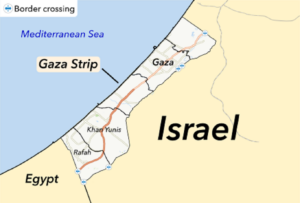
As Israel justifiably seeks to crush Hamas in the aftermath of the terrorist group's horrific attack on October 7, Palestinian civilians in the Gaza Strip are caught in the crossfire. Most of the blame for this rests with Hamas itself, as their fighters use the civilian population as human shields, and do not wear identifying uniforms (the latter is one of Hamas's many violations of the laws and customs of war). But, regardless of whose fault it is, innocent civilians will continue to suffer and die as the conflict intensifies.
If given the opportunity, many Gaza civilians would likely flee abroad to escape the fighting, as have numerous civilians caught up in other recent wars, such as those in Syria, Ukraine, and elsewhere. Letting them do so is both a moral imperative, and a way to help Israel defeat Hamas.
But the Egyptian government and other Arab states are blocking refugees from fleeing Gaza. Even as they shed crocodile tears for the plight of Palestinians, they refuse to let them leave a dangerous war zone. And to the extent they - and Western backers of the Palestinian cause - really believe the oft-heard claim that Gaza is an "open air prison," there is a strong moral imperative to let the unjustly confined "prisoners" leave, if they want to. Even aside from the current war, many might prefer not to live in poverty and oppression under Hamas's brutal medieval theocracy.
Egypt is one of the biggest recipients of US military assistance and other foreign aid. That funding can be used as leverage to force the authoritarian regime of President Abdel Fattah el-Sissi to reverse its cruel policy.
There is an obvious moral case for doing so. Many innocent civilians are threatened with death or injury, and in addition are ruled by a deeply oppressive regime. Letting those who want to escape is a way to help them escape injustice. Blocking them from doing so by force (as Egypt has been doing) is a grave wrong.
The most obvious response to the moral case for opening the door to Gaza Palestinian refugees is the idea that they don't deserve refuge because they bear responsibility for Hamas and its depredations. If they didn't support Hamas, there would be no terrorism, and no war.
But, just as most ordinary Russians are not responsible for the evils of Vladimir Putin's regime and its war on Ukraine, so most ordinary Gazans aren't responsible for Hamas. Like Putin's Russia, Gaza under Hamas is an authoritarian regime that brutally represses dissent.
It is true that Hamas won a plurality in a legislative election in 2006. But it then seized executive power by force, and has not held any even remotely free elections since. A large majority of current Gaza Palestinians never had a meaningful chance to influence Hamas's policies, much less remove it from power. Almost half of Gaza's population consists of children under the age of 18; many others were too young to participate in the 2006 election. You don't have to be a political theorist to recognize that children are not morally responsible for the evil policies of the government that rules over them.
It is true that some significant percentage of adult Gazans do support Hamas, its awful ideology, and its terrorism. But many others do not. A July 2023 poll conducted by the Washington Institute for Near East Policy found that 62% of Gaza Palestinians wanted to maintain a ceasefire with Israel, and 50% agreed that "Hamas should stop calling for Israel's destruction, and instead accept a permanent two-state solution based on the 1967 borders." A large majority also said they preferred Palestinian Authority rule to Hamas.
Polls conducted in areas ruled by repressive regimes should be viewed with caution. But, if anything, this one may underestimate the true extent of opposition to Hamas policies. Some respondents might have been afraid to express views inimical to Gaza's rulers, for fear the latter would find out about it and punish them. Even if the pollster was completely independent (as this one was) and would keep answers confidential, wary respondents might not believe such assurances or at least not be willing to take the risk they might be false.
Even some of those who do not support Hamas may hold abhorrent views on other issues, including anti-Semitic sentiments of a kind all too common in the Arab world. But people should not be forcibly condemned to tyranny and death in war merely because they may have some awful views - especially if they have them in large part because of ubiquitous, difficult-to-avoid indoctrination. And, even more obviously, such things should not be held against the large part of the population that consists of children.
Arab rulers who refuse to take Gaza refugees claim they do so because it would undermine the cause of Palestinian statehood, and the Israelis might not allow them to return to Gaza. In reality, Israel has little interest in annexing Gaza or settling Israel Jews there. Whatever can be said of the West Bank, even most Israeli right-wingers do not want to keep Gaza. For that reason, Israel also has little reason to keep refugees from returning. This line of argument also ignores the fact that the Palestinian leadership could have long since had a state including all of Gaza and nearly all of the West Bank if they had accepted the offers extended to them by Israel and the US in 2000, 2001, and 2008.
In addition, it is wrong to forcibly compel people - including large numbers of children - to endure war and repression merely to support a nationalistic project. If this is what the Palestinian "cause" requires, it's a strong indication that cause is at odds with the rights and interests of actual Palestinians. Those who would prefer to seek a better life elsewhere should be allowed to do so.
In other contexts, hardly anyone says that refugees should be barred from fleeing war and oppression in order to bolster the cause of their nation. While Vladimir Putin's efforts to conquer Ukraine and annex large parts of it are illegal and unjust, virtually no one argues that Ukrainian refugees must therefore be blocked from fleeing in order to oppose Russia's claims. It would be absurd to contend that helping Ukrainians flee Russian invasion and oppression is somehow anti-Ukrainian by making it easier for Putin to hold on to the regions he claims, and few if any observers advance such arguments. Indeed, it would be a grave wrong to prevent Ukrainians from fleeing, which is one of the reasons why the US, Canada, and European nations have opened their doors to Ukrainian refugees.
Western nations would also do well to open their doors to Gaza refugees, in addition to pressuring Arab states on this point. Refugees willing to go there would surely have greater freedom and opportunity in the West than in poor and authoritarian Arab states.
The standard argument against this - deployed by GOP politicians in the US - is that Palestinian refugees pose a security threat. But any such danger is overblown. Cato Institute immigration policy expert Alex Nowrasteh has compiled a database of terrorism incidents involving immigrants to the US from 1975 to 2022. During that entire period, Palestinian migrants killed a total of three people in terrorist attacks on US soil. While it's difficult to make precisely accurate rate calculations with such a small number, that amounts to a per-migrant risk not much greater than that posed by native-born Americans. Another way of looking at this issue is that the average American faces a vastly greater annual risk of being killed by a lightning strike than by a Palestinian immigrant terrorist (about 28 Americans are killed by lighting annually). And that would still be true even if the danger from the latter were several times greater than it is now. And, of course, the period in question includes many confrontations between Israelis and Palestinians that one might expect to incite violence by would-be terrorists.
Moreover, Hamas has instructed Palestinians to stay put. Those who defy Hamas' orders are likely to be disproportionately those least supportive of its awful ideology, and least likely to engage in acts of terrorism inspired by it.
In addition to the moral imperative, there is also a strategic rationale for letting Palestinians who wish to flee Gaza do so. Reducing the number of civilians present during the fighting will also reduce Hamas's opportunities to use them as human shields. That factor is likely one of the reasons why Hamas wants them to stay, and has installed roadblocks to impede flight (they also generally don't want to reduce the number of people under their control).
Letting refugees flee would save innocent lives, protect human rights, and help Israel defeat Hamas faster. It's a win-win for anyone who support human rights and wants to see Hamas defeated.
Episode 478 of the Cyberlaw Podcast
This episode of the Cyberlaw Podcast begins with the administration's aggressive new rules on chip exports to China. Practically every aspect of the rules it announced just eight months ago was sharply tightened, Nate Jones reports. The changes are so severe, I suggest, that they make the original rules look like a failure that had to be overhauled to work.
Much the same could be said about the Biden administration's plan for an executive order on AI regulation that Chessie Lockhart thinks will focus on government purchases. As a symbolic expression of best AI practice, procurement-focused rules make symbolic sense. But given the current government market for AI, it's hard to see them having much bite. So look for more in the way of teeth down the road as the regulatory process again fails forward.
If it's regulatory bite you want, Nate says, the EU has now sketched out what appears to be version 3.0 of its AI Act. It doesn't look all that much like Versions 1.0 or 2.0, but it's sure to take the world by storm, fans of the Brussels Effect tell us. I note that the new version includes plans for fee-driven enforcement and suggest that the scope of the rules is already being tailored to ensure fee revenue from popular but not especially risky AI models.
Jane Bambauer offers a kind review of Marc Andreessen's "'Techno-Optimist Manifesto". We both end up agreeing more than we disagree with Marc's arguments, if not his bombast -- a style that I suspect owes much to extreme mountaineering.
Chessie reveals the Achilles heel of a growing state movement to require that registered data brokers delete personal data on request. It turns out that a lot of the data brokers, just aren't registering.
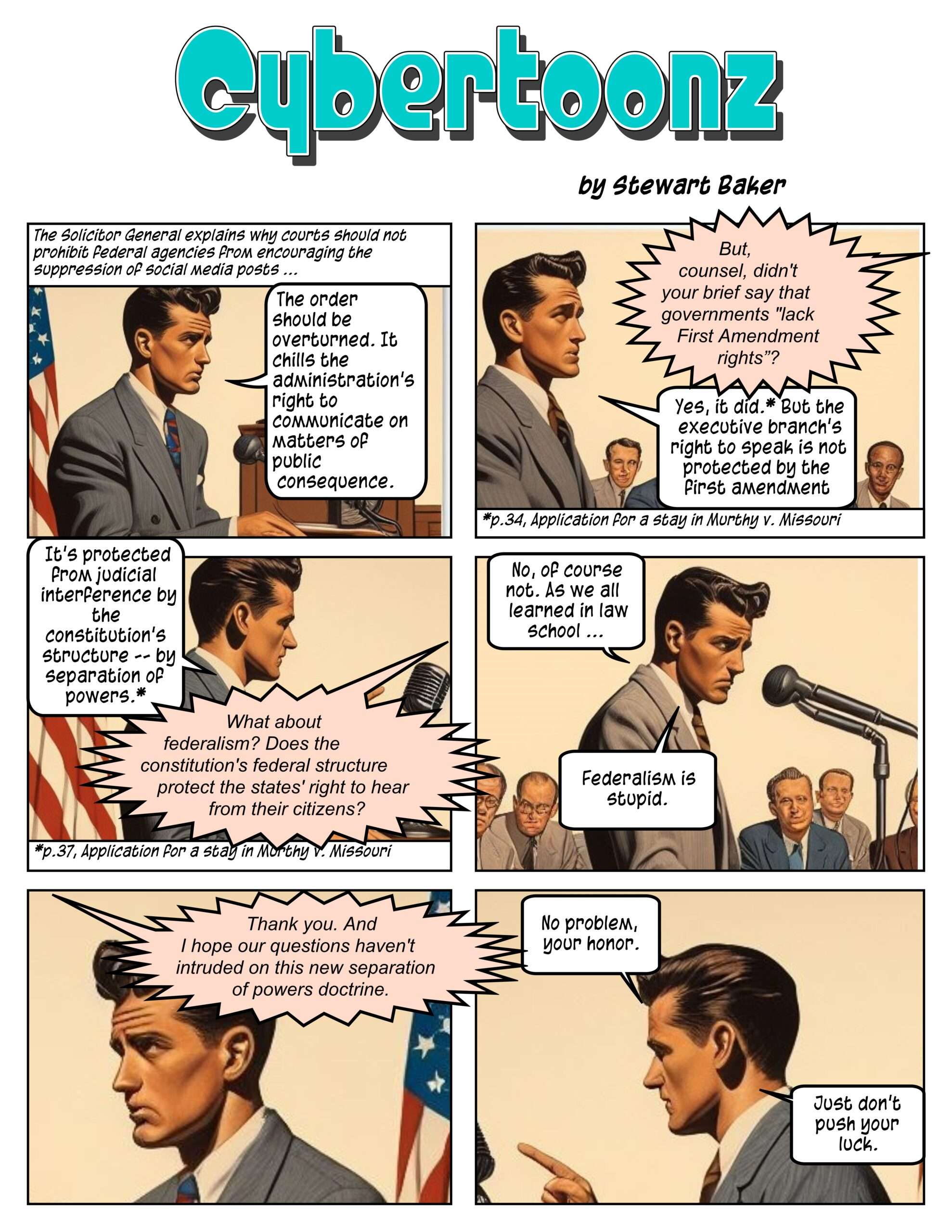
The Supreme Court, moving with surprising speed at the Solicitor General's behest, has granted cert and a stay in the social media jawboning case, which was brought by Missouri among other states to stop federal agencies from demanding that social media suppress speech the federal government disagrees with. I note that the SG's desperation to win this case has led it to make surprisingly creative arguments, as illustrated in yet another Cybertoonz explainer.
Social media's loss of public esteem may be showing up in judicial decisions. Jane reports on a California decision allowing a negligence lawsuit to go forward against kids' social media for marketing an addictive product. I'm happier than Jane to see that the bloom is off the section 230 rose, but we agree that suing companies for making their product's too attractive may run into a few pitfalls on the way to judgment. Listeners who don't remember the Reagan administration may benefit from my short history of the California judge who wrote the opinion.
And speaking of tort liability for tech products, Chessie tells us that Chinny Sharma, another Cyberlaw podcast stalwart, has an article in Lawfare confessing some fondness for products liability (as opposed to negligence) lawsuits for cybersecurity failures.
Chessie also breaks down a Colorado Supreme Court decision approving a keyword search for an arson-murder suspect. Although played as a win for keyword searches in the press, it's actually a loss. The search results were deemed admissible only because the government's good faith excused what the court considered its lack of probable cause. I award EFF the "sore winner" award for its whiny screed complaining that, while the court handed EFF a victory on the impropriety of the search, the court didn't also give a get-out-of-jail-free card to the scumbags accused of burning five people to death.
Finally, Nate and I explain why the Cybersecurity and Infrastructure Security Agency shouldn't expect Congress to pass what used to be a yearly batch of routine small-ball cyber bills. CISA overplayed its hand in the misinformation wars over the 2020 election, going so far as to consider curbs on "malinformation" – information that is true but inconvenient for the government. This has led a lot of conservatives to look for reasons to cut CISA's budget. Sen. Rand Paul (R-KY) gets special billing.
You can subscribe to The Cyberlaw Podcast using iTunes, Google Play, Spotify, Pocket Casts, or our RSS feed. As always, The Cyberlaw Podcast is open to feedback. Be sure to engage with @stewartbaker on Twitter. Send your questions, comments, and suggestions for topics or interviewees to CyberlawPodcast@gmail.com. Remember: If your suggested guest appears on the show, we will send you a highly coveted Cyberlaw Podcast mug! The views expressed in this podcast are those of the speakers and do not reflect the opinions of their institutions, clients, friends, families, or pets.
10/24/1894: U.S. v. E.C. Knight argued.

What's on your mind?
They later issued a "sorry if you were offended" non-apology, and so far the university seems satisfied with that.
Resident advisors are upper-class college students who live in the dorms. In return for free housing and a stipend, Wellesley RAs "collaborate to create a vital and engaged residential community. Resident Assistants aim to foster a spirit of generosity and civic engagement within their community. Together, the residential team provides programs and services that support the mission, vision, and values of the Office of Residential Life and Housing and the Wellesley College community, with the goal of creating a transformative living environment." In short, RAs are not just students but also College employees, and one of their main responsibilities is to foster a comfortable, welcoming community environment for all students. And yet, RA staff at one hall sent the following out a few days ago, reprinted here courtesy of my friend Jake Novak, who first reported it on Twitter:
Hello all, As of October 18th, 2023, the Palestinian-Israeli war has cost the lives of some 3,478 Palestinians and wounded 12,000. Israel's apartheid against Palestinians, characterized by the displacement of 600,000 individuals, the dissemination of genocidal rhetoric by the Israeli government, and the illegal occupation of native Palestinian lands, have left our hearts heavy. With all historical, political, and territorial aspects considered, Israel's zionist government needs to be condemned. Furthermore, individuals who endorse the forced removal of Palestinians should be recognized as supporters of colonization. Munger Hall stands in strong condemnation of Israel's actions and those who have supported their actions against Palestinians. We firmly believe that there should be no space, no consideration, and no support for Zionism within the Wellesley College community. In accordance with these beliefs, we plan on donating to a reputable organization that provides aid to the children and families whose lives have been destroyed. We will vote for the amount and organization in a future HoCo meeting. While Munger res staff want to support and make space for you through this devastating time, we also recognize that we may not be fully equipped to do so in the way each individual needs. Therefore, we'd like to point you to The Stone Center and The Office of Religious and Spiritual Life (ORSL) that may be able to help. ORSL is currently putting together processing spaces specifically for this issue, they may send an email soon regarding that. We care about each and every one of you, and please feel free to reach out with any ideas of how we can best support you during these difficult times.
Thank you, Munger Res Staff
--Moi Nee she/her Class of 2024
Note both the implicit dehumanization of Israelis and Jews, as the initial massacre isn't mentioned at all, and the highlighted sentence, suggesting that Zionism, the basic meaning of which is that Israel should exist, should be extirpated from Wellesley. To say the least, to write such a position is not just morally repugnant, but more pertinently is totally contrary to the role of resident advisors in making all students feel welcome. This is especially true, of course, of Jewish students, the vast majority of whom are "Zionists," and for many of whom this is an important part of their identity. Let's recall, these are not just students expressing an opinion, these are student employees of the college, who wrote this email in their capacity as employees.
The president of Wellesley, Paula Johnson, later sent an email to the Wellesley community, the salient part of which is this:
It recently came to my attention that a small number of student residence hall leaders from one dormitory sent a letter to their housemates in their capacity as resident assistants that expressed views on the Israel-Hamas conflict. Our Student Life team met with these students and talked about their role and responsibility to support all students. They have since sent an apology to all students in the residence hall. That these young leaders were able to learn from this episode gives me hope.
That *might* be adequate if the students had actually expressed true remorse, and showed that understood why this email was problematic beyond the fact that they shouldn't be issuing policy statements as RAs. Instead, they issued a non-apology apology, of the "we're sorry you were offended" variety (see below, again with credit to Jake Novak's reporting).
This is a totally unacceptable response from President Johnson, and leaves Wellesley wide open to a Title VI complaint or lawsuit. Indeed, if I can find the time, I will personally file the former. Read More
From Friday's opinion by Judge Daniel D. Domenico (D. Colo.) in Darren Patterson Christian Academy v. Roy (for more on a different facet of the case and on the possible relevance, or not, of government funding, see this post):
"[T]he First Amendment protects an individual's right to speak his mind regardless of whether the government considers his speech sensible and well intentioned or deeply misguided and likely to cause anguish or incalculable grief. 303 Creative, LLC v. Elenis (2023). "Generally, too, the government may not compel a person to speak its own preferred messages." Indeed, the Court held in 303 Creative that Colorado could not compel a wedding-website designer to create websites that did not discriminate on bases similar to those at issue in this case.
In an even more on-point case, the Sixth Circuit held that a public university's requirement that professors use a student's preferred pronouns in the classroom amounted to a Free Speech violation. Meriwether v. Hartop (6th Cir. 2021). That case involved a professor plaintiff at a public university who declined to use a student's preferred pronouns, instead seeking to refer to that student in name only while referring to other students with pronouns corresponding to their biological sex. That plaintiff faced even more obstacles than Plaintiff would here in proving a Free Speech claim given the various doctrines limiting the ability of public-school teachers to bring First Amendment claims. Even still, the Sixth Circuit held that compelling such speech violated the professor's free-speech free exercise rights. [The words "free exercise" seem to have been erroneously included here by the court. -EV]
The Ninth Circuit has also arrived at a similar conclusion in a related context. They held that an Oregon anti-discrimination law requiring a "natural-born-female-only" beauty pageant to allow transgender contestants violated the pageant's expressive free-speech rights. Green v. Miss United States of Am., LLC (9th Cir. 2022). As the Ninth Circuit noted, this accorded with its "long-standing hesitation to enforce anti-discrimination statutes in the speech context."
Long-time readers will recall that I am a vociferous critic of Human Rights Watch. HRW purports to be a neutral human rights organization, but consistently hires staffers with a history of anti-Israel, pro-Palestinian activism to write and report on the Israel-Palestinian conflict. So how did HRW do after the Oct. 7 massacre and brutalization of Israelis? Perhaps even HRW would find it necessary to issue an immediate, strong condemnation? After all, everything about Hamas murderous rampage violated international law.
Nope. Checking HRW's website, I recount below how it responded, chronologically. Note that it took two days for HRW to say anything about Hamas's actions on 10/7, and even then HRW couldn't spare a single post on Hamas that also did not also address Israel's "obligations." HRW does pay lip service to Hamas's brutality, but only in the context of its primary function, which is as a propaganda outlet for the Palestinian side.
October 9, 2023 Q & A
Questions and Answers: October 2023 Hostilities between Israel and Palestinian Armed Groups
October 9, 2023 News Release
Israel/Palestine: Devastating Civilian Toll as Parties Flout Legal Obligations
Respect International Law, End Impunity to Deter Further Abuses
October 10, 2023 Dispatches
Hamas-Led Attack in Southern Israel Kills Hundreds
All Parties to Conflict Must Abide by Laws of War
October 11, 2023 Commentary
Real or Fake? Verifying Video Evidence in Israel and Palestine
How HRW's Digital Investigations Team is Working to Build Evidence
October 11, 2023 Commentary
With Gaza Sealed Off, Palestinians Face Aid Freezes Too
Amid Humanitarian Crisis, Cutting Off Vital Lifeline Would Be Damaging
October 12, 2023 News Release
Israel: White Phosphorus Used in Gaza, Lebanon
Use in Populated Areas Poses Grave Risks to Civilians
October 12, 2023 Q & A
Questions and Answers on Israel's Use of White Phosphorus in Gaza and Lebanon
October 13, 2023 Commentary
Amid Israel/Palestine Hostilities, Brazil Should Press to Respect International Law
In Hosanna-Tabor v. EEOC (2012), the Supreme Court unanimously held that religious institutions have the constitutional right to freedom in selecting their clergy and religious teachers, notwithstanding federal or state antidiscrimination law. In Our Lady of Guadalupe School v. Morrisey-Berru (2020), the Court held (by a 7-2 vote) that this principle applies broadly as to all teachers whose job includes, even in part, "educating their students in the faith."
But does this also apply when the institution gets government funds, to which a nondiscrimination condition is attached? The question is complex, because analogies to other constitutional rules yield mixed results.
For instance, in the era when the Court recognized a constitutional right to abortion, it nonetheless upheld rules that say that abortions can't be performed on government property (even when they are done by a private physician who has privileges at the hospital). Likewise, Christian Legal Society v. Martinez (2010) upheld a rule that required student groups at public universities, as a condition of access to certain public funding and other public resources, accept all applicants as members or officers.
On the other hand, some of the Court's leading Free Exercise Clause cases, such as Sherbert v. Verner (1963), held that religious freedom rights do apply within government benefits programs (such as unemployment compensation systems). And the Court has held that the First Amendment bars public universities and other government entities that create generally accessible benefit programs from excluding based on the viewpoints that participants seek to express.
Friday's decision by Judge Daniel D. Domenico (D. Colo.) in Darren Patterson Christian Academy v. Roy addresses this issue, and says that religious schools likely do maintain this right to select their religious teachers, even when they are funded by a generally available school choice program:
10/23/1991: Justice Clarence Thomas takes oath.
The effort by Missouri to enjoin the Biden administration's "jawboning" of social media companies has reached the Supreme Court. The Solicitor General filed a long brief seeking a stay of the Fifth Circuit's injunction and explaining why cert should be granted. The Court granted cert and the stay (the latter over three dissents).
The SG's brief was remarkable for its innovative approach to the legal issues in the case, first proclaiming that states like Missouri have no first amendment right to hear from their citizens and then having to resurrect something very like a first amendment right for the federal government to speak to its citizens. Confused? Never fear. Where technology leads lawyers and policymakers to new heights of absurdity, Cybertoonz will be there to explain it all.
Forthcoming in the Texas Review of Law & Politics circa March 2024.
Seth Barrett Tillman and I have posted to SSRN an updated version of our article, Sweeping and Forcing the President into Section 3. It will be published in the Texas Review of Law & Politics circa March 2024.
It's not just antisemitism, it's a Manichean worldview that assigns moral worth based on whether a group is identified as "oppressors" or the "oppressed"
Recent events have been clarifying for many of us. While many left-wing Jews have grasped that they wound up political bedfellows with people who at best downplay and at worst celebrate massacring, torturing, raping, and kidnapping several thousand innocent civilians, from babies to the elderly, even those distinctly not on the left have had some epiphanies. This includes me.
Recall my post on October 9: "There has been too much pointless debate over whether those who call for Israel's destruction are necessarily antisemitic. The important point is that such people know that the end of Israel most likely means genocide for 7.5 million Israeli Jews, and they are okay with that." But why? As I noted, antisemitism is only a partial explanation: "Most antisemites aren't full-on Nazis, and as much as they dislike Jews would object to mass murder (just like most people who have racist opinions of black people would object to mass murder.)"
Moreover, some of those exhibiting indifference or much worse to the fate of Israeli Jews, on Oct. 7 or otherwise, have Jewish partners, Jewish friends, or are even Jewish themselves, and don't otherwise exhibit hostility to Jews, and would reject various antisemitic notions if put before them.
So what I have come up with is that these folks have imbibed and adopted a version of anti-racist, anti-colonial theory that divides the world into two classes by group: the oppressors and the oppressed. The oppressors, in this worldview, are permitted nothing in their battles with the oppressed. Because they are oppressors, they have no right to self-defense, no right not to have their children slaughtered, their women raped, and so on, if it's done by the oppressed, in particular if done in the name of anti-colonial resistance. Members of the oppressor class, regardless of age, regardless of individual attributes, are innately guilty, and thus none can claim innocence.
The oppressed are the opposite. Members of this group are, by definition, innocent. Nothing they do to oppressors, no matter how morally depraved it might seem to normies, is blameworthy. Each side is just acting out the historical struggle of liberation of the oppressed vs. the oppressors.
Grasping this has led me to understand, for example, various interactions I've had over the years with those, most famously Glenn Greenwald, who condemn any Israeli actions in self-defense against Hamas, but consistently decline to state what actions *would* be permissible. The answer, though they won't say so publicly because they usually are purporting to rely on international law, rather than ideology, is that nothing is permitted to the oppressor (Israel), nothing is forbidden to the oppressed (Palestinians).
Of course, this does not explain how Israelis came to be "the oppressor," given that Israeli in this context effectively means "Israeli Jews," and almost every Israeli Jew is no more than two generations away from an attempt by their government in Europe, the Middle East, or Africa to murder or expel them. A very good part of the how Israelis came not just "the oppressor," but perhaps, in competition with the United States, THE great representative of the oppressor is a product of antisemitism, and in particular antisemitism spread by the USSR from the 1960s to the 1980s and absorbed into Western post-colonial theory.
Anyway, once we understand the underlying theory far left "antizionists" have, we can also understand how morally depraved it is. Israeli babies are guilty, because they are members of the oppressor class. Medieval Hamas theocratic butchers are innocent, no matter how many babies they murder. You may occasionally puzzle over leftist "Queers for Palestine" marching on behalf of people who would kill them on sight. Post-colonial theory, like other forms of fanatical belief, is impervious to reason, common sense, or common decency.
UPDATE: This also explains the desperate pleas of Jewish progressives over the last few years to persuade their comrades that Israelis and/or Jews in general aren't white. If you're not white, you're presumptively not the oppressor. This has been a largely unsuccessful gambit. In any event, while this may get to part of the antisemitism issue, it doesn't get to the root of the problem, which is that assigning people moral worth and agency based on whether they belong to a broad ideologically contoured "class" is abhorrent and inevitably leads to defending atrocities.
10/22/1915: Hadacheck v. Sebastian argued.
"Free speech is really getting out of control," one panelist asserts
Wednesday night I spoke on a panel about 303 Creative v. Elenis, which upheld the free-speech right of a graphic designer to decline requests to create same-sex wedding websites. I had previously discussed the decision on a panel at UConn Law School, with Professor Katherine Franke (Columbia), Professor Craig Konnoth (UVA), and Ria Tabacco Mar of the ACLU.
This time around it was at Hamilton College in New York as part of the school's "Common Ground" series, which seeks to bring speakers with diverse perspectives together to discuss controversial issues in a civil way. The panel featured super smart and fully prepared critics of the decision: former state solicitor general Eric Olson (who gamely defended Colorado at oral argument), and Southwestern Law School professor Hila Keren. The moderator was Greenberg Taurig partner Mike Grygiel, who specializes in First Amendment and media law.
As you can see in the video, there were a few slivers of common ground surrounded by quite a bit of passionate but respectful disagreement. As the panel began, a group of students silently unfurled a banner proclaiming, "My Rights Are Not A Debate." There were no disruptions.
The discussion lasted an hour-and-a-half but it really gets going around the 40:00 minute mark. Overall, it was more substantive than most panels I've participated in, even at law schools.
I'll add one more thing: I was amazed at the level of sophistication and engagement of the students at Hamilton College. The perceptiveness of their questions was remarkable (student questions start about the 1:15:00 mark). What's more, a large group of students stuck around for even more thoughtful discussion off-camera for about an hour—until we were expelled by maintenance personnel. I've rarely encountered law students at one of these kinds of events as genuinely curious and open to new ideas as these undergraduates were. Bravo to Hamilton for whatever it is doing to select students and fuel their intellectual fires.
Celebrate your independence with a subscription to Reason magazine, your most trusted source of honest, insightful news and analysis.




