The Volokh Conspiracy

Mostly law professors | Sometimes contrarian | Often libertarian | Always independent | Est. 2002

The Volokh Conspiracy

Immigration

My New USA Today Article on How Biden Can Ease Border Problems by More Fully Implementing His Own Plans to Make Legal Immigration Easier

The article is coauthored with David Bier of the Cato Institute.

|

USA Today has published my article (coauthored with Cato Institute immigration policy expert David Bier) on how Biden's border problems can be alleviated by expanding and more fully implementing the Administration's own plans to make legal migration easier:

In response to high border crossings, President Joe Biden and Democrats in Congress appear ready to at least partially cave to demands to restrict asylum in negotiations on the contours of an ongoing deal.

This would be a grave mistake. It would hurt asylum-seekers but won't stop illegal migration. Biden already has the right plan for the border. He just hasn't fully implemented it.

The best way to reduce pressure on the border from illegal migration is to make legal entry easier, and Biden's 2023 immigration agenda included many of the necessary measures. Unfortunately, he hasn't made them available widely enough, and this failure is leading to people entering illegally…..

The primary initiative is parole sponsorship, under which immigrants sponsored by Americans could receive authorization to enter legally straight from their home country and live and work in the United States for at least two years….

Biden's plan achieved great initial success, simultaneously helping many thousands of people escape violence and repression and reducing disorder at the border…..

Even so, further progress was stymied because parole sponsorship was limited to migrants from just five countries: Ukraine, Cuba, Haiti, Nicaragua and Venezuela. Participation from the Latin American nations (the "CHNV" countries) is capped at just 30,000 migrants a month from all four countries combined….

The backup option – applying for legal entry at the U.S.-Mexico border using the CBP One phone app – might have mitigated the fallout. But arbitrary caps and flawed agency procedures have ruined this option as well. Appointments are capped at 1,450 a day – though there were nearly 9,000 daily migrant encounters in September…..

The combination of horrific poverty and oppression in their home countries and labor shortages in the United States lead people seeking opportunity and freedom to enter illegally if there is no other way to do so…..

It's the same dynamic by which alcohol prohibition led people to illegally obtain smuggled booze from the likes of Al Capone. Barring legal markets in much-wanted goods or services predictably creates vast black markets to which millions of people seek access. When Prohibition was abolished, alcohol smuggling and associated organized crime greatly diminished. Legalizing migration would have similar effects on the black market in immigration….

Expanding legal migration would also save more people from violence, poverty and oppression – and bolster the U.S. economy. Immigrants disproportionately contribute to American innovation and entrepreneurship, thereby greatly enhancing economic freedom, wealth and opportunity for native-born Americans as well…..

Biden should order the agencies to eliminate the arbitrary country limitations and numerical caps on parole sponsorship and CBP One. He should also allow migrants to book CBP appointments in their home countries many weeks in advance.

These options would eliminate the vast majority of illegal immigration, restoring order to a chaotic border.

Biden shouldn't give up on his policies and give in to the demands from the other side. He has already implemented severe asylum restrictions for those who cross illegally, and illegal migration is as high as ever.

Now there are just more people here with no path to legalize their status….

Biden has already laid out a better path forward than imitating Trump. It is time to start following it.
Free Speech

Don't Ask a Judge to Rule for You and Then Send Him a Death Threat

"Cut your backwards ass bullshit or you will start losing family members and the President of the United States will wind up dead!"

|

From Sovereignty Joeseph Helmueller Sovereign Freeman v. Anderson, decided Wednesday by Seventh Circuit Judges Frank Easterbrook, Michael Brennan, and Thomas L. Kirsch:

Dismissal of a lawsuit, although a severe sanction, is sometimes warranted. The district court properly dismissed this suit filed by Sovereignty Joeseph Helmueller Sovereign Freeman as a sanction for sending death threats to the court. We thus affirm.

In this case, Helmueller sued officers and medical providers under 42 U.S.C. § 1983. He alleges that, while he was a pre-trial detainee at St. Croix County Jail in Wisconsin, officers attacked him, broke his shoulder, and ignored his requests for medical treatment. Helmueller was later transported to a medical center where, he continues, staff ignored his request to treat his shoulder injury; instead they restrained and medicated him without his consent.

The lawsuit did not last long. After an assistant attorney general filed a notice of appearance on behalf of the officers, Helmueller objected to the attorney's involvement in the case. In doing so, he threatened the judge and the President in writing:

Plaintiff demands the court show cause for Defendants representation by the WI Atty General and or the WI Dept of Justice. The Defendants have no right to be represented by the WI Attorney General or the WI Dept of Justice in this matter. Cut your backwards ass bullshit or you will start losing family members and the President of the United States will wind up dead! Stop playing games I demand justice not tyranny. Sec 1983 says "shall be liable" stop protecting those who violated the law and my rights.

Read More

Politics

Volokh Conspiracy Holiday Gifts - 2023

Gift ideas for the VC readers in your life!

|

NA

It's Black Friday, and the holiday season is now upon us! If you are looking for possible gifts for the loyal Volokh Conspiracy readers in your life, what could better than books by VC bloggers?

The most recent VC book is David Bernstein's Classified: The Untold Story of Racial Classification in America. It's an indispensable overview of the history and evolution of the use of racial classifications in the modern US.

VC-ers also published two other books in 2021 and 2022: Randy Barnett's The Original Meaning of the Fourteenth Amendment: Its Letter and Spirit (2021) (coauthored with Evan Bernick) and the revised edition of my own Free to Move: Foot Voting, Migration, and Political Freedom  (2022). Barnett and Bernick's book is a major contribution to our understanding of what many consider the single most important amendment to the Constitution. It has already begun to reshape our understanding of the Fourteenth Amendment.

Jonathan Adler's edited volume Marijuana Federalism was published in 2020. It has everything you ever wanted to know about the relationship between federalism and pot, and includes contributions by leading scholars in several different disciplines.

Free to Move (currently available for just $6 on Amazon) makes the case for expanding opportunities for people to "vote with their feet" in federal systems, the private sector, and through international migration. I describe key advantages of foot voting over conventional ballot box voting, and explain how breaking down barriers to foot voting can massively increase freedom and opportunity for millions of people around the world. The revised edition addresses several new issues, including arguments that migration must be constrained to prevent the spread of  dangerous diseases such as Covid-19, claims that immigrants might generate a political backlash that threatens democracy, and the impact of remote work on foot voting. As with the original edition, I am donating 50% of all royalties from the book to charities benefiting refugees, who - sadly - are in more need than ever in this difficult time in world history.

Among my other favorite books by VC authors are Randy Barnett's Restoring the Lost Constitution, David Bernstein's Rehabilitating Lochner, Dale Carpenter, Flagrant Conduct: The Story of Lawrence v. Texas, Jonathan Adler's Business and the Roberts Court, Josh Blackman's Unprecedented and Unraveled, Eugene Volokh, Academic Legal Writing, and Keith Whittington, Repugnant Laws: Judicial Review of Acts of Congress from the Founding to the Present. 

Randy's book is one of the best recent works on originalism and constitutional legitimacy. It is relevant to ongoing debates over legal interpretation that are sure to heat up again as the Supreme Court considers several major cases in the near future. Rehabilitating Lochner explodes numerous myths about one of the Court's most reviled decisions, one that remains relevant to current debates over "judicial activism." Flagrant Conduct is a great account of a milestone in the history of gay rights. It provides useful historical context for the still-ongoing battles over same-sex marriage and related issues. Repugnant Laws is the best survey of how the courts have constrained (and more often failed to constrain) federal power during our history. It's actually just one of several Keith Whittington books that are must-reads for any serious student of judicial review.

Jonathan Adler's edited volume is an excellent guide to the issue of whether the Supreme Court favors business interests, and how we might assess claims that it has a pro-business bias. Josh Blackman's two books provide valuable blow-by-blow accounts of the extensive litigation generated by the Affordable Care Act. Finally, Academic Legal Writing is filled with useful advice, while also somehow managing to make this generally unexciting topic interesting.

The Cambridge Handbook of Classical Liberal Thought (edited by Todd Henderson), includes chapters by three different VC bloggers: Jonathan Adler on environmental policy, David Bernstein on anti-discrimination law, and my own contribution on "voting with your feet."

This list is not intended to slight important books by Ken Anderson, Sam Bray, Orin Kerr, David Kopel, David Post, and other VC bloggers. I have not discussed them only because their subjects are distant from my own areas of expertise.

In the spirit of shameless self-promotion, I will also mention the expanded second edition of my own book Democracy and Political Ignorance: Why Smaller Government is Smarter. My most recent book before Free to Move was Eminent Domain: A Comparative Perspective, co-edited with Iljoong Kim and Hojun Lee. It analyzes the use and abuse of eminent domain in a variety of countries around the world.

My other books include The Grasping Hand: Kelo v. City of New London and the Limits of Eminent Domain, which is the first book by a legal scholar about one of the Supreme Court's most controversial modern decisions, and A Conspiracy Against Obamacare: The Volokh Conspiracy and the Health Care Case (coauthored with VC-ers Randy Barnett, Jonathan Adler, David Bernstein, Orin Kerr, and David Kopel). Conspiracy Against Obamacare focuses on the VC's significant role in the Obamacare litigation, and is the only book that includes contributions by six different VC bloggers. In 2016, the University of Chicago Press published an updated paperback edition of the The Grasping Hand.

I wish all our readers a happy holiday season!


Federalism

New Edition of "Freedom in the Fifty States"

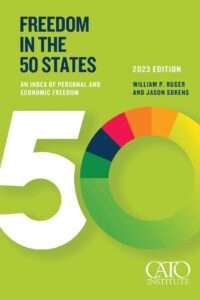
The Cato Institute recently published the latest edition of its ranking of personal, economic, and overall freedom in the states.

|

Cato Institute.

The Cato Institute has recently published the latest edition of the excellent Freedom in the Fifty States, its ranking of state and local policies on economic and personal freedom, authored by political scientists William Ruger and Jason Sorens. Variations in state policy on these issues have major impacts on human freedom and welfare, and also on interstate migration patterns. These rankings are of obvious interest to libertarians; but they are also useful to social scientists and policy analysts with a wide range of views. The book includes a wealth of data on a variety of state policies affecting freedom, as well as overall rankings of state policy, rankings of economic and personal freedom considered separately, and rankings based on a range of subcategories.

Here are the top 10 states, ranked on the combined index of overall freedom (with personal freedom, and two components of economic freedom - fiscal and regulatory) each ranked equally as about 1/3 of the total):

1. New Hampshire 0.71
2. Florida 0.57
3. South Dakota 0.52
4. Nevada 0.51
5. Arizona 0.44
6. Tennessee 0.38
7. Michigan 0.31
8. Missouri 0.30
9. Georgia 0.28
10. Indiana 0.27

The libertarian-leaning purple state of New Hampshire has long ruled these rankings! Several other purple states (Nevada, Arizona, Michigan) also score well. But red states generally do better than blue states, in part because economic freedom variables are about two-thirds of the total score. However, five of the top ten states here voted for Biden in 2020, albeit three of them (Arizona, Michigan, and Georgia) by very small margins.

Blue states do much better on personal freedom, ranked separately:

1. Nevada 0.278
2. Arizona 0.247
3. Maine 0.231
4. New Hampshire 0.204
5. New Mexico 0.198
6. Vermont 0.187
7. Montana 0.147
8. Missouri 0.144
9. Massachusetts 0.138
10. West Virginia 0.128

The top six states here are all blue or purple. But red states Montana, Missouri, and West Virginia still score well. Seven of the top 10 states here voted for Biden in 2020. The bottom of the personal freedom ranking includes many red states, with Texas coming in dead last.

The economic freedom ranking is largely dominated by red and purple states:

1. New Hampshire 0.50
2. Florida 0.48
3. South Dakota 0.43
4. Tennessee 0.35
5. Georgia 0.24
6. Texas 0.24
7. Idaho 0.23
8. Nevada 0.23
9. Wyoming 0.23
10. Michigan 0.22

Four of the top ten states on this list voted for Biden in 2020. But they are all purple states, or perhaps light blue. The bottom of this list is dominated by deep blue states.

The 2023 edition includes a number of new policies and methodological changes, including more extensive inclusion of zoning and other land-use restrictions (an incredibly important set of issues), and state rankings on abortion policy, where great variation has arisen since the Supreme Court overruled Roe v. Wade last year. Because abortion is an issue that divides libertarians among themselves, the authors didn't include it in their main indices. However, the appendices include adjusted rankings that give various types of weights to abortion restrictions, including a pro-life ranking that views them favorably, and two pro-choice versions that give them varying degrees of negative weight.

Not surprisingly, red states look worse and blue states better on the pro-choice ranking models. Because of the fast-moving nature of developments on this issue, the rankings don't pick up some of the most recently enacted abortion restrictions, as they only capture the state of the law as of January 1, 2023.

There is much, much more in this book, including detailed discussions of each individual state, rankings on many specific freedom issues, and more.

Given the nature of the issues at stake, there is plenty of room for disagreement about the authors' choice of policies to focus on, and the relative weights assigned to each. The distinction between "economic" and "personal" freedom is also open to question. To my mind, most economic freedoms also have a personal component (in so far as they enable people to control their lives more fully). For example, private property rights enable people to exercise autonomy, find housing in places where they need it to find professional and educational opportunity, and so on.

"Personal" freedom also often has an economic dimension. Exercising these rights often requires commercial transactions. For example, there would not be much freedom of speech if the government banned payment for its production, or much in the way of abortion rights if the state barred paying medical personnel to perform them.

Despite such caveats, I think the authors generally do a good job of capturing important policy variables, and giving them reasonable weights. Those who disagree with their approach can use the data to assign different weights, or only consider those variables they consider important (e.g. - only economic freedom and not personal freedom, or vice versa).

There are a few policies I would have added, if given the chance. Most notably, "sanctuary city" and "sanctuary state" policies provide undocumented immigrants and those who employ them valuable protection against deportation. The migrants in question could still be detained and deported by federal officials; but the latter often find it difficult to do so without the assistance of much more numerous state and local law enforcement officers. The authors give positive weight to states' willingness to issue drivers' licenses to undocumented immigrants (under their "travel freedom" subcategory of personal freedom), but overlook this even more significant state and local immigration policy.

Despite such caveats, this book is an outstanding resource for anyone interested in freedom, federalism, and the interaction between the two!

NOTE: In addition to my position as a law professor at George Mason University, I am the Simon Chair in Constitutional Studies at Cato. But I have no involvement in the publication of this book.

AI in Court

90-Day Suspension of Colorado Lawyer Who Filed ChatGPT-Written Motion with Hallucinated Cases

Looks like the main problem wasn't the blind reliance, but the coverup.

|

From People v. Crabill, released yesterday:

The Presiding Disciplinary Judge approved the parties' stipulation to discipline and suspended Zachariah C. Crabill (attorney registration number 56783) for one year and one day, with ninety days to be served and the remainder to be stayed upon Crabill's successful completion of a two-year period of probation, with conditions. The suspension took effect November 22, 2023.

In April 2023, a client hired Crabill to prepare a motion to set aside judgment in the client's civil case. Crabill, who had never drafted such a motion before working on his client's matter, cited case law that he found through the artificial intelligence platform, ChatGPT. Crabill did not read the cases he found through ChatGPT or otherwise attempt to verify that the citations were accurate. In May 2023, Crabill filed the motion with the presiding court.

Before a hearing on the motion, Crabill discovered that the cases from ChatGPT were either incorrect or fictitious. But Crabill did not alert the court to the sham cases at the hearing. Nor did he withdraw the motion. When the judge expressed concerns about the accuracy of the cases, Crabill falsely attributed the mistakes to a legal intern. Six days after the hearing, Crabill filed an affidavit with the court, explaining that he used ChatGPT when he drafted the motion.

Read More

Law & Government

It's Not So Hard to Write an Opinion Following Bruen and Reversing in Rahimi

a contrary view to Josh's

|

Below, Josh argues that "an opinion reversing Rahimi will be tougher to write than most critics will admit" and also claims that "Rahimi was a faithful application of Bruen. Efforts to "clarify" Bruen are really an attempt to rewrite the precedent. I don't think anyone seriously doubts this premise."

With respect, I think that both of these claims are wrong, for reasons that Professor Robert Leider and I gave in our essay, The General Law Right to Bear Arms. An opinion that faithfully applies Bruen and reverses the Fifth Circuit in Rahimi is not hard to write. It has two major steps.

First, the Court will point out that Bruen called for a particular kind of originalist approach, one where the Constitution's "meaning is fixed according to the understandings of those who ratified it," but it "can, and must, apply to circumstances beyond those the Founders specifically anticipated." In particular, this approach calls for the judges to enforce historically-recognized principles about when the right to keep and bear arms can be regulated. This is what Bruen is referring to when it talks about lawyerly "analogical reasoning" which focuses on "how and why" past regulations burdened the right -- analogical reasoning that is "neither a regulatory straightjacket nor a regulatory blank check."

Second, the Court will likely conclude that one such historical principle -- as then-Judge Barrett has already argued in detail -- is that the government may forbid those who have been shown to be dangerous to keep and bear arms. What distinguishes this dangerousness principle from other examples of rights that might be thought dangerous or socially costly is the history of the right to bear arms itself, which is what Bruen says to look to.

Finally, such an opinion is especially easy to write because the Fifth Circuit sustained a facial challenge to Section 922(g)(8). Thus many harder questions -- what if the state court proceeding violates due process or is otherwise shoddy? what if the deprivation is not based on a dangerousness finding? etc. -- can all be responsibly postponed to future cases. I don't think this opinion will be hard to write, nor will it require rewriting any part of Bruen.

[To be sure, there are decent arguments that Rahimi's counsel could have made better, and there are likely to be much harder cases coming soon after Rahimi. For instance, Rahimi's counsel could have done more to try to prove that the dangerousness principle only applies to bearing arms, not keeping arms, or perhaps that it is only an incident to the war power and not the commerce power. But I don't think the way the case was argued will make it hard for the Court to conclude otherwise. And I agree with what Josh wrote earlier, that the application of the dangerousness principle to other federal statutes, such as the felon-in-possession ban, is likely to produce much more litigation and soon. Indeed, I would not be surprised if the Court's likely reversal in Rahimi is followed at the next conference by a cert grant in Range or a similar case.]

In general, I do think there is a campaign to get the Court to walk back from the test it set forth in Bruen, as the right to keep and bear arms is generally quite unpopular among lawyers and policymakers. But not every decision upholding a regulation against facial challenges in fact reflects such a retreat from Bruen. And the Court's decision in Rahimi need not be such a retreat, so it seems premature to conclude that it would be.

Free Speech

Challenge to NYU Law Review's Race and Sex Preferences May Proceed Pseudonymously, at Least for Now

[UPDATE: Added a brief discussion of pseudonymity and class actions.]

|

Doe v. NYU (S.D.N.Y.), filed Oct. 27, is a challenge to the NYU Law Review's alleged race- and sex-based preferences in selecting its editors; it alleges,

Even after Students for Fair Admission, the NYU Law Review continues to give unlawful and discriminatory preferences to women, non-Asian racial minorities, and homosexual and transgender individuals when selecting its members and editors. And it intends to continue these unlawful and discriminatory practices until it is enjoined from doing so.

The defendant is NYU, since the NYU Law Review apparently doesn't have a separate corporate identity (unlike many other law journals). The plaintiff is John Doe, "is a first-year law student at NYU [Law School]," who would be representing a class "of all present and future students at NYU Law School who: (a) intend to apply for membership on the NYU Law Review; and (b) are white, heterosexual men who identify as men, consistent with their biologically assigned sex." And today, Judge Victor Marrero allowed Doe to proceed pseudonymously, though "without prejudice to New York University's right to move the Court to direct Plaintiff to disclose his identity, or any other appropriate relief, once the Clerk of Court assigns this case to a District Judge."

This strikes me as unusual, though perhaps it's explicable by the desire to preserve the status quo until the case is taken over by the judge who will be permanently assigned to the case.

Read More

Politics

Maryland Statute Banning Attempts to Influence Judges and Jurors Through "Corrupt Means" Upheld

The case arose following plaintiff's arrest, allegedly for telling Justice Kavanaugh's wife that "he might ruin [Justice] Kavanaugh's career and reputation"; but the charges against him were dropped, and he challenged the statute on its face, rather than as applied to his speech.

|

From Schiff v. Brown, decided Monday by Magistrate Judge J. Mark Coulson (D. Md.):

Plaintiff was allegedly arrested unlawfully in October 2022 pursuant to Md. Code Ann., Crim. Law § 9-305 "due to a statement he made to the wife of Supreme Court Justice Brett Kavanaugh." Specifically, Plaintiff avers that he was arrested for stating that "he might ruin J. Kavanaugh's 'career and reputation.'" The case was later dismissed, but Plaintiff asserts that he now has grounds to sue the Kavanaughs "for various torts related to abuse of court process and free speech retaliation." Plaintiff "would like to freely opine to the Kavanaughs, his opinions on how such a potential suit would further harm Kavanaugh's career and reputation," but is currently self-censoring himself out of fear of the Kavanaughs "using [the statute] to retaliate against him once again." Plaintiff submits that "This is also affecting his pro se effective counsel rights" because Plaintiff's effective representation of himself is hindered by his inability to contact the Kavanaughs….

Md. Code Ann., Crim. Law § 9-305 provides, in pertinent part:

(a) A person may not, by threat, force, or corrupt means, try to influence, intimidate, or impede a juror, a witness, or an officer of a court of the State or of the United States in the performance of the person's official duties.

(b) A person may not solicit another person to, by threat, force, or corrupt means, try to influence, intimidate, or impede a juror, a witness, or an officer of the court of the State or of the United States in the performance of the person's official duties….

The court rejected the claim that the statute was substantially overbroad, on its face, in violation of the First Amendment:

Read More

Second Amendment Roundup: Judge Ho 2.0

If the government must “square corners” to protect illegal aliens and convicted criminals, Constitutional protections for Americans deserve consistent application.

|

In his concurring opinion in the Fifth Circuit's decision in US v. Rahimi, Judge James Ho came out swinging.  As he explained, "Those who commit violence, including domestic violence, shouldn't just be disarmed—they should be detained, prosecuted, convicted, and incarcerated." But the federal gun ban against persons subject to a domestic violence protection order relies on lenient civil procedures, not strict criminal procedures, and thus facially violates the Second Amendment.

Ten days after the Supreme Court heard oral argument in Rahimi, Judge Ho concurred in a case on a different issue, but built on his Rahimi concurrence to show the inherent need to follow criminal procedures when a person's liberty is at stake.  In US v. Kersee, the Fifth Circuit ruled on November 17 that revocation of a probationer's supervised release entitles the person to a qualified right to confrontation of witnesses.  While the Confrontation Clause is inapplicable to a supervised release revocation hearing, due process entitles the subject to confront and cross-examine adverse witnesses.

Jeffrey Kersee's girlfriend accused him of breaking her window, leading to him being charged with criminal mischief, and later accused him of crimes that were charged as aggravated robbery and family assault.  After she recanted regarding the first charge and either asked for dismissal of or failed to show up for the latter two, all of the charges were dropped.  The probation officer then filed the written statements behind these charges; Kersee filed an affidavit denying them. At the revocation hearing, the prosecutor told the court that he did not bring in the girlfriend to testify because it was likely that she was "going to lie." The court revoked Kersee's probation without allowing live testimony.

The revocation of Kersee's probation was thus based on conflicting hearsay.  The girlfriend's recantation affidavit would have exonerated him in part.  The government offered no evidence that women "in abusive relationships will change their mind out of fear or economic reasons." The Fifth Circuit thus reversed the probation revocation and remanded the case to allow an adversary hearing.

Read More

Guns

Half of Respondents in NBC Poll of Voters Say They Live in Household with a Gun

|

That's higher than most recent polls, though not by much. From today's NBC News post by Alexandra Marquez:

More than half of American voters—52% [with a sampling error of +/-3% -EV]—say they or someone in their household owns a gun, per the latest NBC News national poll.

That's the highest share of voters who say that they or someone in their household owns a gun in the history of the NBC News poll, on a question dating back to 1999.

In 2019, 46% of Americans said that they or someone in their household owned a gun, per an NBC News/Wall Street Journal poll. And in February 2013, that share was 42%….

In August 2019, 53% of white voters said that they or someone in their household owned a gun, and 24% of Black voters said the same.

This month, 56% of white voters report that they or someone in their household owns a gun and 41% of Black voters say the same ….

Almost half [of respondents]—48%—say they're more concerned that the government will not do enough to regulate access to firearms, versus 47% who believe the government will go too far in restricting gun rights.

Free Speech

Characterizing Professor's Tweets as Anti-Semitic Isn't Actionable Libel or Invasion of Privacy

|

From Judge Gerald McHugh's decision yesterday in Tannous v. Cabrini Univ. (E.D. Pa.):

This is an action brought by Kareem Tannous, a former university professor, against StopAntisemitism.org, a non-profit watchdog organization that reshared Plaintiff's social media posts with additional commentary…. [B]ecause I agree that Defendant's online blog constituted protected opinion under the First Amendment, even if it "cherry-picked" Plaintiff's tweets as alleged, I will dismiss Plaintiff's false light claim….

In July 2022, Defendant StopAntisemitism.org published an article titled, "Kareem Tannous—Professor of Hate," labeling Plaintiff as "Antisemite of the Week." The article referenced or reposted five tweets from Tannous' personal Twitter account with interspersed commentary, such as: "Tannous spreads conspiracy theories of Jewish control, refers to the Jewish people and nation as Nazis, incites violence, and calls [for] the eradication of Israel." Additionally, the article (1) requested that readers submit an ethnic discrimination complaint against Tannous, (2) encouraged readers to email the President of Cabrini University to "express … concern about Professor Kareem Tannous' ongoing antisemitism," and (3) commented that "[s]omeone with such intrinsic hatred often manifests their racism into real world situations and neither Jewish students nor faculty should have to be subjected to Kareem Tannous' bias." …

Last month, Judge McHugh dismissed plaintiff's defamation and tortious interference with business relations claim, but allowed the false light claim to go forward; but yesterday, the judge reconsidered that decision:

Read More

More