

Volokh, apparently from the place name Wallachia (Romania), is a klezmer (East European Jewish) musical composition, or perhaps a kind of such composition.
The Volokh Conspiracy
Mostly law professors | Sometimes contrarian | Often libertarian | Always independent | Est. 2002

District Court Unseals Sentencing Memorandum in Case Involving Detroit's "Topless Prophet"
From Judge Linda Parker's opinion Thursday in U.S. v. Markovitz (E.D. Mich.); the defendant is the author of Topless Prophet: The True Story of America's Most Successful Gentleman's Club Entrepreneur, though the criminal case appears unrelated to the book:
Charles Blackwell initiated this miscellaneous action to unseal the sentencing memoranda in the criminal proceedings against Defendant Alan Markovitz in Case No. 23-cr-20058. In the criminal matter, Markovitz pled guilty pursuant to a Rule 11 plea agreement to one count of making a false statement in violation of 18 U.S.C. § 1001(a)(2). Prior to sentencing, only the United States filed a sentencing memorandum. The memorandum was sealed pursuant to an order granting the government's motion to seal—both of which were also sealed. Markovitz delivered a letter to the Court prior to sentencing, which was never filed on the docket….
Blackwell seeks to unseal the sentencing "memoranda," arguing that the public has a common law and First Amendment right to access. Blackwell further argues that the sealing of the records was done procedurally and substantively in violation of Sixth Circuit case law, specifically In re Knoxville News-Sentinel Co. (6th Cir. 1983). Blackwell points out that no motion to seal the records was ever filed on the public docket in the criminal matter, and he argues that the complete sealing of the documents suggests that efforts were not made to narrowly tailor the non-disclosure.
In response, the United States suggests that Blackwell has no right to "intervene" to seek the unsealing of the documents at issue. The United States then argues that its sentencing memorandum was properly sealed because it contained "sensitive information that could implicate the safety of an individual." The United States acknowledges that there is only one paragraph in its memorandum containing sensitive information; however, it maintains the entire memorandum was sealed "because it gave context to the sensitive information." Nevertheless, the United States offers to file a redacted sentencing memorandum which balances the need to protect the sensitive information and the public's right to access.
The Bail Project Isn't Liable for Crimes by People It Bailed Out
From Troutt v. The Bail Project, Inc., decided Friday by the Kentucky Court of Appeals (opinion by Judge Pamela Goodwine, joined by Judge Christopher McNeill):
On February 24, 2022, the Troutts filed a complaint against TBP alleging TBP was negligent in posting a bail bond for Michael DeWitt …, loss of consortium of their daughter, and punitive damages. The suit arose out of a fatal accident between DeWitt and the Troutts' daughter Madelynn. According to the complaint, DeWitt has a criminal history dating back to 2012. Relevant to this appeal, on February 16, 2021, DeWitt was arrested in Louisville and charged with receiving stolen property (motor vehicle), public intoxication (controlled substance), criminal trespass, disorderly conduct, resisting arrest, and assault on a police officer resulting in physical injury.
On February 24, 2021, TBP posted a bond for DeWitt, and he was released from custody. Five days later, on March 1, 2021, DeWitt, while under the influence of amphetamines and benzodiazepines, drove a stolen vehicle and crossed the centerline of Dixie Highway in Jefferson County, causing a head-on collision with a vehicle driven by Madelynn, a 17-year-old. DeWitt was allegedly traveling 58 miles per hour one second before the impact, which occurred in a 45-mile-per-hour zone. Additionally, the Troutts alleged DeWitt was driving a stolen car containing six stolen guns. Tragically, Madelynn died at the hospital about forty-five minutes after the accident.
The Troutts claimed TBP was negligent in failing "to reasonably investigate DeWitt's criminal history and propensity to re-offend before posting his bail bond thereby permitting him to be released from jail." They also alleged TBP failed to comply with duties it undertook "to ensure DeWitt attended the drug rehabilitation program and other terms and conditions of bond," and "breached other duties of care not yet known" to the Troutts and other duties that "were the proximate cause" of the accident that resulted in Madelynn's death.
No, said the majority, because posting bail for someone doesn't create a duty to control his behavior:
Today in Supreme Court History: April 22, 1992
4/22/1992: Planned Parenthood v. Casey argued.
Monday Open Thread
What's on your mind?
Special Counsel Jack Smith Lacks Standing to Defend the D.C. Circuit's ruling on Presidential Immunity in the Supreme Court
Defendant standing must exist at all stages of any litigation and must be raised by the justices of the Supreme Court even if the litigants themselves fail to raise it
On Thursday, April 25th the Supreme Court will hear oral argument in Trump v. United States. I have signed an amicus brief in this case, along with former Attorneys General Ed Meese, Michael Mukasey, and Professor Gary Lawson, and with Citizens United, arguing that Special Counsel Jack Smith was unconstitutionally appointed by Attorney General Merrick Garland. Gene Schaerr filed the amicus brief, which grows out of a law review article that Gary Lawson and I published: Why Robert Mueller's Appointment as Special Counsel was Unlawful, 95 Notre Dame. Law Review 87 (2019). We claim that because Jack Smith was unconstitutionally appointed, he therefore lacks standing to defend the order of the D.C. Circuit denying Donald Trump's claim of inherent presidential immunity from criminal prosecution for acts taken while serving as President. Smith can no more defend the lower court order than can any random person picked off the street.
Jack Smith is in the eyes of the law a private citizen, and all the acts he has taken since his appointment on November 18, 2022 are null and void. This is as true of the acts Smith has taken in the Florida classified documents case, against Donald Trump, under the eye of the 11th Circuit, as it is of the actions Smith has taken in the D.C. District Court case, against Trump involving the events of January 6, 2021. All those he has imprisoned or entered into plea bargains with are free. Indeed, Jack Smith can be sued in torts for unconstitutionally depriving people of liberty and property.
The absence of standing to defend the D.C. Circuit's opinion below on Smith's part cannot be waived by Donald Trump's or anyone else's failure to raise it sooner. And, the absence of defendant standing must be raised sua sponte by any federal judge or Supreme Court Justice who Jack Smith purports to appear before in any case whether the case involves Donald Trump or anyone else. Standing must exist at all stages of litigation including throughout all authorized appeals and habeas corpus petitions.
We argue that under the Constitution only Congress can create the Office of Special Counsel to which Jack Smith was appointed. The power to create federal offices is an exclusively congressional power and may not be usurped by the executive branch. Congress, however, may by a clear law, vest in the Head of a Cabinet Department the power to create inferior offices and officers. It has done so for example for the Departments of Agriculture, Education, Health and Human Services, Transportation, and for the Department of Justice, but specifically only for the Bureau of Prisons, and not more broadly for other DOJ components.
Why would Congress deny the Attorney General the broad power it gives to other Cabinet Secretaries to create inferior officer Special Counsels? The answer is that Senators have always insisted on having a say in the selection of the U.S. Attorneys who can bring prosecutions against their political allies in their home States.
Nor would it be wise to give corrupt Attorneys General -- like those who served for Presidents Grant, Harding, Truman, and Nixon -- unlimited power to create Special Counsels to investigate their political enemies. Congress has wisely allowed the Attorney General to designate any one of the 92 Senate-confirmed U.S. Attorneys to be a Special Counsel to investigate high-level wrongdoing vigorously nationwide outside the jurisdiction of their home Districts. Thus, Patrick Fitzgerald, the U.S. Attorney for the Northern District of Illinois, was appointed a Special Counsel to prosecute wrongdoing in the District of Columbia by Scooter Libby, then-Vice President Dick Cheney's Chief of Staff. Libby was convicted and jailed. But, Congress has never given the Attorney General the power to turn private persons, like Jack Smith, neither nominated by the President nor confirmed by the Senate into "Special Counsels" with more power than Senate-confirmed U.S. Attorneys to prosecute the enemies of the President or the Attorney General.
It is critically important to American liberty that we read the organic statutes setting up the Justice Department as only authorizing the appointing of presidentially nominated and Senate-confirmed U.S. Attorneys to be Special Counsels. Our amicus brief, which we will now post on SSRN on the internet, examines the text of all of the Justice Department's organic statutes and proves conclusively that they are narrower than the organic statutes that create the Departments of Agriculture, Education, Health and Human Services, and Transportation, which allow the Heads of those Departments unlimited power to create inferior offices and officers.
Thus, the Agriculture Secretary "may appoint such officers and employees *** and such experts, as are necessary to execute the functions vested in him[,]" 7 U.S.C. 610(a). In contrast, the most empowering law cited by Attorney General Garland is 28 U.S.C. Section 515(a). It says that: "The Attorney General or any other officer of the Department of Justice, or any attorney specially appointed by the Attorney General under law, may, when specifically directed by the Attorney General, conduct any kind of legal proceeding, civil or criminal, including grand jury proceedings and proceedings before committing magistrate judges, which United States Attorneys are authorized by law to conduct, whether or not he is a resident of the district in which the proceeding is brought."
This section allows the Attorney General to appoint a Senate-confirmed U.S. Attorney to have nationwide jurisdiction to prosecute high level wrongdoing, as the Attorney General properly did when he appointed U.S. Attorney David Weiss of Delaware to be Special Counsel for the prosecution of Hunter Biden, allowing Weiss to file charges anywhere in the U.S. and not only in Delaware. This section does NOT authorize the appointing of private citizen Jack Smith to be an inferior officer Special Counsel. Instead, it concerns the powers of people who have been properly appointed to Justice Department offices "under law" pursuant to other statutory provisions.
This is made clear by 28 U.S.C. Section 543. This section provides that "(a) The Attorney General may appoint attorneys to assist United States attorneys when the public interest so requires, including the appointment of qualified tribal prosecutors and other qualified attorneys to assist in prosecuting Federal offenses committed in Indian country." Section 543 is a grant of explicit inferior officer appointment power to the Attorney General, but only to appoint "attorneys to assist United States attorneys" not to replace them as Jack Smith's appointment has done!
Federal prosecutions of former President Donald Trump must be done in a constitutional way no matter how much he is hated for his actions of January 6, 2021 or for any other reason. Here, Special Counsel Jack Smith is an Emperor who wears no clothes.
Today in Supreme Court History: April 21, 1800
4/21/1800: Justice Alfred Moore takes judicial oath.
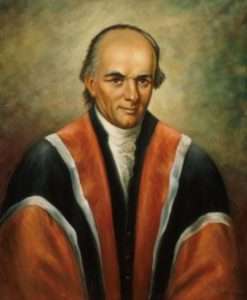
Cruel AND Unusual?
On Monday, the Supreme Court will hear argument in an Eighth Amendment case, City of Grants Pass, Oregon v. Johnson. One thing I will be watching for is whether the justices in their questions treat "cruel and unusual" as two separate requirements, or as one.
Here are a few paragraphs from "Necessary AND Proper" and "Cruel AND Unusual": Hendiadys in the Constitution:
Read as a hendiadys, "cruel and unusual" would mean "unusually cruel." If "unusual" is taken as a term of art meaning "contrary to long usage," then the hendiadys would mean "innovatively cruel."
If "cruel and unusual" means "innovatively cruel," then there are no sequenced inquiries into whether a punishment is "cruel" and then "unusual." There is a single inquiry into innovation in cruelty. It is true that one could break this single inquiry into two analytical steps. First, is this punishment innovative? Second, does this punishment's innovation increase cruelty? Yet that is very different from the two steps associated with a two-requirements view. Those who see the phrase as containing two requirements typically ask first whether a punishment is cruel and then whether it is unusual, treating the two as distinct and unrelated inquiries. But if the phrase is taken as a hendiadys, as an essential unity, then these two inquiries—is the punishment innovative? and does the innovation increase cruelty?—are not really distinct at all. One tells the interpreter to look for innovation; the other tells the interpreter what type of innovation to look for.
In short, if the phrase is taken as a hendiadys, the prohibited punishments would not be ones that merely happen to be both cruel and unusual. Rather, the Clause would prohibit punishments that are new in their cruelty. A new, more painful form of capital punishment; a new, more damaging mode of incarceration (perhaps such as solitary con- finement); a new, more demeaning restriction on the freedom of movement of released offenders—all would be "innovatively cruel."
. . .
The fears expressed by the Anti-Federalists were not without foundation. Indeed, the first Congress prescribed the death penalty for anyone convicted of murder in a place under exclusive federal jurisdiction— adding, for the benefit of science and for greater deterrence, that the court could require "that the body of [the] offender . . . be delivered to a surgeon for dissection."
In other words, the concern behind the Cruel and Unusual Punishments Clause was about progress. But it was not Herbert Spencer's view of social progress as much as it was William Hogarth's view of the rake's progress. Times change and things can go downhill, and when they do, there needs to be something in the Constitution to resist the devolving standards of decency.
A slide into severe punishments was not, however, thought to be inevitable. Although there was little discussion of the Cruel and Unusual Punishments Clause at the time of its ratification, what discussion there was shows a more subtle, two-sided view of innovation: Legislators should be constrained from innovations that increase cruelty, but they should be encouraged to adopt innovations that ameliorate it. The reading given here exactly fits that two-sided view: "Cruel and unusual" is a hendiadys that prohibits not all innovation in punishment, but only innovation that brings new cruelty.
Second, this reading can lead to an inquiry that is better suited to judicial decision making. What makes this second advantage possible is that a hendiadic reading of the phrase allows a broad, non-evaluative reading of "cruel." If "cruel" is taken as an evaluative term, judges are forced to make absolute judgments about what is or is not cruel. That is a difficult question. Of course some punishments are more cruel than others, but the point of difficulty is the constitutional cut-off. If punishments are be- ing judged on whether they are cruel in a sense like "unjustifiably cruel" or "malevolently cruel"—then the question is an inescapably moral one, a question on which individual judgments are likely to vary widely. If the question is shifted to an inquiry into the subjective intentions and knowledge of government officials, that inquiry too is one on which individual judgments will diverge. Nor is the question made easier by directing it towards a moment in history, as in, "What was considered cruel in 1791?" That is still an abstract moral question, yet with the added difficulty of being a question the present is asking of the past.
But the judicial task changes if the phrase is read as a hendiadys and "cruel" is understood in the sense of "harsh." If what sorts the constitutional punishments from the unconstitutional ones is not whether they are "unjustifiably cruel," but whether they are "innovatively harsh," then the judicial inquiry is a comparative one. Judges would not be determining the quantum of cruelty that is constitutionally permissible, but they would instead be asking whether a punishment shows innovation in its harshness. This task is comparative, and such a task tends to be more amenable to judicial competence.
House Passes REPO Act Giving President Authority to Confiscate Russian Government Assets in the US and Transfer them to Ukraine
It's a good idea that will hopefully be imitiated by our allies.

In addition to finally passing long-delayed and much-needed military assistance to Ukraine, the House of Representatives today also enacted the REPO Act. That law gives the president the authority to confiscate $6 billion in Russian government assets currently frozen in the United States, and transfer them to Ukraine, in order to assist that country in resisting Russia's brutal war of aggression.
The Senate will almost certainly pass the REPO Act, as well, and President Biden seems certain to sign it and act on it. While $6 billion isn't all that much relative to the costs of the war, hopefully this US action will incentivize our European allies to confiscate the nearly $300 billion in Russian state assets currently frozen under their jurisdiction.
I have long advocated this idea, which is overdue. In a November post, I outlined the case for it, and addressed a number of objections, including claims that confiscation would violate the Takings Clause of the Fifth Amendment, sovereign immunity arguments, arguments that confiscation is unfair to the people of Russia, and fears that it would set a bad precedent deterring foreign investment in the US.
Here's an excerpt:
There is a staggering $300 billion in frozen Russian state assets located in Western nations backing Ukraine…. To put this figure in perspective, it's worth noting that the total amount of US aid to Ukraine from February 2022 through July 31, 2023 was about $77 billion. The European Union, individual European states, and Canada, gave approximately $165 billion during the same period…. The $300 billion in frozen assets is equal to some two years of total Western assistance to Ukraine at the current pace of spending!…
[I]n the US the private property of foreigners is protected against confiscation by the Takings Clause of the Fifth Amendment, which requires the government to pay "just compensation" if it takes "private property." Most European nations have similar constitutional protections for private property rights, as does the European Convention on Human Rights.
But the Fifth Amendment and its European analogues do not offer the same kind of blanket protection to the property of foreign governments. This distinction undermines claims by some critics that uncompensated seizure of Russian state assets would violate the Takings Clause and similar constitutional guarantees in Europe. It also mitigates concerns that confiscating Russian government assets would create a dangerous slippery slope. Private property rights of foreigners would remain protected by constitutional guarantees….
Oona Hathaway argues that confiscating Russian state assets would violate sovereign immunity. I think the Tribe report offers compelling responses to this argument (pp 60-64).
In addition, I am not convinced that sovereign immunity is actually a just principle that we have a duty to obey. It is in fact a perversion of justice, enabling rulers to escape accountability for violating human rights and other injustices they perpetrate. It was a mistake to read it into the US Constitution. It is equally a mistake to allow it to be a principle of international law. Some laws are so deeply unjust that we have no duty to obey them. The law of sovereign immunity is one such case.
At the very least, sovereign immunity should not be permitted to shield authoritarian states like Putin's regime from having their assets confiscated in order to combat their wars of aggression, mass murder of civilians, and other large-scale human rights violations. Such rulers no more deserve sovereign immunity than Mafia bosses….
"Last Week, a … [UC Berkeley] Professor Confronted a Muslim Student During a Dinner for Graduating Law Students"
From NBC, what strikes me as a misleading characterization of Professor Catherine Fisk's confronting a student who pulled out a microphone to orate at a dinner organized at the professor's (and Dean Erwin Chemerinsky's) house.
Here are the closing paragraphs of yesterday's NBC News article, "Columbia University protesters resume demonstrations after mass arrests":
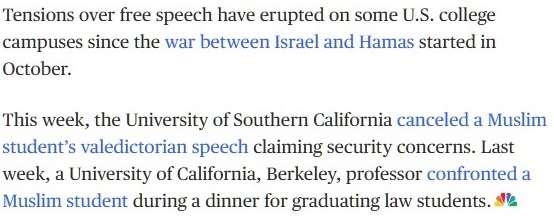
Is this really a fair and objective summary of what happened at the Chemerinsky dinner? "Confronted a Muslim student," with no further explanation, strongly implies that the student was confronted for being a Muslim, rather than for trying to give a speech in the middle of a social occasion. I know of no evidence that Dean Chemerinsky or Professor Fisk (they are married) targeted the student for her religion, as opposed to her disruptive conduct.
Pennsylvania Court Lets Suit Over Removal of Columbus Statue Go Forward
Such a removal by the city from city property wouldn't violate the First Amendment, but that doesn't preclude claims that the removal violated other legal rules.
Italian Sons & Daughters of America v. City of Pittsburgh, decided yesterday by the Pennsylvania Commonwealth Court (Judge Patricia A. Mccullough, joined by Judges Renée Cohn Jubelirer, Christine Fizzano Cannon, Ellen Ceisler, Lori A. Dumas, and Stacy Wallace, and with Judge Michael H. Wojcik concurring in the result), reversed a trial court's decision approving of Pittsburgh's removal of a Columbus statue from a public park. The trial court had held that the removal didn't violate the First Amendment, because monuments permanently erected in a park were "government speech," but the Commonwealth Court concluded that the removal did potentially violate state law:
Here, in its First Amended Complaint, ISDA does not challenge Mayor Peduto's or the Art Commission's actions on First Amendment grounds; nor does ISDA contest that the placement of the Statue in Schenley Park constitutes government speech that the City otherwise may regulate, change, or remove as it sees fit. Thus, ISDA does not argue that … government speech principles … are inapplicable. Rather, ISDA argues that Mayor Peduto and the Art Commission, in taking action to remove the Statue, did not comply with applicable provisions of the Charter and Code, violated ISDA's rights to due process, violated public trust principles, and breached a contract entered into between the City and ISDA's putative predecessor, the Sons of Columbus.
In issuing its decision, the trial court did not make any findings of fact and did not rule on any of Appellees' expressly pleaded preliminary objections, including the objection to ISDA's standing. Instead, the trial court broadly concluded that, because the Statue constitutes government speech, ISDA cannot, as a matter of law, plead a viable claim because the City is free to do with the Statue as it pleases, notwithstanding any local or state-wide legislation or other restrictions to the contrary … [on the view that] "Local ordinances and state laws cannot be used to restrict future government's speech rights." ….
[But a]lthough a government generally may determine those views that it will espouse by way of its own speech, it nevertheless may not do so in violation of applicable "law, regulation, or practice." … The fact that … monuments or pieces of art constitute "government speech" only protects the government from certain First Amendment challenges. It does not, as the trial court here concluded, give government "free reign" to act as it pleases in defiance of the law….
"White Supremacist Leader Sentenced to 44 Months in Prison for Conspiring to Make Death Threats Against Brooklyn Journalist"
The Justice Department reported yesterday:
Earlier today, at the federal courthouse in Brooklyn, Nicholas Welker, also known as "King ov Wrath," was sentenced by United States District Judge Pamela K. Chen to 44 months' imprisonment for conspiring to make death threats. Welker, the leader of Feuerkrieg Division ("FKD"), an international racially or ethnically motivated violent extremist ("RMVE") group, which translates to "War Fire," posted death threats against a Brooklyn-based journalist (the "Journalist") so that the Journalist would stop reporting on the Neo-Nazi group….
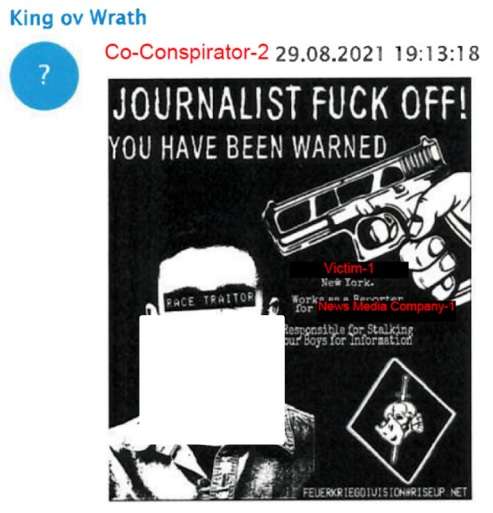
According to court filings, Welker's threat included a photograph of the Journalist with a gun aimed at his head and the words "Race Traitor" over the Journalist's eyes. The threat stated, "JOURNALIST F[***] OFF! YOU HAVE BEEN WARNED." The threat listed the Journalist and his employer by name. Welker posted the threat to a public online forum. Two under-aged FKD members tweeted the death threat directly at the Journalist's social media handle so that he would see it. Welker intended to frighten the Journalist into dropping his reporting on Welker's hate group.
FKD members share a common goal of challenging laws, social order, and the government via terrorism and other violent acts. The organization encourages attacks on racial minorities, the Jewish community, the LGBTQ+ community, the U.S. Government, journalists, and critical infrastructure. FKD has members in the United States and abroad.
UPDATE: Here's the threat, from the government's Sentencing Memorandum (thanks to commenter John F. Carr for the link); the redactions are the government's:
Today in Supreme Court History: April 20, 2010
4/20/2010: United States v. Stevens decided.
Second Amendment Roundup: ATF redefines "engaged in the business"
Agency pushes the envelope to require gun dealer licenses beyond the statute.
ATF's Final Rule Definition of "Engaged in the Business" as a Dealer in Firearms amounts to 466 pages of responses to comments and the final rule itself. Over 252,000 of the 258,000 comments or 98% in favor of the proposed rule were form letters with identical text found online and recommended by (anti-gun) organizations. Only 5,140 were not form letters. Of the 99,000 comments opposed to the rule, 80,000 or 81% were form letters. That means that 18,810 were not form letters. So more than three times the numbers of opponents filed comments with actual substance as did those in favor.
The final rule is substantially the same as the proposed rule. See my previous post "'He's at it again!' Merrick Garland proposes ever-more intrusive ATF regulations." A number of points that I (and others) made in comments filed in opposition to the proposed rule were taken seriously enough for ATF to reject at length.
One new item stands out. The Gun Control Act (GCA) excludes occasional sales and purchases of a "personal collection" of firearms from the term "engaged in the business" of dealing in firearms. The proposed rule defined "personal collection" to include curios and relics and firearms used in recreational activities. In response to numerous comments criticizing the proposal for not including firearms used for self-defense, the final rule explicitly states that "the term [personal collection] shall not include firearms accumulated primarily for personal protection." Yet nothing in the statute excludes such firearms from being part of a personal collection.
By purporting to exclude the occasional buying and selling of firearms acquired for self-defense from the "personal collection" category, the rule would render the person more likely to be subject to the licensing requirement. Yet that category was enacted by the Firearm Owners' Protection Act of 1986, which declared that the rights of citizens … to keep and bear arms under the second amendment to the United States Constitution … require additional legislation to correct existing firearms statutes and enforcement policies." And the Supreme Court stated in D.C. v. Heller that the Second Amendment protects "arms 'in common use at the time' for lawful purposes like self-defense."
Short Circuit: A Roundup of Recent Federal Court Decisions
Bird poop, non-testimonial thumbs, and the heckler's veto.
Please enjoy the latest edition of Short Circuit, a weekly feature written by a bunch of people at the Institute for Justice.
Pish-tosh and tomfoolery! This week, Tex. Attorney General Ken Paxton lost 9-0 at the U.S. Supreme Court. Curiously, he declared victory. But we double checked and can indeed confirm that he urged the Court to affirm the dismissal of IJ client Richie Devillier's Fifth Amendment takings claim and the Court instead revived it. Because Ken Paxton lost. And Texans won. Click here to learn more.
Lawsuit Alleging School District Wouldn't Inform Certain Parents About Their Children's "Sign[s] of an LGBTQ+ Identity" Dismissed for Lack of Standing
From today's opinion by Judge Michael Watson (S.D. Ohio) in Kaltenbach v. Hilliard City Schools (a notice of appeal has been filed):
… Plaintiffs allege that, if the District believes a parent holds anti-LGBTQ+ views, the District will not inform that parent if the parent's child shows any sign of an LGBTQ+ identity. The [District's] Policies allegedly work as follows: The District's "default" is that it will tell parents anything important about their children, including things related to LGBTQ+ issues. However, there is a "health and safety" exception to this default. Separately, the District labels people who do not support LGBTQ+ youth as "unsafe." Plaintiffs allege that when a parent is labelled "unsafe," the "health and safety" exception applies and, therefore, the parent will not be told important information. Thus, Plaintiffs allege, if a child reports that the child is struggling with LGBTQ+-related issues, and if that child's parent has been labelled "unsafe," that parent will never be informed about the child's struggles.
Plaintiffs allege that these fears came to pass for one Plaintiff, D.S. D.S.'s child, who was assigned female at birth, was struggling with mental health issues during eighth and ninth grade. At some point, employees at the child's school started using a male name and male pronouns to refer to the child, apparently believing that doing so would help with the child's mental health. D.S.'s child attempted suicide but, fortunately, survived and has received professional mental health care. No one at the school told D.S. that employees referred to the child with male pronouns, until after the suicide attempt. D.S. has since removed the child from the District. D.S. does not allege whether the District labelled her as "unsafe" or perceived her as having anti-LGBTQ+ views.
In addition, Plaintiffs allege that school employees may have exposed students to graphic sexual material. Some school employees wore a badge (the "Badge") that communicates that the wearer supports LGBTQ+ youth. On the back of the badge, there is a QR code that, if scanned, brings up resources and materials related to LGBTQ+ issues. At least some of these resources allegedly contain sexually explicit material….
2024 Texas Review of Law & Politics - Jurist of the Year
 On April 13, 2024, I was honored to accept the Jurist of the Year award from the Texas Review of Law & politics. Perhaps more importantly, I was quite pleased to see the Josh Blackman Bobblehead. I stand in some great company.
Here is the audio, where you'll hear comments from two very special guests.
And here are my prepared remarks:
Introduction
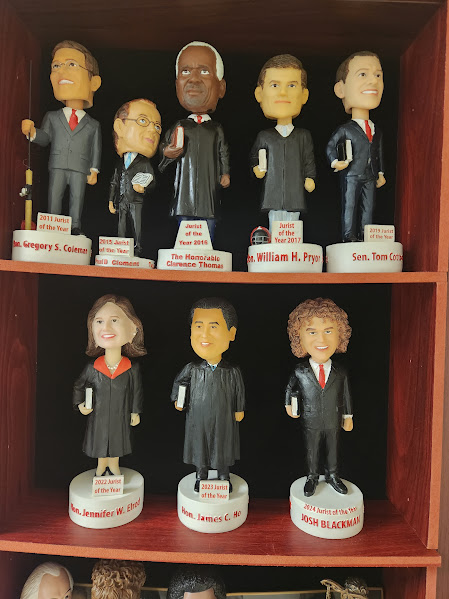 Thank you so much for the introduction, Judge Ho. It is the honor of a lifetime to be up here. But in candor, I'm not sure why I'm here. When Adam Ross told me that I was selected as the 2024 TROLP jurist of the year, my immediate reaction was, to quote Wayne's World: "I'm not worthy." Let's do a survey of the 25 TROLP jurists of the year who came before me. There were two Supreme Court Justices: Scalia and Thomas. There were ten lower-court federal judges: Jones, Starr, Smith, Owen, Garwood, Pryor, Willett, O'Connor, Elrod, and Ho. There were four Senators: Cornyn, Lee, Cruz, and Cotton. There were three Solicitors General: Olson, Coleman, Clement. There were two Attorneys General: Meese and Abbott. There was only one law professor who was jurist of the year: Lino Graglia, a giant in the law, who received the award when he was eighty years old.
Then there's me. I'm not a judge, and I don't consider myself a jurist. I've never held any appointed or elected governmental position. I am not, nor have I ever been, an "Officer of the United States." I've never argued a case before the Supreme Court, or any appellate court for that matter. I did not attend, and do not teach at an elite law school. To quote another classic piece of American pop culture, Sesame Street, One of these things is not like the other. Relatedly, I think my TROLP bobblehead is the first one with curly hair.
So, why am I up here? I'm still not entirely sure. But I'd like to use my brief time at this podium to convey a message: this can be you. If I can be up here, so can you. To state the issue more bluntly, I don't want to be the only one up here. I want each and every one of you to find your path to this stage. As I'll explain, it will not be easy. There will be many forces pushing back against you. There is no glidepath to getting your very own bobblehead. But I am ready to help. Indeed, I try by word and deed to model the behavior it takes to get up here. If you'll indulge me, let me offer five tips.
Lesson #1 - Guard your time wisely and jealously
No matter who you are, there are twenty-four hours in a day and seven days in a week. Nothing, short of a time machine, can change that. So when someone says "I don't have the time to do X" what they are really telling you is that they prefer to spend their time on Y. To be sure, we all have commitments--work, family, recreation, sleep, and so on. (I assure you, I do sleep, just not at the same times you do.) But at bottom, we all choose how to spend our time. Earlier in your career, it will be up to you to seek out opportunities to spend your time. For the students in the room, you should learn to say yes more than no. That is how you get ahead. When more senior people realize you can do stuff, and do it well, they'll ask you to do more. It is a self-fulfilling prophecy. But as you progress and grow, there will be increasingly more demands on your time. Now, you must learn when to say no and when to say yes. I need to learn to say no more, but it is a challenge. Throughout all stages, however, you must guard that time both wisely and jealously. And how do you choose how to spend your time? That brings me to my second point.
Lesson #2 - Use your time to follow your purpose
Why are we all here at this dinner for the Texas Review of Law & Politics? At one level, we're here to have a nice dinner and snag a shaggy bobblehead. But at a deeper level, I think we're all here for a more profound reason. Everyone in this room shares a collective sense of purpose: the Constitution, the rule of law, and civil society. We can argue and debate about the precise contours of those precepts, but we agree on the big picture. Our republic today is on a shaky foundation, and only through a rededication to the Constitution and the rule of law can our civil society be preserved. Your purpose is something bigger than yourself. And you must commit yourself to that purpose.
I am fortunate that I realized my purpose in this movement at a fairly young age. I think it happened at some point during my first year of law school at George Mason, now Scalia Law. And I think those who have joined TROLP had a similar epiphany. Indeed, TROLP is a pillar in this movement. The TROLP Mission statement defines that purpose well: TROLP "publishes thoughtful and intellectually rigorous conservative articles—articles that traditional law reviews often fail to publish—that can serve as blueprints for constructive legal reform." I've published many times in TROLP for that precise purpose. And those articles have been cited by scholars and courts for that reason.
So let's put the first two lessons together. How do you choose to spend your time? Choose to spend your time to pursue your purpose. Which brings me to my third point. What do you do with that time?
Seattle Improperly Imposed a "Heckler's Veto" on Street Preacher at "an Abortion Rally and an LGBTQ Pride Event"
So holds the Ninth Circuit.
From yesterday's decision in Meinecke v. City of Seattle, written by Judge Jay Bybee, joined by Judges Margaret McKeown and Daniel Bress:
Appellant Matthew Meinecke's speech was not well received by his audience. On two separate occasions in June 2022—an abortion rally and an LGBTQ pride event—Meinecke sought to read Bible passages to attendees gathered in the city of Seattle. When those attendees began to abuse and physically assault Meinecke, Seattle police officers asked Meinecke to move and ultimately arrested him when he refused, rather than deal with the wrongdoers directly….
On June 24, 2022, the United States Supreme Court overturned Roe v. Wade. In response, a significant number of people gathered on Second Avenue outside the federal building in Seattle to protest the decision. Meinecke arrived that afternoon dressed in a shirt and tie and went to a public walkway adjacent to Second Avenue. According to his complaint, Meinecke "did not come to this event to condemn abortion" or even to "speak on this topic, but to convey his faith in Christianity to people who were in the area." He held up a sign, read from the Bible, and handed out Christian literature.
Protestors surrounded Meinecke after about an hour. One protestor seized Meinecke's Bible. Meinecke retrieved another Bible from his bag and continued reading aloud. Another protestor grabbed hold of—and ripped pages from—the new Bible. The altercation soon escalated. As protestors, some of whom Seattle police characterized in their written reports as Antifa, encroached, Meinecke took hold of an orange-and-white traffic sawhorse. Five protestors, some clad in all black and wearing body armor, picked up Meinecke and the sawhorse, moved him across the street, and dropped him on the pavement. One law enforcement officer who observed this interaction reported that "'Antifa' members … began to fight/assault" Meinecke.




