The Volokh Conspiracy

Mostly law professors | Sometimes contrarian | Often libertarian | Always independent | Est. 2002

The Volokh Conspiracy

Free Speech

Free Speech Unmuted: Court Upholds TikTok Divestiture Law

|

My cohost Jane Bambauer and I lay out what the D.C. Circuit said. You can also watch our past episodes:

Justice Thomas's Statement Reaffirms Sword-Shield Dichotomy

"A defendant can always raise unconstitutionality as a defense 'where a statute is invalid upon its face and an attempt is made to enforce its penalties in violation of constitutional right.'"

|

Today the Supreme Court denied cert in Wilson v. Hawaii, which I wrote about here. Justice Thomas wrote a statement respecting the denial of cert, joined by Justice Alito. The posture of the case is a bit unusual. The defendant was convicted of carrying a firearm without a license. At the time, Hawaii imposed a "may issue" conceal carry law. It turns out that Wilson had never applied for a carry permit. To challenge his conviction, the defendant argued that Hawaii's carry law runs afoul of Bruen. However, the Hawaii Supreme Court held that he could not raise the Second Amendment as a defense against the carry regime. Justice Thomas explains:

There, the [state] court invoked state standing law to avoid any meaningful Second Amendment analysis. It held that, because Wilson had not applied for a license and had not been charged with violating the licensing statute itself (which was not a criminal statute), he lacked standing to challenge the particulars of the licensing regime. Id., at 12–13, 543 P. 3d, at 444–445. Instead, he could argue only that the Second Amendment categorically forbids state licensing regimes. Because that is not the case, the court held, Hawaii's prohibitions on unlicensed carry "do not graze Wilson's Second Amendment right."

Justice Thomas explained why this approach is mistaken:

A defendant can always raise unconstitutionality as a defense "where a statute is invalid upon its face and an attempt is made to enforce its penalties in violation of constitutional right." Smith v. Cahoon, 283 U. S. 553, 562 (1931). A "long line of precedent" confirms this point. See, e.g., City of Lakewood v. Plain Dealer Publishing Co., 486 U. S. 750, 755–757 (1988) (collecting cases).

Even though Wilson was not being prosecuted for violating the civil registration law, the defendant could still challenge the government's enforcement action based on the unconstitutionality of the gun control law.

Here, the Defendant does not need any sort of cause of action to raise the unconstitutionality of the statute. The Constitution is being used as a "shield."

However, Justice Thomas does not say that "A defendant can always raise unconstitutionality," full stop. It can always be raised as a "defense" or a "shield." But for the Constitution to be raised as a "sword" to seek affirmative relief, a cause of action is needed. Justice Thomas recognized this principle in last term in DeVillier v. Texas:

Constitutional rights do not typically come with a built-in cause of action to allow for private enforcement in courts. See Egbert v. Boule, 596 U. S. 482, 490–491 (2022). Instead, constitutional rights are generally invoked defensively in cases arising under other sources of law, or asserted offensively pursuant to an independent cause of action designed for that purpose, see, e.g., 42 U. S. C. §1983. (slip op. at 5.)

Wilson should have been able to invoke the Second Amendment defensively, but could only assert it offensively with a cause of action.

Justice Thomas continues to bring clarity to an area of that is often misunderstood.

For those interested in reading further, Seth Barrett Tillman and I discuss the sword-shield dichotomy in Sweeping and Forcing (pp. 389–404); see also Anderson v. Griswold, Colo., 543 P.3d 283, 348, 351 & n.7, 356 (Colo. Dec. 19, 2023) (Samour, J., dissenting) (citing Sweeping and Forcing, supra) (adopting the sword-shield dichotomy as basis for dismissing plaintiffs' purported Section 3 action).

Justices Thomas, Alito, Gorsuch, and Kavanaugh Are Active on the Cert Docket

Justice Barrett remains the most gun-shy Justice.

|

Today the Supreme Court denied review in three high profile cases. In each case, Justices Thomas and Alito wrote separately. In two cases, Justice Gorsuch wrote separately. And in one case, Justice Kavanaugh would have granted cert. In all cases, Justice Barrett remained silent.

First, the Court denied cert in Boston Parent Coalition for Academic Excellence Corp v. The School Committee For the City of Boston. This case challenged the affirmative action policies of Boston Public Schools, where there as overt evidence of discrimination against Asian students. The First Circuit, following the Fourth Circuit's lead in Coalition for TJ v. Fairfax County School Board, rejected the Fourteenth Amendment claim because Asian students were "still over-represented."

Justice Gorsuch wrote a statement respecting the denial of cert in the Boston case. Here, Boston had changed its policy, and the plaintiffs had not challenged the new policy. Gorsuch observed:

Strictly speaking, those developments may not moot this case. But, to my mind, they greatly diminish the need for our review.As a result, I concur in the Court's denial of the petition for certiorari.

In other words, the Court has a discretionary docket, and he did not think this case was a good use of discretion.

Justice Alito dissented from the denial of cert, joined by Justice Thomas. He explained that the case was not moot, due to the suit for nominal damages.

Boston later replaced the challenged 2021–2022 admission policy with a new policy that the Coalition does not challenge here. But, unlike respondents, I fail to see how that moots this case. First, the Coalition seeks nominal damages to redress the unconstitutional effects of the 2021–2022 admission policy. See Record 2103; Uzuegbunam v. Preczewski, 592 U. S. 279, 292 (2021).

Alito criticized his colleagues, again, for not addressing post-SFFA "defiance":

We have now twice refused to correct a glaring constitutional error that threatens to perpetuate race-based affirmative action in defiance of Students for Fair Admissions. I would reject root and branch this dangerously distortedview of disparate impact. The Court, however, fails to do so today, so I must respectfully dissent.

Recall that Justices Alito, Thomas, and Gorsuch would have granted the TJ Coalition an emergency injunction back in 2022, and Alito and Thomas (but not Gorsuch) have granted cert in that case in 2024. Justices Kavanaugh and Barrett are silent on this issue. The Court is now content to let these issues fester in the lower courts, as SSFA is ignored.

Second, the Court today denied certiorari in Wilson v. Hawaii. In this case, the Aloha state had a "may issue" carry regime that would violate Bruen. And the defendant was convicted of violating that law. But the Hawaii Supreme Court held that the defendant could not raise the unconstitutionality of the law, because he never applied for a carry license. Justice Thomas, joined by Justice Alito, wrote a statement respecting the denial of cert. They explained that the case came to the Court at an early posture, but this vehicle, or another should be granted in the future:

Although the interlocutory posture of the petition weighs against correcting this error now, I would grant certiorari in an appropriate case to reaffirm that the Second Amendment warrants the same respect as any other constitutional right.

The Hawaii Supreme Court also took time to criticize Bruen:

The Hawaii Supreme Court disagreed. It spent the bulk of its opinion explaining why the Hawaii Constitution does not confer an individual right to bear arms, with analysis that doubled as a critique of this Court's Second Amendment jurisprudence. The court specifically took aim at our focus on original meaning. Bemoaning the policy consequences, the court asserted that an originalist interpretation of the Second Amendment "disables the states' responsibility to protect public safety, reduce gun violence, and safeguard peaceful public movement," by putting firearms restrictions "mostly out of bounds." And, it denigrated the need for public carry in particular, rejecting as un-Hawaiian "a federally-mandated lifestyle that lets citizens walk around with deadly weapons." On the Hawaii Supreme Court's view, a sounder approach to constitutional interpretation would give due regard to the "spirit of Aloha" and would preclude any individual right to bear arms, or at least subject it to "levels of scrutiny and public safety balancing tests." . . .

I think there are some penumbras emanating from the "spirit of Aloha."

Justice Thomas faulted his colleagues for tolerating defiance of Bruen:

The court's contrary path "resist[s] our decisions," Rogers v. Grewal, 590 U. S. ___, ___ (2020) (THOMAS, J., dissenting from denial of certiorari) (slip op.,at 3), and demotes the Second Amendment to a "second class right," McDonald, 561 U. S., at 780 (plurality opinion). This Court cannot tolerate "such blatant defiance" in any constitutional context. Rogers, 590 U. S., at ___ (slip op., at 5).

Justice Gorsuch wrote a separate statement in Wilson v. Hawaii. Gorsuch makes slightly different arguments than did Thomas and Alito. Gorsuch faulted the Hawaii Supreme Court for not analyzing whether the "may issue" regime violated Bruen. Gorsuch also gets into the weeds of the particular Hawaii states that Wilson was charged with violating. Gorsuch also made a Sixth Amendment argument about the state "precluding the presentation of a constitutional defense."

Third, the Court denied cert in Parents Protecting Our Children v. Eau Claire Area School District, Wisconsin. This case challenged the school's policy to encourage students to transition without parental knowledge or consent. The parents raised a Fourteenth Amendment substantive due process claim for the right to make decisions concerning the rearing of their children. The Seventh Circuit panel (Wood, Scudder, St. Eve) rejected this claim on standing grounds.

Justices Alito and Thomas wrote a dissent from the denial of certiorari. Justice Kavanaugh did not join the Alito dissental, but would have granted the petition. Kavanaugh's vote to grant is consistent with some of his questions during the Skrmetti argument. Indeed, I think Justice Kavanaugh is acutely aware of these issues. He has young daughters who attended an elite prep school, and he was the coach of female athletics. He is speaking from experience here.

Alito explains why he would have granted review:

Relying principally on our decision in Clapper v. Amnesty Int'l USA, 568 U. S. 398 (2013), the Seventh Circuit suggested that a parent could not challenge the district's policy unless the parent could show that his or her child is transitioning or considering a transition. 95 F. 4th 501, 505 (2024). But the challenged policy and associated equity training specifically encourage school personnel to keep parents in the dark about the "identities" of their children, especially if the school believes that the parents would not support what the school thinks is appropriate. Thus, the parents' fear that the school district might make decisions for their children without their knowledge and consent is not "speculative." Ibid. (citing Clapper, 568 U. S., at 410). They are merely taking the school district at its word.

Alito also faults the lower courts, as well as his colleagues, for using standing law to avoid controversial issues:

I would grant the petition so that we can address this questionable understanding of Clapper and related standing decisions. I am concerned that some federal courts are succumbing to the temptation to use the doctrine of Article III standing as a way of avoiding some particularly contentious constitutional questions. While it is important that federal courts heed the limits of their constitutional authority, it is equally important that they carry out their "virtually unflagging obligation . . . to exercise the jurisdiction given them." Colorado River Water Conservation Dist. v. United States, 424 U. S. 800, 817 (1976).

This charge is a lack of courage. Here, I think Alito is looking right at Gorsuch. Speaking of Justice Gorsuch…

Of course, with three votes to grant, only one more was needed. But Justices Gorsuch and Barrett were silent. Gorsuch's silence is predictable. Last week, I listed the string of LGBT-related cases where Gorsuch did not vote to grant cert: Tingley, Edmo, Grimm, and Kincaid. He was silent in Skrmetti. And now add Eau Claire to that list. Yet, there is a deafening sound to this silence.

Justice Barrett's silence is also quite predictable. She is a standing stickler, and is most likely to find that parties are not injured. But more broadly, she is a cert stickler. Justice Barrett does not seem interested in parental rights here, and apparently did not vote to grant cert on the ACLU's due process petition in Skrmeti. (In my post last week, I erroneously wrote that the Court denied the petition, which in fact remains pending. )

By my best recollection, Barrett has only ever dissented from the denial of cert once. Perhaps with good reason. On any case where Barrett wants to grant review, there will almost certainly be three or four more votes to back her up. But where she wants to sit things out, cert is likely to be denied. Indeed, even if Justice Kavanaugh might be inclined to grant cert, he may not see a fifth vote for reversal, and sits it out.

The Court's docket continues to shrink. Maybe we should blame William Howard Taft for pushing the Court's discretionary docket a century ago, as flagged in Adam Liptak's column today. I still think we should expand the Court's mandatory jurisdiction.


Originalism

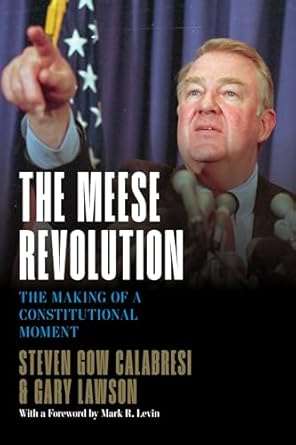
The Meese Revolution: The Making of a Constitutional Moment (2024)

by Steven Gow Calabresi and Gary Lawson.

|

Gary Lawson and I have just published an intellectual biography of former Attorney General Ed Meese, which argues that Ed Meese is the most influential person ever to hold the office of U.S. attorney general—but almost no one knows it. (The runners-up are: Homer S. Cummings (1933-1939) and Robert F. Kennedy (1961 to 1964), neither of whom helped to win the Cold War or to shape judicial selection for nearly forty years.) We explain why Ed Meese beats out Cummings and RFK in 401 pages of text. We think our book would be of great interest to many of the readers of this blog.

Ed Meese was at the center of virtually every major accomplishment of Ronald Reagan's transformational presidency, from winning the Cold War without firing a shot to the economic boom that by the end of the 1980s was the envy of the world. Meese served for nearly eight years on President Ronald Reagan's National Security Counsel, and when Meese and Secretary of State George P. Schulz disagreed, President Reagan always sided with Ed Meese. Meese also served as the Chairman of President Reagan's Domestic Policy Counsel. Ed Meese was in all matters of policy President Ronald Reagan's right hand man in waging the Reagan Revolution.

Our book reveals that Ed Meese: (1) urged Ronald Reagan to make Bill Casey his campaign manager in 1980 after Reagan won the New Hampshire Republican primary that year and later to name him as head of the CIA; (2) urged Ronald Reagan to make George H.W. Bush his running mate in 1980; (3) managed Ronald Reagan's presidential transition in 1980, baking in the submission of Reagan's revolutionary slashing of marginal tax rates in legislation submitted to Congress as soon as Reagan took office; (4) advised President Reagan on the firing of air traffic controller union members who went out on strike in 1981; (5) convened the first meeting with President Reagan in the White House on developing the strategic missile defense systems from which the Patriot missile systems now defending Kiev and Tel Aviv are descended; (6) urged President Ronald Reagan's first term judicial appointments of Judges Robert H. Bork, Antonin Scalia, and Ralph K. Winter, among many others; (7) helped President Reagan confidentially hire his third White House Chief of Staff, Howard Baker, when Donald Regan resigned because of the Iran-Contra scandal; and (8) with the help of Leonard Leo, successfully lobbied President George W. Bush to appoint Justices Samuel Alito and John Roberts to the U.S. Supreme Court in 2005.

More to the point for our book, Ed Meese is the person most responsible for the rise of constitutional originalism, a style of legal interpretation that treats the text and original meaning of the Constitution rather than the policy fads of the moment as authoritative law. Ed Meese gave more than thirty speeches on constitutional law and originalism during his tenure as Attorney General debating liberal Justices William J. Brennan, Jr. and John Paul Stevens. Meese gave speeches on originalism, constitutional criminal procedure, religious liberty, economic liberties, the separation of powers, and federalism, as well as on many other legal subjects.

Read More

Free Speech

City's Christmas Parade May Not Exclude Pride Float Because Risk of Thrown Objects or Slashed Tires

The court rejects the City's action as implementing a "heckler's veto."

|

From Friday's opinion by Judge Austin Huffaker (M.D. Ala.) in Prattville Pride v. City of Prattville:

Prattville Pride is a non-profit, LGBTQ organization that alleges that the Defendant, the City of Prattville ("City"), has excluded it from participating in the City's Christmas parade (scheduled to begin at 7:00 p.m. on December 6, 2024; i.e., this evening) in violation of the group's First Amendment right to free speech and right to Equal Protection ….

According to Prattville Pride, the group has complied with all the conditions imposed by the City to participate in the parade. The group has submitted its application, paid its fee, and was granted approval by the City to participate in the parade. Thereafter, certain members of the public made general complaints about Prattville Pride's participation in the parade because of the nature of the organization.

On December 3, 2024, the Prattville City Council met and discussed the group's participation. Apparently, members of the public voiced vehement opposition to Prattville Pride's participation in the upcoming parade…. Yesterday, Prattville Pride informed the City's Police Chief that the group had received threats which "referenc[ed] harmful actions to be taken against [the group] and [its] float during the Prattville Christmas Parade," and therefore the group requested additional security monitoring and presence.  Prattville Pride also stated that it was "concerned not only with [its] own safety but that of bystanders and parade goers as well. Having police escorts could be a[n] invaluable deterrent."

In response, the City did not reject the request [f]or additional security, or agree to provide additional security, or offer to investigate the threats. Instead, the City's mayor removed Prattville Pride from the parade, stating: that Prattville Pride had brought to the City's attention "serious safety concerns" and that the "City will not put the rights of parade participants ahead of the safety of []its citizens." …

Read More

Free Speech

Olivet University "Pled Guilty to Conspiracy to Commit Money Laundering"; Newsweek Reported That as "Pleaded Guilty to Money Laundering"

Not libel, says the Second Circuit: "the truth is so near to the facts as published that ... no legal harm has been done."

|

From Friday's decision in Olivet Univ. v. Newsweek Digital LLC, by Second Circuit Judges Guido Calabresi and Sarah Merriam, and District Judge Jed Rakoff (S.D.N.Y.):

For purposes of our de novo review, we accept the following allegations of the operative Amended Complaint as true. "Olivet is a private religious institution consisting of multiple colleges" with "campuses across the United States," founded by Dr. David Jang in 2004. Olivet had "close ties to" Newsweek from 2013 to 2018; several individuals in leadership at Newsweek's parent company at the time, IBT Media Inc., were affiliated with Olivet.

In 2018, IBT Media was "facing an investigation by the Manhattan District Attorney's Office relating to" financial matters. Olivet was under investigation in 2018 as well, and on October 31, 2018, a grand jury issued a 16-count indictment charging Olivet, its Trustee William Anderson, IBT Media, and others with a scheme to fraudulently "obtain financing from financial institutions, divert the proceeds of the financing and conceal its origins in order to fund … needs unrelated to the stated purpose of the financing, and maintain a credit profile sufficient to continue" the scheme. Anderson, Olivet, and others were also charged with laundering the proceeds of that scheme.

Anderson pled guilty to money laundering in the second degree and to participating in a scheme to defraud in the first degree. On February 11, 2020, Olivet … pled guilty to (a) Count 4 of the indictment, charging it with felony falsification of business records in the first degree; and (b) a lesser included charge of Count 3 of the indictment, specifically, conspiracy in the fifth degree, a misdemeanor. Count 3 of the indictment charged Olivet and others with conspiring to commit "Money Laundering in the Second Degree," a class C felony. Under the terms of Olivet's plea agreement, the felony falsification of business records charge was eventually reduced to a misdemeanor, and all remaining counts of the indictment, except for the conspiracy charge, were dismissed.

Read More

Cats Are from Berkeley, Dogs Are from Mar-A-Lago

|

AP reports that Harris won among voters who owned only cats, 54-45, but Trump won among those who owned only dogs, 55-44, and among those who owned both, 53-46. Harris also won among voters who owned neither (averaging her 58-41 margin among women who owned neither and Trump's 51-46 margin among men who owned neither). The story has more, including further breakdowns by sex.

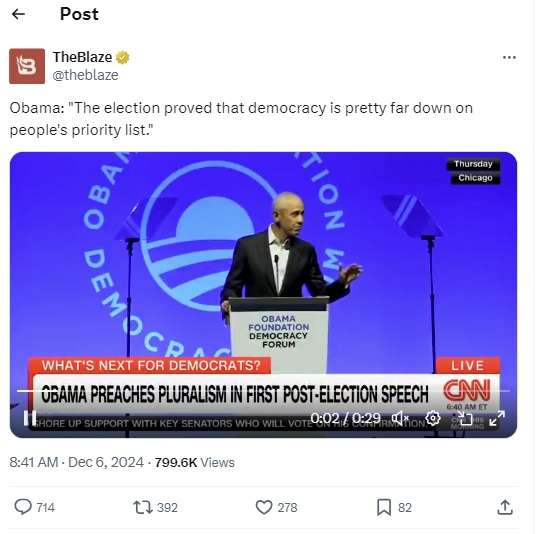
Did President Obama Say "the Election Proved that Democracy Is Pretty Far Down on People's Priority List"

|

From a recent Tweet:

But actually, here's what he says (or you can read the very similar version in Obama's Medium post):

I should tell you that when I mentioned to a few friends that our foundation would be hosting a forum on democracy and pluralism, I got more than a few groans and eye-rolls. And it's understandable; after all, here in the United States we have just been through a fierce, hard-fought election, and it's fair to say that it did not turn out as they hoped. And for them, talk of bridging our differences when the country and the world seem so bitterly divided felt like an academic exercise. It felt far-fetched, even naïve, especially since, as far as they were concerned, the election proved that democracy is pretty far down on people's priority list. And I understood their skepticism; maybe you had a conversation with a friend that felt the same way. But as a citizen and part of a foundation that believes deeply in the promise of democracy—not only to recognize the dignity and the worth of every individual, but to produce freer, and fairer, and more just societies—I can't think of a better time to talk about it.

Obama is characterizing what some people believe ("as far as they were concerned"), not stating it as his own message. Indeed, he's expressing some disagreement with those people, at least as to the value of discussing democracy now. Perhaps some might suspect that he actually does agree that "democracy is pretty far down on people's priority interest." But quoting that phrase without Obama's "as far as they were concerned" strikes me as not quite right.

Here, by the way, is another passage from the speech that I'm glad Obama included, and that I think more people, on the Left, Right, and otherwise should bear in mind:

Read More

Politics

Short Circuit: A Roundup of Recent Federal Court Decisions

Foreign adversaries, abortion trafficking, and Virginia's readmission.

|

Please enjoy the latest edition of Short Circuit, a weekly feature written by a bunch of people at the Institute for Justice.

New case: In 2023, South Carolina enacted a law providing $6,000 education scholarship accounts for low-income families to be used for a virtually unlimited number of education expenses: textbooks, tutoring, homeschool materials, therapies, and tuition and fees at private and out-of-district public schools. But in response to a recent state supreme court ruling, officials have barred families from using the ESAs for private school tuition. So this week, IJ filed a petition in the South Carolina Supreme Court, arguing that the new policy falls afoul of two bedrock, towering, and monumental U.S. Supreme Court cases: Meyer v. Nebraska, which recognized the right of parents to direct the education of their children; and Pierce v. Society of Sisters, which held that this right includes the right to send one's children to a private school. Click here to learn more.

New on the Short Circuit podcast: Chicago attorney Patrick Eckler joins the podcast to share a trainwreck of a Seventh Circuit oral argument.

Read More

Free Speech

Chief Judge Srinivasan's "Alternate Path" to Upholding the TikTok Divestiture Mandate Against First Amendment Challenge

|

Here are some excerpts from Chief Judge Srinivasan's opinion concurring in the judgment as to the First Amendment inquiry in Tiktok, Inc. v. Garland. First, Judge Srinivasan stresses the history of restrictions on foreign ownership of electronic communications media:

[C]oncerns about the prospect of foreign control over mass communications channels in the United States are of age-old vintage. In that respect, Congress's decision to condition TikTok's continued operation in the United States on severing Chinese control is not a historical outlier. Rather, it is in line with a historical pattern.

The first communications medium capable of reaching mass audiences in real time—radio—was subject to restrictions on foreign ownership and control from the very outset. The Radio Act of 1912 required radio operators engaged in interstate (or international) communications to obtain a license from the Secretary of Commerce and Labor, but Congress made licenses available only to U.S. citizens or companies. Congress then extended the restrictions to encompass foreign control (not just foreign ownership) in the Radio Act of 1927, prohibiting licensing of any company if it had a foreign officer or director or if one-fifth of its capital stock was in foreign hands.

Within a few years, the Communications Act of 1934 shored up the restrictions on foreign control. Section 310 of the law incorporated with little change the 1927 Act's foreign-control requirements, and also gave the newly created Federal Communications Commission (FCC) authority to withhold a license if a company is "directly or indirectly controlled" by a foreign-dominated parent company. In urging Congress to adopt the additional restrictions on foreign control, the Navy conveyed its concerns that foreign-controlled stations could "be employed in espionage work and in the dissemination of subversive propaganda." The FCC has described Section 310's original purpose as "protect[ing] the integrity of ship-to-shore and governmental communications" from foreign interference and "thwart[ing] the airing of foreign propaganda on broadcast stations."

Read More

Free Speech

Protecting Speech Against Governments

|

If I had to identify one paragraph as the key to the majority opinion in TikTok v. Garland, I think it would be this:

In this case, a foreign government threatens to distort free speech on an important medium of communication. Using its hybrid commercial strategy, the PRC has positioned itself to manipulate public discourse on TikTok in order to serve its own ends. The PRC's ability to do so is at odds with free speech fundamentals. Indeed, the First Amendment precludes a domestic government from exercising comparable control over a social media company in the United States. See NetChoice v. Moody (2024) (explaining that a state government "may not interfere with private actors' speech" because the First Amendment prevents "the government from tilting public debate in a preferred direction"). Here the Congress, as the Executive proposed, acted to end the PRC's ability to control TikTok. Understood in that way, the Act actually vindicates the values that undergird the First Amendment.

Agree or disagree with it, but it seems to me the heart of the argument.

Property Rights

TikTok Divestiture Requirement Doesn't Constitute a Taking of Private Property Under the Fifth Amendment

|

Besides challenging the law on First Amendment grounds, TikTok also raised a Takings Clause argument, but the D.C. Circuit panel unanimously rejected it:

TikTok claims the Act constitutes a per se regulatory taking in violation of the Fifth Amendment because it will render TikTok defunct in the United States. The Government counters that TikTok has assets that can be sold, and that the Act requires only divestiture, which need not be uncompensated. Although the Act will certainly have a substantial effect on the TikTok platform in the United States, regardless whether TikTok divests, the Act does not qualify as a per se regulatory taking.

The Supreme Court recognizes two situations in which regulatory action constitutes a per se taking: (1) where the government requires that an owner suffer a "physical invasion of [its] property," and (2) where a regulation "completely deprives an owner of all economically beneficial use of [its] property." TikTok's argument is of the second variety, but it does not demonstrate the complete deprivation such a claim requires.

Here the causal connection between the Act and the alleged diminution of value is attenuated because the Act authorizes a qualified divestiture before (or after) any  prohibitions take effect. That presents TikTok with a number of possibilities short of total economic deprivation. ByteDance might spin off its global TikTok business, for instance, or it might sell a U.S. subset of the business to a qualified buyer.

Read More

Free Speech

No Bill of Attainder Problem with the Tiktok Divestiture Law

|

Besides challenging the law on First Amendment grounds, TikTok also claimed that it violated the Bill of Attainder Clause, because it singles out TikTok. The D.C. Circuit panel unanimously rejected that argument:

A law is a bill of attainder if it "(1) applies with specificity, and (2) imposes punishment." Because the Act applies with specificity, this claim turns on whether the Act can fairly be deemed a punishment. We conclude the Act is not a punishment under any of the three tests used to distinguish a permissible burden from an impermissible punishment….

[W]e have assumed without deciding that the clause applies to corporations but emphasized that differences between commercial entities and persons need to be considered. See, e.g., Kaspersky Lab, Inc. v. DHS (D.C. Cir. 2018) (assuming the Bill of Attainder Clause protects corporations but emphasizing the differences between corporations and "living, breathing human beings"); BellSouth Corp. v. FCC (D.C. Cir. 1998) (assuming the clause protects corporations but recognizing the importance of understanding "its effect on flesh-and-blood people"). We take the same approach here.

To determine whether a law constitutes a punishment, we analyze:

  1. whether the challenged statute falls within the historical meaning of legislative punishment [the historical test];
  2. whether the statute, viewed in terms of the type and severity of burdens imposed, reasonably can be said to further nonpunitive legislative purposes [the functional test]; and
  3. whether the legislative record evinces a congressional intent to punish [the motivational test].

The Act clearly is not a bill of attainder judged by any of these tests.

Read More

More