The Volokh Conspiracy

Mostly law professors | Sometimes contrarian | Often libertarian | Always independent | Est. 2002

The Volokh Conspiracy

Free Speech

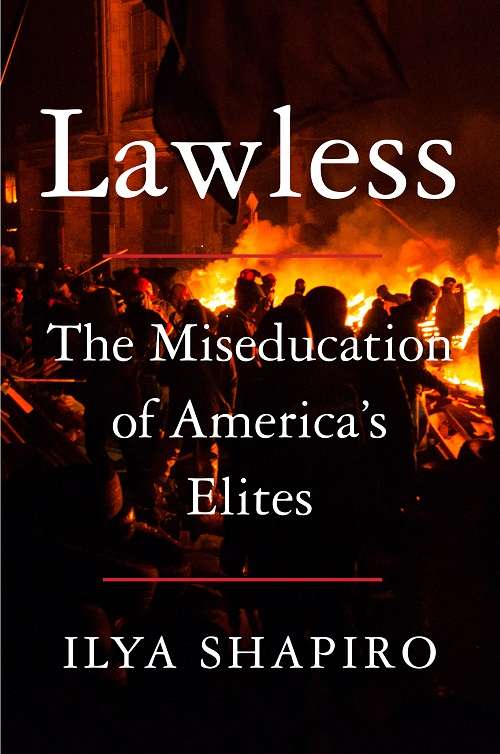
Lawless IV: Leadership Failures Old and New

The pandemic showed the weakness of the leadership class. [UPDATE: Inadvertently posted it under my byline, but it's of course Ilya Shapiro's post, as the byline now reflects. -EV]

|

People who study these things point to the Ferguson protests of 2014 as the discernible moment when CRT/woke ideology broke into the mainstream. I describe in Lawless how the pandemic accelerated that trend toward perceiving our nation as racially intolerant, particularly as cultural influencers retreated to their laptops. The killing of George Floyd threw gas onto that fire, as institutions decided to radically restructure themselves overnight, centered on "antiracism." Everyone all of a sudden needed a vice president or associate dean for DEI.

Indeed, the pandemic was a boon to bureaucratic leviathans wishing to crawl even further into normal life. Anything could be justified as long as it was labeled a public-safety initiative. Any questioning of regulations would be labeled thought crime. In the resultant atmosphere, institutions seemed like organs of disorder and illogic, so it's little wonder that anarchic elements arose that questioned the very foundations of law and order.

And so we have illiberal student mobs, coached by professors who increasingly see their jobs as training activists, enabled by spineless deans who allow and encourage DEI to swallow every other law school goal. Counterexamples are few and far between; they're the exceptions that prove the rule because there's not much institutional will to remedy these problems. There was some hope that things might settle down after the waning of the pandemic, but the explosion of pro-Hamas sentiment on campus after October 7 showed that the heart of antisemitism in America lies on campus, among the most "progressive" people. As Bill Ackman put it in a revelatory essay the day Harvard president Claudine Gay resigned, antisemitism is the "canary in the coal mine." It's a leading indicator of underlying pathologies, which here means everything from cancel culture to ideological indoctrination, intellectual corruption to moral decay.

Read More

Was Justice Gorsuch thinking about Title IX in EMD Sales?

The FLSA case considers whether to apply the “preponderance of the evidence” standard or the “clear and convincing evidence” standard.

|

If you skipped EMD Sales v. Carrera, I won't blame you. The Supreme Court unanimously reversed the Fourth Circuit about the correct evidentiary standards in a Fair Labor Standards Act case. Boring, right? Maybe. But I think this case may be about something more. At issue was how an employer had to show if an employee was exempt from overtime and minimum wage laws. Did the employer need to make his case that the employee was exempt with a preponderance of the evidence? Or did he need to meet a higher burden, clear and convincing evidence?

There has been a long-running debate about whether the appropriate burden in Title IX is "preponderance" or "clear and convincing." In many cases, especially those involving allegations of sexual assault, the evidence boils down to a he-said, she-said. Universities can often impose sanctions based on a preponderance, but cannot punish students if they need to provide clear and convincing evidence.

Justice Kavanaugh's majority found that for the FLSA, the appropriate standard is a "preponderance." Kavanaugh expressly drew an analogy between FLSA and Title VII.

Most relevant here, the Court has applied a preponderance standard in Title VII employment-discrimination cases. See Price Waterhouse, 490 U. S., at 253–254 (plurality opinion); id., at 260 (White, J., concurring in judgment); id., at 261 (O'Connor, J., concurring in judgment). . . . Third, this is not a case where the government otherwise seeks to take "unusual coercive action" against an individual. Price Waterhouse, 490 U. S., at 253 (plurality opinion). Cases under the Fair Labor Standards Act are more akin to the Title VII cases where the Court has held that a preponderance standard applies. If clear and convincing evidence is not required in Title VII cases, it is hard to see why it would be required in Fair LaborStandards Act cases.

If the standard for Title VII is preponderance, would the standard for Title IX also be preponderance? 

Justice Gorsuch wrote a brief concurring, joined by Justice Thomas:

Sometimes, the Constitution or Congress provides a particular standard of proof. See ante, at 4–5. If not, courts must find one. As in other contexts, they do so by examining the legal backdrop against which Congress has legislated. See, e.g., Dixon v. United States, 548 U. S. 1, 17 (2006); cf. Astoria Fed. Sav. & Loan Assn. v. Solimino, 501 U. S. 104, 108 (1991) ("Congress is understood to legislate against a background of common-law adjudicatory principles"). In civil cases, those background legal principles typically require proof by a preponderance of the evidence. See ante, at 4. Occasionally, though, the default "common-law rule" provides instead for a "heightened standard of proof." Microsoft Corp. v. i4i L. P., 564 U. S. 91, 116 (2011) (THOMAS, J., concurring in judgment). Either way, courts apply the default standard unless Congress alters it or the Constitution forbids it. See, e.g., Octane Fitness, LLC v. ICON Health & Fitness, Inc., 572 U. S. 545, 557–558 (2014). To do otherwise would be to "choose sides in a policy debate," ante, at 7, rather than to declare the law as our judicial duty requires. Our decision today is consistent with this understanding, and I am pleased to join it.

I suspect Gorsuch and Thomas are writing about Title IX. They likely think the Due Process Clause requires the higher burden of proof. Alternatively, a "common-law rule" for a "heightened standard of proof" ought to apply to these disciplinary proceedings.

Given the outcome of the election, and recent litigation, the Biden Title IX regulations are not long for this world. The Trump Administration will likely revert back to "clear and convincing" evidence. And since there is no longer the benefit of Chevron deference, the Court will have to decide what is the best reading of Title IX. Given the longstanding adherence to "clear and convincing" evidence, and that "preponderance" is a more recent manifestation, I suspect the Trump rules would pass muster.

Professor Kagan Writes Perfect Synopsis of Arising Under Jurisdiction, Supplemental Jurisdiction, and Federal Removal

All CivPro students should read these pages.

|

Justice Kagan's opinion in Royal Canin U. S. A. v. Wullschleger was such a joy to read, and a reminder of how good of a CivPro professor she must have been. 

Here are the facts. A case was filed in state court with both federal and state claims on the face of the complaint. The defendant removed the case to federal court, invoking supplemental jurisdiction over the state-law claims. The plaintiff amended the complaint in federal court, dropping all federal claims, leaving only state claims. Does the case stay in federal court by virtue of supplemental jurisdiction? The Court, per Justice Kagan, says no. "When an amendment excises the federal-law claims that enabled removal, the federal court loses its supplemental jurisdiction over the related state-law claims."

All CivPro students should read Part I-A of Kagan's opinion, from the bottom of page 1 through the top of page 4. It is a tight and crisp summary of the relationship between §1331 (arising under jurisdiction), §1367(a) (supplemental jurisdiction), and §1441(a) (removal jurisdiction). Here is the full section (and stick around for some other observations about the case at the end):

Read More

Second Amendment Roundup: Supreme Court Relists Two Cases

Citizens are ultimately responsible for their own security.

|

The Supreme Court has relisted two Second Amendment cases for its conference on Friday January 17.  They include Snope v. Brown, which concerns whether Maryland may ban semiautomatic rifles that are in common use for lawful purposes, and Ocean State Tactical v. Rhode Island, which asks whether a confiscatory ban on the possession of magazines that are in common use violates the Second Amendment.  Last Friday, when it relisted these cases, the Court denied certiorari in two other Second Amendment petitions (see my posts on all four of the cases here and here).

The courts of appeals in the above two relisted cases held that no one "needs" the banned rifles and magazines that Americans nationwide choose.  They rely on the false premise that the government will be there to protect them.

Recent mass tragedies reaffirm how inapt or incapable the government may be to protect lives.  They are wakeup calls for why Second Amendment rights are so fundamental.  It's been said time and again, but citizens really are their own first responders.

The Los Angeles wildfires have left thousands homeless.  California law doesn't make looting during an emergency a felony.  To date, some 50 looters have been arrested, and some district attorneys are advocating for changes to California's current laws, but this is too little too late for the thousands of Americans rendered homeless.  For those residents whose homes are still standing, they may have to rely on their own firearms to defend against the plundering.  Given the extent of the devastation, it's unrealistic to think that the police will be able to timely respond (if at all) to a 911 call about a potential burglary.

When it comes to police protection from human violence, New Orleans proudly declared large areas including Bourbon Street a gun-free zone but neglected to erect the bollards that may have prevented the ISIS terrorist from running over dozens of people, killing 14.  That occurred early on New Years' Day.

The same day in New York City, there were three separate stabbings on the subways.  The day before, a man was pushed onto the subway tracks.  The week before, a man was stabbed to death during an attempted robbery, and a woman was burned to death while sleeping on the train.  All told, 579 felony assaults were reported on the NYC subway in 2024.

Not to worry, the New York Penal Law declares the subway (and countless other places) a "sensitive location" and makes it a felony to possess a firearm in such places, even by a person with a carry permit.  That law was passed in reaction to, and to nullify, the Supreme Court's Bruen decision, which held that New York's restrictions on the issuance of carry permits violate the Second Amendment.  Permits had been limited to the rich and the powerful as well as those who paid bribes to the NYC License Division.

Remember when the entire NYC police department was mobilized to arrest the citizen who dared use a firearm to defend himself from robbers on the subway?  Routine murders didn't matter much, but no stops were pulled when it came to apprehending the likes of Bernard Goetz, the bespeckled nerd, aka "Subway Vigilante," who shot four armed robbers when they attacked him.  The tradition of prosecuting those who defend themselves or threatened victims continues with the now-defunct homicide charges against the bodega clerk Jose Alba and the Good Samaritan Daniel Penny.

It's worth recalling some of the remarks of the Justices in the oral argument in Bruen.  Chief Justice John Roberts stated that "if the purpose of the Second Amendment is to allow people to protect themselves, that's implicated when you're in a high-crime area."  Justice Samuel Alito was more specific:

So I want you to think about people like this, people who work late at night in Manhattan, it might be somebody who cleans offices, it might be a doorman at an apartment, it might be a nurse or an orderly, it might be somebody who washes dishes. None of these people has a criminal record. They're all law-abiding citizens. They get off work around midnight, maybe even after midnight. They have to commute home by subway, maybe by bus. When they arrive at the subway station or the bus stop, they have to walk some distance through a high-crime area, and they apply for a license, and they say: Look, nobody has told – has said I am going to mug you next Thursday. However, there have been a lot of muggings in this area, and I am scared to death. They do not get licenses, is that right?

New York's lawyer confirmed that, no, "if there's nothing particular to them," they don't get carry licenses.  Justice Alito responded, "all these people with illegal guns, they're on the subway … they're walking around the streets, but the ordinary hard-working, law-abiding people I mentioned, no, they can't be armed?"

These comments by the Justices recall criminal justice reformer Cesare Beccaria's truisms in Crimes and Punishments (1764), "The laws that forbid the carrying of arms … disarm those only who are neither inclined nor determined to commit crimes…. Such laws make things worse for the assaulted and better for the assailants; they serve rather to encourage than to prevent homicides, for an unarmed man may be attacked with greater confidence than an armed man."  As documented in my book The Right to Bear Arms and discussed in greater detail in Mark W. Smith's article Enlightenment Thinker Cesare Beccaria and His Influence on the Founders, Beccaria was highly influential to our Founders like John Adams and Thomas Jefferson.

*  *  *

I'd like to make a correction to my recent post on Colorado's SB 3, which would ban transfer of semiauto rifles, gas-operated semiauto handguns, and semiauto shotguns if they use detachable magazines.  I misidentified the Remington 870 DM as in the last category, but it is a pump.  A correct example would be the SAS-12 semiauto shotgun which uses a 3-round detachable magazine.

Bill DeBlasio Argued N.Y. Had First Amendment Duty to Pay Travel Costs for NYPD Security Detail on His Presidential Campaign

|

A short excerpt from the 33,000-word De Blasio v. N.Y. City Conflict of Interest Board, decided Tuesday by Manhattan judge Shahabuddeen Abid Ally:

Bill DeBlasio … was Mayor of New York City from 2014 to 2021. In May 2019, Petitioner announced that was he running for President of the United States. Four months later, in September 2019, Petitioner suspended his campaign. [I had completely forgotten that, if I ever noticed in the first place. -EV] During his campaign, Petitioner or members of his immediate family took 31 out-of-state trips on which they were assigned and accompanied by a full-time security detail of officers of the New York City Police Department ….

Shortly before announcing his candidacy, Petitioner consulted [the] New York City Conflict of Interest Board … on whether … the City of New York … could pay all costs associated with providing Petitioner and his immediate family an NYPD security detail during political trips…. [T]he Board opined that while the City could indeed pay the officers' salaries and overtime, it could not pay the officers' out-of-City travel-related costs. Payment of those costs by the City, the Board advised, would violate the City's conflict-of-interest laws, … because it would constitute a prohibited use of City resources for a non-City purpose as well as Petitioner's use of his official position for his own financial gain or personal advantage.

Read More

Free Speech

TikTok, HamHom, and the First Amendment

|

I was having a conversation with my Stanford colleague Diego Zambrano, and this perspective on the TikTok case emerged. I'm not positive it's a sound perspective; but I thought I'd pass it along and see what people thought about it.

[1.] Let's imagine for a moment that there was a social media platform, HamHom, that was run by Hamas. Hamas is a designated foreign terrorist organization, so the federal material support statute outlaws "knowingly provid[ing] material support or resources" to it. That includes providing "communications equipment" and general "facilities" or "service[s]." It seems to me that it would therefore be illegal for, say, Google and Apple to carry the HamHom app in their app stores, or to provide internet hosting services for HamHom.

And this application of the material support statute to HamHom would be constitutional, given Holder v. Humanitarian Law Project (2010). Holder upheld parallel provisions of the material support statute that banned providing "training" and "expert advice or assistance" to designated foreign terrorist organizations.

The Court recognized that the statute restricted speech, including the challengers' plans to "train members of [a terrorist group] on how to use humanitarian and international law to peacefully resolve disputes," and to "teach [the group's] members how to petition various representative bodies such as the United Nations for relief." But the Court nonetheless upheld the law, because it was "carefully drawn" and served "an urgent objective of the highest order"—the interest in "combating terrorism." That was especially so because the law targeted activity coordinated with the foreign organization, and excluded "independent advocacy." (Op-eds in the New York Times praising a foreign terrorist organization weren't covered, however much they might help the organization.)

Given that providing training and expert advice to Hamas is illegal and constitutionally unprotected, providing it with communications facilities (again, such as internet hosting or app distribution) would be, too. That would be true even if our concern is Hamas's use of the facilities as a means of gathering detailed information about individual Americans (e.g., what they're viewing, what they're searching for, and so on) or as a means of spreading Hamas propaganda. And it would be true even if HamHom had somehow drawn a lot of American users, so that banning it (and thus making American users switch to other platforms) would make it harder for them to reach the audience that they had developed on HamHom.

Read More

Free Speech

Free Speech and Private Power: No Categorical Right to Control Property

|

[I am serializing my short Harvard Law Review Forum essay titled "Free Speech and Private Power", responding to the Harvard Law Review's publication of Evelyn Douek & Genevieve Lakier's excellent new article, Lochner.com? I actually agree with much of what Douek & Lakier say, but offer a somewhat different perspective on the matter, mostly asking what the Court's recent cases mean going forward, rather than trying to critique them.]

[1.] In Moody.—While Moody protected some platform rights, it rejected the view that a property owner has a categorical First Amendment right to make sure that its property is not used to convey messages of which it disapproves. Such an argument was made, based on Wooley v. Maynard, and it could have derived some support from cases such as Janus v. AFSCME, Council 31, which held that the government may not require people to contribute money for ideological uses that they reject.

But the Court made clear that "ordering a party to provide a forum for someone else's views implicates the First Amendment" "if, though only if, the regulated party is engaged in its own expressive activity, which the mandated access would alter or disrupt." And the Court acknowledged that PruneYard Shopping Center v. Robins and Rumsfeld v. FAIR upheld compulsions that an entity host speech on its property, "because in those cases the compelled access did not affect the complaining party's own expression."

Read More

Politics

Lawless III: It's the Bureaucracy, Stupid

CRT gets all the attention, but this less-sexy part is equally important—if not more so.

|

As I wrote on Monday in my introduction to Lawless, the crisis in higher-ed is different than the decades-old complaint about the liberal takeover of the academy. Instead, university officials placate, facilitate, and even foment illiberal mobs, with everyone else keeping their heads down to avoid the cancellation crossfire. And that's a story of growing bureaucracies.

In the 25 years ending in 2012, the number of professional university employees who don't teach grew at about twice the rate of students, while tuition at public colleges more than tripled. Those trends have only accelerated, though useful statistics are hard to come by as surveyors change methodologies and the government fails to collect or disclose uniform data.

What all this really means is that students are paying more and more to fund an expanding cohort of well-compensated bureaucrats, without getting anything in return. And this isn't just a budget issue. Administrators are more radical than professors, and not steeped in norms of academic freedom, all of which detracts from the educational environment.

Read More

The 10th Most-Cited-by-Cases Law Journal Article Since 1990 Was Written by a Student

|

I was looking at a list of law journal articles published since 1990 that were most heavily cited by courts (generated using HeinOnline), and saw that #10 on the list was a student-written Note, Powers of Congress and the Court Regarding the Availability and Scope of Review (Harv. L. Rev. 2001), cited by over 100 cases. As with many heavily cited articles, this one got many follow-on cites stemming from some early appellate court cites; but that itself is a mark that it had something significant to say that made its way into influential appellate court reasoning.

I resolved to note this on the blog, but then I had to find the author's name, since Harvard Law Review Notes are unsigned; and I was especially pleased that the author was Victoria Dorfman, a Jones Day lawyer whom I've known for over 20 years. Nice work!

Special Counsel David Weiss Responds To President Biden's Attacks on Hunter Biden Prosecution

"These baseless accusations have no merit and repeating them threatens the integrity of the justice system as a whole."

|

Jack Smith isn't the only game in town. Attorney General Garland also released a 278-page report from Special Counsel David Weiss concerning Hunter Biden. Because President Biden gave his son a full, complete, and preemptive pardon, Weiss did not discuss any other potential uncharged conduct. But Weiss spent several pages responding to President Biden's comments concerning the prosecution.

In making my decisions, I remained impervious to political influence at all times. However, Mr. Biden and his counsel have continuously accused me of vindictively and selectively prosecuting him. 137 And in the press release accompanying his son's pardon, President Biden echoed these claims, stating that he believed Mr. Biden was "selectively, and unfairly, prosecuted."138 These baseless accusations have no merit and repeating them threatens the integrity of the justice system as a whole.

Weiss quotes from several judges who ruled against Hunter, and found no evidence of political bias.

Weiss notes that Biden's own spokesperson has stressed that this prosecution was independent, until Biden flipped the script:

Moreover, throughout this prosecution, President Biden and his spokesperson have repeatedly and emphatically asserted that the prosecution "has been done in an independent way by the Department of Justice," 146 that the President would "abide by the jury's decision," 147 and that he would not pardon his son. 148 These remarks stand in stark contrast to the President's recent assertion that the jury's verdict and Mr. Biden's admission of guilt amounted to a "miscarriage of justice."149 Only after Mr. Biden's guilt had been fully and fairly adjudicated did the President claim that this prosecution was the result of "raw politics" and that "[n]o reasonable person who looks at the facts of Hunter's cases can reach any other conclusion than Hunter was singled out only because he is my son." 150

Weiss concludes:

Politicians who attack the decisions of career prosecutors as politically motivated when they disagree with the outcome of a case undermine the public's confidence in our criminal justice system. The President's statements unfairly impugn the integrity not only of Department of Justice personnel, but all of the public servants making these difficult decisions in good faith.

I think Biden's pardon of his son, attack on the special counsel, and vetoing of the JUDGES Act will go a long way to defining how Biden will be remembered: not as uniting candidate who put his country before any party, but as just another self-serving politician who puts his own interest first when push comes to shove. There are plenty of those politicians in D.C., and Biden is no different.

Jack Smith Explains Why He Did Not Charge Trump With Insurrection

And Smith demonstrates why the Colorado Supreme Court got it wrong.

|

Attorney General Merrick Garland has released Volume I of Jack Smith's report, which focuses on the January 6 prosecution of Trump. Smith addresses one of the lingering questions: why did he not charge Trump with violating the federal insurrection statute (18 U.S.C. § 2383). In early 2021, Seth Barrett Tillman and I wrote an article anticipating a prosecution based on Section 2283, but that case would never come.

First, Smith explains that there was no clear definition under federal law for an "insurrection." He acknowledges that the Colorado Supreme Court found that the attack on the Capitol was an insurrection as that term was used in Section 3. Likewise, some federal courts in D.C. described the attacks as an insurrection. "These cases, however, did not require the courts to resolve the issue of how to define insurrection for purposes of Section 2383, or apply that definition to the conduct of a criminal defendant in the context of January 6."

During the Section 3 debates, Will Baude, Mike Paulsen, and many others, thought it was perfectly clear what an insurrection was, and that January 6 was clearly an insurrection. Smith did not think the issue was so clear. Seth Barrett Tillman and I also did not take a position on this question.

Second, Smith did not think there was enough authority to distinguish an insurrection from a riot:

The Office recognized why courts described the attack on the Capitol as an "insurrection," but it was also aware of the litigation risk that would be presented by employing this long-dormant statute. As to the first element under Section 2383-proving an "insurrection against the authority of the United States or the laws thereof'-the cases the Office reviewed provided no guidance on what proof would be required to establish an insurrection, or to distinguish an insurrection from a riot.

Third, Smith recognized that an insurrection usually involves an attempt to overthrow a sitting government, but on January 6, Trump was President of that government.

In case law interpreting "insurrection" in another context, one court has observed that an insurrection typically involves overthrowing a sitting government, rather than maintaining power, which could pose another challenge to proving beyond a reasonable doubt that Mr. Trump's conduct on January 6 qualified as an insurrection given that he was the sitting President at that time. . . .  The Office did not find any case in which a criminal defendant was charged with insurrection for acting within the government to maintain power, as opposed to overthrowing it or thwarting it from the outside. Applying Section 2383 in this way would have been a first, which further weighed against charging it, given the other available charges, even if there were reasonable arguments that it might apply.

In November 2023, Rob Leider argued that the President cannot commit an insurrection against the government he leads. Smith seems to have approached the issue similarly.

Fourth, Smith finds there was insufficient evidence to show that Trump personally engaged in insurrection, but there was evidence that he gave aid and comfort to an insurrection:

As to the second element under Section 2383, there does not appear to have ever been a prosecution under the statute for inciting, assisting, or giving aid or comfort to rebellion or insurrection. The few relevant cases that exist appear to be based on a defendant directly engaging in rebellion or insurrection, but the Office's proof did not include evidence that Mr. Trump directly engaged in insurrection himself.

The Colorado trial court, and the Colorado Supreme Court found that Trump personally engaged in insurrection.

¶196 The question remains whether the record supported the district court's finding that President Trump engaged in the January 6 insurrection by acting overtly and voluntarily with the intent of aiding or furthering the insurrectionists' common unlawful purpose. Again, mindful of our applicable standard of review, we conclude that it did, and we proceed to a necessarily detailed discussion of the evidence to show why this is so. Anderson v. Griswold, 2023 CO 63, ¶ 196, 543 P.3d 283, 332 (2023).

Jack Smith expressly disagrees with this claim. Again, Smith is not talking about whether the evidence was sufficient to demonstrate proof beyond a reasonable doubt. He said the record "did not include evidence," full stop.

Fifth, Smith writes that Trump may have given aid and comfort to an insurrection (assuming there was an insurrection.)

Read More

Free Speech

Free Speech and Private Power: The Right to "Present[] a Curated Compilation of Speech"

|

[I am serializing my short Harvard Law Review Forum essay titled "Free Speech and Private Power", responding to the Harvard Law Review's publication of Evelyn Douek & Genevieve Lakier's excellent new article, Lochner.com? I actually agree with much of what Douek & Lakier say, but offer a somewhat different perspective on the matter, mostly asking what the Court's recent cases mean going forward, rather than trying to critique them. Here is the section on Moody's reaffirming the right to "present[] a curated compilation of speech."]

[1.] The Majority.—To begin with, as Douek and Lakier note, the Moody majority strongly reaffirmed private entities' power to exclude speech from their "curated compilation[s]" that make up "a single speech product," such as news feeds, parades, and newspapers. That remains true even when the private entities have a great deal of influence over the public sphere.

And this makes sense, partly because we rely on private entities to provide us as readers some valuable services that the First Amendment disables the government from providing. For instance, the government's power to restrict misinformation is sharply limited. But we of course count on newspapers and other publishers to avoid misinforming their readers, including by screening third-party submissions (such as op-eds) for accuracy.

Indeed, it would be hard to have effective democratic self-government or search for truth without some private entities—newspapers, scientific journals, book publishers—that help us sort the true from the false and good ideas from bad ones. The Court concluded that the same principles that protect newspaper publishers, parade organizers, and the like also protect social media platforms. A magazine might want to present a conservative view or a liberal view. A parade organizer might want to organize a parade that conveys a particular theme and not other messages that the organizer views as inconsistent with the theme. Likewise for social media platforms striving to create particular "curated speech products" for their users.

Read More

Politics

Lawless II: Critical Theory Returns with a Vengeance

You can’t have legal education dominated by an ideology that denies the law’s legitimacy.

|

Yesterday I laid out my how my personal experience led me to "do the work" and write Lawless. That research uncovered some disturbing differences from when I was in law school in the early 2000s. Back then, critical theory was a spent force. But now "the crits" are back, even stronger, and not just in literature and sociology departments.

Critical legal studies (CLS), which developed in the 1970s, teaches that laws enshrine biases against marginalized groups and thus preserve the status quo. CLS scholars also criticize formalism, which they see as overly focused on analyzing the logic of doctrines, principles, and texts without considering broader social and political implications. From their perspective, the law is simply the codification of the cultural and political preferences of those in power.

In 1973, Derrick Bell, the first black tenured professor at Harvard Law School, wrote that racism was a permanent feature of American life that couldn't be remedied under existing legal structures. After he left Harvard to become dean at the University of Oregon, students began protesting their law school's lack of diversity. The Harvard Law Review invited Bell to write the prestigious foreword to its 1984 Supreme Court volume, allowing him to dispense with academic rigor and instead present his theories of racial grievance as allegorical narratives. Those establishmentarian career-builders thus helped mainstream the ideas that would become CRT.

Read More

Second Amendment Roundup: Circuit Conflict in Felon Gun Ban Cases

Congress should reinstate ATF appropriations for removal of disabilities.

|

On December 23, the Third Circuit en banc handed Bryan Range an early Christmas present by ruling that despite his decades-old conviction for a false statement to obtain food stamps in violation of Pennsylvania law, he "remains among 'the people' protected by the Second Amendment."  Further, "the Government did not carry its burden of showing that the principles underlying our Nation's history and tradition of firearm regulation support disarming Range…."

The case is Range v. Attorney General.  After the Supreme Court in Bruen reinforced the text-history approach to deciding Second Amendment cases, in 2023 the Third Circuit had reached that same result.  However, after deciding Rahimi, the Supreme Court granted Merrick Garland's cert petition, vacated the judgment, and remanded the case for further consideration in light of Rahimi.

In a decision by Judge Thomas Hardiman, the majority again ruled in favor of Range.  It reasoned, first, that the criminal histories of the parties were not at issue in the Supreme Court's previous civil cases – Heller, McDonald, and Bruen – with their dicta about "law-abiding" persons having the right to bear arms.  Second, "the people" also appears in the First and Fourth Amendments, and felons are included.  Third, certain groups may be stripped of Second Amendment rights, but limits exist.  And fourth, persons may not be deprived of Second Amendment rights because they are not "responsible."

The Range court continued that "today, felonies include a wide swath of crimes, some of which seem minor," and that legislatures should not have "unreviewable power to manipulate the Second Amendment by choosing a label." The first federal ban on firearm receipt by felons and the father to today's felon gun ban, 18 U.S.C. § 922(g)(1), was passed in 1961, far short of the requirement that historical precedents be "longstanding."  In a passage sure to encourage challenges to other parts of § 922(g), the court stated: "Nor are we convinced by the 1920s and 1930s state statutes banning firearm possession by felons, or the 1960s laws disarming drug addicts and drug users, 1980s laws disarming persons unlawfully present in the United States and persons dishonorably discharged from the armed forces, or 1990s laws disarming domestic violence misdemeanants."

While "Rahimi did bless disarming (at least temporarily) physically dangerous people," the court concluded that there was "no evidence that he [Range] poses a physical danger to others or that food-stamp fraud is closely associated with physical danger."  Range was thus eligible under the Second Amendment to receive and possess firearms.

There were four concurring opinions in Range, all of which deserve careful study.  Judge Paul Matey focused on the classical sources, beginning with Cicero, that recognized the fundamental right to bear arms for self-defense.   He concluded with support "for greater executive review of petitions to restore firearm rights, regardless of whether Congress provides funding for 18 U.S.C. § 925(c)…."  That provision empowers ATF to consider petitions for relief from legal disabilities, but since 1992 Congress has prohibited use of funds to do so.

Judge Peter Phipps pointed out that before enactment of the federal felon gun ban, Attorney General Katzenbach incorrectly represented to Congress that "the Supreme Court of the United States long ago made it clear that the amendment did not guarantee to any individuals the right to bear arms."  No Supreme Court case made any such claim, and following Heller, "That advice has not aged well."

Judge Cheryl Ann Krause wrote that courts should not "blindly defer to a categorical presumption that a given individual permanently presents a special risk of danger without the opportunity for him to rebut it."  Absent other avenues of relief, federal courts should be open to consider those seeking restoration of gun rights.  Courts routinely make decisions about gun possession as a condition of bail and in sentencing, and so would be equipped to decide whether rights should be restored.

The final concurrence was by Judge Jane Richards Roth, who opined that "when disarmament is purely based on felon status (not an individualized assessment of danger to others), an indicator of the power to regulate is the maximum penalty for the offense of conviction."  Once the maximum penalty for which a convicted person might have been incarcerated passes, the person should be permitted to petition for restoration of rights.

The main difference between Judge Krause's and Judge Roth's concurrences is that the former opined that individuals should be eligible to seek reinstatement of their rights once their sentences are completed, while the latter would require them to wait until the time for the maximum possible penalty ran. Judge Krause's approach is plainly superior, as it reflects the actual punishment meted out for the crime. Notably, both Judges Krause and Roth had dissented from the en banc court's prior decision in favor of Range, but the Supreme Court's emphasis on temporary disarmament in Rahimi apparently persuaded them to reconsider their position.

Dissenting, Judge Patty Shwartz wrote that the majority disregarded the Supreme Court's statements that the felon ban was "longstanding" and "presumptively lawful," that the Second Amendment protects "law-abiding" persons, and that the historical test is not a "regulatory straightjacket."  She thought that status-based bans on Native Americans, Blacks, and Catholics were, however repugnant today, proper analogues for the felon ban, as they all were based on being "disloyal to the sovereign."

The Eighth Circuit reached the opposite result as the Third.  On August 8, in United States v. Jackson, it upheld the felon ban categorically.  Post-Bruen, it had already upheld the ban, but the Supreme Court granted the felon's cert petition, vacated, and remanded for reconsideration consistent with Rahimi.  Its subsequent decision replicated its earlier decision.

In the panel decision by Judge Steven Colloton, Jackson held that "there is no need for felony-by-felony litigation regarding the constitutionality of § 922(g)(1)."  The court opined that Rahimi does not require a showing of special danger by specific persons who are disarmed by laws applicable to categories of persons.  Jackson had been twice convicted of sale of controlled substances, although the court did not specify the type.

The clincher for categorical bans, Jackson reasoned, was based on historical practice: "Not all persons disarmed under historical precedents—not all Protestants or Catholics in England, not all Native Americans, not all Catholics in Maryland, not all early Americans who declined to swear an oath of loyalty—were violent or dangerous persons."  Voilà, no as-applied challenges are allowed even if the specific persons are not violent or dangerous.

Dissenting from denial of a petition for rehearing, Judge David Stras noted that the law Rahimi upheld required a finding of "a credible threat to the physical safety" of others. By leaping from "presumptively constitutional to always constitutional," the court "insulat[ed] felon-dispossession laws from Second Amendment scrutiny of any kind."  The decision deferred "to Congress's blanket determination that a group numbering in the tens of millions and ranging from murderers to ketchup-bottle tamperers categorically 'present[s] an unacceptable risk of danger if armed.'"

The Fourth Circuit recently agreed with the Eighth, in United States v. Hunt, holding that § 922(g)(1) is not subject to as-applied challenges. Notably, the panel (with Judge Toby Heytens writing) did not rely exclusively on history but also concluded that felons are not even part of the people under the plain text of the constitution. Query what this means for the First Amendment petition and assembly rights and Fourth Amendment rights of felons in the Fourth Circuit, as those rights also are guaranteed to "the people."

One more decision is worthy of note, that of the Sixth Circuit rendered on October 8. United States v. Williams, written by Judge Amul R. Thapar, was decided in the first instance after Rahimi and thus did not go through the GVR procedure.  The court allowed that "when the legislature disarms on a class-wide basis, individuals must have a reasonable opportunity to prove that they don't fit the class-wide generalization."

However, the Williams court opined, a person is "dangerous" and may be disarmed "if he has committed (1) a crime 'against the body of another human being,' including (but not limited to) murder, rape, assault, and robbery, or (2) a crime that inherently poses a significant threat of danger, including (but not limited to) drug trafficking and burglary." Crimes that entail "no threat of physical danger, like mail fraud, tax fraud, or making false statements" would be a harder case, but they were not involved here – Williams had been convicted of aggravated robbery.  (He has since filed a cert petition.)

Based on the above four cases, the cert conflict could not be more dramatic.  Range and Williams allow as-applied challenges to the felon ban.  Jackson and Hunt categorically allow no challenge to the ban.  Since felons are the overwhelming majority of persons prosecuted under § 922(g), resolution by the Supreme Court is direly needed.

Given the circuit split, the Supreme Court likely would grant cert if the government seeks review in Range. Whether the government will do so is an interesting question. The Biden administration surely would have – indeed, it did the last time the Third Circuit ruled in favor of Range. But the Trump administration my take a different position on the rights of non-violent felons than the Biden administration did.

Indeed, now that President-Elect Trump's conviction is final he himself is barred by § 922(g)(1) from possessing a firearm, even though his alleged crime had nothing at all to do with violence. Perhaps, the Trump administration will seek review to resolve the circuit split but argue that the Third Circuit was right to rule in favor of Range. It would not be the first time the federal government sought review while urging the Court to affirm a lower court ruling against the government—the Obama administration did just that in litigation challenging the Defense of Marriage Act.

Meanwhile, federal circuits that recognize as-applied challenges will impose on district courts the burden of case-by-case adjudication.  Their authority to do so would be necessitated by the duty to protect constitutional rights.

In doing so, such courts would not be substituting themselves for the Attorney General, who is empowered to remove disabilities under 18 U.S.C. § 925(c) based on a finding that the circumstances of the disability and the applicant's reputation are such that he/she "will not be likely to act in a manner dangerous to public safety."  The Supreme Court ruled in U.S. v. Bean that district courts have no authority to remove disabilities under the statute if the Attorney General fails to act.  Courts may only entertain appeals from administrative action, not from non-action.  But courts removing disabilities under the Second Amendment would not be doing so under § 925(c).

Congress could do our district judges a big favor and appropriate funding for ATF to administer § 925(c) again.  That may render the circuit conflict moot, as it did in BATF v. Galioto (1986), in which the Supreme Court ruled that an equal protection challenge to § 925(c) became moot when the Firearm Owners' Protection Act of 1986 extended the statute to include all § 922(g) disabilities, including mental commitments.

Despite Congress not funding removal of disabilities for over three decades, ATF's regulation (27 C.F.R. § 478.144) remains on the books with the procedure for filing and processing a petition to remove disabilities. (The regulation states that relief will not be granted if the applicant is prohibited from gun possession by the state law where he resides, but that is invalid because § 925(c) imposes no such condition for relief from the federal disability.) If the petition is denied, § 925(c) entitles the applicant to file a petition for judicial review in which new evidence may be admitted.  That provides a check on abusive agency action.

The ball is in Congress's court to restore funding. Otherwise, given the circuit split, it is likely that the Supreme Court will step in to resolve this issue soon.




More