

I'm delighted to report that David and Josh are among the recipients of the Heritage Foundation's 2025 Freedom and Opportunity Academic Prize, and that Todd won it last year. Many other academics in various fields (law, economics, history, philosophy, political science, and more) also received the prizes.
The Volokh Conspiracy
Mostly law professors | Sometimes contrarian | Often libertarian | Always independent | Est. 2002

Natalie Alkiviadou Guest-Blogging About "Hate Speech and the European Court of Human Rights"
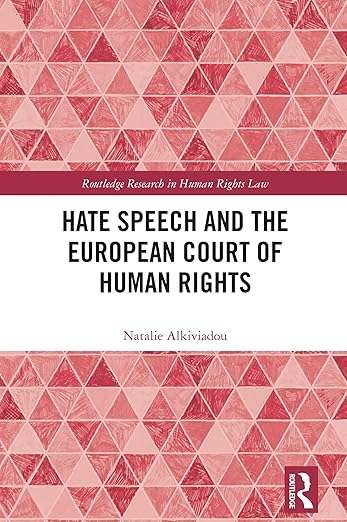
I'm delighted to report that Dr. Natalie Alkiviadou, Senior Research Fellow at the Future of Free Speech at Vanderbilt University will be guest-blogging this week about this new book of hers. Here is a summary of the book, from the publisher:
This book argues that the European Court of Human Rights (ECtHR) should reconsider its approach to hate speech cases and develop a robust protection of freedom of expression as set out in the benchmark case of Handyside v the United Kingdom. In that case, the ECtHR determined that Article 10 of the European Convention on Human Rights (ECHR), safeguarding the right to freedom of expression, extends protection not only to opinions which are well received but also to those deemed offensive, shocking, or disturbing. However, subsequent rulings by the Court have generated a significant amount of contradictory case law.
Against this backdrop, this book provides an analysis of hate speech case law before the ECtHR and the now-obsolete European Commission on Human Rights. Through a jurisprudential analysis, it is argued that these institutions have adopted an overly restrictive approach to hate speech, which fails to provide adequate protection of the right to freedom of expression. It also demonstrates that there are stark inconsistencies when it comes to the treatment of some forms of 'hate speech' versus others.
Skrmetti, Mahmoud, and Free Speech Coalition - "Won't Somebody Please Think of the Children?"
I think Skrmetti, Mahmoud, and Free Speech Coalition can be summed up in a meme: Won't somebody please think of the Children? But more precisely, the Court was protecting children from misguided parents.
In Free Speech Coalition, the Court allowed the state to protect children from accessing pornography that their parents might wish to access. In Skrmetti, the Court allowed the state to protect children whose parents approved puberty blockers and cross-sex hormones. And in Mahmoud, the Court allowed parents to protect their children from the school board.
These three cases are not the same, but at bottom, they were all about protecting the children.
Free Speech Coalition Brings Text, History, and Tradition to the Free Speech Clause
Justice Thomas tries to Bruenify free speech doctrine, but I'm not sure it will work.
I have now finished reading Free Speech Coalition v. Paxton. This 6-3 decision upheld Texas's age-verification law to access pornographic materials online. Justice Thomas wrote the majority opinion and Justice Kagan wrote the dissent.
In many regards, this case is confounding. I think the Texas law is constitutional under any standard of review--rational basis, intermediate scrutiny, or strict scrutiny. And I think that Justice Kagan likely agrees on that point, though I doubt that her two colleagues would uphold the law under strict scrutiny. The only debate concerns the appropriate standard of review. I think the Fifth Circuit rightly found that this law is best reviewed with rational basis scrutiny. And I suspect that Justice Thomas agrees with the Fifth Circuit. Indeed, the first half of his opinion sounds as if the law will be reviewed deferentially.
Yet, the majority ultimately applies intermediate scrutiny, under something like the O'Brien test. Thomas probably needed to go down this path to hold five votes. On this point, I find myself in agreement with Justice Kagan. O'Brien seems like a very bad fit for the sort of law at issue. O'Brien is about conduct with speech elements. The Texas law does not implicate any conduct. Indeed, while I usually celebrate Justice Thomas's opinions, Paxton was not his finest moment. This is an area where Justice Kagan clearly has more expertise, and she shows it. Then-Professor Kagan did not write very much (sound familiar?), but she was a well-regarded expert on First Amendment law.
So what is going on here? Justice Thomas was trying to reorient Free Speech doctrine around text, history, and tradition. Or, Justice Thomas tried to Bruenify free speech doctrine, but I'm not sure it will work.
In Bruen, Thomas argued that Second Amendment claims are not reviewed with means-end scrutiny. And, Thomas claimed that this "Second Amendment standard accords with how we protect other constitutional rights," including the First Amendment. Specifically, for the government to meet its burden to restrict speech, it "must generally point to historical evidence about the reach of the First Amendment's protections." When I first read Bruen, I scratched my head with this sentence. Free Speech doctrine is a doctrinal mess. The Court has employed a series of different means-ends balancing test. Originalism is not really relevant to the the Free Speech clause.
In Free Speech Coalition, Justice Thomas, like in Bruen, was trying to ground the doctrine in text, history and tradition. At least with the Second Amendment, there was not much caselaw to apply. Heller was decided in what I've described as an "open field." But the Free Speech Clause is a thorny ticket with so much caselaw. I suppose that the fact that five members joined Thomas's opinion suggests that the Court is comfortable with changing course on Free Speech law. Then again, five members joined his Bruen opinion and jumped ship at an entirely predictable moment.
I blame Chief Justice Roberts (who else?). He should not have given this opinion to Justice Thomas. Indeed, for reasons that are unclear, Thomas took a shot at Roberts's majority opinion isn Williams-Yulee v. Florida Bar:
In Williams-Yulee v. Florida Bar, 575 U. S. 433 (2015), a bare majority held that a ban on the personal solicitation of campaign donations by candidates for judicial office survived strict scrutiny. But, only four Members of the majority thought that the statute triggered strict scrutiny to begin with.
Thomas has a hard time holding together a majority opinion on a difficult case. When he was given the Bruen majority, the Court had to clean it up barely a year later in Rahimi. I would have assigned this opinion to Justice Barrett or Justice Alito or really anyone else. Hell, Roberts could have assigned Kagan the majority opinion, to uphold this law under strict scrutiny, with Thomas and Alito concurring to say rational basis review should apply. I can imagine how much finessing this majority opinion took to cross the finish line. Roberts probably would take this one back.
So (at least for now) what is Thomas's approach: use history to determine what is the appropriate standard of review. If there is some long-standing, "traditional" prohibition, the Court should presume it is constitutional; and given that strict scrutiny is usually fatal, that sort of prohibition must be subject to a more deferential standard of review. States have long imposed some sort of age-verification system on pornography, so these sorts of law are not subject to strict scrutiny.
Here are all the ways that Justice Thomas refers to "tradition":
And petitioners concede that an in-person age verification requirement is a "traditional sort of law" that is "almost surely" constitutional. Tr. of Oral Arg. 17.
H. B. 1181 thus falls within Texas's traditional power to protect minors from speech that is obscene from their perspective.
Strict scrutiny therefore cannot apply to laws, such as in-person age-verification requirements, which are traditional, widespread, and not thought to raise a significant First Amendment issue.
Petitioners would like to invalidate H. B. 1181 without upsetting traditional in-person age-verification requirements and perhaps narrower online requirements. But, strict scrutiny is ill suited for such nuanced work. The only principled way to give due consideration to both the FirstAmendment and States' legitimate interests in protecting minors is to employ a less exacting standard.
Thomas also tries to bring some sort of means-ends balancing into the historical component. He speaks of "ordinary and appropriate means." That is sort-of like "necessary and proper"?
Instead, as we have explained, the First Amendment leaves undisturbed States' power to impose age limits on speech that is obscene to minors. That power, according to both "common sense" and centuries of legal tradition, includes the ordinary and appropriate means of exercising it.Scalia & Garner, Reading Law, at 192. And, an age-verification requirement is an ordinary and appropriate means of enforcing an age limit, as is evident both from all other contexts where the law draws lines based on age and from the long, widespread, and unchallenged practice of requiring age verification for in-person sales of material that is obscene to minors.
Justice Kagan, in dissent, expresses bewilderment about this approach.
The majority's opinion concluding to the contrary is, to be frank, confused. The opinion, to start with, is at war with itself.
See, I got in trouble for calling a Supreme Court justice "confused."
Kagan continues:
The usual way constitutional review works is to figure out the right standard (here, strict scrutiny because H. B. 1181 is content-based), and let that standard work to a conclusion. It is not to assume the conclusion (approve H. B. 1181 and similar age verification laws) and pick the standard sure to arrive there. But that is what the majority does. To answer what standard of scrutiny applies, the majority first spends four pages lauding age verification schemes as "common," "traditional,""appropriate," and "necessary." Ante, at 13–18. In other words, all over the place, and a good thing too. No wonder the majority doesn't land on strict scrutiny.
Kagan writes that the majority's approach seems backwards:
The analytic path of today's opinion is winding, but I take the majority to begin with a conviction about where it must not end—with strict scrutiny. The majority is not so coy about this backwards reasoning. To the contrary, it defends it.
Thomas sort of acknowledges the criticism:
Finally, the dissent claims that we engage in "backwards," results-oriented reasoning because we are unwilling to adopt a position that would call into question the constitutionality of longstanding in-person age-verification requirements. Not so. We appeal to these requirements because they embody a constitutional judgment—made by generations of legislators and by the American people as a whole—that commands our respect. A decision "contrary to long and unchallenged practice . . . should be approached with great caution," "no less than an explicit overruling" of a precedent. Payne v. Tennessee, 501 U. S. 808, 835 (1991) (Scalia, J., concurring). It would be perverse if we showed less regard for in-person age-verification requirements simply because their legitimacy is so uncontroversial that the need for a judicial decision upholding them has never arisen.
I think this is a Kavanaugh-like mode of reasoning about tradition. But I'm not entirely sure how it maps on the First Amendment. I think Thomas would determine the level of scrutiny based on tradition. This wasn't the Court's approach before. But it, apparently, is the approach now. Or at least until the Court walks it back.
I do have to commend Justice Kagan's dissent. This is vintage Kagan. It has all of her usual witticisms, combined with a deep knowledge of the subject matter. It was a bit of a breath of fresh air, as this last term has not been her best. She simply didn't write that much, and what she wrote was not really memorable. Moreover, her questions from the bench were not as tight as they had been in the past. I sense she is frustrated and perhaps annoyed at where the Court is. I also sense some discord with her progressive colleague. For example, it would have made so much sense for Justice Kagan to write the principal dissent in Casa. The former federal courts and procedure professor would have been uniquely suited to respond to another former federal courts and procedure professor. But instead, we got Justice Sotomayor.
Donald Trump, The Transformational President
The New York Times admits that Trump is going further than Buckley, Reagan, Goldwater, and Taft "might have imagined possible"
Today the New York Times published a "news analysis" titled "From Science to Diversity, Trump Hits the Reverse Button on Decades of Change." For those who do not read the Times--and I don't blame you--a "news analysis" is where a reporter writes an op-ed. It is not entirely objective, but instead allows a card-carrying journalist to tell us what he really thinks. Yet, if you read between the lines, you can actually see some admiration: Trump is doing what was once thought impossible. Consider this excerpt:
Mr. Trump's shift into reverse gear reflects the broader sentiments of many Americans eager for a change in course. The United States has cycled from progressive to conservative eras throughout its history. The liberal period ushered in by Franklin D. Roosevelt eventually led to a swing back to the right under Ronald Reagan, which led to a move toward the center under Bill Clinton.
But Mr. Trump has supercharged the current swing. The influential writer William F. Buckley Jr. once defined a conservative as someone standing athwart history and yelling, "Stop!" Mr. Trump seems to be standing athwart history yelling, "Go back!"
He has gone further than noted conservatives like Mr. Buckley, Mr. Reagan, Barry Goldwater or Robert Taft might have imagined possible. While they despised many of the New Deal and Great Society programs that liberal presidents introduced over the years, and sought to limit them, they recognized the futility of unraveling them altogether.
"They were living in an era dominated by liberals," said Sam Tanenhaus, author of "Buckley," a biography published last month. "The best they could hope for was to arrest, 'stop,' liberal progress. But what they dreamed of was a counterrevolution that would restore the country to an early time — the Gilded Age of the late 19th and early 20th centuries."
"Trump," he added, "has outdone them all, because he understands liberalism is in retreat. He has pushed beyond Buckley's 'stop,' and instead promises a full-throttle reversal."
Indeed, although Mr. Reagan vowed during his 1980 campaign to abolish the Department of Education, which had been created the year before over the objections of conservatives who considered it an intrusion on local control over schools, he never really tried to follow through as president, because Democrats controlled the House. The issue largely faded until Mr. Trump this year resurrected it and, unlike Mr. Reagan, simply ignored Congress to unilaterally order the department shuttered.
One of Trump's greatest strengths is his ability to not care what elites think. Usually, when the elites calls a conservative a racist or sexist or homophobe or something else, he wilts. When they accuse a conservative of trying to hurt poor people or roll back progress, he caves. When they charge a conservative with standing on the wrong side of the arc of history, he switches sides. Not Trump. He can almost single-handedly shift the Overton window on what topics are open for discussion. And Trump inspires other conservatives to likewise discount what elites think. That mantra has spread.
Things that have been accomplished would have been unfathomable a decade ago. Let's just rattle off a few high points. Roe v. Wade is gone. Humphrey's Executor is on life support. Even after Obergefell and Bostock, we got Skrmetti. Despite all the outrage, illegal immigration at the southern border has basically trickled to a halt. Blind deference to "experts" has been irreparably altered by the distrust occasioned by COVID and transgender medicine for children. The federal bureaucracy is being dismantled. Nationwide injunctions are no more. And so on.
A common refrain is that Trump is ignoring the Constitution. During the New Deal and the Great Society, FDR and LBJ did great violence to the Constitution and the separation of powers. They got away with it because they were trying to do the "right" thing. Yet critics expect Trump to behave nicely, and be a good conservative like George W. Bush or Mitt Romney. That's not what we have. And in Trump's defense, some (but not all) of his actions are seeking to restore the original meaning of the Constitution, whereas the same could not be said for FDR and LBJ.
Speaking of book projects, I am in the early stages of a three-volume set on the Trump presidency and the Constitution. I actually wrote most of the first installment by the end of 2020, but put it on hold after January 6. I had no idea what the future would bring, so I stood down. I think the first installment would track from the moment Trump came down the golden escalator to election day in 2020. The second installment would start with the 2020 election, cover January 6, and chronicle the three years of Lawfare (Jack Smith, Section 3, and everything else). The third installment would begin on inauguration day 2025, through… Well, I'm not really sure where this all ends. But it is clear enough to me that Trump has transformed the nation in ways that likely cannot just be forgotten come 2029.
Constitutional Law, in Pop Culture
A funny movie from my youth was Tommy Boy, starring Chris Farley and David Spade. I recently rewatched it. This question on Chris Farley's final exam in history made me cringe (and not because he wrote Herbie Hancock).
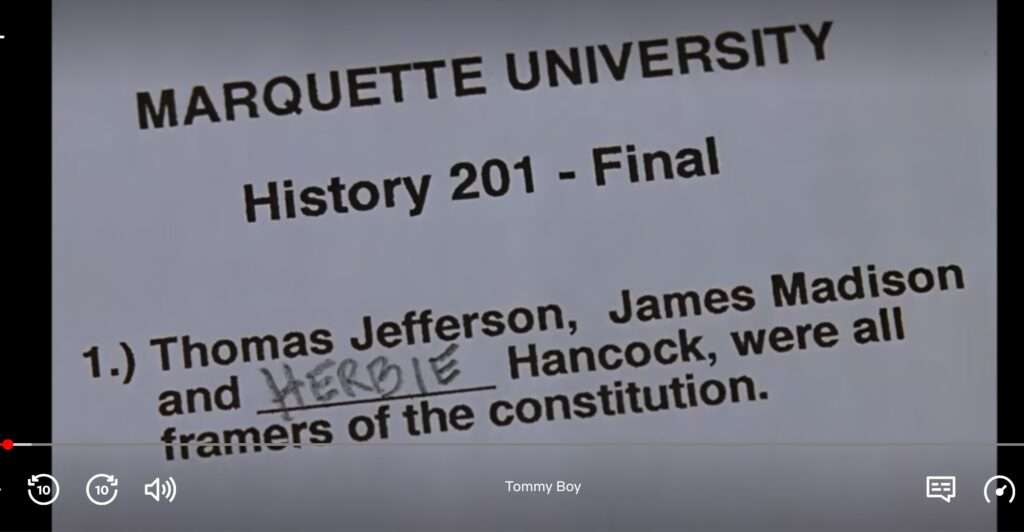
Then again, perhaps I should let the producers off easy. I recently saw this book at the Houston Public Library, and also cringed.
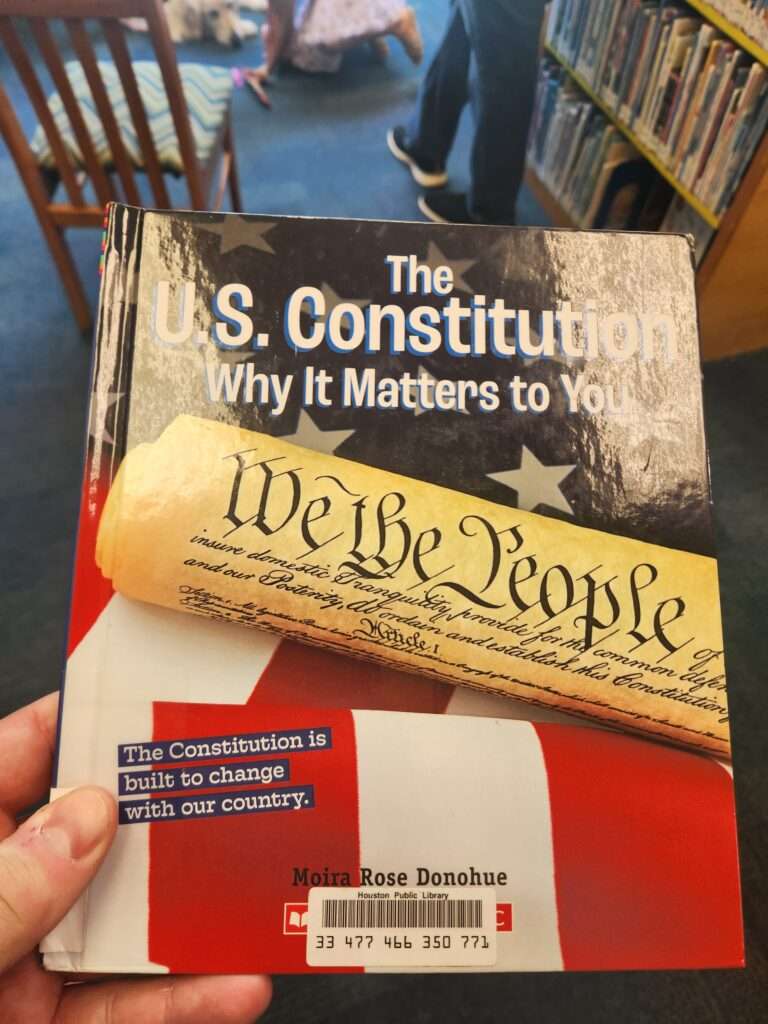
No, the Constitution is not built to change with our country. It was made notoriously difficult to amend. This author has no apparent expertise about the Constitution, but I suppose that shouldn't stop her from writing about it.
One of my long-term goals is to write children books about the Constitution. It's on the agenda.
Today in Supreme Court History: July 13, 1787
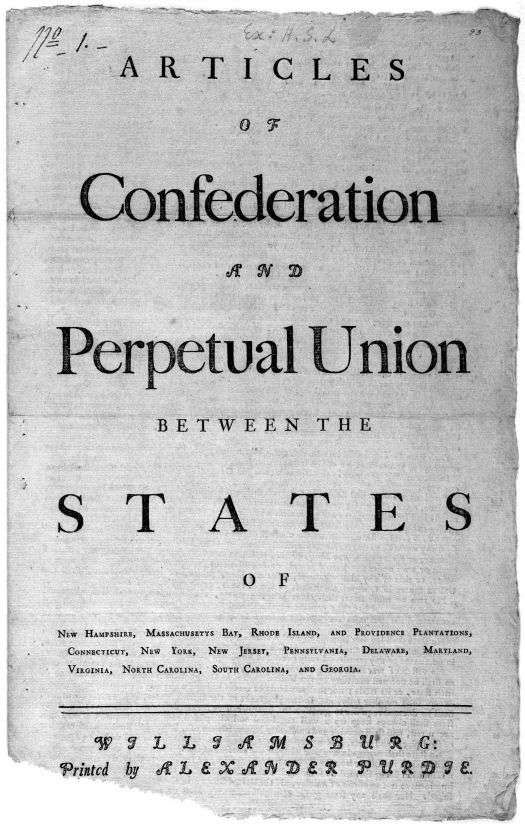
7/13/1787: The Articles of Confederation Congress enacts the Northwest Ordinance.
Does Hiring Diversity Officers Increase University Diversity?
It is easier for universities to hire administrators than to engage in meaningful change.
A new study in the Southern Economic Journal suggests that university efforts to enhance diversity by hiring DEI executives to oversee diversification efforts were largely ineffective. Specifically the study, "The Impact of Chief Diversity Officers on Diverse Faculty Hiring," finds that hiring CDOs had no effect on faculty diversity.
The abstract reads:
Racial diversity among faculty, students, and administrators is increasing at universities in the United States. These changes have been uneven, with growth in underrepresented students exceeding that of faculty diversity. To address these and other inequities, a growing number of universities have established an executive-level chief diversity officer (CDO). Our study offers a first empirical examination of this effort at selected 4-year U.S. universities from 2001 to 2019 using unique data on the initial hiring date of a CDO and publicly available demographic data. We provide a comprehensive overview of demographic trends within our data and find confidence intervals around the estimated instantaneous average treatment effect for an executive-level CDO on diverse hiring tightly contain zero. Estimated treatment effects are small and lack statistical significance within 4 years of a CDO position being established. We discuss other possible factors that explain trends toward higher diversity on campus and several possible constraints.
Should the paper's results be surprising? Not particularly. It is relatively easy for a university (or any large, bureaucratic institution) to hire administrators and adopt superficial policies. Actually changing hiring practices, on the other hand, can be quite difficult, and changing the composition of a faculty can be quite slow. If a university faculty is resistant to hiring people of different backgrounds (or viewpoints), hiring a few administrators is unlikely to change things very much.
None of this means that hiring DEI administrators has no impact. There are certainly anecdotal accounts suggesting that some such efforts can affect university culture (and perhaps in quite negative ways--as seems to have occurred at the University of Michigan). The point is that such investments do not appear to produce the sorts of changes that they promise.
The Role and Ethics of AI Use in Online Dating
From Helpful Learning Tool to Problematic Deception
The Washington Post has a new podcast up this week about the ways that AI is changing online dating. Some of these ways risk crossing the line into the territory of deception. I have written previously in law review articles here and here about the issues with deception in online dating, from sexual fraud to hiding one's true identity for purposes of financial fraud or downright violence.
Deploying AI as a learning tool seems relatively unproblematic and could even turn someone into a genuinely better partner. Users of AI dating coaches have at times reported positive experiences with self-development in the relationship context. When it comes to coaching, one way to describe the line into the unethical might be the distinction between truly improving oneself versus seeking out manipulation techniques to trick others, in the genre of pick-up artists.
Those who use AI in the online dating context should ask themselves if their interaction style in the physical world will fail to reflect the image that the AI-improved texting suggested. Another, related question is whether their mate would experience frustration if they learned the extent of said AI use. It would certainly be unethical to use AI to engage in what Prof. Jill Hasday has deemed in her book on intimate lies and the law "linchpin deception," meaning to hide a known dealbreaker (sometimes in the hope of overcoming it via personal charm or the like down the line).
Today in Supreme Court History: July 12, 1909
7/12/1909: 16th Amendment is submitted to the states.
No Pseudonymity for Plaintiff Suing Fashion Institute of Technology Over Alleged Anti-Semitic Discrimination
From Judge John Cronan (S.D.N.Y.) today in Doe v. Fashion Institute of Tech., refusing to reconsider an earlier decision that denied Doe pseudonymity:
First, Plaintiff argues that the Court erred in several ways by concluding that the second and third factors [of the Second Circuit pseudonymity test] (risk of retaliation and severity of harm to the plaintiff) weighed only slightly in favor of anonymity. In so arguing, Plaintiff suggests that the Court overlooked evidence presented along with the renewed motion that a sticker bearing the phrase "The only good Zionist is a dead Zionist" has been affixed to at least two locations inside FIT buildings since early February 2023. Similarly, Plaintiff highlights "[r]ecent violence against Jewish students" on school campuses in New York and across the country in arguing that the Court improperly assessed the risk of harm to her. While Plaintiff's allegations of derogatory stickers affixed to buildings on FIT's campus and of violence against Jewish students elsewhere "are abhorrent," these alleged actions "were 'not directed at plaintiff or similarly situated individuals and so do not demonstrate that plaintiff is at risk of harm.'"
Plaintiff also argues that the second and third factors weigh in her favor because she has "alleged more than reputational harm resulting from the disclosure of her identity." She claims instead that disclosure of her name would result in "potential employers and educational institutions [having] easy access to the disciplinary measures Defendant has taken against Plaintiff …, which would in turn threaten her ability to secure future employment and pursue academic opportunities," and would result in a "severely compromised" "likelihood of [Plaintiff] being hired or accepted to a prestigious graduate institution."
Plaintiff's identified harms are no different than mere reputational harms, insufficient to support a motion to proceed anonymously. These claims of "economic hardship and loss of professional goodwill" do not weigh in favor of anonymity.
Friday Open Thread
What's on your mind?
Short Circuit: An inexhaustive weekly compendium of rulings from the federal courts of appeal
Colorado River abstention, Wilton-Brillhart abstention, and sua sponte shenanigans.
Please enjoy the latest edition of Short Circuit, a weekly feature written by a bunch of people at the Institute for Justice.
What's so natural about rights? Well, a lot of our state constitutions actually call some rights "natural." And state courts consider all kinds of rights of the "natural" variety, from life, liberty, and the pursuit of happiness to the right to worship to the right to earn a living. In State Court Report, Anthony Sanders, the director of IJ's Center for Judicial Engagement, summarizes the family of "natural," "inherent," "unalienable," and "fundamental" rights—both "enumerated" and "unenumerated"—and what state courts are doing these days to protect them.
This week on the Short Circuit podcast: One gun a month is too few, even in the Ninth Circuit.
- At 2020 police-brutality protest, a 6'5", 250-lb. Stamford, Conn. officer—without warning or command—hoists woman by her bra strap, pushes her backward in the air for about 15 feet, and then slams her to the pavement. The woman—who was not a protester; she was there at the request of a police supervisor to deescalate—suffers serious head and neck injuries. Second Circuit: And since it's not clear from the video whether he was trying to get past her to aid other officers or just gratuitously thumping people, the grant of qualified immunity is vacated.
- Shortly before the 2016 election, self-described Twitter "shitlord" tweets and retweets memes urging supporters of Hillary Clinton to vote by text message. More than four years later—and two days after the inauguration of President Biden—he is criminally indicted for conspiring to injure citizens in the exercise of their right to vote. After four days of deliberation and two Allen charges to the jury, he's convicted and sentenced to seven months in prison. Second Circuit: But there was no evidence he actually conspired with anyone, which is, y'know, an element of the crime. Read More
Justice Jackson Wants People to Focus on "What Is Happening in Our Country and in Our Government" (Updated)
Justice Jackson Sees Her Colleagues' Rulings As Threats to Democracy and the Rule of Law
Supreme Court Justice Ketanji Brown Jackson said Thursday that the "state of our democracy" keeps her up at night, echoing a theme that has animated some of her recent public appearances and fiery dissents from recent decisions.
"I'm really very interested to get people to focus, and to invest and to pay attention to what is happening in our country and in our government," Jackson said. . . .
On Saturday, at a different event in New Orleans, Jackson called the conservative bloc's decisions "an existential threat to the rule of law." . . .
On why she writes dissents as much as she does, Jackson commented:
"It's because I feel like I might have something to offer and add, and I'm not afraid to use my voice," said Jackson, noting that she's not offended by other justices taking issue with her opinions because she has a "thick skin."
Justice Jackson's comments echoed sentiments she has expressed in some of her opinions, including her dissent in Trump v. CASA, which drew a sharp response from Justice Barrett writing on behalf of the Court.
UPDATE: C-Span has posted video of the talk, and highlights this quote:
There are sometimes when, even after the principal dissent is written, I have a slightly different perspective or a different take on something or this is an issue of particular importance to me for whatever reason. Where I will say, 'Forgive me Justice Sotomayor, but I need to write on this case.' It's because I feel like I have something to offer, and something to add and I'm not afraid to use my voice.
When Does a Regulation Become Final?
The D.C. Circuit resolves a dispute over which set of visa regulations bind the public.
Today, in National Council of Agricultural Employers v. U.S. Department of Labor, the U.S. Court of Appeals for the D.C. Circuit helped bring a little more clarity to the question of when a new regulation becomes binding upon the public. Senior Circuit Judge Ginsburg wrote for court, joined by Judges Katsas and Childs.
The introduction of Judge Ginsburg's opinion effectively summarizes the nature and significance of the dispute, and the court's conclusions.
This case presents a recurring question of administrative law: At what point does a substantive rule submitted by an agency to the Office of the Federal Register (OFR) for publication become final so that it cannot be withdrawn or amended without going through the notice-and-comment requirements of the Administrative Procedure Act? The answer to this question is particularly significant during transitions between one presidential administration and the next. Those periods are often marked by a flurry of rulemaking activity. Agency leaders of the departing administration work furiously to finalize and publish new regulations, then newly appointed leaders act expeditiously to withdraw unpublished rules that might be inconsistent with the new administration's priorities, while through it all the OFR beavers away trying to keep up with the changes.
Ambiguity regarding the legal significance of processing by the OFR can result in regulatory uncertainty that persists well past the presidential transition period, as this case illustrates. In 2019 the Department of Labor (DoL) issued a notice of proposed rulemaking (NPRM) to amend its 2010 regulations regarding a visa program. During the last days of the Trump Administration in 2021, the DoL announced to the public and submitted to the OFR for publication in the Federal Register what it characterized as a final rule. While the OFR was processing the rule, however, the DoL under President Biden withdrew it. Then, in 2022, the DoL issued a new rule based upon the 2019 NPRM.
The question here is which rule marked the culmination of the rulemaking process that began in 2019, the 2021 Trump rule or the 2022 Biden rule? Or, more generally, at what point does a substantive rule submitted to the OFR for publication become final so that a new round of notice and comment is required before the agency can change or withdraw the rule?
In this case, we hold the rulemaking process culminated in the 2022 Rule. A substantive rule is not ordinarily final until the OFR makes it available for public inspection. At that juncture the rule is "duly fixed," GPA Midstream Ass'n v. Dep't of Transp., 67 F.4th 1188, 1195 (D.C. Cir. 2023), and "becomes 'valid' against the public at large," Humane Soc'y v. USDA, 41 F.4th 564, 570 (D.C. Cir. 2022) (quoting 44 U.S.C. § 1507). Although an agency can "for good cause," 5 U.S.C. § 553(d)(3), make a rule final without processing by the OFR — by putting it into effect expeditiously and giving actual notice of the official rule to members of the public — the DoL did not do so here. Instead, the DoL made the 2021 Rule contingent upon processing by the OFR and then withdrew the rule before it became final.
Would "Affirmative Action" for Conservatives in Academia "Backfire"?
Universities should be wary of adopting practices or policies that "discourage curiosity and reward narrowness of thought."
Should universities increase (initiate?) efforts to enhance viewpoint or ideological diversity among faculty? Some think so. Others are not so sure. And would such efforts necessarily require taking affirmative steps to increase the likelihood of hiring conservatives, such as creating special centers or faculty lines, or would it be enough to counteract bias against non-progressive views in the hiring process? On this there is active debate.
The New York Times published an op-ed this week on the subject by University of Pennsylvania philosophy professor Jennifer Morton, "Why Hiring Professors With Conservative Views Could Backfire on Conservatives." In the op-ed Professor Morton writes:
Certainly, there is not enough engagement with conservative ideas on college campuses. Schools can and should do more to ensure that students encounter a greater range of political perspectives in syllabuses and among speakers invited to give talks.
But a policy of hiring professors and admitting students because they have conservative views would actually endanger the open-minded intellectual environment that proponents of viewpoint diversity say they want. By creating incentives for professors and students to have and maintain certain political positions, such a policy would discourage curiosity and reward narrowness of thought.
Perhaps few would argue that universities should adopt policies or practices that "discourage curiosity and reward narrowness of thought." But if that is really the concern, it seems that potential, as-yet-unimplemented policies designed to increase viewpoint diversity would hardly top the list of things to be worried about.
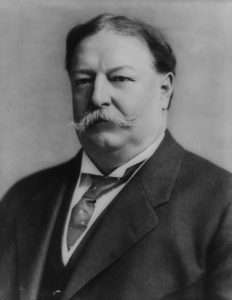
Today in Supreme Court History: July 11, 1921
7/11/1921: Chief Justice William Howard Taft takes oath.
Federal Court Issues Class Action Injunction Against Trump's Birthright Citizenship Executive Order [Updated]
This ruling was widely expected in the wake of the Supreme Court's decison barring nationwide injunctions.

In the aftermath of the Supreme Court's ruling in Trump v. CASA, barring nationwide injunctions, most informed observers expected courts to instead certify broad class actions against Donald Trump's birthright citizenship executive order (which denies birthright citizenship to children of undocumented immigrants and non-citizens present on temporary visas). That's precisely what happened today.
Federal District Judge Joseph Laplante has certified a class consisting of all current and future children who stand to lose citizenship rights because of Trump's order, and issued a preliminary injunction barring enforcement of the order against all members of that class.
Obviously, the administration will appeal the class certification and injunction, and the issue could well get back to the Supreme Court. Perhaps sooner rather than latter.
I am no class action expert. But, for what little it's worth, I think this class does meet the Rule 23 requirements of numerosity (the class has hundreds of thousands of members), commonality (the class members all have an obvious common interest in getting citizenship, thereby avoiding potential deportation), typicality (the class representatives litigating the case seem to be typical of the class as a whole), and adequacy of representation (the ACLU lawyers litigating the case seem more than adequate, as far as I can tell). But, again, I am no class action expert, so this opinion may not be worth much more than the money you're (not) paying to read it!
Even if this class action succeeds, I remain convinced that Trump v. CASA was a bad decision. The class action certification remedy may not be so readily available in some other important cases involving large-scale illegality by federal, state, or local governments.
But assume I am wrong about that. Assume that class actions or some other comparably broad remedy will be feasible in every situation where a nationwide injunction might have been available before. In that event, I would wonder what the point of getting rid of nationwide injunctions was in the first place, as litigants would still be able to get essentially the same remedy by another name. If basically the same remedy is in fact available to same degree as before, I say it's better to just call a spade a spade, than to pretend your spade is actually a shovel.
Today's ruling, like the Supreme Court decision, does not address the substantive legality of Trump's order. This same district court had already ruled that the order is unconstitutional, and the Supreme Court's decision did not overturn that, but only addressed the issue of the scope of the available remedy.
For my explanations of why children of undocumented immigrants are constitutionally entitled to birthright citizenship and criticisms of some standard contrary arguments, see here and here.
UPDATE: Judge Laplante's opinion justifying the class action certification is available here. His analysis of the various class action factors strikes me as compelling. But, again, this is not my area of expertise.




