The Volokh Conspiracy
Mostly law professors | Sometimes contrarian | Often libertarian | Always independent
My New Dispatch Article on Trump's Section 301 "Forced Labor" Tariffs
The article explains why the new tariffs are harmful and illegal for many of same reasons as those invalidated by the Supreme Court.
Today, The Dispatch published my new article on Donald Trump's massive new Section 301 tariffs. Here is an excerpt:
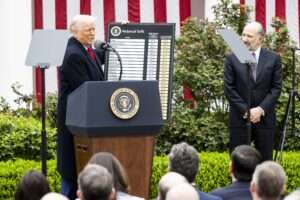
President Donald Trump recently used Section 301 of the Trade Act of 1974 to impose massive new tariffs on 60 U.S. trading partners, including the European Union, Canada, Australia, Japan, South Korea, and more. Imports from 41 trading partners will now face 12.5 percent tariffs, and the others will be subject to 10 percent levies.
In February, the Supreme Court invalidated Trump's International Emergency Economic Powers Act of 1977 (IEEPA) tariffs, which imposed tariffs of 10 percent or more on almost all U.S. trading partners… In a case I helped develop and litigate, the court's 6-3 decision held that IEEPA does not authorize tariffs and that the president could not legally claim unlimited tariff authority. With the new Section 301 tariffs, Trump seeks to circumvent the Learning Resources v. Trump decision and once again enact a broad trade war without congressional authorization.
Unlike IEEPA, Section 301 does authorize tariffs. But it sets limits that Trump's policy blatantly transgresses. Section 301(b), the provision Trump is relying on, allows the U.S. Trade Representative (USTR) to impose tariffs if it finds, after an investigation, that "an act, policy, or practice of a foreign country is unreasonable or discriminatory and burdens or restricts United States commerce." In this case, the USTR claims the offending policies relate to the importation of goods supposedly made by forced labor.
In a recent Dispatch article, my Cato Institute colleague Scott Lincicome explained why the forced-labor "investigations" the administration claims justified the Section 301 tariffs are a sham. As he noted, the conclusion of the investigations was clearly predetermined, the tariffs imposed have no real connection to any genuine forced-labor issues, and many of the countries subject to the new tariffs actually have tighter restrictions on goods produced by forced labor than the U.S. itself does….
The new Section 301 tariffs also run afoul of the major questions doctrine, which requires Congress to "speak clearly" when authorizing the executive to make decisions of "vast economic and political significance." At the very least, Section 301 does not clearly authorize the president to start a trade war against almost all our major trading partners on the basis of a sham investigation and dubious pretexts.
The Section 301 tariffs undoubtedly implicate the major questions doctrine. The Tax Foundation estimates the Section 301 tariffs will impose some $629 billion in new taxes on Americans over the next decade. Like the IEEPA tariffs, they are likely to significantly reduce income and economic growth. These potential effects are larger than those of any of the previous policies the Supreme Court has determined to be major questions, with the exception of the IEEPA tariffs themselves. (In that case, three of the six justices in the majority relied on the major questions doctrine.) The new tariffs outstrip even President Joe Biden's sweeping student loan forgiveness program, which involved some $400 billion in unauthorized expenditures and was invalidated by the Supreme Court in 2023 in large part because it ran afoul of the doctrine….
Even if the courts conclude that Section 301 authorizes these new tariffs, they should also rule that their imposition violates the constitutional nondelegation doctrine, which limits the delegation of legislative power to the executive. Tariffs are a specifically enumerated congressional power. The Supreme Court's nondelegation precedent is far from completely clear, but last year's decision in FCC v. Consumers' Research held that delegations of the power to impose taxes and other financial levies must have a clear floor and ceiling and that "[t]he guidance needed is greater when an agency action will affect the entire national economy than when it addresses a narrow, technical issue." There is, pretty obviously, no meaningful floor or ceiling under the administration's approach to Section 301. And the authority claimed by Trump is certainly one that affects the "entire national economy…."
If Trump can use IEEPA, Section 301, or some other statute to impose unlimited tariffs on any import from any nation whenever he wants, that makes this enormously important power subject to the whims of one person. Such unconstrained authority is inimical to the rule of law, which requires that major laws and regulations be set in advance by legislation and not subject to any one person's total control. It thereby destroys the stable expectations businesses, investors, and consumers need to make their plans, imperiling the economy.
Relatedly, if the president can impose massive new tariffs at will, including by making utterly bogus accusations related to "forced labor," the nation's credibility with trading partners is damaged. Any trade agreement with the U.S. becomes essentially worthless, as the president can violate it at will. And businesses and governments would be foolish to commit to trade and investment in America, knowing those commitments could be imperiled any time the president becomes peeved about some issue. Over the last year, Trump has either threatened or actually imposed tariffs on major trading partners for ridiculous reasons: wildfires in Canada, the supposed threat of foreign-made movies, and the prosecution of Brazil's former president for launching a coup to stay in power after he lost an election. In addition to the economic damage, such actions poison U.S. relations with key allies and make it more difficult to work together to counter adversaries like Russia and China….
Three lawsuits challenging the tariffs have already been filed: one brought on behalf of two small businesses by the Liberty Justice Center (the public interest law firm I worked with on the IEEPA case); one filed by several firms, including Learning Resources Inc., the toy manufacturer whose IEEPA challenge ended up before the Supreme Court; and—most recently—one brought by 25 state governments led by Oregon…