

Gorsuch and Sotomayor Unite in Another Civil Liberties Case
Plus: How a conservative Supreme Court justice ushered in “the birth of modern zoning.”
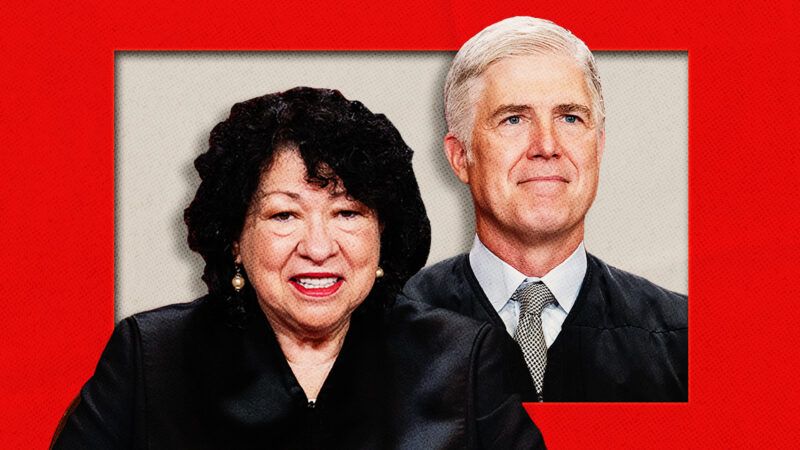
One of the more interesting developments at the U.S. Supreme Court in recent years has been the rise of a kind of sporadic alliance in defense of civil liberties between Justices Sonia Sotomayor and Neil Gorsuch.
You’re reading Injustice System from Damon Root and Reason. Get more of Damon’s commentary on constitutional law and American history.
In 2018, for example, Gorsuch, joined by Sotomayor, blasted the Supreme Court for refusing to even hear arguments in Stuart v. Alabama, an important case about forensic evidence, criminal trials, and the Sixth Amendment right to cross-examine one's accusers.
Similarly, in United States v. Davis (2019), Sotomayor joined Gorsuch's majority opinion striking down a federal law that called for enhanced sentencing when a gun was used in connection with certain federal crimes because the law at issue was too imprecisely written to pass constitutional muster. "When Congress passes a vague law," Gorsuch wrote, "the role of courts under our Constitution is not to fashion a new, clearer law to take its place, but to treat the law as a nullity and invite Congress to try again."
Gorsuch and Sotomayor have also been on the same page in a number of Fourth Amendment cases, though Sotomayor's overall Fourth Amendment record is arguably stronger than Gorsuch's. In Torres v. Madrid (2021), for instance, the Supreme Court held that when the police shoot a fleeing suspect, it still counts as a "seizure" for Fourth Amendment purposes even if the suspect kept on the move after being shot. "The application of physical force to the body with the intent to restrain is a seizure," the Court held, "even if the person does not submit and is not subdued." Sotomayor joined that pro-civil liberties decision; Gorsuch, along with Justices Clarence Thomas and Samuel Alito, sided with the officers and voted in dissent.
Fortunately, the Gorsuch-Sotomayor band was back together last week to make some noise in support of the Bill of Rights in a dispute that pitted property rights against police powers. As Reason's Billy Binion reported, the Supreme Court declined to hear a case challenging a lower court's "categorical rule" that "property destroyed in the exercise of [a state's] 'police power' is immune to claims under the Takings Clause, the U.S. Constitution's pledge that government cannot usurp private property without fairly compensating the owner."
Sotomayor, joined by Gorsuch, strongly implied that she thought the lower court's rule was unconstitutional, though she accepted that "further percolation" on the issue was needed before the Court should step in. "Where, as here, a person alleges a 'classic taking in which the government directly appropriates private property for its own use' or to pay an outstanding debt, like a tax lien," Sotomayor wrote, "the talismanic invocation of the State's 'law enforcement authority,' may be insufficient to avoid the requirement of just compensation." (Citations omitted.) Sotomayor then urged the lower courts that are "considering this issue to take care that due deference to state police powers does not eclipse constitutional rights."
Just as Gorsuch's Fourth Amendment record has its blemishes, Sotomayor's record on property rights has also been less than impressive at times. So it is doubly welcome to see these two justices back in the trenches together on this particular civil liberties front.
Elsewhere in the Law
Writing at SCOTUSblog, Anastasia Boden, a senior attorney at the Pacific Legal Foundation, has an interesting article about the Supreme Court's landmark 1926 decision in Euclid v. Ambler, in which, as Boden put it, the Court ruled in favor of a town's "power to pass comprehensive zoning, and against a local developer who had argued the town's plan exceeded the city's police power and destroyed the property's value." In effect, the Court's ruling was "the birth of modern zoning."
One of the things that has long fascinated me about Euclid v. Ambler is the fact that the opinion was authored by Justice George Sutherland, who is probably best remembered today for his role as a leading judicial foe of President Franklin Roosevelt's New Deal. In Euclid v. Ambler, however, Sutherland endorsed a view of regulatory authority that has been celebrated by liberal academics as "a model of pragmatic and well-balanced Progressive jurisprudence."
I suppose we might call it an irony of legal history: The intellectual leader of the Supreme Court's anti–New Deal bloc actually left a greater mark on the law by shoring up the immense power of city planners.



