

The E.U. Just Proposed Its Most Sweeping Social Media Restriction to Date
The KIDS Act could age-gate the internet for hundreds of millions of users.
The European Union is rolling out another proposal to restrict freedom online for hundreds of millions of users across Europe.
Last week, the European Commission unveiled the E.U. KIDS Act, a proposal to effectively ban children under 13 from accessing social media. The act would also require parent-supervised accounts for teens aged 13 to 15.
The act proposes some of the "tightest restrictions yet on technology products," reported CNET. If enacted, it would cover more than social media platforms; it could also apply to video-sharing platforms, video games, and AI chatbots. According to Reuters, it would cover 450 million people across 27 countries.
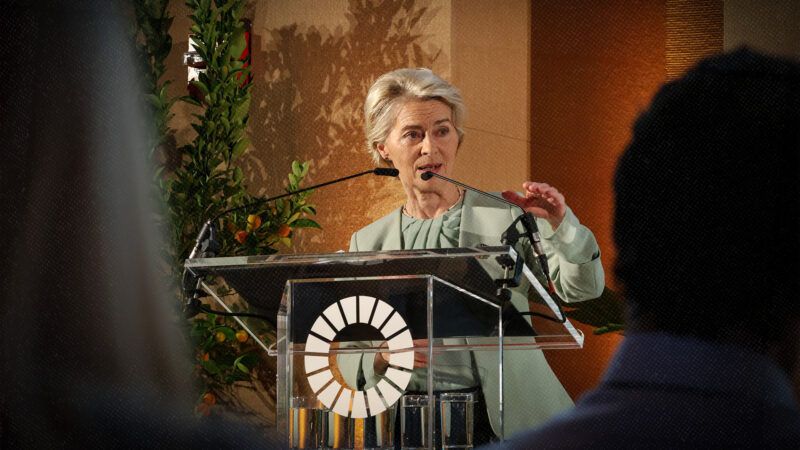
European Commission President Ursula von der Leyen announced the proposal during her 2026 State of the Union address on Wednesday. She emphasized that, in addition to restricting children's access to online platforms, the act would put the burden on social media companies to prove that they are proactively preventing children from using their platforms.
"Because it is not about our minors accessing social media," von der Leyen said. "It is about when and how do we allow social media to access minors."
The proposal would also require age verification for users making new social media accounts and for users accessing existing accounts if a "provider cannot tell with a high degree of confidence that the holder of the account is above the age threshold."
The proposal acknowledges that implementing age verification could lead to "additional costs for digital services providers" but says companies could mitigate these costs by using the E.U. age verification solution, an app that is being developed by the European Commission. According to this dystopian video by the E.U., the app verifies identities using several methods, including uploading a passport, showing up in person at a post office, or connecting an online banking app. The E.U. says the app protects user privacy because it only collects age information once up front. If a user wants to access a restricted website, they can then use the app to scan a QR code.
"Deciding what is 'safe' can easily become a question of what content people can access or share," the Electronic Frontier Foundation, a digital freedom group, has pointed out. With such a sweeping online safety apparatus in place, powerful bureaucrats such as von der Leyen become gatekeepers of the internet. Even if the E.U.'s age verification app does protect user privacy, users should be able to access apps and websites anonymously without proving their age.
The Kids Act would need approval from individual E.U. member states, and it could take years to take effect, according to CNN. Still, E.U. member states are moving forward with other online safety measures. Last October, 25 E.U. member states signed the Jutland Declaration, which calls for a "legal requirement for effective and privacy-preserving age verification on social media." And in France, Parliament voted to enact a social media ban for children under 15. The law would have required age verification for enforcement, but the country's top court has since blocked the ban from moving forward because of privacy and free speech concerns.
Unfortunately, the E.U.'s crusade against online freedom is just getting started. During her address, von der Leyen also warned that addictive social media design is "harming everyone," and the E.U. needs a "wider framework" to address the problem. She said the European Commission plans to introduce the Digital Fairness Act this fall.
Many people understandably want to shield children from certain corners of the online world, but the state cannot fulfill this parental role without severely curtailing online freedom. Online safety laws do not only apply to children. By default, they apply to every adult making online accounts or attempting to access sensitive websites.




