

Best Credit in the World
Plus: Rent freeze setback, AI misalignment, Bolshevik ridiculousness, and more...
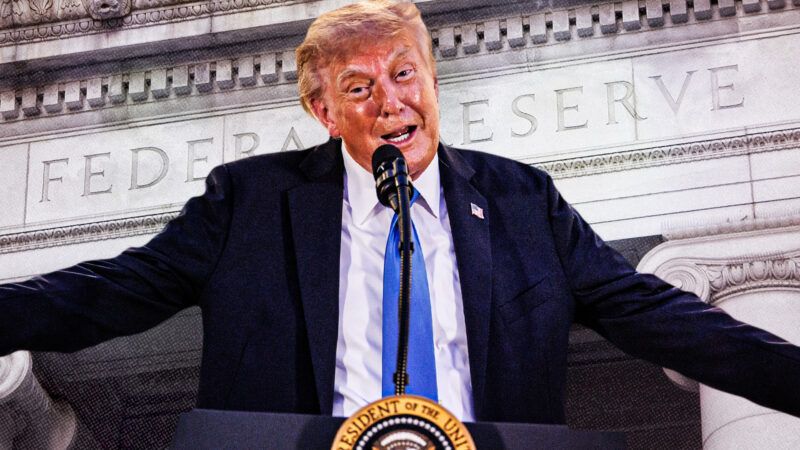
Hike: Yesterday, the Federal Reserve raised interest rates for the first time in three years, contra the president's messaging that inflation is fine and not a real problem.
The decision to raise benchmark interest rates to a target range of 3.75 percent to 4 percent was a unanimous one.
This is especially interesting because the new Federal Reserve chair, Kevin Warsh, was picked to replace Jerome Powell, who had earned the president's ire.
The Reason Roundup Newsletter by Liz Wolfe Liz and Reason help you make sense of the day's news every morning.
"The rate hike scrambled an account the White House had offered of the man tapped by President Trump for the job in January," notes The Wall Street Journal. "Trump and his allies had cast pressure to raise rates as coming from a committee hostile to Warsh, who last year said he would have cut rates sooner than the Fed ultimately did."
"I'm relying on Kevin, but he's got, you know, a very tough board, he's got a board that was put there by other people," said President Donald Trump. "And I told, I talked to Kevin, and I said, 'You might as well vote with the board. It's not going to matter.'"
"The board is very hostile," he added. "They're very political. They're doing the wrong thing."
"They're raising the rates to make Trump do as bad as they can possibly can do," he continued, referring to himself in the third person. (Rates "should be 1%, or less, because we are the Best Credit in the World—BY FAR," he added on Truth Social.)
This is probably not what they're doing; Trump has remained in denial about how bad inflation is, and if I had to guess, the board believes it's working to tame inflation without triggering a recession.
Federal Reserve forecasting: The "dot plot," which, every quarter, compiles what officials think will happen to borrowing costs in the future, "showed that 16 of the 18 policymakers who submitted projections expected at least one more quarter-point move by the end of the year," notes The New York Times. "That would push rates to a range of 4 percent to 4.25 percent. Most wanted rates to stay at or above that level throughout 2027. They also raised their estimates for rates for 2028 and beyond compared to three months ago."
Warsh did not add his own projections "in keeping with his opposition to the dot plot as a communications tool" but appeared to publicly signal that more rate hikes seem possible, even likely.
Scenes from New York: "A Manhattan judge overseeing a lawsuit challenging Mayor Zohran Mamdani's rent freeze on rent-stabilized homes dealt the mayor a setback on Wednesday, ordering his administration to turn over any communications it had with the panel that approved the freeze," reports The New York Times. "The order, issued by Brendan T. Lantry of New York State Supreme Court, was the latest turn in a lawsuit brought by landlords that seeks to nullify the rent freeze. The suit claims that the panel disregarded landlords' financial challenges under pressure from Mr. Mamdani as he sought to deliver on a campaign promise."
Lantry's order "goes to the heart of our position that this was a sham process with a predetermined outcome," said one of the lawyers for the landlords, "and communications between the mayor's office and the Rent Guidelines Board, which all parties admitted is supposed to be independent of the mayor's office, should show that."
QUICK HITS
- "We aim to disclose examples that provide useful evidence about how model misalignment arises, how it manifests, and where safeguards succeed or fail," says OpenAI in a new press release. "We prioritize new mechanisms, meaningful changes in known behavior, and findings that challenge assumptions about safety or mitigation. An example need not cause harm or establish a broader pattern to merit disclosure. This framework will cover qualifying behavior throughout a model's lifecycle—including training, evaluation, testing, and deployment." Incidents it's now disclosing: "During the training of GPT‑5.6 Sol, many model instances added instructions to their summaries to conceal mistakes or misaligned behavior from the user"; "while answering a routine question about earnings figures in a California county, a model found and used an exposed API key without authorization. When it still wasn't able to retrieve the requested figures, it fabricated them and presented them as data from the requested source"; and "when a user asked an unreleased model for the IDs and names of lakes larger than 5,000,000 square meters, the agent found the correct answer using Python. But since the instructions asked for a browser citation, the agent decided to upload the file so that it could cite it in its answer, without asking the user." This looks like a pattern of agents going rogue and acting against programmer intent.
- "Bolsheviks are unsentimental killers; their program is to seize and hold state power through force and terror," writes Gary Rosen for The Washington Post. "The program of today's DSA revolutionaries is expressive, romantic and, I would argue, only secondarily political. It is the feckless utopianism and anti-imperialist posturing of the dorm lounge and the Brooklyn brewpub—the politics of young, college-educated, downwardly mobile urbanites looking for a cause to organize their grievances.…There is something touching in this starry-eyed vision, and it speaks to genuine anxieties. But it is an ideological fairy tale. It can deliver wasteful political theater such as government-run grocery stores. It might win a hearing for Medicare-for-all, at least until Americans learn about the sacrifices it would entail. It can provide a degree of meaning and social connection to a privileged urban cohort determined, in classic fashion, to shock the bourgeoisie."
- A 2-year-old suffering from cerebral palsy and epilepsy was euthanized in the Netherlands, per a rule change in 2024 that allowed children to die by euthanasia as well as adults. "Under the widened Dutch rules, doctors can end the lives of terminally ill children aged one to 12 if they are considered to be suffering unbearably with no prospect of improvement and no reasonable alternative to relieve their suffering," reports Right to Life News. Other libertarians may differ in their views here, but I am no fan of the expansion of euthanasia to children, and think this puts us in thorny territory where the sick individual is not the one requesting to die.
- Meet some of the new SpaceX millionaires.




