

Virginia Man Argues His 'FTP&ATF' License Plate Is Free Speech. The Supreme Court Might Hear His Case.
A federal appeals court ruled that Curtis Whateley's anti-police vanity plate was private speech protected by the First Amendment. Virginia says it will seek review from the Supreme Court.
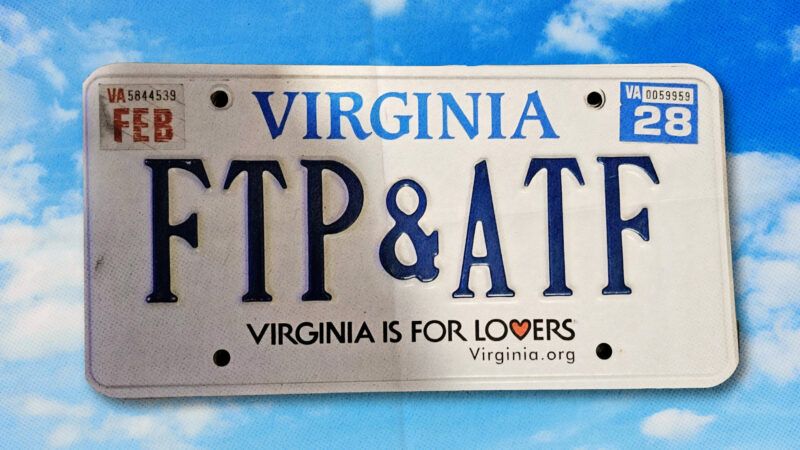
A Virginia man's anti-police license plate is at the center of what could be a landmark First Amendment case, following a federal appeals court ruling in his favor last month.
Virginia motorist Curtis M. Whateley says he has a free speech right to keep his customized license plate, which reads "FTP&ATF," an abbreviation that foul-mouthed puzzle-solvers will decipher as "Fuck the police and the Bureau of Alcohol, Tobacco, and Firearms." The State of Virginia argues that it has the right to revoke Whateley's plate because license plates are government-owned, not a public soapbox. The state says it's going to take its case to the Supreme Court.
The case highlights a niche, often amusing, but still consequential issue in First Amendment law: whether a vanity license plate is private or government speech.
The U.S. Supreme Court ruled in 2015 that Texas could deny a group's application for a specialty license plate design showing the Confederate flag. Most U.S. district courts and state courts interpreting the decision have held that, while government-run vanity plate programs are a nonpublic forum, the specific character combination of the plate is private speech, which restricts the government from censorship based on viewpoint.
But until the U.S. Court of Appeals for the 4th Circuit issued an opinion on Whateley's case on July 31, no federal appeals court had ruled on the matter, according to the American Civil Liberties Union of Virginia (ACLU-VA), which is representing Whateley. The three-judge panel unanimously found Virginia's personalized license plate messages are private speech subject to First Amendment protection.
"There is no doubt that Virginia has final approval authority over the messages Virginia's drivers wish to convey on their vanity plates, and that it may deny approval for messages it believes to be vulgar or offensive," the 4th Circuit panel wrote. "But the exercise of that authority, on its own, is more consistent with the regulation of private expression in a public forum than it is with the government speaking on its own behalf."
Matt Callahan, a senior supervising attorney at the ACLU-VA, said in a press release that the 4th Circuit's ruling "goes beyond Mr. Whateley, reaffirming these protections for the almost one million drivers in Virginia who have exercised their free speech rights through personalized license plates."
"The First Amendment is a foundational American principle created specifically to ensure that the government cannot silence people for speech it does not agree with," Callahan said.
According to his lawsuit, Whateley ordered and received his customized license plate without any problems in 2023. But in May of 2024, the Virginia Department of Motor Vehicles (DMV) received an anonymous complaint that Whateley's license plate was "offensive."
The next month, the Virginia DMV's Personalized Plate Review Board voted to recall Whateley's plate because it violated rules forbidding messages that were "profane, obscene, or vulgar in nature" or "used to condone or encourage violence."
Whateley filed a First Amendment lawsuit against the Virginia DMV commissioner, arguing that his personalized plate was private speech expressing his political opinions.
A lower district court dismissed Whateley's suit last year, ruling that the state's personalized license plates aren't subject to ordinary First Amendment scrutiny because they are government speech.
The 4th Circuit ruling vacated that decision and remanded Whateley's case back to the district court. The court could still rule against Whateley, but Virginia's arguments for censorship will be subjected to a much higher bar.
Virginia doesn't want to have to meet that bar in Whateley's case or any number of future First Amendment lawsuits. A spokesperson for the Virginia attorney general told The New York Times following the ruling that the state would ask the Supreme Court for review.
"The commonwealth has a responsibility to ensure that state-issued license plates are not profane and do not promote dangerous hate speech or incite harm," the spokesperson said.
Attempting to conflate anti-government rhetoric with hate speech is a common censorship tactic by federal, state, and local governments.
In any case, similar bans have mostly fared poorly in court. In 2024, a federal judge struck down Delaware's rules governing vanity plates for unconstitutional viewpoint discrimination; the plaintiff in that case was a breast cancer survivor whose application for a "FCANCER" plate was first approved and then recalled for offensiveness.
Over the last decade, similar rulings have come down against censorious state DMVs in California, Kentucky, and South Dakota. In 2016, Maryland's Court of Appeals held that, "Although mindful that we risk being haunted by the spirit of the late comedian and social commentator George Carlin…the characters or message on a vanity license plate represent private speech in a nonpublic forum."
And in 2014, New Hampshire's ban on vanity plates that were "offensive to good taste" was struck down after being challenged by a man whose application for a "COPSLIE" vanity plate was rejected.
However, not all courts have ruled in favor of drivers. The Tennessee Supreme Court ruled last year that personalized license plates are government speech and not subject to the First Amendment's ban on viewpoint discrimination.
At the center of the case was plaintiff Leah Gilliam's personalized Tennessee license plate, "69PWNDU," which she held for more than a decade before the state revoked it in 2021 on the grounds that it "referred to sexual domination," according to the Tennessee Supreme Court opinion. (The number 69 is a popular reference to a sex position. "PWNDU" is short for "pwned you," ancient video game slang for "owning" or defeating an opponent.)
The Indiana Supreme Court is one of the only others that has ruled that license plates constitute government speech.




