

Reason.com - Free Minds and Free Markets
Reason logo Reason logo
  • Latest
  • Magazine
    • Current Issue
    • Archives
    • Subscribe
    • Crossword
  • Video
    • Reason TV
    • The Reason Roundtable
    • Free Media
    • The Reason Interview
  • Podcasts
    • All Shows
    • The Reason Roundtable
    • The Reason Interview With Nick Gillespie
    • Freed Up
    • The Soho Forum Debates
  • Volokh
  • Newsletters
  • Donate
    • Donate Online
    • Ways To Give To Reason Foundation
    • Torchbearer Society
    • Planned Giving
  • Subscribe
    • Reason Plus Subscription
    • Print Subscription
    • Gift Subscriptions
    • Subscriber Support

Log In

Create new account

Artificial Intelligence

Don't Blame AI for Your Own Medical Problems

A former pastor suing ChatGPT says the chatbot gave him life-threatening medical advice. But tech-enabled healthcare is not the problem.
Nick Gillespie | 7.23.2026 11:58 AM

Share on FacebookShare on XShare on RedditShare by emailPrint friendly versionCopy page URL Add Reason to Google
Media Contact & Reprint Requests
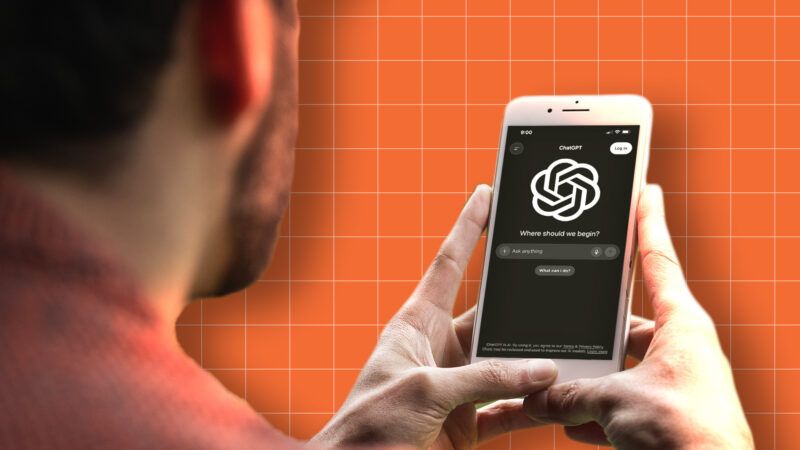
Man on iPhone looking at ChatGPT | Adani Samat/Envato
(Adani Samat/Envato)

A few weeks ago, I hurt my left elbow while doing my regular weight workout. I've been lifting for over 50 years and have spent a lot of time swimming and playing baseball, tennis, and other sports that are well known for creating nagging joint pains, but this was new to me. I thought about making an appointment with my regular doctor or scouting out nearby physical therapists who are in-network for my insurance—two sensible options that also meant spending an undefined amount of money and, even more off-putting, an undefined amount of time scheduling appointments, juggling calendars, and sitting in waiting rooms.

So I did what an increasing number of us are doing: I consulted ChatGPT.

It responded with a probable diagnosis of lateral epicondylitis, or what's commonly called tennis elbow. After a lengthy interrogation about my symptoms, it recommended a series of exercises to try, a cheap elbow strap to help relieve the pain, and repeatedly told me to contact my primary-care physician or a physical therapist if the problems persisted or got worse. ChatGPT supplied copious photos, diagrams, videos, and links to respected places like Cleveland Clinic and WebMD. Within an hour or so, I had a plan to address my pain and discomfort through a mix of rest, targeted exercise, and over-the-counter pain meds.

I thought about this while reading about Scott Winters, a Florida resident who is suing ChatGPT and its CEO, Sam Altman, for allegedly almost killing him. Per CBS News, Winters and Tech Justice Law (the nonprofit helping Winters out) argue that ChatGPT crossed "the line from providing information into practicing medicine without a license" and "prioritized user engagement and profit at the expense of public safety, and…failed to provide adequate guardrails to protect users from following bad health advice."

Last year, Winters complained to ChatGPT about feeling dizzy and having blood pressure issues. He and his lawyers say ChatGPT advised him to remain "recliner-bound," and even invoked religious language ("God did not design your body to endlessly fail") to cajole the former pastor into taking it easy. A few weeks after consulting ChatGPT, Winters had a "massive pulmonary embolism" intensified by blood clots that might have been linked to his lack of movement.

In a Tech Justice Law press release, Winters didn't hold back, saying, "ChatGPT manipulated my own language and beliefs because it knew I was a pastor. Not only did I nearly die, but I also lost my job, my career, my ministry, my home, everything."

"If ChatGPT were a physician dispensing medical advice, it would be guilty of medical malpractice," said Matthew P. Bergman of the Social Media Victims Law Center in the same release. "Scott Winters nearly died because ChatGPT acted like a medical authority while having none of the responsibility."

But if we're talking about responsibility, what about the plaintiff's responsibility in any of this? ChatGPT—and every other AI platform I've encountered—constantly tells users that it is not a medical authority and that you should always consult your doctors or providers.

Winters' case is not an isolated incident. Tech Justice Law is itself involved in another case against OpenAI involving a fatal overdose by a University of California undergrad last year. The suit charges that OpenAI encouraged the student to mix kratom and Xanax, a combination that led to his death.

OpenAI has yet to lose a case over medical advice (at least, that's what Google's AI-enabled search tells me), but it's hard not to see where this sort of thing is headed. It has taken years for social media companies to lose analogous cases. But earlier this year, YouTube and Meta, the parent company of Facebook, Instagram, WhatsApp, was found guilty by a Los Angeles jury in a civil case of "addicting a young woman to their services and exacerbating her mental health struggles." Meta also lost a case in New Mexico where a jury said it harmed the mental health of minors while failing to protect them from sexual predators.

Even as AI tools become more ubiquitous and more deeply embedded in daily life, AI itself is becoming more feared—and will almost certainly become a scapegoat for everything that goes wrong in our collective and individual lives. An NBC poll earlier this year found that AI had a net favorability of –20 percentage points, with "AI ranked less favorably than US Immigration and Customs Enforcement, President Donald Trump, former Vice President Kamala Harris, the Republican Party and The Late Show host Stephen Colbert." When you are that unpopular, you're likely to lose cases regardless of the strength of the arguments.

Although AI has yet to actually create the large-scale unemployment many fear, the mere possibility of such disruption energizes much of the negativity toward it. Stories like the one involving Scott Winters will likely stay in the public's mind longer than reports that AI is helping doctors be more efficient, that it "literally may have saved my life," or that it sometimes scores better than humans at diagnosing illnesses.

In my case, ChatGPT helped me clear up my tennis elbow in a few weeks without having to access my traditional health network. If my issues had been more serious, I still would have consulted my AI, though I certainly wouldn't let it be the last word—if anything, it would have informed the questions and concerns I brought to my doctor and healthcare team. This is exactly what my wife did during her recent pregnancy and while it at times it consternated her OB-GYN, it definitely made for a better process than had she eschewed AI.

As with most supposedly transformative technologies, AI is less a complete replacement for the existing world than a supplement to it, something that adds new spaces and possibilities. It's a great tool, but it's up to us whether we use it wisely or not.

Contra his legal backers, Scott Winters didn't nearly die because "ChatGPT acted like a medical authority while having none of the responsibility." He almost died because he didn't take responsibility for his health. If that sort of basic abdication gains the force of law, we'll create a world that no technology will be able to fix.

Start your day with Reason. Get a daily brief of the most important stories and trends every weekday morning when you subscribe to Reason Roundup.

This field is for validation purposes and should be left unchanged.

NEXT: The People Fighting Technology That Could Save Thousands of Lives

Nick Gillespie is an editor at large at Reason and host of The Reason Interview With Nick Gillespie.

Artificial IntelligenceHealthMedicineHealth CarePatientsDoctorsLawsuitsTechnology
Share on FacebookShare on XShare on RedditShare by emailPrint friendly versionCopy page URL Add Reason to Google
Media Contact & Reprint Requests

Hide Comments (8)

Editor's Note: As of February 29, 2024, commenting privileges on reason.com posts are limited to Reason Plus subscribers. Past commenters are grandfathered in for a temporary period. Subscribe here to preserve your ability to comment. Your Reason Plus subscription also gives you an ad-free version of reason.com, along with full access to the digital edition and archives of Reason magazine. We request that comments be civil and on-topic. We do not moderate or assume any responsibility for comments, which are owned by the readers who post them. Comments do not represent the views of reason.com or Reason Foundation. We reserve the right to delete any comment and ban commenters for any reason at any time. Comments may only be edited within 5 minutes of posting. Report abuses.

  1. Rick James   49 minutes ago

    Even as AI tools become more ubiquitous and more deeply embedded in daily life, AI itself is becoming more feared—and will almost certainly become a scapegoat for everything that goes wrong in our collective and individual lives.

    That's kind of how this works-- especially if you live in a rather litigious society. As something becomes more ubiquitous and more deeply embedded in daily life, it becomes a bigger target for lawsuits, especially when that thing is underwritten by a specific technology-- from an identifiable brand and company (or subset thereof).

    As Thomas Sowell said, "there are only tradeoffs". You can't only point out the benefits of something that has become "ubiquitous and deeply embedded in daily life" and pretend there are no downsides.

    Log in to Reply
  2. Rick James   48 minutes ago

    AI ranked less favorably than US Immigration and Customs Enforcement, President Donald Trump, former Vice President Kamala Harris, the Republican Party and The Late Show host Stephen Colbert." When you are that unpopular, you're likely to lose cases regardless of the strength of the arguments.

    One wonders how many cases President Trump has lost due to that same calculus of popularity vs strength of arguments?

    Log in to Reply
  3. Rick James   46 minutes ago

    "literally may have saved my life," or that it sometimes scores better than humans

    Literally may have saved my life... sometimes scores better than humans.

    *crosses arms, stares across table*

    Log in to Reply
  4. Rick James   35 minutes ago

    n my case, ChatGPT helped me clear up my tennis elbow in a few weeks without having to access my traditional health network. If my issues had been more serious, I still would have consulted my AI, though I certainly wouldn't let it be the last word—if anything, it would have informed the questions and concerns I brought to my doctor and healthcare team.

    All I can say is, "Thank goodness it was something like Tennis Elbow and not something which required medical attention within an hour of symptoms".

    Without defending or criticizing any specific lawsuit, not everyone will consult ChatGPT for knee pain, shoulder pain or that minor rash.

    Personal anecdote: Many years ago, a very close family member noticed that the entire left side of her face had become limp and alarmingly drooped, giving her a kind of Quasimodo look. She thought it might be a stroke but wasn't sure what to do... so she did nothing. For the next 24 hours, she sort of checked herself in the mirror periodically and when it wasn't going away, she reluctantly went to the doctor.

    When I heard about this and arrived at the hospital, I took one look at her and became so pissed off I could barely contain my anger. That's how horrible and shocking it looked. I was convinced she'd had a stroke- as was the initial fear with medical professionals.

    It turns out, she was perfectly fine but had been hit with a rare condition called Bell's Palsey, a relatively rare condition of the inflammation of a facial nerve which causes one entire side of the face to become numb and immobile-- a condition which is largely self-correcting (although I think they can prescribe medication).

    The point here is, not everything is a minor owie that can be fixed interchangeably with physical therapy or a visit to the Orthopod on a non-critical time scale. Believe it or not, there are situations which can be not just severe, but dire that could be mistaken for something much less serious but containing similar symptoms.

    So I'll summarize with this: when people start using Claude to determine the difference between some of these more niche conditions having similar symptoms, but potentially deadly outcomes, there are going to be some nasty-assed lawsuits.

    Log in to Reply
  5. Agammamon   26 minutes ago

    >But if we're talking about responsibility, what about the plaintiff's responsibility in any of this?

    Setting aside the libertarianism - there is a reason we require doctors to go through multiple years of training and limit prescribing and other activities to those who have a license.

    As your own example points out, LLMs are not pointing you to healthcare resources, they are prescribing courses of treatment.

    So when they get it wrong the company that chose to move into this area is blameless? Yet it the guy's doctor, a person had done it, he could have been sued.

    Log in to Reply
  6. JFree   14 minutes ago

    A former pastor suing ChatGPT says the chatbot gave him life-threatening medical advice.

    Wotta surprise. A product of the 'one techbro slop to rule the world' mindset is gonna get protection from the media whores here at Reason.

    Hayek specifically poohpoohs that mindset in the FIRST paragraph of Use of Knowledge in Society. Because, in fact, it is central planning relating to knowledge. Instead he points out that The peculiar character of the problem of a rational economic order is determined precisely by the fact that the knowledge of the circumstances of which we must make use never exists in concentrated or integrated form but solely as the dispersed bits of incomplete and frequently contradictory knowledge which all the separate individuals possess.

    ChatGPT CAN NEVER be better at 'diagnosing a medical situation' than either a specialized LLM model (say one that is targeted for general practitioner level of knowledge) or a really really speiclized LLM model (say one that a specialist may use to diagnose/treat orphan type diseases where the statistical probability paths are too uncommon even for a specialized medical model). Much less models that are tailored to a pastor - or someone who doesn't believe in medical doctors - or someone who only accepts medical advice from R or D Presidents/pols.

    Ultimately the open-source model - personalized uniquely for everyone - is the only one that can meet that Hayek criteria.

    Log in to Reply
  7. LIBtranslator   12 minutes ago

    I AM ABSOLUTELY in favor of Republidans and Demobrats switching entirely to Altruificial Integligence--especially for major surgery. Shucks... I'd even pay money to watch from the viewing gallery.

    Log in to Reply
  8. Liberty_Belle   8 minutes ago

    Just wait until the insurance companies figure out how to use DoctorGPT to cut out meaningful healthcare once and for all without getting sued.

    Unlimited Profits !!!

    Log in to Reply

Please log in to post comments

Mute this user?

  • Mute User
  • Cancel

Ban this user?

  • Ban User
  • Cancel

Un-ban this user?

  • Un-ban User
  • Cancel

Nuke this user?

  • Nuke User
  • Cancel

Un-nuke this user?

  • Un-nuke User
  • Cancel

Flag this comment?

  • Flag Comment
  • Cancel

Un-flag this comment?

  • Un-flag Comment
  • Cancel

Latest

Don't Blame AI for Your Own Medical Problems

Nick Gillespie | 7.23.2026 11:58 AM

The People Fighting Technology That Could Save Thousands of Lives

Veronique de Rugy | 7.23.2026 11:40 AM

This Bipartisan Senate Bill Would Make Your Google Search Results Less Useful

Sam Raus | 7.23.2026 11:23 AM

Through the Red Sea

Liz Wolfe | 7.23.2026 9:30 AM

The Homicide Rate Has Dropped to Historic Lows. Contrary to What Politicians Say, No One Really Knows Why.

Jacob Sullum | 7.23.2026 7:30 AM

Recommended

  • About
  • Browse Topics
  • Events
  • Staff
  • Jobs
  • Donate
  • Advertise
  • Subscribe
  • Contact
  • Media
  • Shop
  • Amazon
Reason Facebook@reason on XReason InstagramReason TikTokReason YoutubeApple PodcastsReason on FlipboardReason RSS Add Reason to Google

© 2026 Reason Foundation | Accessibility | Privacy Policy | Terms Of Use

This site is protected by reCAPTCHA and the Google Privacy Policy and Terms of Service apply.

Reason's July 4 Special!

For America's 250th, Get 2 Years of Reason for $17.76

Celebrate your independence with a subscription to Reason magazine, your most trusted source of honest, insightful news and analysis.

Subscribe to Reason


