

A Biohacker Gives Birth
When I got pregnant, my quest for optimization got weirder and more wonderful.
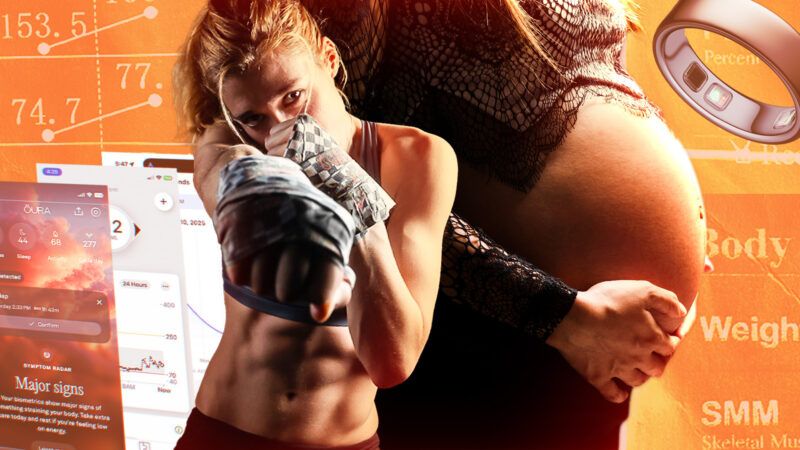
My six-pack began to disappear in the fourth month of my pregnancy, with the final pack officially vanishing in week 15.
My disappearing abs were just one of many demoralizing trade-offs my career as a biohacker took when I got pregnant. Since adolescence, I have been genetically blessed with visible abs. While I would like to credit my hard work, six-packs are mostly just the product of weight distribution and low body fat. You cannot control where your body adds fat, even subcutaneous fat. But optimizing my body's performance has been a delightful hobby since the lockdown, when I locked in on biohacking.
Side note: I don't use the phrase "we're pregnant" since Nick Gillespie, Reason editor at large and also my husband, endured very little of the pregnancy experience.
Pregnancy meant my commitment to biohacking was about to get more intense—even as the tools available were about to get less useful. I had become someone else's sensory deprivation tank. The biohacker had become the biohack-ee. Biohacking is the simple application of science and tech to change your body however you desire. A whole market has sprung up so that a whole new cadre of self-experimenters can be absolutely insufferable at parties. Whatever your ailment or desired outcome, there's a supplement or smart app for it.
But these tools are meant for a certain body. Which is to say, a body that does not currently contain another body.
In some ways, my previous biohacking habits had prepared me for pregnancy. I am an ultramarathon runner. So when my feet swelled, I had my choice of running shoes with expandable laces and a wide toe box. I had a reserve of electrolytes at the ready. I had heard there was even a small athletic advantage to being pregnant: Your blood supply increases during pregnancy. In fact, blood volume increases by up to 50 percent. This is basically blood doping, when done by nongestators. I hoped, perhaps a little too fervently, that this might improve my time in my first post-pregnancy race. (It did not.)
I was excited to take prenatal vitamins. Already, real estate on my kitchen countertop is scarce, thanks to bottles of creatine, peptides, L-theanine, iron supplements, etc. I had a custom ChatGPT project dedicated to cross-referencing supplements and drugs to make sure there were no contraindications. I also asked ChatGPT to help match my nutritional needs to pregnancy cravings. (Pickles are an excellent source of electrolytes.)
I took a body composition test at three months pregnant and took another at six months. I was surprised and impressed to see I had gained muscle! Then I realized it probably was not entirely "my" muscle. (If I made muscle attached to another human being, could I still consider it mine?) I certainly felt more "swoll" than ever before.
Biohacking my way through pregnancy wasn't all fun and pills, though. Starting in my third trimester, I began to suffer from a condition that sounds like more fun than it is: lightning crotch. This is an actual medical term for the shooting pain that occurs when the baby's head presses on a nerve in your groin. (It would also be a great drag name.)
Sometimes the doctor's visits for pregnancy felt more like a frat prank than a medical checkup. Routine ultrasounds require you to show up with a full bladder, for example. The most frat-ish was the blood glucose test. This is a test for gestational diabetes where a medical professional requires you to chug a bottle of 50 or 100 grams of sugar in five minutes. The packaging declares that the glucose drink is "for prescription use only" and "best served chilled." The flavor offered was "orange." You are not allowed to walk after the test. Then they test your blood again to see how your blood sugar spikes.
When I showed troubling results from the sugar chug test, I was assigned a continuous blood glucose monitor. I was jazzed. Many biohackers use these regularly to learn about how their energy and mood levels change throughout the day in response to blood sugar. I learned that I am, medically, not a morning person. Also that I do not have gestational diabetes.
I may have overhacked my pregnancy. My baby was diagnosed with LGA (large for gestational age). I was going to be induced early. Was it the creatine or just genetics? We may never know.
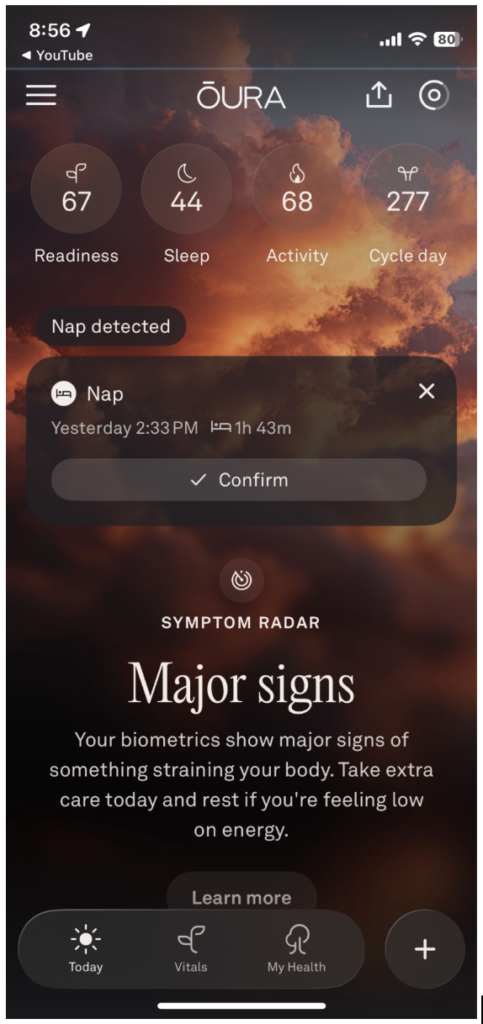
Though I chose not to log my pregnancy on my Oura Ring, out of a foreign desire for privacy, I did wear it into the delivery room. A little while after delivering my son, I checked my phone. My ring app, usually with a sunny cloud background, had become a foreboding red storm. During childbirth, a red alert popped up: "Symptom Radar: Major Signs. Your Biometrics show major signs of something straining your body." And in a separate corner: You are 277 days late for your period. It also detected a "nap," likely the moment when my epidural kicked in.
I had been warned by mothers that right after you give birth and are drugged up and tired, the nurses throw a million pieces of information at you. I was determined not to forget anything, so I used a Plaud AI note pin to transcribe the entire process. The record was invaluable. But my transcription tool is usually meant for conferences and work meetings. So the auto-generated summary of the birth of my child included "Mental Fortitude in Adversity" as a "Meeting Highlight."
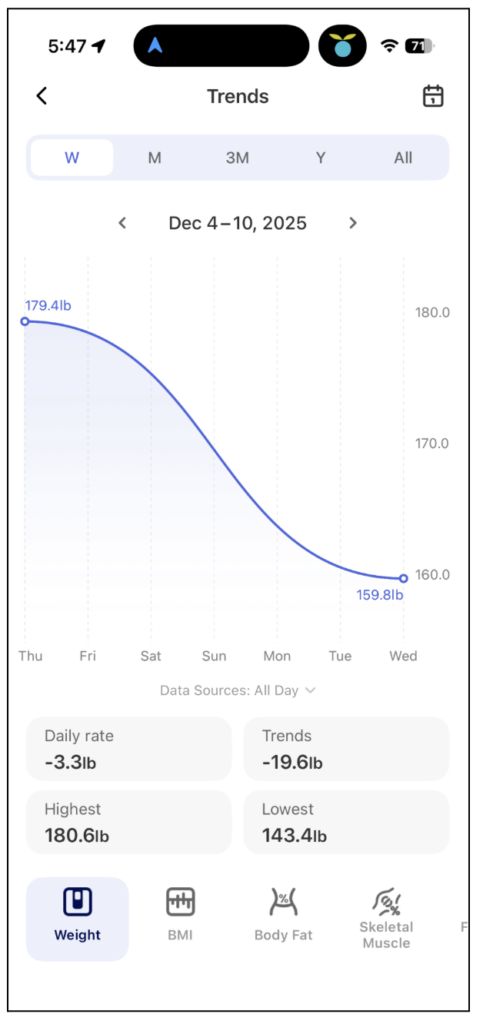
After I got home from the hospital, I decided to weigh myself. I felt lighter, almost felt like a new person. In fact, my smart scale refused to believe I was the same person. First, it asked me if I was OK. Then it logged me out.
Pregnancy is criminally understudied due to the lack of randomized controlled trials for ethical reasons. And biohacking is usually a solitary venture. The result is that billions of pregnant women pay the price of the precautionary principle: avoid everything, know nothing, and call that safety. But I have been able to contribute to scientific understanding by enrolling in a study sponsored by the National Institutes of Health, which measured how my behavior affects my son's brain development. It's the largest long-term study of early brain development in the U.S. It entails endless surveys, functional magnetic resonance imaging, and collecting my fingernail clippings, but it feels good to contribute to a historical scientific venture. Also they give me free diapers.
I am now six months postpartum. I have a new host of tools to play with. The SNOO bassinet automatically rocks my baby to sleep whenever it detects motion or sound. The Huckleberry app tracks my baby's sleep to predict his nap times with AI. I'm now hacking two different bios.
I recently got a notification from Pulse, ChatGPT's custom newsfeed. It was an essay the AI thought I should read: "When pregnancy optimization goes too far." It was about how my excessive use of the tool might indicate that I was trying so hard to control the experience of motherhood that I was not actually experiencing it. Here was technology, telling me not to use so much technology.
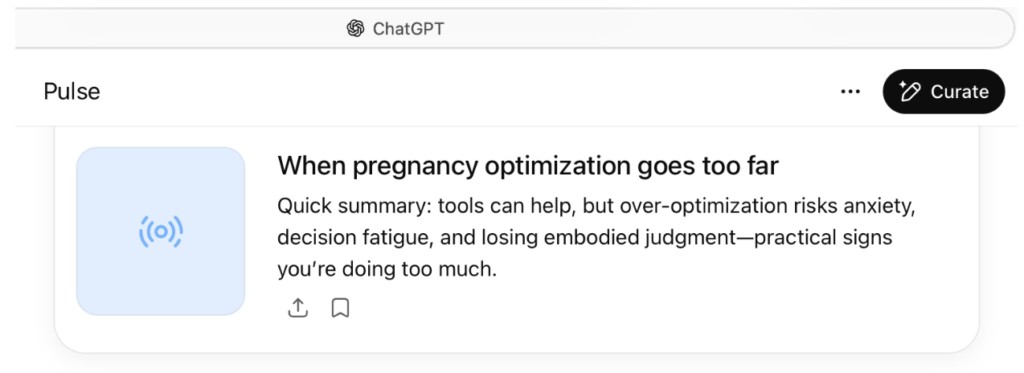
I had been talking at my tech for a year. It was finally talking back. And its message was: chill out.
Previous generations did not have the same wealth of products to alleviate the suffering and risks of this most transformative and defining human experience. But there is also delight in mystery. Modern science sometimes confirms old ways of knowing. For years, midwives have told pregnant women that heartburn means the baby will have more hair. Science has recently documented this correlation, though we still don't know the cause. Formula is a fantastic and often necessary supplement and substitute for breastmilk, but only breastmilk has incredible adaptive advantages of responding in real time to your baby's needs—melatonin at night and cortisol in the day, and custom antibodies for your environment. The female body is truly a force of nature.
So far, I have regained two parts of my six-pack. But I have not been throwing myself at regaining the whole set. I am much more at peace with the costs of giving birth because I know what it was for. In some ways, reproduction is the ultimate biohack. Women can not only exert some control over their own bodies, but they can also control whether a new body comes into existence. And somehow this is still legal—so far. I now recommend procreation to everyone I meet at parties the same way I used to push creatine. My son has put more serotonin in my brain than any Selective Serotonin Reuptake Inhibitor ever has. One could say I biohacked my soul. And it feels optimal.




