
Don't Blame AI for Your Own Medical Problems
A former pastor suing ChatGPT says the chatbot gave him life-threatening medical advice. But tech-enabled healthcare is not the problem.
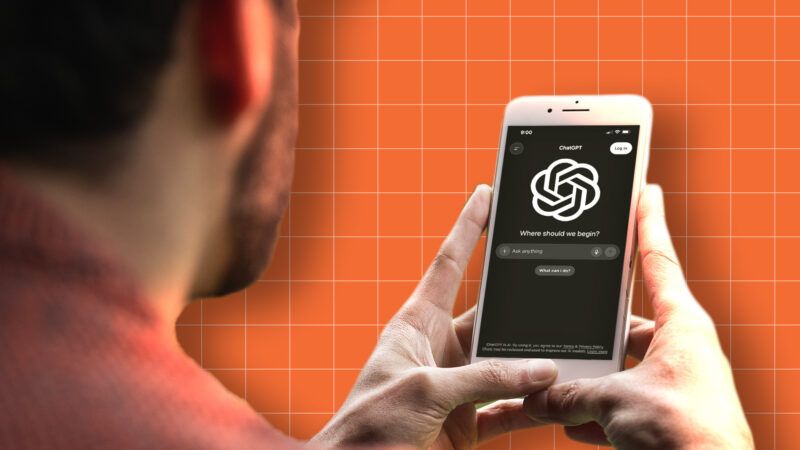
A few weeks ago, I hurt my left elbow while doing my regular weight workout. I've been lifting for over 50 years and have spent a lot of time swimming and playing baseball, tennis, and other sports that are well known for creating nagging joint pains, but this was new to me. I thought about making an appointment with my regular doctor or scouting out nearby physical therapists who are in-network for my insurance—two sensible options that also meant spending an undefined amount of money and, even more off-putting, an undefined amount of time scheduling appointments, juggling calendars, and sitting in waiting rooms.
So I did what an increasing number of us are doing: I consulted ChatGPT.
It responded with a probable diagnosis of lateral epicondylitis, or what's commonly called tennis elbow. After a lengthy interrogation about my symptoms, it recommended a series of exercises to try, a cheap elbow strap to help relieve the pain, and repeatedly told me to contact my primary-care physician or a physical therapist if the problems persisted or got worse. ChatGPT supplied copious photos, diagrams, videos, and links to respected places like Cleveland Clinic and WebMD. Within an hour or so, I had a plan to address my pain and discomfort through a mix of rest, targeted exercise, and over-the-counter pain meds.
I thought about this while reading about Scott Winters, a Florida resident who is suing ChatGPT and its CEO, Sam Altman, for allegedly almost killing him. Per CBS News, Winters and Tech Justice Law (the nonprofit helping Winters out) argue that ChatGPT crossed "the line from providing information into practicing medicine without a license" and "prioritized user engagement and profit at the expense of public safety, and…failed to provide adequate guardrails to protect users from following bad health advice."
Last year, Winters complained to ChatGPT about feeling dizzy and having blood pressure issues. He and his lawyers say ChatGPT advised him to remain "recliner-bound," and even invoked religious language ("God did not design your body to endlessly fail") to cajole the former pastor into taking it easy. A few weeks after consulting ChatGPT, Winters had a "massive pulmonary embolism" intensified by blood clots that might have been linked to his lack of movement.
In a Tech Justice Law press release, Winters didn't hold back, saying, "ChatGPT manipulated my own language and beliefs because it knew I was a pastor. Not only did I nearly die, but I also lost my job, my career, my ministry, my home, everything."
"If ChatGPT were a physician dispensing medical advice, it would be guilty of medical malpractice," said Matthew P. Bergman of the Social Media Victims Law Center in the same release. "Scott Winters nearly died because ChatGPT acted like a medical authority while having none of the responsibility."
But if we're talking about responsibility, what about the plaintiff's responsibility in any of this? ChatGPT—and every other AI platform I've encountered—constantly tells users that it is not a medical authority and that you should always consult your doctors or providers.
Winters' case is not an isolated incident. Tech Justice Law is itself involved in another case against OpenAI involving a fatal overdose by a University of California undergrad last year. The suit charges that OpenAI encouraged the student to mix kratom and Xanax, a combination that led to his death.
OpenAI has yet to lose a case over medical advice (at least, that's what Google's AI-enabled search tells me), but it's hard not to see where this sort of thing is headed. It has taken years for social media companies to lose analogous cases. But earlier this year, YouTube and Meta, the parent company of Facebook, Instagram, WhatsApp, was found guilty by a Los Angeles jury in a civil case of "addicting a young woman to their services and exacerbating her mental health struggles." Meta also lost a case in New Mexico where a jury said it harmed the mental health of minors while failing to protect them from sexual predators.
Even as AI tools become more ubiquitous and more deeply embedded in daily life, AI itself is becoming more feared—and will almost certainly become a scapegoat for everything that goes wrong in our collective and individual lives. An NBC poll earlier this year found that AI had a net favorability of –20 percentage points, with "AI ranked less favorably than US Immigration and Customs Enforcement, President Donald Trump, former Vice President Kamala Harris, the Republican Party and The Late Show host Stephen Colbert." When you are that unpopular, you're likely to lose cases regardless of the strength of the arguments.
Although AI has yet to actually create the large-scale unemployment many fear, the mere possibility of such disruption energizes much of the negativity toward it. Stories like the one involving Scott Winters will likely stay in the public's mind longer than reports that AI is helping doctors be more efficient, that it "literally may have saved my life," or that it sometimes scores better than humans at diagnosing illnesses.
In my case, ChatGPT helped me clear up my tennis elbow in a few weeks without having to access my traditional health network. If my issues had been more serious, I still would have consulted my AI, though I certainly wouldn't let it be the last word—if anything, it would have informed the questions and concerns I brought to my doctor and healthcare team. This is exactly what my wife did during her recent pregnancy and while it at times it consternated her OB-GYN, it definitely made for a better process than had she eschewed AI.
As with most supposedly transformative technologies, AI is less a complete replacement for the existing world than a supplement to it, something that adds new spaces and possibilities. It's a great tool, but it's up to us whether we use it wisely or not.
Contra his legal backers, Scott Winters didn't nearly die because "ChatGPT acted like a medical authority while having none of the responsibility." He almost died because he didn't take responsibility for his health. If that sort of basic abdication gains the force of law, we'll create a world that no technology will be able to fix.