

Afroman on Free Speech, Government Abuse, and Election 2028
"I want a smaller government. I want to get crooked judges and police officers out of the government," the rapper tells Reason's Andrew Heaton.
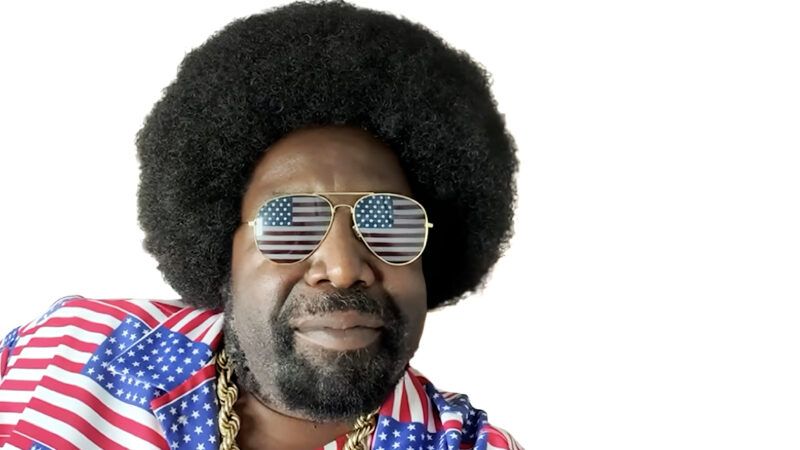
In 2022, sheriff's deputies in Adams County, Ohio, showed up at the home of the Grammy-nominated rapper Joseph Foreman, a.k.a. Afroman, with a warrant and a tip about a basement dungeon. They busted down the front door, rifled through his belongings, and seized thousands in cash. The search turned up nothing—the house didn't even have a basement.
Rather than let it go, Afroman made music about it and used surveillance footage of the raid in music videos and on merchandise. Seven of the deputies sued him in 2023, claiming he'd used their likenesses for commercial gain and caused them embarrassment and reputational harm. In March, Afroman showed up to trial in an American flag–print suit, arguing he had a First Amendment right to mock the deputies who kicked down his door. A jury agreed.
In a conversation with Reason's Andrew Heaton, Afroman says the verdict was a win for ordinary Americans who want the right to criticize public officials without being dragged into court. They also discuss small government, Afroman's potential presidential platform, and why the man behind the anthem "Because I Got High" may be the unifying figure America needs.
Q: If I think you've kidnapped somebody and I break into your house, but I apologize and I fix the door, would we be OK? What could the cops have done to make the situation OK?
A: It's OK to make mistakes in this lifetime. It's not OK to not apologize for making those mistakes. They put erasers on the end of pencils because they expect you to make mistakes. I expect a human being to make a mistake, but when a human being knows they made a mistake and they're not apologetic and they're arrogant about it, then that takes you down a whole other road.
Q: Why do you think the deputies thought this would work? I assume the threshold for this is so high that it was very unlikely they'd pull it off.
A: Yes. I believe they live in a small world. Being government officials, they control that small world. The police department is inside the courthouse. They all meet up at the snack machine and laugh, and they've got ongoing relationships with each other. They are accustomed to bullying the civilians of Adams County. They are accustomed to influencing the jury with intimidation, or just the whole "the police are always right every single time, under every single circumstance." They are accustomed to those types of situations. They figured that they could violate me and then sue me and then win.
Q: Is this a First Amendment case from your perspective and from the case that your attorney pushed?
A: Yes. We the people. The government is for the people, by the people. The people supervise the government. I am the government supervisor. I have the right to criticize and critique my government, my employees.
Q: Do you think this is going to embolden people in terms of free speech in general?
A: Yes, sir. But it's nothing that I gave the people. It was something that the Founding Fathers of America gave the people hundreds of years ago. I just microwaved it and reinstated it. Just reminded people about it.
Q: Is there anything about your trial that people don't understand?
A: I don't think so. I think everybody gets it. The police raided my house, didn't find nothing, were sarcastic, ornery, and unapologetic about the damages they did. I did the most peaceful, positive thing I could do: made songs about them to raise money for the damages they caused. They had the arrogance and the audacity to try to sue me. I told them that I had freedom of speech. They lost. Beautiful story. Beautiful American story!
Q: If you run for president again, would your campaign be weed legalization? Would you also want to get into police reform? What kind of stuff would you want to have in your platform?
A: I'm going to do a whole lot more with freedom of speech, corruption in the government. I want a smaller government. I want to get crooked judges and police officers out of the government. I want better-character people. I want people with integrity.
Q: If you end up running on legalizing weed, getting rid of corruption, and pro–free speech, you'd probably have my vote. I think there are a lot of people who would very much resonate with that message.
A: I'm not a scholar on paperwork, but I think this world is missing common sense, and I'll bring it back. Everything will be all right. People might think about me being president; they might roll their eyes and think that's the most absurd thing. I believe I can unite America. I've been in every circle, every circle—circles that you might feel I shouldn't be in. I realized that we're not as different as we think we are. Just with that knowledge, I believe that I know how to move in a way that will unite us. We were united when I was celebrating freedom of speech. I had Republicans jumping with me. I had Democrats jumping with me. I had Libertarians jumping with me. I had white people. I had country hillbillies with long beards and overalls jumping with me. I had some thugs jumping with me. I believe I can unite America. I love everybody, and a lot of people love me. Of course, everybody ain't gonna love everybody. But I believe I can unify the country, get the patriotism going again, get the spirit going again, and bring us all together.
This interview has been condensed and edited for style and clarity.




