

The DOJ Challenges Virginia's 'Assault Firearm' Law and California's Glock Ban
Assistant Attorney General Harmeet Dhillon argues that both laws are unconstitutional because they prohibit arms in common use for lawful purposes.
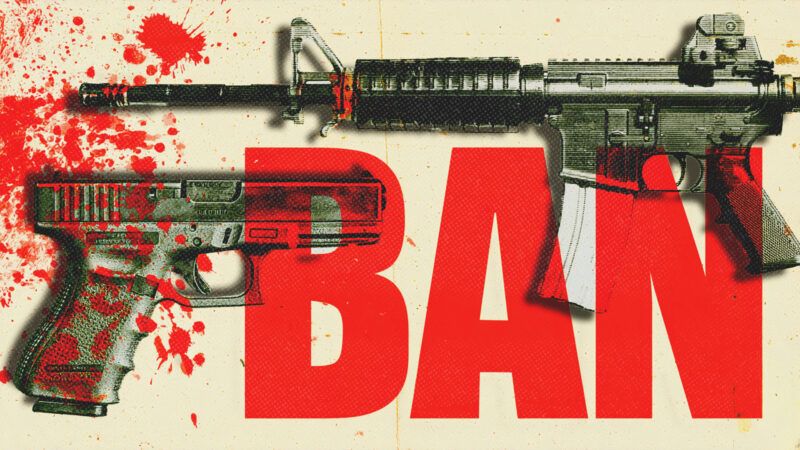
In a lawsuit filed last week, the Justice Department argues that Virginia's recently enacted "assault weapon" ban violates the Second Amendment, raising the same issue that the Supreme Court recently agreed to address in cases involving similar laws. Also last week, the Justice Department challenged California restrictions that make it illegal to sell handguns commonly sold in other states, including Glock pistols.
Virginia's law, which Gov. Abigail Spanberger signed on April 13, makes it a crime to manufacture, import, sell, purchase, or transfer "assault firearms." It defines that category to include semiautomatic center-fire rifles that accept detachable magazines and have any of five listed features: 1) a folding or adjustable stock, 2) a thumbhole stock or pistol grip, 3) a second handgrip or protruding grip that can be held by the non-trigger hand, 4) a grenade launcher, or 5) a threaded barrel that can be used to attach a muzzle break, a muzzle compensator, a sound suppressor, or a flash suppressor.
That definition encompasses some of the most popular firearms sold in the United States, including AR-15-style rifles. In January, the National Shooting Sports Foundation, the gun industry's trade association, reported that Americans own more than 32 million "modern sporting rifles," its preferred term for the models covered by bans like Virginia's. Survey data suggest that somewhere between 16 million and 25 million Americans have owned AR-15-style rifles. They commonly report using them for lawful purposes such as self-defense, hunting, and target shooting.
Those facts are constitutionally relevant. In the landmark 2008 case District of Columbia v. Heller, the Supreme Court said the Second Amendment guarantees the right to own "bearable arms" that are "in common use" for "lawful purposes like self-defense." And under the test established by the Court's 2022 ruling in New York State Rifle & Pistol Association v. Bruen, Virginia has the burden of showing that its law is "consistent with this Nation's historical tradition of firearm regulation."
The state cannot possibly do that, Assistant Attorney General Harmeet Dhillon argues in the Justice Department's complaint, which was filed in the Eastern District of Virginia. "Americans own and use for lawful purposes tens of millions of AR-15-style rifles," she writes, and "there is no historical tradition of banning arms in common use."
The Firearms Policy Coalition and two other Second Amendment groups make the same basic argument in their challenge to Virginia's law, which they filed on May 14. That argument also figures in previous Justice Department lawsuits challenging "assault weapon" bans enacted by Denver and the District of Columbia. And it is at the center of two cases that the Supreme Court will hear during its next term, which involve rifle restrictions imposed by Connecticut and Cook County, Illinois.
While the details of these laws vary, all of them cover arms in common use for lawful purposes, making them presumptively unconstitutional under Heller. It is hard to see how Virginia can overcome that presumption by meeting the Bruen test, which requires "relevantly similar" historical analogs that resemble a challenged law in motivation and scope.
Dhillon acknowledges that the Justice Department's lawsuit contradicts the reasoning of Bianchi v. Brown, a 2024 ruling by the U.S. Court of Appeals for the 4th Circuit, which includes Virginia. That case "was wrongly decided," she says, and the Justice Department "brings this action seeking to have Bianchi overturned."
In Bianchi, the 4th Circuit upheld Maryland's "assault weapon" ban, saying it met the Bruen test. The targeted guns, it averred, "fall outside the ambit of protection offered by the Second Amendment because, in essence, they are military-style weapons designed for sustained combat operations that are ill-suited and disproportionate to the need for self-defense."
In a dissent joined by four of his colleagues, Judge Julius Richardson rejected that premise, saying the majority ignored the self-defense advantages of AR-15s, including better accuracy, greater recoil absorption, and more stopping power than handguns. While handguns also have certain advantages, Richardson said, the appeals court had no business second-guessing gun owners' weighing of these rifles' pros and cons, thereby "replac[ing] Americans' opinions of their utility with its own."
Where Richardson saw self-defense advantages, the majority saw features that make AR-15s especially deadly in mass shootings. Those clashing perspectives illustrate the folly of trying to draw a legal distinction between guns that are suitable for legitimate purposes and guns that supposedly are good for nothing but killing innocent people.
The 4th Circuit's opinion was long on detailed descriptions of such horrifying crimes but short on the sort of analysis required by Bruen. To give you a sense of its reasoning, the appeals court cited early laws restricting the storage of gunpowder—fire prevention measures that have nothing to do with prohibiting rifle features such as pistol grips and folding stocks—as a relevant historical precedent.
The 4th Circuit described AR-15s as the "weapons of choice" for mass shootings, even while noting that most mass shooters choose other kinds of guns. It emphasized the rifles' military lineage, which Richardson noted is common for civilian firearms, and their destructive power, which is shared by many guns that Maryland did not ban.
In any event, Dhillon notes, AR-15-style rifles "are not commonly used by criminals." In 2019, according to the FBI, "only 364 homicides were known to have been committed with rifles of any type, compared to 6,368 with handguns, 1,476 with knives or other cutting instruments, 600 with personal weapons (hands, feet, etc.) and 397 with blunt objects."
While those numbers suggest the irrationality of the obsession with "assault weapons," they are not constitutionally decisive. In Heller, after all, the Supreme Court held that Americans have a right to own handguns, which it described as "the quintessential self-defense weapon," notwithstanding their prominence in homicide statistics.
Dhillon's case against California's handgun rules likewise argues that they fail the Bruen test. "It is illegal for California firearms dealers to sell certain semiautomatic pistols," she notes in the Justice Department's complaint, which was filed in the Central District of California. The state's restrictions include a new law "commonly known as the 'Glock Ban,' because it bans the sale of virtually all Glock and Glock-style pistols," Dhillon adds. "California's ban on the sale of the most popular handgun in America obviously violates the Second Amendment."
A California law that took effect on July 1 prohibits the sale of "machinegun-convertible" pistols. It defines that category as models with "a cruciform trigger bar that can be readily converted by hand or with common household tools" to fire automatically "by the installation or attachment of a pistol converter as a replacement for the slide's backplate without any additional engineering, machining, or modification of the pistol's trigger mechanism." That definition encompasses Glock and Glock-style pistols, including models that had previously been approved for sale in California.
"All factory-stock models of Glock pistols have a cruciform trigger bar," Dhillon notes.
"This includes Glock's 'Gen 6' and 'V series' pistols, which were introduced into the U.S. market in late 2025. The cruciform trigger bar is integral to Glock's design. Among other things, it is a safety device that ensures that a Glock pistol will not discharge accidentally if dropped." It has been "a feature of Glock pistols since they were first sold in the U.S. in 1986."
California apparently "believes it can outlaw perfectly legal and safe firearms if those firearms can be converted into illegal firearms," Dhillon writes. "This is not the law.
A legal shotgun can be turned into an illegal sawed-off shotgun in a matter of seconds with a common hacksaw. Surely, this does not mean the State can outlaw shotguns. A semiautomatic rifle can be converted into a machinegun, but unmodified semiautomatic rifles are 'widely accepted as lawful possessions.'"
Glock and Glock-style pistols are "unquestionably in common use for lawful purposes," Dhillon says. "Analysts estimate that, as of 2020, Glock held nearly 65% of the U.S.
market for handguns….Glock pistols consistently rank among the top-selling firearms in the U.S. civilian market." That's a problem for California under Bruen, she notes, because "there is no historical tradition analogous to a ban of a weapon in common use."
The lawsuit also challenges California's "Roster of Certified Handguns," which took effect in 2001 and reflects additional restrictions. As of 2007, for example, newly approved models had to have a chamber load indicator (CLI), which shows whether a gun is ready to fire, and a magazine-disconnect mechanism (MDM), which deactivates the weapon when the magazine is removed. "Until recently, these handguns were also required to have the ability to transfer microscopic characters representing the handgun's make, model, and serial number onto shell casings fired by the gun," Dhillon notes. "As a result of these requirements, no new handguns were added to the Roster between 2013 and 2023."
As of 2023, in fact, none of the handguns on California's roster met current requirements for newly listed models. "Not one of the handguns being sold in California had a CLI, MDM, and microstamping ability," Dhillon says. "Thus, every single handgun on the Roster was a grandfathered handgun—one the California legislature deemed 'unsafe.'"
That bizarre situation led to a 2023 ruling by U.S. District Judge Cormac Carney, who deemed it unconstitutional. "Californians have the constitutional right to acquire and use state-of-the-art handguns to protect themselves," Carney wrote in Boland v. Bonta. "They should not be forced to settle for decade-old models of handguns to ensure that they remain safe inside or outside the home."
Carney issued a preliminary injunction blocking enforcement of California's handgun specifications, which was stayed pending appeal. California's legislature later delayed enforcement of the microstamping requirement until January 1, 2028.
"These provisions of the Roster statute violate the Second Amendment," Dhillon argues, because they prevent California residents from "acquiring state-of-the-art handguns for self-defense." She notes that "the state has failed to proffer any historical regulation analogous to" the CLI, MDM, and microstamping requirements, meaning it cannot satisfy the Bruen test.
These lawsuits exemplify the work of the Second Amendment Section that was recently established within the Justice Department's Civil Rights Division, which Dhillon oversees. Unfortunately, the section's mission does not include opposing laws that disarm broad categories of Americans for no good reason, which the Trump administration has defended despite its avowed commitment to "protecting Second Amendment rights." But in addition to challenging arbitrary restrictions on which kinds of guns Americans are allowed to buy, the Justice Department has sought to overturn magazine caps and obstacles to obtaining carry permits.
The legal hook for such litigation is 34 USC 12601, which prohibits any law enforcement "pattern or practice of conduct" that "deprives persons of rights, privileges, or immunities secured or protected by the Constitution or laws of the United States." That statute authorizes the attorney general to address such abuses by filing civil actions seeking "appropriate equitable and declaratory relief."
The Civil Rights Division "will defend law-abiding citizens from states that seek to disarm them illegally," Dhillon said when she filed the California lawsuit. "This lawsuit is yet another example of this Justice Department enforcing the Second Amendment by protecting citizens against unconstitutional state regulation of firearms."




