

Shipping Thrived After Trump Waived the Jones Act
Perhaps it's time to scuttle the law once and for all.
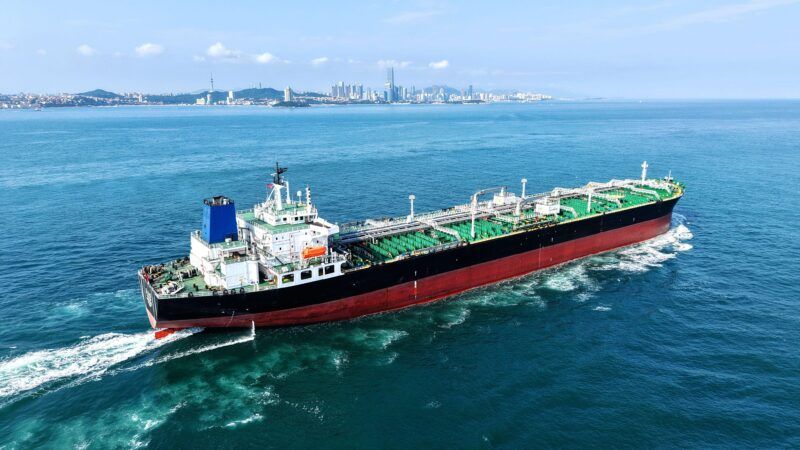
When the U.S. launched a war against Iran in February, it sent the prices of goods like fuel and fertilizer skyrocketing.
Hoping to remediate the damage, President Donald Trump issued a waiver of Section 27 of the Merchant Marine Act of 1920. Better known as the Jones Act, the statute says cargo moving between American ports must be carried on a ship that was built in America, with predominantly American owners and crew.
Under the Jones Act, Alaskan refiners may only send oil to the U.S. mainland on a ship built, owned, and staffed by Americans. A waiver allows companies to send goods between U.S. ports without worrying about where a ship was built or what flag it flies.
While the waiver was initially for 60 days, Customs and Border Protection later approved a 90-day extension, delaying its expiration until mid-August.
Since the waiver has been in effect, America's shipping lanes have thrived—providing further evidence that we should scrap the Jones Act altogether.
"More than 31 million barrels of fuel and chemicals were shuttled between U.S. ports by foreign vessels" in 90 days, Alana Pipe and Ryan Dezember write at The Wall Street Journal. "More than 70% of these shipments originated on the Gulf Coast, home to more than half of U.S. refining capacity and numerous petrochemical facilities and fuel-export docks."
"The most popular destination has been California, which depends on Persian Gulf imports and has the highest gasoline prices in the country," they add. "Gasoline has been shipped to California from refineries in Texas and Louisiana and Washington."
Colin Grabow, associate director of the Herbert A. Stiefel Center for Trade Policy Studies at the Cato Institute, has observed something similar. "Long-dormant U.S. energy supply chains have come to life," he wrote in The Washington Post. "Ships transported jet fuel from America's East Coast to the West Coast for the first time in nearly two decades. Bulk propane shipments reached Puerto Rico from Texas and Pennsylvania for the first time ever. Hawaii bought gasoline from Texas, and Alaska imported jet fuel from Louisiana. Ohio shipped fuel across the Great Lakes to Wisconsin."
This is wonderful news, but it should come as no surprise that a piece of protectionist legislation stands in the way of progress.
The Jones Act was designed to protect American shipbuilders from foreign competition. And yet it has not led to a U.S. shipbuilding boom.
"Of the tens of thousands of large vessels that dot the oceans, a mere 0.13 percent are built in the United States," Arnav Rao wrote last year at The Atlantic. "China, by contrast, fulfills roughly 60 percent of all new shipbuilding orders and has amassed more than 200 times America's shipbuilding capacity. Not only do most U.S. imports and exports travel on foreign-built ships, but those ships are owned and crewed almost exclusively by nine giant carriers based in Europe and Asia."
"Rather than bolstering US commercial shipping capacity and the merchant marine, the Jones Act has presided over the steady degradation of both," wrote Scott Lincicome of the Cato Institute.
Shielding an industry from competition makes its product more expensive, not less. In fact, cargo ships can cost five times as much to build in the U.S. as in Asia, and requiring American owners and crew can cost twice as much.
As a result, some Americans routinely struggle to get products that are plentiful in other parts of the country. Puerto Rico, for example, pays more for liquefied natural gas (LNG) from the U.S. than does its neighbor, the Dominican Republic—even though Puerto Rico is a U.S. territory. That's because of the hundreds of LNG tankers worldwide, only one is compliant with the Jones Act.
So even though the U.S. produces more LNG than any other nation, there is only one vessel in existence allowed to carry it to another U.S. port.
Even some of the law's defenders implicitly acknowledge it hasn't lived up to its promises. In a letter to the president last week, 52 Republican lawmakers—including House Speaker Mike Johnson (R–La.) and House Majority Leader Steve Scalise (R–La.)—advised Trump to let the waiver expire and called the Jones Act "our nation's strongest shield against foreign exploitation of American waterways."
"Less than one percent of new commercial ships are built in the United States," which "underscores the importance of protecting durable domestic maritime policy and safeguarding against foreign encroachment in our nation's waterways," the letter cautioned. "The Jones Act waiver has become a loophole exploited by adversarial countries to erode America's maritime dominance."
"The Jones Act waiver gives work to foreign vessels and foreign mariners instead of Americans," adds the American Maritime Partnership, which represents the domestic shipping industry. "Every waiver extension creates additional uncertainty for American shipowners, American mariners, and American shipyards."
But the waiver has only been in effect since March; the Jones Act, meanwhile, has been on the books for more than a century, other than the few dozen times it was briefly waived.
And during those 100-plus years in which federal law protected the industry from competition, did American shipyards churn out a glut of new ships? Of course not—fewer competitors make an industry less efficient, not more.
International trade should simply be about whether you can get the product under favorable terms. It shouldn't matter who built the ship or what language its crew speaks. But in the U.S., it unfortunately does matter, simply because a century-old protectionist law says so.
It should be clear by now that, just like an old ship, the Jones Act should be scuttled.




