

Trump's Temporary Waiver of the Jones Act Only Illustrates Why the Law Should Be Permanently Trashed
The Trump administration has issued a 60-day waiver of a federal law that limits the number of ships allowed to carry goods between American ports.
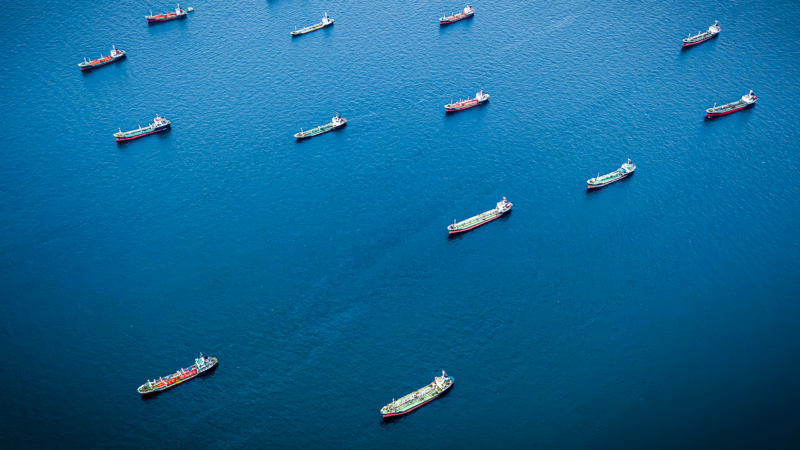
The Trump administration has issued a 60-day waiver of a federal law that limits the number of ships allowed to carry goods between American ports.
The move, White House press secretary Karoline Leavitt wrote in a post on Twitter, is meant to "mitigate the short-term disruptions to the oil market" caused by the ongoing war in Iran. "This action will allow vital resources like oil, natural gas, fertilizer, and coal to flow freely to U.S. ports for sixty days, and the Administration remains committed to continuing to strengthen our critical supply chains," she added.
That's a framing that demands a follow-up question. If waiving that law will make it easier (and presumably cheaper) for Americans to access vital resources for the next 60 days, why stop there?
Indeed, the White House's announcement seems to be a glaring admission that the federal restrictions on shipping only inflate prices and limit trade—as economists, libertarians, and anyone who understands the relationship between supply and demand and price have long recognized.
Under the terms of the Merchant Marine Act of 1920, more commonly known as the Jones Act, any cargo shipped from one American port to another must be carried by vessels that are American-built, American-crewed, and American-flagged. It's an openly protectionist piece of legislation meant to benefit domestic shipbuilders by outlawing most of the world's boats from carrying goods between, say, Hawaii and California or Houston and New York.
Unsurprisingly, the lack of competition drives up shipping costs. A recent lawsuit that unsuccessfully challenged the constitutionality of the Jones Act pointed out that it costs roughly three times as much to ship rum from Hawaii to Los Angeles as it does to ship the same goods from Los Angeles to Australia—an international route where greater competition keeps prices lower, even though the trip is significantly longer.
The law creates some whacky workarounds. For example, California routinely imports gasoline from the Gulf Coast states like Texas and Louisiana—but only after the fuel has been shipped to the Bahamas, moved from one boat to another, and then sent back to the U.S. In another infamous example (at least among those of us who are amused and frustrated by this stuff), the federal government sued an importer that was using a 100-foot railway in Canada to avoid triggering the Jones Act's requirements and the higher shipping prices that come with it.
Temporarily waiving the enforcement of a bad law is better than continuing to enforce it, of course. However, critics of the Jones Act were quick to note that President Donald Trump's action only underlines the law's failures.
"The Trump administration's 60-day Jones Act waiver is essentially an admission that the law doesn't work," Colin Grabow, a trade policy expert with the Cato Institute and longtime, fierce critic of the Jones Act, told Reason on Wednesday. "If it must be suspected to keep supply chains functioning during times of war and economic stress, that's a clear sign it serves no useful purpose and should be repealed."
The National Taxpayers Union Foundation, another organization critical of the Jones Act, has compiled a list of the recent waivers of the law granted by various presidents, including in the wake of major hurricanes and, now, as the U.S. deals with the economic consequences of war in Iran. Each time the law gets waived to address a crisis, the logic for keeping it in place seems more strained.
Unless, of course, you happen to represent the narrow sliver of special interests that benefit from this bit of protectionism. In response to the news that Trump was issuing a temporary waiver of the Jones Act, a coalition of unions representing American shipbuilders said it was "deeply concerned" about the decision—and warned that the change may not achieve much.
"This decision will not provide meaningful relief at the gas pump," the unions said in their joint statement.
It may be true that a 60-day waiver does little to ease shipping costs. Lasting benefits will require permanent changes. In the meantime, Trump has succeeded at once again illustrating the foolishness of protectionism—that's a lesson he should learn in other contexts too.




