

ICE Warns Syracuse Poll Worker To Delete a Political Instagram Post
Federal law can punish true threats, and doxing intended to facilitate violence. But this woman simply named a government agent, which is not a crime.
Over the past year and a half, Trump administration officials have gone after protestors—and even apps—critical of the government's immigration policies. Now, federal agents are targeting individuals for constitutionally protected speech on social media.
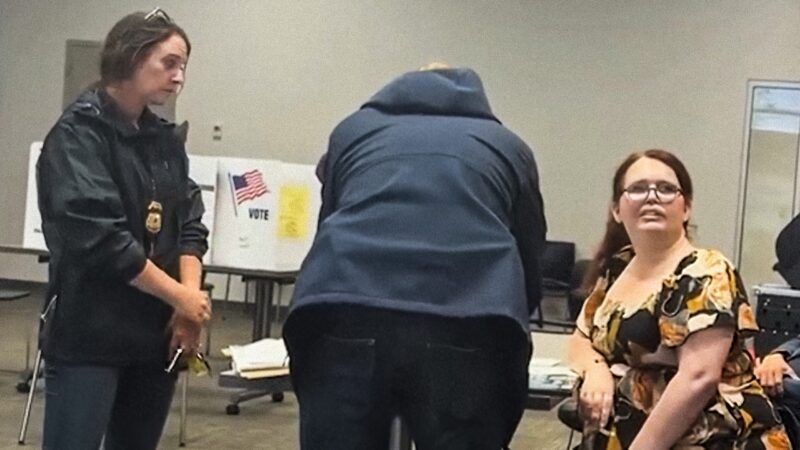
Last week, Syracuse resident Paigelynne Gonyea was approached by two Immigration and Customs Enforcement (ICE) agents at her workplace and given a warning to remove a social media post on an Instagram account the agents believed was hers. In a letter given to Gonyea, the ICE agents say the post may have broken federal law, as reported by Syracuse.com.
"YOU MAY BE IN VIOLATION OF FEDERAL LAW," the document she shared on Instagram reads. "OPR (ICE's Office of Professional Responsibility) has identified an Instagram post handle 'TURNDAPAIGEOFFICAL', which it has reason to believe may constitute a violation of Title 18 of the U.S. Code. Accordingly, OPR is requesting that you promptly remove and/or discontinue the aforementioned behavior."
Under Section 115 of Title 18, it is illegal to threaten to assault, kidnap, or murder a federal official, federal law enforcement officer, or their immediate family member when the threat is intended to impede, intimidate, interfere with, or retaliate against that official for doing their job. A threat made in violation of this statute could carry up to 10 years in prison. Section 119, meanwhile, prohibits knowingly publishing "restricted personal information" about protected people, but only when it is done with the intent to threaten, intimidate, or incite a crime of violence, or with the knowledge that the information will be used for that purpose. Therefore, the laws do not criminalize criticizing or naming a federal officer, but prohibit threats and doxing carried out with a specific unlawful intent.
Gonyea, who posts about immigration on her social media frequently, says the post at issue named the ICE agent who shot protester Renée Good in Minnesota, and who had already been identified in public reporting. "BREAKING: The ICE agent who shot and killed Renee Good in broad daylight has been identified as Jonathan Ross by the Minnesota Star Tribune. I think today is a great day for Jonathan to be indicted!" the post says.
The post, as described, appears to fall short of breaking the statutes cited in the warning. It did not include Ross' address, phone number, Social Security number, or other personal information, nor did she threaten to assault him. It merely named a federal agent who had already been identified in news reports and expressed the view that he should be indicted.
Gonyea denies threatening anyone or publishing private information. "I didn't dox his personal information, such as address, phone number," she told Syracuse.com. She has contacted the attorney general's office, her local congressman, Syracuse Mayor Sharon Owens, and the New York Civil Liberties Union. She has no plans to delete the post.
"For ICE to come to me over a social media post just feels very 1984 to me…They definitely should have known better to not go into a polling place, even if I said it was OK," she told the outlet.
Armed federal agents showing up at a poll worker's workplace to pressure her to delete a political Instagram post without charging her, obtaining a court order, or clearly identifying the supposedly unlawful language raises obvious concerns about government officials using intimidation to silence critics.
Notably, the document doesn't give Gonyea a practical way to challenge or clarify the warning. It tells her to contact "the undersigned Special Agent who served you with this Warning Notice to the local OPR field office" if she wishes to discuss it further, but, as the photo of the document on her Instagram shows, the section where the agent's name and contact details are supposed to be added is blank.
Gonyea is not the first American to face scrutiny from law enforcement over a social media post. In October, Larry Bushart, a 61-year-old former police officer in Tennessee, was arrested and held on a $2 million bond after posting a Facebook meme about President Donald Trump. Both Bushart's case and Gonyea's illustrate how quickly officials can treat political speech as a criminal threat, even when the likelihood of actual violence is speculative at best.
"A free America doesn't dispatch federal law enforcement agents to intimidate someone for an Instagram post of publicly available information," said Adam Steinbaugh, senior attorney at the Foundation for Individual Rights and Expression (FIRE), regarding Gonyea's case. "Free speech is the bedrock of a free society, and the First Amendment squarely prohibits ICE agents from intimidating Americans for nothing more than repeating information from a newspaper report. As we approach the 250th anniversary of our independence from England, where police now hassle residents over social media posts, let's not follow their lead."
Gonyea's encounter occurs at a moment when Americans are increasingly worried that free speech is under threat. According to a FIRE poll from November 2025, a record 74 percent of Americans believe free speech in the U.S. is headed in the wrong direction. The poll found that 53 percent of Americans are "very" or "extremely" concerned about government officials pressuring social media companies to remove content based on the ideology expressed.
Federal officials showing up at a woman's workplace to pressure her to delete a political social media post certainly makes fears about threats to free speech in America feel far less abstract.




