

Trump's Lawyers Insist There Is 'No Evidence' of 'Collusion or Fraud' in His 'Settlement With Myself'
The sweet deal that resolved the president's fatally flawed lawsuit against the IRS was business as usual at the DOJ, his attorneys told a federal judge.
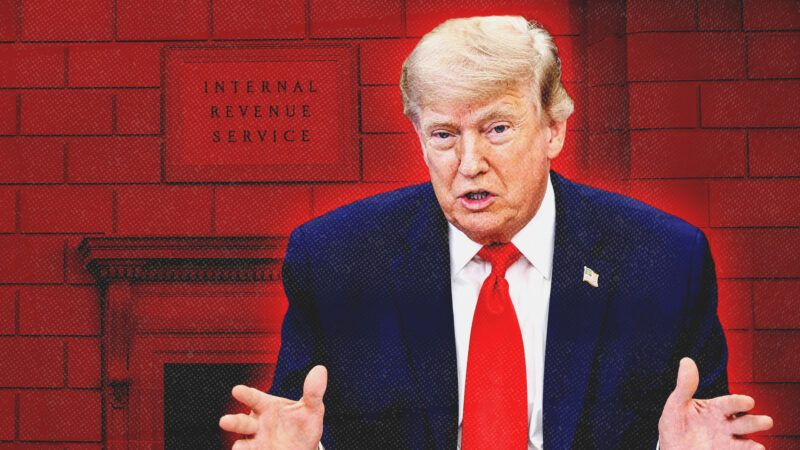
"I'm supposed to work out a settlement with myself," President Donald Trump told reporters a few days after he sued the IRS. He wasn't kidding: His January 29 lawsuit, which alleged damages from an IRS contractor's illegal leaking of his tax returns, pitted Trump against an agency he oversees, represented by Justice Department lawyers who also answer to him.
The "settlement" that the president reached with himself, which Acting Attorney General Todd Blanche announced on May 18, included $1.8 billion in taxpayer money for purported victims of the Biden administration's "lawfare and weaponization." It also included protection from liability for tax violations and any other federal offenses that Trump or his family might have committed. That sweet deal was business as usual at the Justice Department, Trump's personal lawyers improbably claim in a brief they filed on Monday in the Southern District of Florida.
There is "no evidence" of "collusion or fraud" in Trump v. IRS, Alejandro Brito and two other lawyers told U.S. District Judge Kathleen Williams, who last month ordered briefing on that issue. Any suggestion that Trump used a phony lawsuit as a pretext to obtain huge favors for himself, his relatives, and his supporters is based on "nothing but speculation," Trump's attorneys say.
Brito et al. glide over the glaring conflicts of interest created by a case in which both sides were represented by lawyers who worked for Trump. Further compromising the Justice Department's ability to defend the IRS, an executive order that Trump issued in February 2025 bars the government's lawyers from taking legal positions at odds with the president's.
That bizarre situation prompted Williams to question whether the case involved a genuine controversy between adverse parties, as required for the lawsuit to proceed. After Williams ordered briefing on that crucial issue by May 20, Trump avoided the need to address it by dropping his lawsuit two days before the deadline. But in response to a May 27 motion by 35 former federal judges, Williams is now mulling "whether the case should be reopened because the Court was the 'victim of a fraud.'"
Those former judges did not have standing to file their motion, Brito et al. argue, and Williams has no authority to reopen the case. Even if she did, they say, the most she could do after determining that there was no true "case or controversy" would be to dismiss the lawsuit again. Under no circumstances, they argue, would Williams have the power to review the "settlement," which the Justice Department "had independent statutory authority to enter regardless of whether this case was ever filed."
The Justice Department reached "a fully proper government settlement" after weighing the merits of Trump's claims and assessing the cost of defending against them, Brito et al. claim. "Because the government can and routinely settles claims with or without a lawsuit, it is irrelevant whether Movants believe that this case presented a robust case or controversy," they write. "The Government's decision to settle rather than litigate does not by itself render the underlying claims fraudulent or the litigation collusive." They add that "the validity of the settlement does not depend on this Court's jurisdiction over the dismissed action, and the dismissal did not result from collusion with anyone."
Whether or not Trump's lawyers are right about Williams' authority to intervene at this point, their argument that there is nothing to see here relies entirely on blithe assurances and comical misdirection. They emphasize, for example, that "three of the four Plaintiffs"—Donald Trump Jr., Eric Trump, and the Trump Organization—were not the president of the United States or even "employees of the federal government." When "private plaintiffs sue the United States for statutory violations," they say, the case is "inherently adversarial."
Trump, his sons, and his business claimed IRS contractor Charles Littlejohn's unauthorized disclosure of their tax returns had caused them "at least" $10 billion in damages. In addition to offering a preposterous estimate of the injury they had suffered, they missed the statutory deadline for filing such claims, meaning the lawsuit was doomed from the outset.
Although Brito et al. do not mention that fatal flaw, they do note another obstacle to the lawsuit. Trump's main claim was based on 26 USC 7431, which authorizes taxpayers to sue for damages when an "officer or employee of the United States" illegally discloses their tax information. "The question of whether Mr. Littlejohn qualified as an 'officer or employee' of the United States, as opposed to merely a contractor, was a contested issue that required application of a joint-employer analysis under federal common law," Trump's lawyers acknowledge.
That issue figured in a lawsuit that Citadel CEO Kenneth Griffin, another billionaire whose tax returns Littlejohn had leaked, filed in December 2022, also in the Southern District of Florida. Griffin filed an amended complaint about a year later, after Littlejohn had been publicly identified as the leaker. Unlike Trump, Griffin filed his lawsuit within two years of learning about the disclosure, as Section 7431 requires. Also unlike Trump, Griffin faced Justice Department lawyers who were keen to pick apart his claims.
The government's attorneys argued that Littlejohn did not qualify as a federal employee, making Section 7431 inapplicable. They also argued that the specific remedy authorized by Section 7431 preempted a claim under the Privacy Act, another statute that Griffin invoked.
In April 2024, U.S. District Judge Robert N. Scola Jr. ruled that Griffin had failed to adequately state a Privacy Act claim. He declined to dismiss Griffin's claim under Section 7431 but added that "whether the evidence ultimately supports the complaint's allegations that Littlejohn was an IRS employee remains to be seen." Griffin dropped his case two months later in exchange for an apology from the IRS.
The Justice Department offered a similar defense in Safe Harbour International v. Booz Allen Hamilton, another lawsuit triggered by Littlejohn's leaks, arguing that Section 7431 did not apply because Littlejohn was not an IRS employee. In April 2026, Lydia Kay Griggsby, a federal judge in Maryland, agreed with the government that the law applies only to "wrongful disclosures by employees and officers of the United States." But she declined to dismiss the Section 7431 claims, noting that "the parties disagree about whether Mr. Littlejohn was an employee of the United States."
Brito et al. cite Griffin v. IRS by way of showing that Trump's lawsuit raised serious questions worthy of judicial consideration. But a comparison of that case and Safe Harbour International with Trump v. IRS reinforces the impression of collusion. While the Justice Department vigorously contested the plaintiffs' claims in those other two cases, it did not even try to mount a defense against Trump's lawsuit.
From January 29, when Trump filed his lawsuit, until May 18, when he "settled" it on extremely generous terms, the Justice Department sat on its hands. In fact, Trump's lawyers emphasize that point to support their argument that he was free to drop his lawsuit without Williams' permission. They note that "no Defendant ever filed an answer, a motion for summary judgment, or any other responsive pleading—at any point in this case." But they say "the absence of filed appearances" and the government's "decision not to assert defenses that were available in parallel litigation" do not count as evidence of collusion.
"The Government's decision not to raise every available defense is a litigation judgment, not a badge of fraud," Brito et al. say. "Defendants in civil cases routinely elect not to contest certain claims for strategic, economic, or institutional reasons, including the entirely rational conclusion that the cost of defense exceeds the cost of settlement. The fact that the IRS may have identified viable defenses in internal memoranda does not mean it was obligated to assert them, and the decision not to do so does not give rise to an inference of collusion."
The "cost of settlement" in this case was $1.8 billion, plus the money that the IRS might have obtained by pursuing the claims against Trump or his family that the "settlement" prohibits. Judging from just one IRS dispute regarding Trump's reported business losses, the value of those forgone claims may exceed $100 million. Given those terms, it beggars belief to suggest that "the cost of defense" would have been higher than "the cost of settlement."
Brito et al. come closer to the truth when they say the Justice Department may have thrown in the towel for "institutional reasons." But the most obvious institutional reason is that the Justice Department's lawyers serve at Trump's pleasure and therefore were keen to please him. That hardly seems "adversarial."
Brito et al. likewise say "the scope of the settlement" does not support an inference of collusion. But they make no attempt to explain how a sweeping immunity deal and a $1.8 billion slush fund for Trump's friends and supporters were logically related to his claims against the IRS. Nor do they explain why the Justice Department thought those terms were necessary to settle a fatally flawed lawsuit. And they avoid any comparison between the benefits that Trump obtained and settlements in similar cases involving taxpayers who are not the president. Griffin and Trump both got apologies, after all, but Trump got a lot more than that.
"The government routinely takes different positions in different cases, under Department of Justice leadership, based on the specific facts, parties, and settlement value presented," Brito et al. note. "Litigation decisions are made case by case."
Those bland observations do not even begin to explain why the Justice Department's "litigation decisions" in this case were so favorable to the plaintiffs. Trump did not have to deal with the objections that plaintiffs in similar cases routinely face, and he won benefits grossly out of proportion to the legal merits of his claims. His lawyers want us to believe that outcome had nothing to do with Trump's status as the boss of his supposed adversaries.




