

Jeff Merkley Wants To Save Big Government From Donald Trump
The Oregon senator's "For Our Republic Act" would check many of the president's abuses while preserving the powerful federal state he commands.
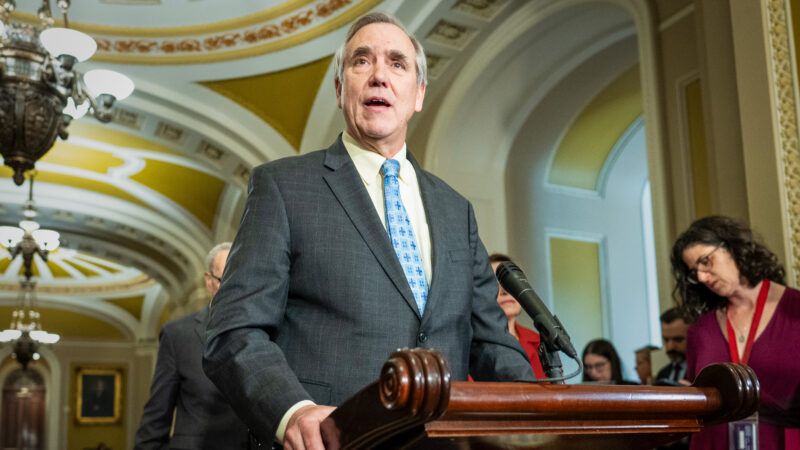
Jeff Merkley has a plan to save the republic from Donald Trump's "authoritarian playbook", or so says the senator from Oregon.
"This is a president trying to become a strongman authoritarian," said Merkley on the On NOTUS podcast this week. "If we don't repair the Constitution, we don't have a republic."
His "For Our Republic Act", which was introduced earlier this month, is a sprawling piece of legislation that aims at reversing many of the president's claims of executive authority and clamping down on some of the more novel forms of corruption we've seen under the president's second term.
Its proposed reforms range from moving immigration judges from the executive branch to the judicial branch, requiring congressional approval of executive-led department shutterings and reorganizations, and banning executive officers from trading in prediction markets and hawking crypto products.
While Merkley claims the bill is intended to check all presidents, and not just the current one, the legislation does often read as a list of particular Democratic grievances against Trump.
It would prohibit the Federal Communications Commission (FCC) from revoking broadcast licenses or taking action against broadcasters based on the viewpoints they broadcast, a clear nod to the commission's recent beefs with Jimmy Kimmel and The View.
The legislation would likewise block the president's renovations to the White House's East Wing and prohibit him from putting his face (or that of any living political figure) on National Park passes.
Merkley's bill would also impose a number of new restrictions on immigration enforcement officers, some of which they tried (and failed) to attach to a Department of Homeland Security funding bill earlier this year.
(Ironically enough, Merkley told On NOTUS that he'd support reforming the filibuster in order to pass his list of reforms, even though the filibuster was Democrats' sole piece of leverage to try and get ICE reforms through a Republican-controlled Congress. Republicans were able to fund ICE without those reforms by bypassing the filibuster.)
The legislation would ban immigration enforcement officers' use of facial recognition and gait recognition technology without a warrant and explicitly prohibit racial profiling. Private individuals and state attorneys general would be empowered to bring civil suits against immigration officers for on-the-job rights violations.
Merkley's bill is an interesting animal beyond any of its particular provisions. It highlights those areas of common concern that libertarians and liberal Democrats have with the second Trump administration. It also illustrates the limits of a progressive opposition to the abuses of the current White House.
Trump came into his second term asserting a maximalist view of the president's powers over the executive branch. That has not always been detrimental to libertarian policy goals.
His DOGE effort to fire federal workers and not spend appropriated funds is well in line with a vision of a federal government that costs less and does less.
At times, the administration's efforts to impound funds, lay off staff, and shutter departments arguably went beyond the president's powers. At other times, Trump was merely exercising powers to rescind funds or reduce staff that Congress gave him.
Merkley's bill would put a stop to it all and reassert Congress' ability to veto any executive-led economizing of the federal bureaucracy.
For all his rhetoric about Trump being a strongman, a major theme of Merkley's critique of Trump is that he's reducing the scope of the federal government in a way that clashes with his own liberal big government vision.
This is most obvious in the sections of Merkley's bill dealing with the FCC.
A legislative affirmation that the FCC can't engage in viewpoint discrimination is all well and good. But the commission's threats to free speech didn't start with Donald Trump and Brendan Carr's beef with late-night hosts.
A century of communications laws passed by Congress that treat access to the airwaves as a privilege, not a right, have long posed a serious free speech threat.
While Merkley's bill would prohibit the FCC from denying license renewals based on broadcasters' expressed views, he'd also reaffirm its independence and prohibit the president from setting its agenda.
If a future FCC attempted to crack down on all forms of political speech under a more robust interpretation of its "public interest" standard, a president would have little ability to rein in the independent agency.
The best protection for free speech would be to eliminate the FCC. It's not protection that Merkley contemplates.
The senator's bill would also arguably create new unconstitutional restrictions on free speech by banning AI-generated "deceptive depictions of election officials." State-level efforts to ban deepfake depictions of politicians have already been struck down by the courts on First Amendment grounds. Merkley's proposal would seem to run into similar constitutional problems.
Trump is a self-aggrandizing bully. He'd be a bad person to be in charge of any government, no matter how limited. While I don't believe he has dictatorial aspirations, the vast federal bureaucracy he commands makes his worst impulses especially dangerous.
But a vast federal bureaucracy is a danger to liberty in its own right, even if it's helmed by a fairer chief executive less eager to use its powers for narrow partisan advantage.
As Murray Rothbard wrote in the pages of Reason a half century ago, "It matters very little, then, who runs collectivism or Big Government; the important point is the existence of massive statist institutions, which can be readily adapted to whichever group takes power, and hence to the controlling and repressing of the subject population."
Merkley's bill contains a lot of reasonable reforms to check the particular abuses of the current president. But he, and liberal Democrats generally, are still wedded to a belief in a powerful leviathan state.
There are severe limits on how much progressives can do to protect Americans' liberties from a large federal government they ultimately support.




