

Reason.com - Free Minds and Free Markets
Reason logo Reason logo
  • Latest
  • Magazine
    • Current Issue
    • Archives
    • Subscribe
    • Crossword
  • Video
    • Reason TV
    • The Reason Roundtable
    • Free Media
    • The Reason Interview
  • Podcasts
    • All Shows
    • The Reason Roundtable
    • The Reason Interview With Nick Gillespie
    • Freed Up
    • The Soho Forum Debates
  • Volokh
  • Newsletters
  • Donate
    • Donate Online
    • Ways To Give To Reason Foundation
    • Torchbearer Society
    • Planned Giving
  • Subscribe
    • Reason Plus Subscription
    • Print Subscription
    • Gift Subscriptions
    • Subscriber Support

Log In

Create new account

FDA

The FDA Finally Approved a New Sunscreen Ingredient. It Only Took Over 25 Years. 

The FDA's burdensome regulatory process has throttled sunscreen innovation. 
Meagan O'Rourke | 6.10.2026 2:46 PM

Share on FacebookShare on XShare on RedditShare by emailPrint friendly versionCopy page URL Add Reason to Google
Media Contact & Reprint Requests
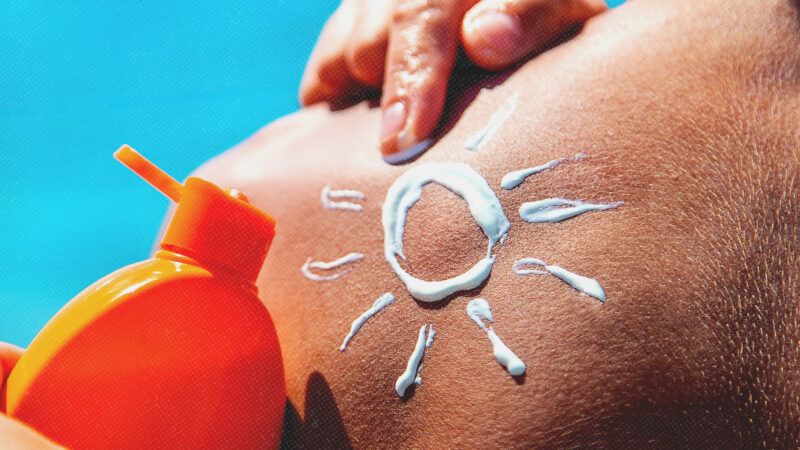
An outline of a sun made out of sunscreen on someone's skin | Yanadjana/Envato
(Yanadjana/Envato)

The U.S. has led the world in several innovations in recent decades: the iPhone, Facebook, and artificial intelligence. But when it comes to sunscreen, Americans have been living in the Dark Ages compared with Europe and Asia. 

That could be changing. This week, the Food and Drug Administration (FDA) added bemotrizinol (BEMT) to its list of permitted active sunscreen ingredients, updating the list for the first time since 1999, according to National Geographic. BEMT, per the FDA, "provides protection against both ultraviolet A and B rays and has low levels of absorption through the skin into the body," and it is safe and effective "for use in sunscreens by adults and children 6 months of age and older." Beginning August 9, BEMT will be sold in the U.S. exclusively by the manufacturer DSM, under the name Parsol Shield, The Hill reports. After 18 months, other manufacturers will be allowed to sell BEMT.

While the approval might be good news for sunscreen consumers, it's long overdue: BEMT has been used in the European Union's sunscreen market since 2000, and it has been approved in Australia, Canada, and several Asian countries. So why has the U.S. lagged so far behind other countries when it comes to sunscreen innovation? Sunscreen ingredients are "treated as over-the-counter drugs," reports Time, whereas "in the E.U., they are considered cosmetics," making the approval process in the U.S. lengthy and costly. 

There has been a bipartisan push to remove some of these regulatory hurdles. In 2014, Congress passed the Sunscreen Innovation Act, which was intended to expedite the approval process, but it did not prompt the FDA to approve any new ingredients. In 2020, Congress again tried to modernize the sunscreen ingredient approval process via a provision of the 2020 CARES Act, but it still took six years for BEMT to become the first ingredient approved under the new process, according to the FDA. And last November, as part of a stopgap government funding bill, Congress passed a provision requiring the FDA to draft guidance on how to allow for non-animal testing while still meeting safety standards for sunscreens—meaning there will likely be more pathways for approval in the future. The issue has even united political foes Rep. Alexandria Ocasio-Cortez (D–N.Y.) and Sen. Mike Lee (R–Utah), who have called for an overhaul of the regulatory process. 

Given the impact that bad sunscreen can have on people's health, it's important that new sunscreen ingredients are seriously tested for their safety. A 2020 study by FDA researchers demonstrated that some sunscreen active ingredients can be absorbed into the bloodstream. While the study's authors said that the study does not mean people should stop wearing sunscreen, it emphasizes the need to ensure sunscreens are safe for use. 

But rather than approving a new ingredient once every 20 years, alternative approval pathways should be considered. One that has been proposed by the Cato Institute's Jeffrey A. Singer would allow for international drug reciprocity, which would enable the U.S. to approve drugs already found safe in other developed countries. Such a policy would have allowed the U.S. to sell products containing BEMT long before 2026. And clearly, there has been a demand for new products, as Americans have turned to a gray market for overseas sunscreens from countries like South Korea.

Some consumers may remain sunscreen skeptics, perhaps opting to brave the sun barefaced or lathering themselves in olive oil and baking to a crisp. But those who want more skin protection options should not be burned by outdated and inefficient regulations.

Start your day with Reason. Get a daily brief of the most important stories and trends every weekday morning when you subscribe to Reason Roundup.

This field is for validation purposes and should be left unchanged.

NEXT: Inflation Reaches 4.2% as Prices Outpace Paychecks

Meagan O'Rourke is an associate editor at Reason.

FDABureaucracyScienceConsumer FreedomRegulationHealth
Share on FacebookShare on XShare on RedditShare by emailPrint friendly versionCopy page URL Add Reason to Google
Media Contact & Reprint Requests

Hide Comments (5)

Editor's Note: As of February 29, 2024, commenting privileges on reason.com posts are limited to Reason Plus subscribers. Past commenters are grandfathered in for a temporary period. Subscribe here to preserve your ability to comment. Your Reason Plus subscription also gives you an ad-free version of reason.com, along with full access to the digital edition and archives of Reason magazine. We request that comments be civil and on-topic. We do not moderate or assume any responsibility for comments, which are owned by the readers who post them. Comments do not represent the views of reason.com or Reason Foundation. We reserve the right to delete any comment and ban commenters for any reason at any time. Comments may only be edited within 5 minutes of posting. Report abuses.

  1. Don't look at me! ( Is the war over yet?)   4 hours ago

    Is it 100% safe and effective with no downsides?

    Log in to Reply
  2. RC   3 hours ago

    After the COVID shot propaganda, seeing "safe and effective" for anything linked to the federal 'health' bureaucracy tells me that the product likely doesn't work and/or likely causes cancer & has other harmful effects.

    Log in to Reply
    1. Zeb   2 hours ago

      So presumably you have stopped taking any and all over the counter and prescription medications since the covid debacle?
      I think you might be overreacting a bit.

      Log in to Reply
  3. Rossami   2 hours ago

    It's neither a food nor a drug. The FDA shouldn't be in this decision cycle at all.

    Mind you, the FDA probably also shouldn't be in the decision cycle for actual food or drugs, either. They do a crappy job and do nothing the market can't do better. They should be an entirely consumer-advisory agency. Commission their own testing and publish the results so we can make our own decisions. Other than that, butt out.

    Log in to Reply
  4. Bobster0   51 minutes ago

    Did you know 48% of the funding for the FDA comes from fees the pharmaceutical companies pay them to approve their drugs? Talk about regulatory capture!

    Log in to Reply

Please log in to post comments

Mute this user?

  • Mute User
  • Cancel

Ban this user?

  • Ban User
  • Cancel

Un-ban this user?

  • Un-ban User
  • Cancel

Nuke this user?

  • Nuke User
  • Cancel

Un-nuke this user?

  • Un-nuke User
  • Cancel

Flag this comment?

  • Flag Comment
  • Cancel

Un-flag this comment?

  • Un-flag Comment
  • Cancel

Latest

A DOJ Brief Preposterously Insists That Trump's 'Anti-Weaponization Fund' Was Politically Neutral

Jacob Sullum | 6.10.2026 5:00 PM

Why Are Republicans and Democrats Abandoning Economic Freedom?

John Stossel | 6.10.2026 3:00 PM

The FDA Finally Approved a New Sunscreen Ingredient. It Only Took Over 25 Years. 

Meagan O'Rourke | 6.10.2026 2:46 PM

Inflation Reaches 4.2% as Prices Outpace Paychecks

Eric Boehm | 6.10.2026 1:15 PM

The Smartphone Theory of Birth Rate Decline Still Doesn't Hold Up

Elizabeth Nolan Brown | 6.10.2026 12:25 PM

Recommended

  • About
  • Browse Topics
  • Events
  • Staff
  • Jobs
  • Donate
  • Advertise
  • Subscribe
  • Contact
  • Media
  • Shop
  • Amazon
Reason Facebook@reason on XReason InstagramReason TikTokReason YoutubeApple PodcastsReason on FlipboardReason RSS Add Reason to Google

© 2026 Reason Foundation | Accessibility | Privacy Policy | Terms Of Use

This site is protected by reCAPTCHA and the Google Privacy Policy and Terms of Service apply.

r

I WANT FREE MINDS AND FREE MARKETS!

Help Reason push back with more of the fact-based reporting we do best. Your support means more reporters, more investigations, and more coverage.

Make a donation today! No thanks
r

I WANT TO FUND FREE MINDS AND FREE MARKETS

Every dollar I give helps to fund more journalists, more videos, and more amazing stories that celebrate liberty.

Yes! I want to put my money where your mouth is! Not interested
r

SUPPORT HONEST JOURNALISM

So much of the media tries telling you what to think. Support journalism that helps you to think for yourself.

I’ll donate to Reason right now! No thanks
r

PUSH BACK

Push back against misleading media lies and bad ideas. Support Reason’s journalism today.

My donation today will help Reason push back! Not today
r

HELP KEEP MEDIA FREE & FEARLESS

Back journalism committed to transparency, independence, and intellectual honesty.

Yes, I’ll donate to Reason today! No thanks
r

STAND FOR FREE MINDS

Support journalism that challenges central planning, big government overreach, and creeping socialism.

Yes, I’ll support Reason today! No thanks
r

PUSH BACK AGAINST SOCIALIST IDEAS

Support journalism that exposes bad economics, failed policies, and threats to open markets.

Yes, I’ll donate to Reason today! No thanks
r

FIGHT BAD IDEAS WITH FACTS

Back independent media that examines the real-world consequences of socialist policies.

Yes, I’ll donate to Reason today! No thanks
r

BAD ECONOMIC IDEAS ARE EVERYWHERE. LET’S FIGHT BACK.

Support journalism that challenges government overreach with rational analysis and clear reasoning.

Yes, I’ll donate to Reason today! No thanks
r

JOIN THE FIGHT FOR FREEDOM

Support journalism that challenges centralized power and defends individual liberty.

Yes, I’ll donate to Reason today! No thanks
r

BACK JOURNALISM THAT PUSHES BACK AGAINST SOCIALISM

Your support helps expose the real-world costs of socialist policy proposals—and highlight better alternatives.

Yes, I’ll donate to Reason today! No thanks
r

FIGHT BACK AGAINST BAD ECONOMICS.

Donate today to fuel reporting that exposes the real costs of heavy-handed government.

Yes, I’ll donate to Reason today! No thanks


