

Fewer Migrants, Fewer Homeless
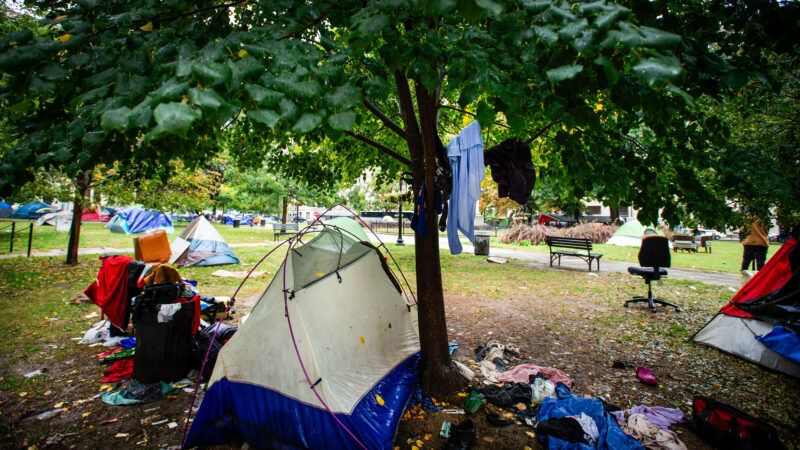
The rare reported fall in the nation's homeless population is mostly the result of the ebbing migrant surge of 2023 and 2024.
Happy Tuesday, and welcome to another edition of Rent Free.
This week's lead story covers the release of the federal government's latest homelessness survey, which reported a rare decline in the country's homeless population. That's welcome news that nevertheless looks a little less rosy when one examines the details.
Rent Free Newsletter by Christian Britschgi. Get more of Christian's urban regulation, development, and zoning coverage.
Next up, the newsletter covers Daniel Grand, who is asking the Supreme Court to hear his First Amendment challenge to zoning laws that prevented him from hosting a Jewish prayer gathering in his own home.
The End of the Migrant Surge Leads to a Fall in Nationwide Homelessness
There were 745,652 homeless people in the country in 2025, according to the Department of Housing and Urban Development's (HUD) latest annual homelessness survey.
That represents a rare decline of 3 percent in the homeless population from 2024, when there were 771,480 homeless people.
HUD's numbers come from the annual point-in-time count, conducted one night each January by state and local homeless service providers, during which volunteers go out and literally count the number of people sleeping on the streets and in shelters.
This year's reported 3 percent decline follows an unprecedented 18 percent spike in the homeless population in 2024.
That spike was largely driven by the influx of foreign migrants into big city shelter systems in places such as New York, Chicago, and Denver. Even by the time the 2024 numbers had been published, there were signs that the migrant surge was ebbing.
That's now reflected in the 2025 numbers. The report notes that New York and Illinois, the two states hit hardest by the migrant surge, saw the biggest declines in their homeless populations.
Collectively, the two states saw their homeless populations fall by roughly 24,000 people. That accounts for almost 90 percent of the national total fall in homelessness.
Cause for Pessimism
Any fall in the homeless population is welcome. That said, the 745,652 people who were counted as homeless in January 2025 are still pretty close to 2024's record high.
States reporting declines in the homeless population this year are also generally states that saw massive increases in their homeless populations over the last couple of decades.
For example, Massachusetts registered a 3.6 percent decline in its homeless population this year. But the state's homeless population is 87 percent larger than it was in 2007, according to the HUD report. During the same time, the state's overall population grew by 11 percent.
Not all states report long-term increases in homelessness. Florida's homeless population fell 11 percent from last year, and 42 percent since 2007.
In general, Southeastern states are reporting long-term declines in homelessness, while all Western states show serious long-term spikes in their homeless populations.
In other regions, such as the Midwest, Mid-Atlantic, and New England, the state-by-state numbers are mixed, with some states reporting long-term declines in homelessness and others reporting long-term increases.
The Trump administration has used the occasion of the report's release to tout its own efforts to end "housing first" homeless policies, which prioritize placing homeless people in permanent housing instead of emergency shelters.
"The data is clear that the status quo of 'housing first' has failed to meaningfully reduce homelessness, resulting in crisis levels of people living on the streets," said HUD Secretary Scott Turner in a statement. "HUD is restoring its programs to advance recovery and self-sufficiency and to ensure that taxpayer-funded benefits serve American families."
Limits of the Point-in-Time Count
In general, it's wise not to draw too many global conclusions from the annual churn in the HUD-compiled homelessness numbers.
Some argue that sending out volunteers to literally count homeless people over a single night isn't a super rigorous methodology. There are also plenty of ways that the data can rise and fall that are specific to one state or particular to a short-term trend, and thus don't tell us much about the general trajectory of homelessness.
For instance, North Carolina registered a major increase in homelessness because its point-in-time count was performed in the immediate aftermath of Hurricane Helene.
Oregon, which had the largest numerical increase in its homeless population, performed its point-in-time count on a night with extremely cold weather. The HUD report says that this led to more of the unsheltered population moving into warming centers and thus more of those people getting counted in the survey.
Taking the long view of the data, which presumably smooth out some of these state-specific yearly spikes and falls and one-off migrant crises, the problem of homelessness is generally getting worse, not better.
Do You Have a Permit for That Prayer Gathering?
Can a city use its zoning powers to stop someone from hosting prayer gatherings in their home?
That's one of the questions raised by a petition submitted to the U.S. Supreme Court by Daniel Grand, who, in 2021, was threatened with fines and other legal penalties for inviting other Orthodox Jews in his neighborhood to come pray in his home in University Heights, Ohio.
University Heights officials told Grand over the phone and in a cease-and-desist letter that his planned gathering would illegally use his residentially zoned home as a "place of religious assembly."
He was told he'd be liable for legal sanction if he proceeded with his prayer meeting without first getting a special use permit from the city.
Grand's application for that permit provoked heated opposition from elected city officials and his neighbors, some of which was explicitly antisemitic. "I am not Jewish and I do not want our neighborhood labeled as Jewish," said one person in a letter to the University Heights Planning Commission.
Per Grand's petition, police were ordered to surveil his house, and a code inspector visited his home in search of violations. After Grand withdrew his application under all this pressure, the University Heights mayor encouraged residents to report any religious assemblies held at Grand's house to the police.
Case History
Eventually, Grand sued University Heights and individual city officials in federal court for violating his First Amendment right to free exercise of religion as well as a federal law protecting religious land uses from zoning restrictions.
Both the district court and the 6th Circuit Court of Appeals dismissed Grand's case largely on the grounds of "ripeness." Both courts said they couldn't decide Grand's case so long as he still had the option of legalizing his prayer gatherings through the local zoning process.
In its own filing urging the Supreme Court to reject Grand's petition, the city of University Heights similarly argued that Grand had voluntarily withdrawn his permit application, and the city had never imposed any actual penalties on him.
Any chilling effect Grand felt on his First Amendment rights was thus subjective and self-imposed, the city argues.
In a response filed earlier this May, lawyers with the Alliance Defending Freedom (ADF), which is representing Grand, argue that requiring him to get a permit to exercise his First Amendment rights within his own home is injury enough.
The ADF also notes on its webpage for the case that if Grand succeeded in getting his home zoned for religious assemblies, University Heights' zoning code would then prohibit him and his family from living on the property.
Yet Another Arbitrary Line
Many of the legal issues raised by Grand's petition are specifically about religious land uses and technical questions about when, in the zoning process, someone can sue their local government for a First Amendment violation.
His case does illustrate a more general problem with zoning restrictions. Zoning is often justified as a necessary means of regulating the neighborhood effects of land uses. More often than not, zoning arbitrarily restricts one activity while permitting another, despite them having the same impacts on surrounding properties.
As the ADF's latest Supreme Court filing says, "If Grand's next-door neighbor invited nine friends over for a weekly poker night or a Tupperware party, the City would not require a special permit to operate a 'casino' or 'storefront.'"
Grand's petition is pending before the Supreme Court, which has yet to make a final decision on whether to take it up or not.
Quick Links
- San Francisco politicians dream up new zoning restrictions to stop corner stores from opening in the Tenderloin district. Those shop fronts should be toy stores instead, they say.
- A helpful new video from Pew explains the logic of moving chains.
- The New York Times Editorial Board comes out in favor of a Massachusetts ballot initiative that shrinks minimum lot sizes. It also criticizes a separate ballot initiative that would impose a statewide rent control regime. Read Rent Free's past coverage of the two initiatives here and here.
- Cleveland, Ohio, cracks down on short-term rentals.
- Kevin Erdmann on build-to-rent.




