

Trump Cut Nuclear Red Tape. Now His Administration Is Picking Winners.
The Trump administration can build on its success in the nuclear industry by getting out of the way.
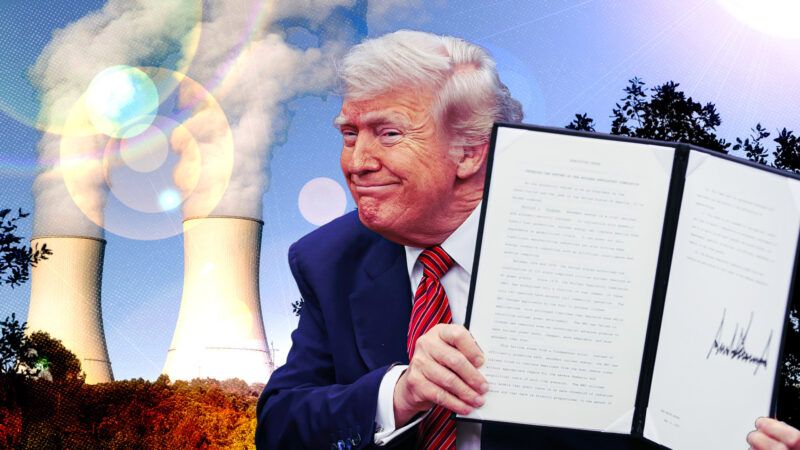
Earlier this week, the Energy Department announced that it would give its surplus plutonium from dismantled warheads to five energy startups—Oklo, Exodys Energy, SHINE Technologies, Standard Nuclear, and Flibe Energy—to use as fuel for commercial nuclear reactors. The move, which has sparked controversy, is yet another example of the Trump administration's push to accelerate nuclear energy, albeit through unconventional methods.
Some of the administration's other moves happened a year ago this week, when President Donald Trump issued four executive orders aimed at revitalizing America's commercial nuclear industry. These orders sought to bolster the country's nuclear industrial base, reform technology testing within the Energy Department, and accelerate the deployment and export of advanced nuclear reactors.
Perhaps the most impactful of the four called for a "wholesale revision" of the Nuclear Regulatory Commission (NRC) and its regulations governing the industry. Specifically, it directed the NRC to issue a final decision on all new construction and operating licenses—a process that normally takes years—within 18 months of receiving an application. The order also directed the agency to revisit its radiation standards that inflate the cost of nuclear power projects for no added safety or public health benefit. The agency has begun to reconsider these standards, E&E News reported in March.
These orders, while an important signal to the market, were not particularly novel in policy ideas. Rather, they closely resembled changes that Congress ordered in the 2024 ADVANCE Act, a bill that was a product of a "broader recognition that the regulatory framework," which didn't account for new and advanced nuclear technologies, "needed to change," says Nick Loris, president of energy research firm C3 Solutions.
Since the passage of the ADVANCE Act and Trump's directives, the NRC shortened its timelines for reviewing new and renewal licenses to 18 months and 12 months, respectively. The agency has leaned more heavily on AI to streamline its processes, which, in one instance, cut a four- to six-week task down to one day. It has also expedited its environmental reviews and is certifying approved designs for longer periods.
Similarly, the Energy Department changed its authorization process to account for nuclear technology outside the light-water model, eliminating over "900 pages of unnecessary, repetitive, and extraneous language," according to the agency.
These regulatory changes, paired with the growing power demands from AI, have made nuclear power a hot commodity among investors. James Walker, CEO of NANO Nuclear Energy—an advanced nuclear technology company—tells Reason that, in the private sector, there has historically been a "large amount of underinvestment into everything necessary to sustain the nuclear energy industry."
That no longer appears to be the case. In 2024, private investment in advanced nuclear companies reached $783.3 million, 13 times the 2023 total, according to S&P Global Market Intelligence data. Big Tech firms Meta, Microsoft, Amazon, and Google are pursuing nuclear power as an alternative to connecting to local electricity grids in response to the blame heaped on hyperscalers due to rising energy costs.
Startups like Valar Atomics and Terra Power are benefiting. X-energy, an advanced nuclear startup, raised more than $1 billion in its initial public offering in April—a record for a nuclear stock, according to CNBC. As America's energy demands continue to grow, Morgan Stanley estimates that potential nuclear investments could reach $2.2 trillion by 2050.
Yet despite this success and Trump's rhetoric to right-size the federal government's role in the industry, Washington continues to play a significant role in America's nuclear sector. Trump's Energy Department has financed several R&D initiatives and pilot projects and disbursed hundreds of millions of dollars to restart a decommissioned power plant in Michigan. The administration has also agreed to underwrite part of the buildout of Westinghouse reactors in exchange for a 20 percent equity stake in the company, the country's largest nuclear firm.
The government's insistence on remaining involved is likely to set back the private sector's progress with the energy source. Rod Adams, managing partner at nuclear venture fund Nucleation Capital, tells Reason there's "a lot of interested private capital" in nuclear energy. Still, projects must have a "predictable cost and schedule." "If you're dependent on subsidies," he added, "that's a problem."
Jack Spencer, director of the Heritage Foundation's Center for Energy, Climate, and Environment, says American firms have the necessary nuclear expertise; we just need to "de-risk it from a policy and regulatory standpoint." Allowing the government to remain involved "puts too much emphasis on what politicians and bureaucrats want," says Spencer, "rather than what energy producers and users need."
Deregulating the nuclear industry has led to significant milestones in Trump's second term. But this success could soon be erased if the administration continues to place its thumb on the scale.




