

Reason.com - Free Minds and Free Markets
Reason logo Reason logo
  • Latest
  • Magazine
    • Current Issue
    • Archives
    • Subscribe
    • Crossword
  • Video
    • Reason TV
    • The Reason Roundtable
    • Free Media
    • The Reason Interview
  • Podcasts
    • All Shows
    • The Reason Roundtable
    • The Reason Interview With Nick Gillespie
    • Freed Up
    • The Soho Forum Debates
  • Volokh
  • Newsletters
  • Donate
    • Donate Online
    • Ways To Give To Reason Foundation
    • Torchbearer Society
    • Planned Giving
  • Subscribe
    • Reason Plus Subscription
    • Print Subscription
    • Gift Subscriptions
    • Subscriber Support

Log In

Create new account

Supreme Court

Ranking the Worst Supreme Court Decisions of All Time

What cases belong on the list?
Damon Root | 5.19.2026 7:00 AM

Share on FacebookShare on XShare on RedditShare by emailPrint friendly versionCopy page URL Add Reason to Google
Media Contact & Reprint Requests
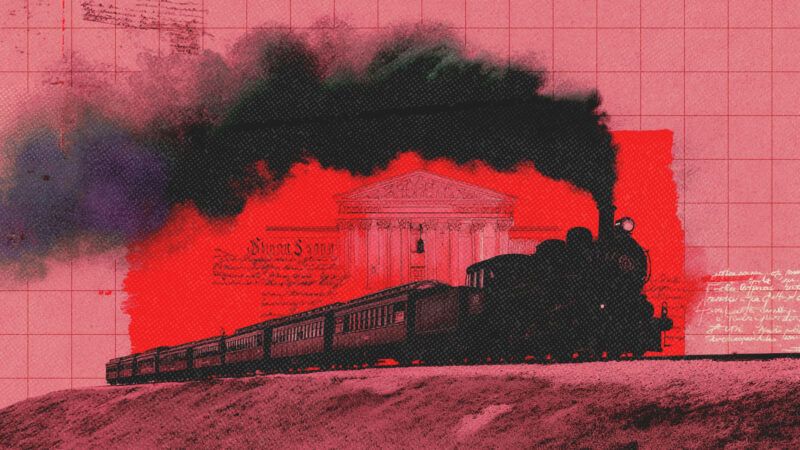
An illustration of a train | Illustration: Midjourney
(Illustration: Midjourney)

When Reason magazine celebrated its 50th anniversary back in 2018, I helped mark the occasion with a column about "the 5 worst Supreme Court rulings of the past 50 years," a list that featured destructive and far-reaching decisions on issues ranging from qualified immunity to eminent domain.

I got to thinking about that list when I noticed that yesterday was the 130th anniversary of one of the worst Supreme Court rulings of all time, the Court's notorious decision in Plessy v. Ferguson (1896), which upheld a Louisiana law that forbade railroad companies from selling first-class tickets to black passengers. The Supreme Court purported to justify this obvious violation of liberty on the grounds that "the competency of the state legislatures in the exercise of their police power" should not be subjected to meddlesome second-guessing by the judiciary.

Plessy is the case, of course, which enshrined the notorious pro-Jim Crow doctrine of "separate but equal," a doctrine that stood as the law of the land until the Supreme Court finally reversed course in Brown v. Board of Education (1954). Plessy thus surely belongs at or near the top of any list of the worst SCOTUS decisions ever made.

What else should be on there?

You’re reading Injustice System from Damon Root and Reason. Get more of Damon’s commentary on constitutional law and American history.

This field is for validation purposes and should be left unchanged.

Dred Scott v. Sandford (1857), which said that black Americans "are not included, and were not intended to be included, under the word 'citizens' in the Constitution," also clearly belongs in the hall of shame. Indeed, the legal and intellectual travesty of that ruling was exposed in real time via the dissenting opinion of Justice Benjamin Curtis, who pointed out:

At the time of the ratification of the Articles of Confederation, all free native-born inhabitants of the States of New Hampshire, Massachusetts, New York, New Jersey, and North Carolina, though descended from African slaves, were not only citizens of those States, but such of them as had the other necessary qualifications possessed the franchise of electors, on equal terms with other citizens.

This means that when the U.S. Constitution came up for ratification in 1787–1788, a number of black Americans were literally among "the people" who "ordained and established" the document by participating in its ratification as lawful electors in the above-named states. Dred Scott's pro-slavery holding ignored this clear historical evidence and trampled on the actual events of the founding.

Another awful Supreme Court decision that should be included in our parade of horribles is Korematsu v. United States (1944), which upheld President Franklin D. Roosevelt's wartime internment of innocent Japanese-American citizens. You will probably not be surprised to learn or recall that this blatant violation of civil liberties was justified by the Supreme Court on the all-too-familiar grounds that the executive branch is entitled to receive broad judicial deference during an emergency.

Much like what happened in Dred Scott, the flaws of the Korematsu judgment were also exposed in real time by a dissenting member of the Court. "It is essential that there be definite limits to military discretion, especially where martial law has not been declared," protested Justice Frank Murphy. "Individuals must not be left impoverished of their constitutional rights on a plea of military necessity that has neither substance nor support."

Now it's my turn to ask you, the readers, to weigh in with your own votes. What other cases belong on the list of the worst SCOTUS decisions of all time? Email me at injusticesystem@reason.com. Also, if you'd like to subscribe to this newsletter (it's free), you can sign up right here. Perhaps The Slaughter-House Cases (1873), which gutted the 14th Amendment's Privileges or Immunities Clause? Or what about Buck v. Bell (1927), which upheld a state eugenics law that permitted the forced sterilization of the "feebleminded and socially inadequate"?

If enough votes are cast, I'll discuss the results in a future newsletter.

Start your day with Reason. Get a daily brief of the most important stories and trends every weekday morning when you subscribe to Reason Roundup.

This field is for validation purposes and should be left unchanged.

NEXT: Coffee Is Good for Your Brain

Damon Root is a senior editor at Reason and the author of A Glorious Liberty: Frederick Douglass and the Fight for an Antislavery Constitution (Potomac Books). His next book, Emancipation War: The Fall of Slavery and the Coming of the Thirteenth Amendment (Potomac Books), will be published in June 2026.

Supreme CourtHistoryCivil LibertiesExecutive PowerRaceLaw & GovernmentFederal government
Share on FacebookShare on XShare on RedditShare by emailPrint friendly versionCopy page URL Add Reason to Google
Media Contact & Reprint Requests

Hide Comments (78)

Editor's Note: As of February 29, 2024, commenting privileges on reason.com posts are limited to Reason Plus subscribers. Past commenters are grandfathered in for a temporary period. Subscribe here to preserve your ability to comment. Your Reason Plus subscription also gives you an ad-free version of reason.com, along with full access to the digital edition and archives of Reason magazine. We request that comments be civil and on-topic. We do not moderate or assume any responsibility for comments, which are owned by the readers who post them. Comments do not represent the views of reason.com or Reason Foundation. We reserve the right to delete any comment and ban commenters for any reason at any time. Comments may only be edited within 5 minutes of posting. Report abuses.

  1. Chuck P. (Now with less Sarc more snark)   2 months ago

    This seems like a bad idea.

  2. Stupid Government Tricks   2 months ago

    Brown v. Board of Education Was just as bad as Plessy for the very reason you noted: "the Supreme Court finally reversed course". They went from mandated segregation to mandated integration -- inclusive racism instead of exclusive racism. It mandated that the government and society treat race as all-important. It led to mandated racism again ten years later -- affirmative action -- which justified all the racial quotas of college admissions, contract favoritism, quotas, and all the other evils to be expected from racism. Then the Supreme Court threw another muddle into the mix by telling Harvard et al to stop considering race, as if their affirmative action racism is no good, but government affirmative action racism is good when it favors racial minorities for contracts, small business loans, and all the rest of it.

    Another racist Supreme Court travesty was Slaughterhouse, which deliberately repudiated everything both proponents and opponents both agreed on during the Congressional debates and the ratification debates -- that it was meant to apply the entire Bill of Rights to states.

    1. Michael Ejercito   2 months ago

      It actually did not go into mandated integration. It simply stated states could no longer consider race is admissions into schools.

      1. Stupid Government Tricks   2 months ago

        Right, that's why they bussed so many kids so far from home. Everyone knows how much kids like getting up an hour earlier to ride the big yellow buses for an hour, it had nothing to do with forced integration. All those quotas, disparate impact or whatever they called it, race blind.

        1. Zeb   2 months ago

          Kids aren't usually the ones deciding where they'd like to go to school and making transportation arrangements. Narrowly speaking, Brown was the right decision against legally enforced segregation. I can't remember what exactly the path to forced integration, bussing, etc. was, but I don't think it was Brown itself directly.

          1. Rossami   2 months ago

            Brown led directly to Brown II which required that school districts desegregate "with all deliberate speed" and allowed little time to consider options. Then in Green v. County School Board of New Kent County, SCOTUS rejected voluntary desgregation via school choice. Finally, Swann v. Charlotte-Mecklenburg BoE ruled that the school district must achieve racial balance even if it meant redrawing school boundaries and the use of forced busing.

            So, no, it wasn't Brown I directly but that case did set us on the path to the injustice (and massive backfire) that was forced bussing.

            1. charliehall   2 months ago

              Separate school systems for black and white students was wrong stupid and expensive, full stop, period.

              I rode a school bus an hour through county roads to get to junior high school. My heart bleeds for you.

              1. Rossami   2 months ago

                Yet again, you're reading into what's not there just so you can feel morally superior.

                Brown was rightly decided. Brown II was on weaker ground. Green was wrong in it's rejection of freedom of association. Just like free speech includes speech I disapprove of, freedom of association includes association choices I personally deplore. Swann was flat evil, not for the length of time on a bus but because it imposed government-directed race balancing and made racial tensions and educational disparities worse, not better.

  3. JesseAz (RIP CK)   2 months ago

    Ranking the worst legal analysts at reason.

    1. Damon Root
    2. Molly
    3. WindyCityBarista
    4. Sarc
    5. Sullum

    1. SCOTUS gave JeffSarc a big sad   2 months ago

      Yes.

  4. Rossami   2 months ago

    You seem to have locked in on SCOTUS' racial decisions. While I don't disagree that those were pretty horrible decisions, there have been some pretty bad property-based decisions, too. While the direct consequences don't appear as stark as your examples, each became precedents for ever-increasing erosions of personal liberties toward government intrusion.

    Wickard jumps to mind. Slaughterhouse definitely belongs on the list. Hester might deserve a place (maybe not worst 5 but definitely in the bottom 10). Kelo for a recent example.

    1. Zeb   2 months ago

      Bong Hits for Jesus? Maybe not among the very worst, but might squeak in the top 50. And it's funny.

  5. Fist of Etiquette   2 months ago

    Wickard v. Filburn. Duh.

    1. KiwiDude   2 months ago

      Fuck yes that fucking mess of a case!!

    2. CE   2 months ago

      The No. 1 answer for actual libertarians.
      The majority's pretzel logic in Wickard v. Filburn counter-intuitively applied the "interstate commerce" clause to non-interstate, non-commercial activity, in effect saying the federal government's very limited power to regulate business activity in fact had no limits at all. Weird that the Founders didn't write it that way, huh?

  6. Squirrelloid   2 months ago

    How can Reason avoid naming Wickard as among the worst court decisions? I understand if economic liberty isn't considered a real thing by a lot of mainstream writers, but for a libertarian publication to skip it is mind-boggling.

    Similar cases that probably belong on the list: West Coast Hotel Co. v. Parrish (1937), NLRB vs. Jones & Laughlin Steel Corp (1937), Helvering v. Davis (1937), Steward Machine Co. vs. Davis (1937). In fact, all the New Deal era decisions from 1937 onwards are probably at least suspect. Add Kelo v. City of New London and Berman v. Parker to the list of decisions destructive of economic rights.

    Then add US v. Miller and Smith v. Maryland, which devalued the 4th amendment and created the third party doctrine.

    Bowers v. Hardwick probably belongs on the list. It ignored existing SCOTUS precedent regarding privacy rights.

    1. Stupid Government Tricks   2 months ago

      I think the economic rights decisions were worse than the racist ones. Society was eliminating racism on its own. Several economists have said black unemployment in the 1930s was actually improving slightly better than white unemployment, even with minimum wage laws and express government racism, but once government went into racist welfare policies, black statistics stagnated.

      Whereas the economically destructive decisions affected everybody with Big and Bigger Brother and are so woven into society that they can never be undone without a revolution or fiscal collapse.

      1. Squirrelloid   2 months ago

        I agree.

        Further, that Damon doesn't list a single case destructive of economic liberty should be disqualifying for writing at Reason, much less being an editor.

        1. Rossami   2 months ago

          He did include Slaughterhouse, though not in his worst 5. Maybe he thought it came in at #6? Reasonable people could disagree on the ranking without claiming he's ignoring it altogether.

      2. mad.casual   2 months ago

        black statistics stagnated regressed.

        FIFY

      3. Zeb   2 months ago

        I suppose it's understandable from an emotional perspective that people think policies that unfairly harm certain groups are worse than policies that harm everyone. But objectively it doesn't make much sense. Unless you put some odd sense of fairness above all else. As long as everyone suffers equally, we're all good.

      4. charliehall   2 months ago

        The former Confederacy would never have abolished separate school systems had it not been forced to do so.

    2. Squirrelloid   2 months ago

      Oh, before i forget:

      Auer v. Robbins (Auer deference)

      Chevron U.S.A., Inc. v. Natural Resources Defense Council, Inc. (Chevron deference)

      Probably some other stupid cases along these lines.

    3. Squirrelloid   2 months ago

      There's so many bad supreme court decisions, here's some more:

      Pierson v. Ray
      Harlow v. Fitzgerald

      (qualified immunity created out of nothing).

      Pearson v. Callahan

      (Don't even need to say whether the conduct was unconstitutional when finding qualified immunity applies).

    4. JoeJoetheIdiotCircusBoy   2 months ago

      In the original list, he has Gonzalez vs. Raich which amplified the Wickard decision. In this article he is talking about what other cases should be included besides the 5 he noted in his original (linked) piece from 2018. You'll notice that he didn't include any of the "race" decisions in his original list, but rather noted 5 cases that affect everyone. But I get it, the narrative has to narrative.

    5. TJJ2000   2 months ago

      ^THAT "all the New Deal era decisions"
      Which includes wickard v. filburn.

  7. jonnysage   2 months ago

    The absolute worst was Texas vs White - opined That whenever any Form of Government becomes destructive of life and liberty, it is NOT the Right of the People to alter or to abolish it.

    Marbury vs Madison was pretty bad in that it led to everyone thinking the court had powers not defined by congress.

    1. 557e54f   2 months ago

      If the court did not have powers explicitly defined by Congress, it would compromise the balance of co-equal branches. For example, presidents could egregiously violate the Constitution and its Bill of Rights without recourse. In the recent past, imposition of tariffs, wars and violations of the 1st, 4th, 5th, 10th, and 14th Amendments would go without a check. Regardless of the political party involved, it would lead to a virtual dictatorship.

      1. jonnysage   2 months ago

        Beyond the constitution I meant. The constitution defines all powers, including congress power to make all laws regarding all other powers.

        In Marbury vs Madison the court said it could strike down laws, when the constitution does not say that. The courts power is only to offer an opinion. Execution of that opinion is left to another branch, as the founders wrote in the federalist papers.

        "The judiciary, on the contrary, has no influence over either the sword or the purse; no direction either of the strength or of the wealth of the society; and can take no active resolution whatever. It may truly be said to have neither FORCE nor WILL, but merely judgment; and must ultimately depend upon the aid of the executive arm even for the efficacy of its judgments. . . ."

  8. John Rohan   2 months ago

    Are we talking about the worst in moral terms of the or the worst in legal terms? This article seems to focus on the former. But for the latter, two decisions come to mind.

    2015 Obergefell v. Hodges, and I say that as someone who thinks same sex marriage should be legal. But the decision was ludicrous, and is a textbook example of legislation from the bench. The judges decided that the 14th amendment included a right to gay marriage, a right that somehow every court had missed for the past 150 years, and that the framers of the amendment clearly would never have intended?

    Another would be a very obscure case, the 2001 PGA Tour, Inc. v. Martin. The justices ruled 7-2 that the Americans with Disabilities act applied to golfers competing in the PGA tournament, and in this case allow a golfer who had difficulty walking to use a golf cart between shots. In other words, the court ruled that they can decide the rules of a sport, and that sporting events are now forced to bend the rules make accommodations for athletes with disabilities. Fortunately, the damage was limited because this ridiculous ruling has generally been ignored since then and no one has tried to apply it to other sports.

    1. Squirrelloid   2 months ago

      I mean, you could say the same thing about Roe v. Wade as about Obergefell. Roe was worse, actually. Even supporters like RBG said Roe's reasoning was terrible. (And I think Roe was good *policy*, but it should have been Congress acting, not a court decision. The legal reasoning was terrible).

      1. Zeb   2 months ago

        Yeah, agree on both of those. I actually favor the policy outcomes, but they were definitely just legislating from the bench.

    2. mad.casual   2 months ago

      +1 Beyond legal terms, I would say Bostock v. Clayton County is worse than Obergefell. Bostock is a black hole of moral, legal, and rational thought. It's so tortured, twisted, confused, and logically wrong it's not even legislating from the bench.

      Fortunately, so far, or for now, it doesn't seem to have been more widely cited or impactful.

    3. mad.casual   2 months ago

      Also, along these lines, Bragdon v. Abbott.

      Probably more obscure and more critically impactful than PGA v. Martin. In 1998, Abbott declared she had asymptomatic HIV. Bragdon, her dentist refused to fill a cavity, citing that his office was not appropriately equipped to protect everyone involved. Notably, 8 yrs. earlier, Dr. Acer was sued for spreading HIV to as many as 6 patients. Bragdon offered to perform the surgery if a facility could be found at her cost. The court agreed that because HIV posed a "substantial limitation" to Abbott's lifestyle, particularly via her ability to reproduce, discriminating against her was a violation of the ADA. They specifically ruled that objective proof rather than Bragdon's subjective expertise and judgement in his own practice should be applied.

    4. Kords   2 months ago

      Obergefell was poorly reasoned but reached the right conclusion. It simply should have been decided on equal protection grounds instead of substantive due process. If a man can marry a woman, then equal protection dictates that a woman can marry a woman. That application is entirely consistent with the Fourteenth Amendment's original meaning, as explained in the Cato Institute's amicus brief.

  9. minus the clever name   2 months ago

    Roe V Wade
    Bostock v Clayton County
    Obergefell v. Hodges
    and Kelo V City of New London

    All perverted and a huge limitation on freedom and law

    1. TJJ2000   2 months ago

      Who's freedom on Roe v Wade? The freedom of the State to force reproduction?
      Sure Roe v Wade wasn't 'freedom' but it was a lot more-so than now.

      1. minus the clever name   2 months ago

        Even an atheist Libertarian finds your view DISHONEST

        Here is Christopher Hitchens :

        A federal prohibition on abortion, then, with rape and incest exceptions?

        Yes, but I would like to see something much broader, much more visionary. We need a new compact between society and the woman. It’s a progressive compact because it is aimed at the future generation. It would restrict abortion in most circumstances. Now I know most women don’t like having to justify their circumstances to someone. “How dare you presume to subject me to this?” some will say. But sorry, lady, this is an extremely grave social issue. It’s everybody’s business.

        =================TJJ says, It is a grave social issue so LET"S IGNORE SOCIETY in the interest of 'freedom' so dumb it makes me think Tjj is protecting his own bad conscience

        1. TJJ2000   2 months ago

          The fact you believe a persons body is a 'societal' issue sums up everything wrong about everything else you have to say on the subject.

          The federal didn't and never-did prohibit anyone but State Legislatures. Roe v Wade just ensured the 4A Individual Liberty, "to be secure in their persons" (to 'own' your own body) prohibiting State legislation from violating that 4A right.

          Thus is why Roe v Wade isn't congressional legislation. It is a SCOTUS ruling preventing States from violating the peoples Individual Rights ... most notable from tyrannical-morons who think a persons own body is a 'societal' issue.

          1. minus the clever name   2 months ago

            NO man is an island (I admit I didn't make that up, but you probably would think I did)

            In every respect what you do is societal and can't be otherwise.
            Even ROE ended up mocking your defense of her :

            ==============
            Jane Roe—whose real name was Norma McCorvey—shocked the nation in 1995 when she left the pro-choice movement to join the anti-abortion cause. In her 1997 autobiography, Won by Love, and her 2005 Senate Testimony, McCorvey expressed deep regret over her role in the landmark Roe v. Wade ruling.Her pro-life journey and testimony can be summarized by these key phases:The Conversion: After working at a Texas abortion clinic in the mid-1990s, McCorvey befriended staff from the anti-abortion group Operation Rescue, who had set up an office next door. She was baptized in 1995 and publicly renounced her title as the face of the pro-choice movement.The Message: In her pro-life testimony, McCorvey argued that abortion ended a human life and stated her belief that a woman considering an abortion should be presented with alternatives. She became a vocal advocate for crisis pregnancy centers and frequently expressed deep remorse for the "paperwork" she signed that led to widespread abortion access.

  10. Nelson   2 months ago

    Pierson v. Ray (qualified immunity)
    Berman v. Parker (eminent domain, private to public)
    Kelo v. City of New London (eminent domain, private to private)
    Dobbs v. Jackson Women's Health Organization (bodily autonomy)
    Branzburg v. Hayes (journalist source protection)
    Citizens United v. FEC (corporate personhood)

    1. operagost   2 months ago

      I disagree on Dobbs. For one, returning control to the states and local governments from the federal strengthens federalism and overall empowers the people. For another, protecting the right to life when in doubt is always the most moral approach. I would like to know what your rationale is for criticizing the decision.

      1. Zeb   2 months ago

        Dobbs was legally correct as Roe was a mess. Morality and delivering good policy has nothing to do with the court's job.

        1. minus the clever name   2 months ago

          What a stupid statement.

          In his Farewell Address of September 1796, Washington called religion, as the source of morality, "a necessary spring of popular government,"

          Adams claimed that statesmen "may plan and speculate for Liberty, but it is Religion and Morality alone, which can establish the Principles upon which Freedom can securely stand."

      2. TJJ2000   2 months ago

        What 'empowers' did the people get?
        The power to be forced to reproduce?
        Do you wear your shoes on top of your head too?

        1. Zeb   2 months ago

          No, the power to force others to reproduce (if you want to put it that way, though mostly people do still have that choice before someone gets pregnant) through state legislation.

          1. TJJ2000   2 months ago

            Exactly. I just framed it as an ?empowerment? to be forced by someone else to reproduce in sarcasm.
            There isn't a single thing about Dobbs that 'empowered' anyone over themselves (own body).
            Which is truly the biggest beef about it.
            It's not just taking Individual Liberty it's taking it in the most personal arena one can get into (i.e. themselves).

        2. minus the clever name   2 months ago

          If you've been involved in an abortion be up front about it. You are taking on a very unconvincing detached intellectual air and those who know your usual comments sense some 'dishonesty' here

    2. charliehall   2 months ago

      A Kelo decision that went the other way would have had the unintended consequence of making it impossible for anyone other than a government agency to build a pipeline, electric transmission line, or railroad. Basically it would have resulted in the nationalization of much of the economy.

      1. Rossami   2 months ago

        No, it would not. The electric transmission line serves a public purpose and is easily distinguishable from taking property from one person to give it to another solely because it would bring in more taxes.

        That was the rule for all the years before Kelo and there is absolutely no reason to think that those precedents would have disappeared.

        1. SCOTUS gave JeffSarc a big sad   2 months ago

          Charlie says a lot of stupid unsupported things here every day.

      2. minus the clever name   2 months ago

        Lincoln had always favored a system of canals and roads and railroads for the state. In
        Vandalia he found that most of the other members of the Tenth General Assembly were
        of the same mind. One legislator wrote to the Galena newspaper, “This is doubtless a
        mammoth undertaking for a state like ours; yet I am in favor of it in almost every
        particular, and particularly the state doing the work. [Simon, Paul, Lincoln’s Preparation
        for Greatness: The Illinois Legislative Years, University of Illinois Press, 1971, page 49]

        The problem is that under Obama, Biden and others government did nothing but obstruct. Biden for example totally ruined modern transportation for the sake of votes.
        "the absurdity of federal spending heavily favoring mass transit—which accounts for a tiny fraction of American passenger travel—over desperately needed repairs to roads, highways, and practical infrastructure."

    3. minus the clever name   2 months ago

      Nelson offends on all points but the last shows his lack of any sense of American history :

      "Legally and philosophically, "intermediate associations" (like families, churches, unions, and local communities) sit between the individual and the state. Under natural law, these groups have an inherent, pre-political right to exist, organize, and pursue their goals independently of government interference."

      Now does Nelson disagree with that. You tell me

      "In his work Democracy in America, Alexis de Tocqueville highlighted the vital role of "intermediate associations" (civil and political groups) as the crucial space between the individual and the state. He argued that, unlike aristocracies that have established nobility, democracies require these voluntary organizations to prevent tyranny of the majority and combat extreme individualism."

      My tentative conclusion :Nelson is so addicted to individualism (abortion, homosexuality, trans)that he is glad to see nothing stand between you and raw Uncle Sam

  11. PuddingHead   2 months ago

    Wickard v. Filburn

  12. SMP0328   2 months ago

    In addition to the cases referenced in the article:

    McColloch v. Maryland (absurdly broad reading of Necessary and Proper Clause)
    Wickard v. Filburn (absurdly broad reading of Commerce Clause)
    Kelo v. City of New London ("public use" includes corporate welfare)

    1. Social Justice is neither   2 months ago

      But all 3 of those gave the socialists and communists more power in American politics so Root cannot call them bad.

      1. 557e54f   2 months ago

        Indeed. Since these decisions every president has been a socialist or communist along with Congress and the courts.

    2. charliehall   2 months ago

      So allowing a private pipeline company to build a pipeline is corporate welfare?

      1. minus the clever name   2 months ago

        Charlie, I was around to watch Hillary change her mind 3 X on the Keystone Pipeline.

        2010 (Inclined to Approve): As Secretary of State, Clinton told an audience in San Francisco that the State Department was “inclined” to approve the pipeline, a comment that galvanized early environmental protests.

        Mid-2015 (Undecided/Refused to Say): During the 2016 Democratic primary, Clinton repeatedly declined to take a position, arguing that it would be inappropriate to preempt the ongoing review by the Obama administration.

        September 2015 (Opposed): Clinton publicly broke her silence to explicitly oppose the Keystone XL pipeline. She framed the project as a "distraction" that ran counter to the global climate goals she wanted to prioritize.

        5 years to come up with that!!! And of course she was totally wrong about climate goals. SEveral trillion to make sure we are beholden to China for everything that matters.

  13. Joe   2 months ago

    United States v. Carolene Products Company, 304 U.S. 144 (1938)

  14. I, Woodchipper   2 months ago

    Wickard v Filburn is an easy top 10 candidate. My god, the damage this decision has done.

    1. Squirrelloid   2 months ago

      Get past the moral revulsion at some of the race ones and looking at the actual impacts and consequences, Wickard has a good claim at being #3 or better.

  15. TWW   2 months ago

    National Federation of Independent Business v. Sebelius
    Roe v. Wade
    Kelo v. City of New London

  16. Jim Conley   2 months ago

    Supreme Court coulda overturned Plessy vs Ferguson but for "muh stare decisis" so they went with some wacky pseudo-psychology theory.

    1. minus the clever name   2 months ago

      If you know the case, you know Plessy was whiter than you are. The legal injustice was in defining him as Black in the first place. That's the one drop rule : if one of your 8 great grandarents was Black then so are you ...no mind that logically that one might not have been really Black either !!!!!

  17. Anastasia Beaverhausen   2 months ago

    Bush v Gore

    1. EISTAU Gree-Vance   2 months ago

      No worries, ana. The dems totally upped their election rigging game after that one to prevent trump 2.0. Gotta take the good with the bad.

      Oh, wait….. haha.

  18. JParker   2 months ago

    The root of the Supreme Court's bad decisions is Marbury v. Madison, A clear reading of the Constitution specifies that either the People or the States have the authority to interpret the Constitution, depending on whether or not such interpretation is considered a right (my preference) or a power. In the former, it lies with the People; in the latter it resides either with the People or the States.

    If it was with the States, the Supreme Court could have carved out a small exception for disputes outside of any individual state, such as the District of Columbia. If it was with the People, then the natural source of a decision would reside with a jury, as the best tool given to the People in the Constitution.

    Aside from placing the People at the top of the authority hierarchy, this would also weaken stare decis, since juries would not be bound to prior rulings; such rulings would become advisory as they were traditionally implemented in Common Law prior to government taking it over.

    1. minus the clever name   2 months ago

      This is more an education complaint . take Juries ...
      Historically, nullification has been used to resist laws perceived as unjust, such as the Fugitive Slave Act, alcohol prohibition

      THe culprit : Terribly rotten education
      "A national survey by the Institute for Citizens & Scholars (formerly the Woodrow Wilson National Fellowship Foundation) found that only 36% of U.S. citizens could pass a multiple-choice version of the U.S. citizenship test. T"

      I taught college for 10 years, they know NOTHING.

  19. charliehall   2 months ago

    This is nonsense. How would you operationalize "People" at the top of the hierarchy? Referenda on every legal dispute?

    1. JParker   2 months ago

      Read more closely; "If it was with the People, then the natural source of a decision would reside with a jury, as the best tool given to the People in the Constitution." This, combined with the right to present their interpretation of the Constitution by the defendant as it bears on the case at hand, directly to the jury, would solve the problem quite cleanly.

    2. minus the clever name   2 months ago

      You misuse a science word, operatinal definition.
      It would be an abuse to refereda every legal dispute. As I said as far as jury trials go there is jury nullification. You are getting a tad "Hillary" here 🙂 It is not a choice between ths and a perfect and achievable alternative. Careful, once you partial Hillary you risk going full Hillary

      I remember her 3 changes of tune on the Keystone Pipeline.

  20. charliehall   2 months ago

    Buck v. Bell was an abomination, and it contributed to anti-Catholic bigotry. The only dissident was Pierce Butler, the only Catholic on the Court then. And the Catholic Church was a lonely disssenter to the nearly universal support for Eugenics from everywhere else on the political and religious spectrum.

    1. minus the clever name   2 months ago

      and the Catholic Church was the great voice against Prohibition. Let's see Reason talk about that. "'Abusus non tollit usum' (The abuse of a thing does not destroy its use)

  21. charliehall   2 months ago

    Plessy caused nightmares for inter city paassenger rail travel. Pennsylvania actually had a law banning segregation but Delaware and Maryland required it.

    1. minus the clever name   2 months ago

      actually Plessy was the nightmare. Plessy was white as hard-boiled egg and only 'legally' Black. To complain against Plessy is to miss the boat. The law followed but did not create the One Drop Rule.

      And the government foisted this on all us even the Census Bureau : Well into the 20th century, the U.S. Census Bureau relied on a variant of the one-drop rule. Census takers (enumerators) were instructed to classify anyone of mixed Black and white ancestry simply as "Negro."

  22. Barnum   2 months ago

    Wickard v. Filburn is definitely the worst decision. It uses “butterfly effect” logic that effectively eliminates the existence of intrastate commerce.

  23. minus the clever name   2 months ago

    Plessy was a totally white man treated as a Black because he said you have to arrest me because I am legally Black. Tell normal folk this case and they all say 'pure bullshit"

    "Homer Plessy was legally classified as Black under Louisiana's "one-drop rule" (having one-eighth African ancestry), but he was light-skinned and easily passed for white. People knew he was Black because he intentionally told the train conductor his racial heritage as part of a planned civil rights test case"

    This is what drags lawyers and the law into disgrace before most normal decent people

Please log in to post comments

Mute this user?

  • Mute User
  • Cancel

Ban this user?

  • Ban User
  • Cancel

Un-ban this user?

  • Un-ban User
  • Cancel

Nuke this user?

  • Nuke User
  • Cancel

Un-nuke this user?

  • Un-nuke User
  • Cancel

Flag this comment?

  • Flag Comment
  • Cancel

Un-flag this comment?

  • Un-flag Comment
  • Cancel

Latest

Punisher

Liz Wolfe | 7.21.2026 9:30 AM

Is Court Packing Inevitable If Democrats Retake Congress and the White House?

Damon Root | 7.21.2026 7:00 AM

Brickbat: In-N-Out but Not Thru

Charles Oliver | 7.21.2026 4:00 AM

Research Suggests Trump and His Opponents Are Both Wrong About the Impact of Voter ID Requirements

Jacob Sullum | 7.20.2026 5:25 PM

South Carolina Law Prohibits Tattoo Parlors Near Churches. A New Lawsuit Calls That Unconstitutional.

Meagan O'Rourke | 7.20.2026 4:59 PM

Recommended

  • About
  • Browse Topics
  • Events
  • Staff
  • Jobs
  • Donate
  • Advertise
  • Subscribe
  • Contact
  • Media
  • Shop
  • Amazon
Reason Facebook@reason on XReason InstagramReason TikTokReason YoutubeApple PodcastsReason on FlipboardReason RSS Add Reason to Google

© 2026 Reason Foundation | Accessibility | Privacy Policy | Terms Of Use

This site is protected by reCAPTCHA and the Google Privacy Policy and Terms of Service apply.

Reason's July 4 Special!

For America's 250th, Get 2 Years of Reason for $17.76

Celebrate your independence with a subscription to Reason magazine, your most trusted source of honest, insightful news and analysis.

Subscribe to Reason


