

Donald Trump and Josh Hawley's Federal Gas Tax Holiday Would Save Drivers Less Than $9 Per Month
It was a bad idea when Biden proposed it, and it's a bad idea now that Trump is proposing it. Want lower gas prices? End the war.
The week before the United States launched its war with Iran, the average gas price in America was less than $3 per gallon.
The war was supposed to last about a month. Twelve weeks later, it is ongoing with no end in sight. The Strait of Hormuz is still closed. Global oil prices have spiked and, as a result, drivers are now paying an average of more than $4.50 per gallon of gas. In all, the higher gas prices have drained an estimated $42 billion out of Americans' wallets.
And with the midterms looming, it is understandable why President Donald Trump and his allies in Congress would want to provide drivers with some relief.
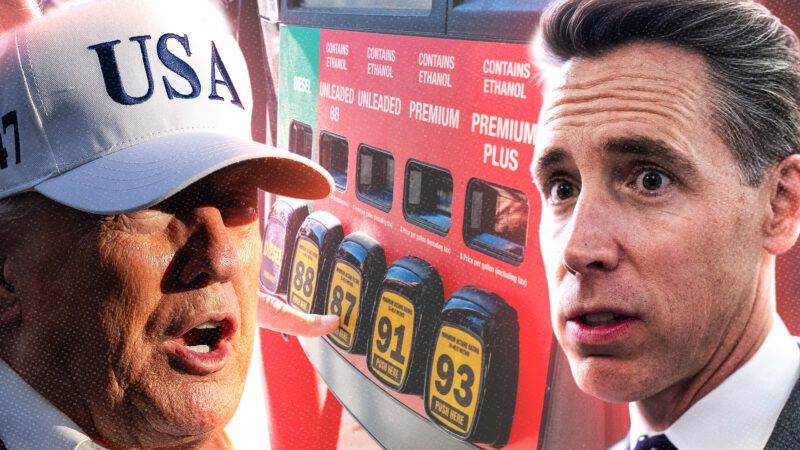
The president has floated the idea of suspending the federal excise tax on gasoline, which adds 18.4 cents per gallon to the price at the pump (and 24.4 cents per gallon for diesel fuel).
Sen. Josh Hawley (R–Mo.) quickly responded by introducing a bill to suspend the federal gas tax for 90 days. "American workers and families deserve immediate relief and this legislation will do just that," Hawley said in a statement as he introduced the bill.
But how much relief will the gas tax holiday actually provide? Very little, it turns out.
The average driver would save less than $9 per month if the federal gas tax was suspended, according to an analysis published Monday by the Peter G. Peterson Foundation, which advocates for sound fiscal policies. Every dollar counts, of course, but those savings would not provide meaningful relief from higher gas prices.
Meanwhile, suspending the gas tax for three months, as Hawley is proposing, would create an $10.5 billion shortfall in the federal Highway Trust Fund, which is fueled by revenue from the excise taxes on gasoline. That includes about $3 billion in additional interest costs on the borrowing that would be necessary to close the shortfall, according to the Committee for a Responsible Federal Budget (CRFB).
The trust fund is already facing insolvency as soon as 2028, and a temporary gas tax holiday would accelerate that crisis. The CRFB estimates that a three-month gas tax holiday would cause the trust fund to run dry seven weeks earlier than currently expected.
It's good to see politicians instinctively turn to tax cuts as a way to lower the cost of living—but, like with all tax cuts, that is a policy that only works if you cut spending too. Unfortunately, road construction and repairs are still necessary even when gas is expensive.
Could we find better ways to finance highways and other transportation infrastructure that don't require a federal gas tax? Sure! But Trump and Hawley are not proposing to do that. They are proposing to blow another hole in the federal budget in an attempt to escape the political consequences of poor decision making.
This is another situation where Trump's second term is mirroring the failures of Joe Biden's presidency. When inflation was surging during 2022, the Biden administration also floated the idea of suspending the gasoline excise tax for three months.
Then, like now, serious analyses of the proposal showed that it would save the average driver very little money. The Penn Wharton Budget Model estimated that per capita savings would total between $4.79 and $14.31 over three months. Meanwhile, the tax holiday would have blown an estimated $6 billion hole in the federal highway budget.
It was a bad trade-off then, and it is a bad trade-off now.
Thankfully, some prominent Republicans seem uninterested in going along with it.
"The best way to get gas prices to normalize in my view is to get the [Strait of Hormuz] open," Senate Majority Leader John Thune (R–S.D.) said last week. "We do have a Highway Trust Fund and it does perform an important service in making sure that we've got highways and roadways across our country that are serviceable."
Exactly.
If Trump wants to relieve Americans from the pain of higher gas prices, he could swiftly end the war in Iran (and avoid stumbling into more conflicts like it). Until that happens, global oil prices will remain high—and a gimmicky tax holiday won't fix it.




