

How Mortal Kombat Went From National Panic to Nostalgic Camp
Even with copious gore, the new movie is too tame to be a controversy. There's a lesson in its trajectory.
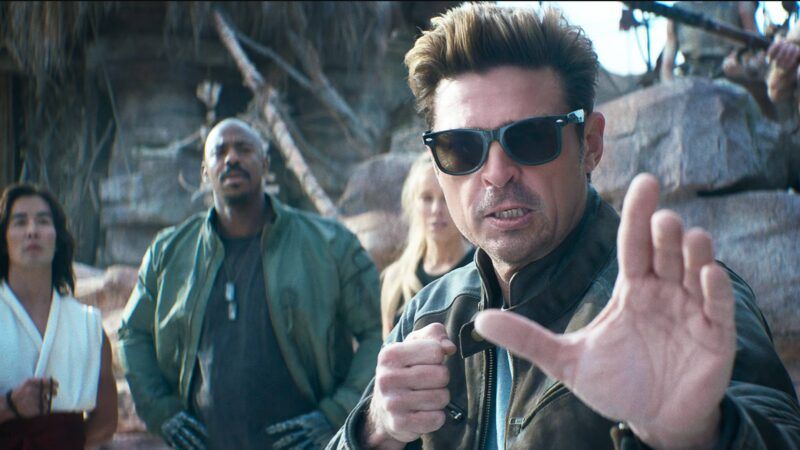
While watching Mortal Kombat II, a cheesy '90s throwback that's essentially a family-friendly fantasy picture with copious R-rated gore, I couldn't help but recall the controversy surrounding the original Mortal Kombat video game. The game was released in the early 1990s, and it was both a runaway hit and a mass cultural panic that approached the level of a national emergency—a matter of congressional inquiry and, eventually, a literal Supreme Court case.
The game was first released to arcades in 1992, but shortly after it was released for home consoles the following year, Sen. Joe Lieberman, a Democrat from Connecticut and eventual vice presidential nominee, declared his intention to hold hearings on the game.
Lieberman's concern was the game's graphic and realistic violence. Mortal Kombat was a fighting game like so many others, most notably the Street Fighter franchise, pitting two players against each other in a flat, two-dimensional space. But unlike other fighting games, Mortal Kombat used scans of human actors as its characters, and punches, kicks, and other hits were depicted with explosions of blood. Most controversially, the game featured "fatalities" that allowed winning players to input a code that would conclude a match with an extra gory finishing kill—a severed head and spinal cord or torn-out heart. The Kombat was, well, Mortal.
Lieberman found out about Mortal Kombat when a staffer whose child wanted one for a home system brought the game to his attention. He was a middle-aged centrist Democrat with a penchant for crusades against the media, and he was appalled. He vowed to hold formal congressional hearings.
When the hearings eventually happened in late 1993 and again in early 1994, near the peak of America's urban crime wave, Lieberman made clear that he believed Mortal Kombat was a serious behavioral influence and a contributor to an increasingly violent culture. As Reason's Jesse Walker noted in 2014, his opening statement described high-profile real-world crimes, including a slumber party abduction and a mass shooting on a train. Then he implied a link to games, declaring that "violence and violent images permeate more and more aspects of our lives, and I think it's time to draw the line. I know that one place where parents want us to draw the line is with violence in video games."
Lieberman argued that video games were teachers that trained young minds to enjoy violence. "We're talking about video games that glorify violence and teach children to enjoy inflicting the most gruesome forms of cruelty imaginable," he said. He later said he'd "like to ban all the violent video games," but he knew this would conflict with the First Amendment, which turned out to be prescient.
What Lieberman missed and misunderstood was that these games were ironic, even funny—intended to shock, yes, but also to amuse and confuse, especially prudish adults and parental authority figures like Lieberman. They were smirking, juvenile provocations, kind of obnoxious, kind of repulsive, and also kind of clever. (The sequel featured cutesy finishing moves known as "Friendships," a sort of in-game retort to the controversy.) Lieberman not only took the bait, but he took it in the most public forum imaginable, practically insisting, on the floor of Congress, There ought to be a law!
Over the next decade, various politicians did indeed try to implement a law, most notably in California, where in 2005, Gov. Arnold Schwarzenegger—who became famous starring in violent movies like The Terminator—signed a bill banning the sale of violent games to minors. In 2011, the Supreme Court struck down the law on First Amendment grounds, and Justice Antonin Scalia even specifically referenced Mortal Kombat in his majority opinion. "Reading Dante is unquestionably more cultured and intellectually edifying than playing Mortal Kombat," he wrote. However, "these cultural and intellectual differences are not constitutional ones. Crudely violent video games, tawdry TV shows, and cheap novels and magazines are no less forms of speech than The Divine Comedy." Scalia may not have personally appreciated the garish amusements of Mortal Kombat. But he understood that it wasn't, and shouldn't, be up to him to determine the value of those amusements for other people.
Today, the Mortal Kombat series still exists in both video game and film form. But there are also action figures, plushy toys, and even cartoons—very, very R-rated cartoons. The franchise has all the trappings of a teen-friendly brand, like Marvel and DC comics, but with a lot more blood and guts.
Like those brands, Mortal Kombat now traffics in nostalgia as much as action. The latest movie, a direct sequel to the 2021 reboot that came out just as movie theaters were starting to reopen after COVID-19, is focused on the character of Johnny Cage, a Hollywood action star recruited to fight in a to-the-death elimination tournament that will decide the fate of Earth. The movie introduces the character through a flashback to a fake cheesy '90s action film, shown on scratchy VHS and produced by New Line Cinema, the studio behind both the '90s film adaptations of the video game and the current installments. We then catch up with Cage, now a former star who has become a down-and-out has-been working the fan convention circuit.
When one of those fans approaches him and suggests a reboot of an old series, Citizen Cage, he dismisses the idea. "Nobody wants that," he says. "They want grounded. They want gritty. They want Keanu Reeves murdering a million fucking dudes with a pencil—not some dinosaur doing karate poses. That shit went out in the 90s." The fan, saddened, responds, "I thought it was pretty cool." This is a movie for those fans.
Mortal Kombat II knows it's a relic, and attempts, in its own ironic way, to resuscitate the magic of the '90s.
It doesn't really work. The movie's story is a snooze, partly because it tries to adhere to the incomprehensible lore of the video game. Its wink-wink nostalgia isn't funny or clever enough to justify its existence, though it does highlight the series' inherent camp. And its gory provocations are too stale to make an impact. No one is going to warn about this movie at a congressional hearing or in a Supreme Court argument. It's neither good nor shocking enough to be worth the effort.
Part of the reason Mortal Kombat is still with us, though, is that Lieberman made it a cultural totem. He made it seem dangerous, and thus attractive. But by the 2010s, even Lieberman had mostly given up his crusade. Although he still warned about violent games, he was more concerned about online radicalism and the dark corners of the internet.
There's a lesson in all of this. Today's cultural panics are likely to become tomorrow's cheesy nostalgia plays, too ridiculous and too obviously irrelevant to matter. That's what happened to video games, to comic books, to pinball, and even, to some degree, to social media. Next time, maybe skip the panic?




