

Why the Federal Government Can't Charge Anyone With 'Domestic Terrorism'
Federal law defines the term but there is no federal statute to charge someone with "domestic terrorism."
Vice President J.D. Vance and outgoing Department of Homeland Security (DHS) Secretary Kristi Noem both said Renée Good, an activist shot three times in her car by a federal immigration officer, was engaged in "domestic terrorism." Two weeks later, after officers shot Alex Pretti at least 10 times, White House deputy chief of staff Stephen Miller called Pretti "a domestic terrorist [who] tried to assassinate federal law enforcement."
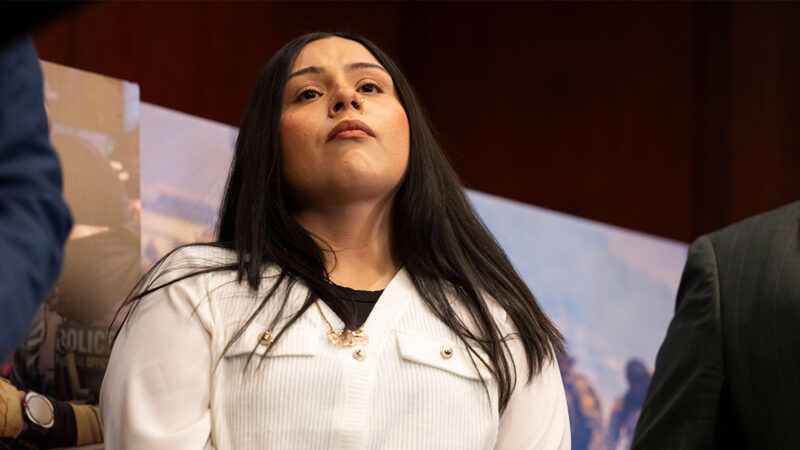
And in October 2025, a Border Patrol officer shot Marimar Martinez five times in her car; unlike Good and Pretti, Martinez survived. DHS deemed her a "domestic terrorist" who had "rammed" the officers' vehicle while it was "boxed in." Even after Martinez demonstrated in court that officers had sideswiped her before opening fire, DHS refused to retract its characterization of her as a terrorist.
Despite officials' proclivity for the phrase, there is no federal statute to charge someone with domestic terrorism. Federal law does define domestic terrorism—criminal acts "dangerous to human life," intended to intimidate civilians or influence government policy. But as the FBI noted in a November 2020 memo, "This is a definitional statute, not a charging statute." The bureau prefers the term domestic violent extremism "because the underlying ideology itself and the advocacy of such beliefs is not prohibited by US law."
Federal sentencing guidelines already allow for an "enhanced penalty….if the offense involves international or domestic terrorism," and it's easy to see its potential for abuse. When leaders of the far-right Proud Boys were convicted for organizing the U.S. Capitol riot on January 6, 2021, prosecutors alleged the mob violence that day was "no different" than blowing up a building.
U.S. District Judge Timothy J. Kelly disagreed but still felt "the constitutional moment we were in that day is something that is so sensitive that it deserves a significant sentence." Kelly applied terrorism enhancements and sentenced them each to over a decade in prison. (All participants received a presidential pardon in 2025.)
Over the past 25 years, we've learned the government won't waste an opportunity to increase its power in the name of fighting "terror," whether at home or abroad. The Trump administration already claims the authority to label people "domestic terrorists" based on such perceived offenses as "anti-Americanism, anti-capitalism, and anti-Christianity." The FBI cited January 6 as justification to dramatically increase surveillance of American citizens who opposed then-President Joe Biden. We should look skeptically at any further expansion of power that will supposedly fight "terror."
This article originally appeared in print under the headline "The Feds Can't Charge Anyone With 'Domestic Terrorism'."




