This Attempt by the Trump Administration To Cripple Legal Immigration Is Illegal, Judge Rules
The government had imposed an indefinite pause on adjudicating asylum petitions and applications for green cards, work permits, and citizenship for legal immigrants from certain countries.
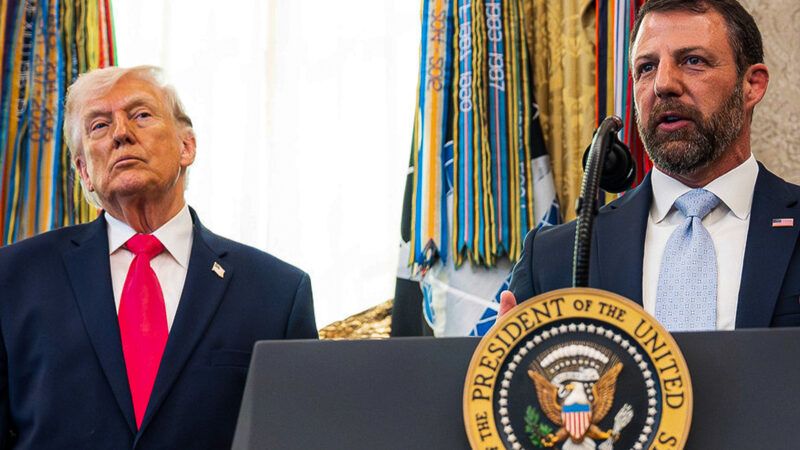
A judge on Friday struck down one of the Trump administration's attempts to hamstring legal immigration, ruling that U.S. Citizenship and Immigration Services (USCIS) ran afoul of federal law when it instituted an indefinite pause on processing asylum and green card applications submitted by people from certain countries.
"The rule of law has to apply to everyone equally and, as evident here, USCIS has neither 'followed the law' nor 'done things the right way,'" wrote Judge John J. McConnell Jr. of the U.S. District Court for the District of Rhode Island. "Indeed, the agency has violated the very immigration laws that Congress has charged it with administering, as well as the administrative laws that govern the agency's actions." Those actions, he said, were "arbitrary and capricious."
The Trump administration put the halt in place last year after Afghan migrant Rahmanullah Lakanwal allegedly shot two National Guard servicemembers, Andrew Wolfe and Sarah Beckstrom, the latter of whom died. Lakanwal was permitted to come to the U.S. in 2021 in connection with the support he provided CIA-affiliated units in Afghanistan. His case was a part of Operation Allies Welcome, an initiative that offered Afghans refuge in exchange for helping the U.S. during military operations against the Taliban and al-Qaeda. Lakanwal submitted to multiple rounds of screening under the Biden administration and was ultimately granted asylum under the Trump administration.
The restrictions initially included a global hold on USCIS processing asylum applications; that was eventually modified to apply solely to the 39 countries on President Donald Trump's travel ban list, which are mostly in Africa and Asia. The agency also stopped processing applications for green cards, work permits, and citizenship from people from those countries, meaning many individuals already in the U.S. legally were thrown into a perpetual limbo.
Through Trump has railed primarily against illegal immigration, the move appeared to be part of a broader strategy meant to disincentivize legal avenues to enter America as well. The administration has tried to apply expedited removal to humanitarian parolees—who entered the country legally—from such countries as Cuba and Venezuela, fast-tracking them for deportation. It also put in place a $100,000 supplemental fee for certain H-1B visa applications. Most recently, the government announced it would require some people seeking green cards to apply from abroad, forcing them to potentially leave their families, and perhaps lose their jobs, while they endure what can be extremely long wait times. The government has since walked that back amid widespread outrage.
What is the practical effect of the restrictions applied to the "travel ban" countries? "Plaintiffs and their members have observed the legal processes that Congress enacted by statute and USCIS promulgated by regulation so that they may one day obtain immigration benefits," writes McConnell. "They have, for example, filed the appropriate paperwork, paid the required filing fees, submitted to the requested biometrics collections, and attended the necessary inperson interviews. Even so, Plaintiffs and their members are stuck waiting, for months on end, for benefit requests that USCIS refuses to adjudicate."
McConnell concedes that the Court's role is not "to pass on the wisdom of the Government's policy choices" but rather to examine if those choices are lawful. "Having undertaken that inquiry," he writes, "the Court concludes that they do not and therefore must be set aside."