

When SCOTUS Did Lasting Damage to the Bill of Rights
Plus: The Alito retirement rumors keep swirling.
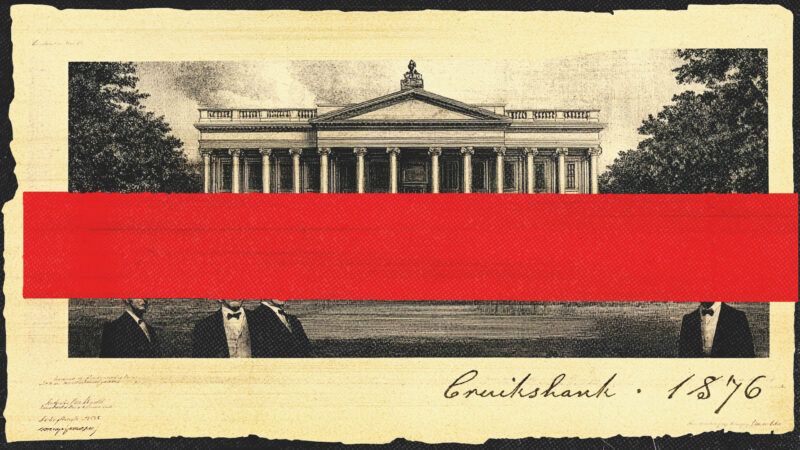
The U.S. Supreme Court has issued many deplorable decisions throughout its history. Some of them—such as Dred Scott v. Sandford (1857) or Korematsu v. United States (1944)—are so infamous that their very names have become synonymous with the miscarriage of justice.
But other judicial travesties are less well-known. Take the case of United States v. Cruikshank (1876). Although Cruikshank is mostly forgotten today outside of legal and scholarly circles, its negative impact was still felt in American law in the early 21st century.
You’re reading Injustice System from Damon Root and Reason. Get more of Damon’s commentary on constitutional law and American history.
The Cruikshank case originated with a truly appalling event, the Colfax massacre, which the historian Eric Foner has called "the single bloodiest act of carnage in all of Reconstruction." It occurred 153 years ago yesterday.
After the 1872 statewide elections in Louisiana, rival Democratic and Republican factions each laid claim to certain local political offices. In Grant Parish, the political fighting turned violent when an armed white mob linked to the local Democrats launched an attack on the courthouse in the town of Colfax, where hundreds of black supporters of the local Republicans, including members of a black militia, had gathered. After the initial attack proved unsuccessful, the mob returned a few days later with even greater numbers. This time, the results were beyond horrific.
"The courthouse was fired and the negroes slaughtered as they left the burning building, after resistance ceased," reported James R. Beckwith, the U.S. attorney in New Orleans. "Sixty-five negroes terribly mutilated were found near the ruins of the courthouse. Thirty, known to have been taken prisoner, are said to have been shot after the surrender, and thrown in the river."
Beckwith soon prosecuted several of the malefactors, including a mob ringleader named William Cruikshank, for violating a federal law which made it a crime for "two or more persons" to "band or conspire together…to injure, oppress, threaten, or intimidate any citizen with intent to prevent or hinder his free exercise and enjoyment of any right or privilege granted or secured to him by the Constitution or laws of the United States." Cruikshank and his coconspirators were specifically charged with seeking to prevent "certain citizens of African descent…from (1) peaceably assembling together, (2) bearing arms, (3) enjoying life and liberty."
Cruikshank's lawyers claimed that even if he was guilty of such acts, the federal courts still had no business hearing the case. Suppose the white mob had forcibly disarmed the black Republicans, Cruikshank's legal team told SCOTUS, "the right to bear arms, if it be a right, is a matter to be controlled and regulated by the State, as each State may deem best for itself."
To its lasting shame, the Supreme Court sided with Cruikshank and effectively slammed the federal courthouse doors shut in the faces of his victims and their survivors. None of the liberties listed in the Bill of Rights, including the First Amendment right to peaceably assemble or the Second Amendment right to keep and bear arms, the Supreme Court declared, were applicable against either state governments or private individuals.
Nowadays, it is established that the liberties in the Bill of Rights generally apply against both the federal government and the states. But at the time when Cruikshank was decided, a majority of the Supreme Court was adamantly opposed to that position. Indeed, it was not until 1925's Gitlow v. New York that the Supreme Court finally changed its tune on the First Amendment and found that particular constitutional provision to be applicable against the states.
As for the Second Amendment, the individual right to keep and bear arms would not be recognized as a limit on the states until the 2010 case of McDonald v. Chicago. And, as it happened, Cruikshank was something of a spur to that very case. In his 2008 opinion in District of Columbia v. Heller, which struck down a handgun ban in the federal enclave of Washington, D.C., Justice Antonin Scalia observed that his majority opinion did not reach the related question of whether the Second Amendment also applied against state or local handgun bans.
But in Heller's Footnote 23, Scalia offered a rather strong hint about how he thought the matter should be handled in a future case. "With respect to Cruikshank's continuing validity," Scalia wrote, "we note that Cruikshank also said that the First Amendment did not apply against the States and did not engage in the sort of Fourteenth Amendment inquiry required by our later cases." In other words, if Cruikshank was now a dead letter in First Amendment law, why shouldn't Cruikshank likewise be rendered a dead letter in Second Amendment law? Alan Gura, the lawyer who argued and won both Heller and McDonald, later told me that he understood Footnote 23 to be "an invitation" for the litigation that culminated in the landmark decision striking down Chicago's handgun ban.
So there you have it. Cruikshank was not only a wrongly decided case that sided with a racist domestic terrorist during Reconstruction, but it also did lasting damage to the Bill of Rights that was not fully repaired until 2010. Good riddance.
In Other Legal News
Retirement rumors continue to swirl around Justice Samuel Alito. Will the 76-year-old Supreme Court justice step down in time for President Donald Trump to name his successor? According to a new report in The New York Times, the upcoming midterm elections, in which the Republicans could lose control of the Senate and thereby lose the power to easily confirm a Trump judicial nominee, have been on Alito's mind. "In interviews," the Times stated, "Justice Alito's friends, former colleagues and law clerks said that the justice is well aware of the political calendar and would prefer to have a Republican president choose his successor." I still remain mostly skeptical of the Alito retirement rumors. But I would be foolish to dismiss them outright.




