

The Iran War Has Already Hurt Oil Production More Than the '70s Energy Crisis Did
The conflict is squeezing global supply and pushing prices up.
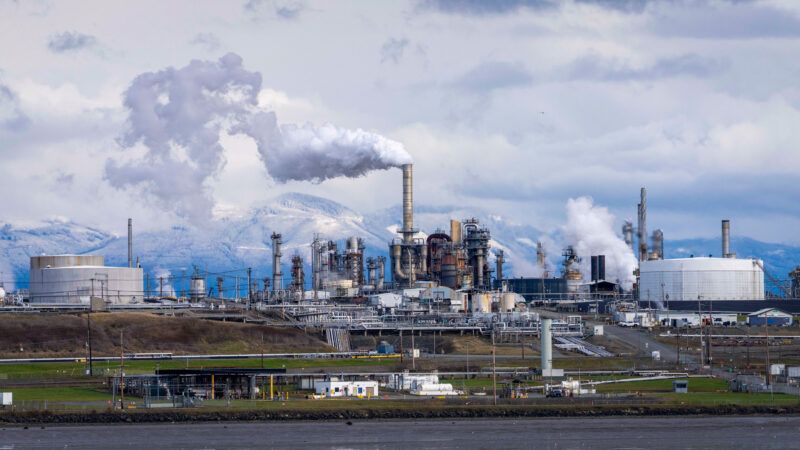
Days after Israel and the United States began bombing Iran, White House trade adviser Peter Navarro boldly proclaimed that the "Iran war will lower energy prices." Navarro's prediction has, thus far, been exceedingly wrong.
The war has led to the effective closure of the Strait of Hormuz, through which about 20 percent of the world's oil passes. As a result, global oil prices have continued to fluctuate, reaching as high as $119 per barrel on March 19, before falling to about $99 a barrel following signals of possible de-escalation.
If the war has given you a sense of déjà vu from the energy crisis of the '70s, you're not alone. In fact, in some ways, it's been worse. Fatih Birol, the head of the International Energy Agency, said on Monday that the war has caused global oil production to drop by 11 million barrels per day. That's more than "the loss of 10 million barrels per day from the oil shocks in 1973 and 1979 combined," reports The New York Times.
Americans have yet to experience '70s-era fuel rationing, but they are seeing prices at the pump spike. If history is any guide, this could spell trouble for President Donald Trump's popularity.
After winning reelection by a landslide in 1972, President Richard Nixon faced a tumultuous and unpopular second term, thanks to the Watergate scandal and the Yom Kippur War. Support for Israel in the latter set off an oil embargo against America, causing oil prices to double and even quadruple. Nixon laid out various energy-saving policies, including asking gas stations to stop selling gas from 9 p.m. Saturday and midnight Sunday, a national speed limit, and year-long daylight savings time. (The latter two were approved by Congress.)
In a particularly unpopular move, Nixon requested the "curtailment of ornamental outdoor lighting for homes and the elimination of all commercial lighting except that which identifies places of business" weeks before Christmas. That year, Nixon arrived at the annual Christmas tree lighting ceremony to light up a tree that used 80 percent less energy than the previous year, and featured just one lit-up decoration—a (rather sad-looking) lone star at the top. Jimmy Carter continued to promote unpopular energy-saving measures, including suggesting that Americans ought to turn down the thermostat and put on more clothes to conserve energy. Rhetoric like this, as well as stagflation from the energy crisis, led to Carter enjoying among the lowest presidential approval ratings in history, according to Gallup.
While the U.S. is now in a far better position to stave off energy supply shocks than it was back then, most Americans realize that war will still impact prices at home. A recent CBS News/YouGov poll found that 90 percent of Americans believe the conflict will make gas prices more expensive in the short term. Fifty-eight percent said it will impact gas prices in the long run. Couple this with the fact that the war was unpopular from the start, and it becomes easy to see history repeating itself with Trump.
Even if the war were to end tomorrow, energy prices are likely to remain high for the foreseeable future. Reopening the Strait of Hormuz would take weeks. Repairing and rebuilding damaged facilities could take significantly longer. As Kevin Book, managing director at ClearView Energy Partners, told The New York Times, "If the market is pricing in a short disruption that could be resolved in a cease-fire or the end of the war, it would be weeks for full functional facilities to come back online. If it is damaged, it could be months."
Whatever the timeline is, Americans will, contrary to Navarro's claim, continue to pay high energy prices thanks to a war they don't want to be involved in. And, if history is any guide, this manufactured energy crisis is likely to backfire on whoever is in charge.




