

Reason.com - Free Minds and Free Markets
Reason logo Reason logo
  • Latest
  • Magazine
    • Current Issue
    • Archives
    • Subscribe
    • Crossword
  • Video
    • Reason TV
    • The Reason Roundtable
    • Free Media
    • The Reason Interview
  • Podcasts
    • All Shows
    • The Reason Roundtable
    • The Reason Interview With Nick Gillespie
    • Freed Up
    • The Soho Forum Debates
  • Volokh
  • Newsletters
  • Donate
    • Donate Online
    • Ways To Give To Reason Foundation
    • Torchbearer Society
    • Planned Giving
  • Subscribe
    • Reason Plus Subscription
    • Print Subscription
    • Gift Subscriptions
    • Subscriber Support

Log In

Create new account

Social Media

A Jury Hit Meta With a $375 Million Verdict. The Open Internet May Pay the Price.

Meta's loss in a New Mexico "product design" case could also be a blow against Section 230, free speech, and online privacy.
Elizabeth Nolan Brown | 3.25.2026 12:07 PM

Share on FacebookShare on XShare on RedditShare by emailPrint friendly versionCopy page URL Add Reason to Google
Media Contact & Reprint Requests
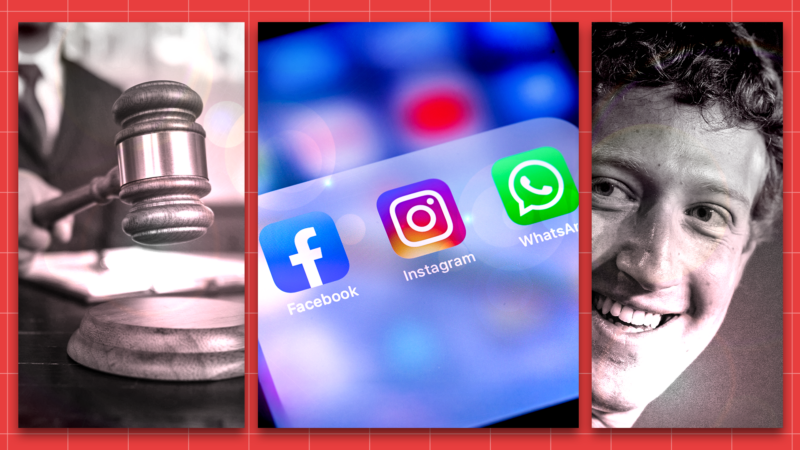
A judge's gavel, Meta app icons, and Mark Zuckerburg | Photo: Dreamstime
(Photo: Dreamstime)

Meta has been ordered to pay New Mexico $375 million, in a verdict that paves the way for more states to steal from social media companies under the guise of child protection—and demand changes that will compromise everyone's online speech and privacy.

In the lawsuit, New Mexico authorities accused Meta—parent company of Facebook, Instagram, and WhatsApp—of violating the state's Unfair Practices Act.

You are reading Sex & Tech, from Elizabeth Nolan Brown. Get more of Elizabeth's sex, tech, bodily autonomy, law, and online culture coverage.

This field is for validation purposes and should be left unchanged.

States accusing tech platforms of violating consumer protection laws have been a big trend lately. This ruling all but ensures it will intensify, and that's dangerous. It opens up a new way for authorities to regulate and sanction online platforms for their users' speech.

A Way Around Section 230

Section 230 of the Communications Act is supposed to protect against this sort of thing. If someone uses Facebook to engage in illegal activity, it's that person—not Meta—who may be criminally liable or face penalties. The speaker of the illegal speech is guilty, not the platform.

State attorneys general have been fighting against this paradigm for nearly two decades. It means they're stuck prosecuting individual criminals—a task paramount to public safety, but not great at garnering massive payouts to state coffers or getting national attention.

Section 230—and the First Amendment rights that it protects—have generally barred the sort of high-profile, high-profit lawsuits against tech companies that state authorities have been hankering for. But Section 230 (and the First Amendment) only apply when we're talking about actions involving speech.

If authorities can convince juries and judges that what they're really targeting is product design, all bets are off.

So, that's what we're seeing, in New Mexico v. Meta and countless other cases.

New Mexico argued that the design of Meta products exposed minors to psychological dangers, sexual content, and potential predators.

The verdict in this case is "a really problematic result and if it holds will be terrible for the open internet," commented Techdirt editor in chief Mike Masnick on Bluesky. "This case easily should have been tossed on 230 grounds. That it wasn't means Section 230 is that much weaker today."

Forcing Platforms To Be Censors

"Product liability is generally imposed…on tangible 'products' (think brakes, tires, dishwashers, etc.) with inherent and unreasonable dangers that are hidden to consumers," noted Tyler Tone of the Foundation for Individual Rights and Expression (FIRE) in a recent post about chatbot liability.

A book that unexpectedly explodes upon opening it would be good grounds for a product liability claim; a book whose content inspires someone to act recklessly should not.

Courts have repeatedly rejected the notion that intangible ideas or messages within an entertainment or media product are grounds for product liability claims—and with good reason. "Imposing liability for 'dangerous' ideas would set us down a dark path; every author and publisher would have to make sure that the ideas they put out in the world couldn't possibly be interpreted or used to some harmful end," writes Tone. "If you've ever met other human beings, you already know that the list of such ideas is…quite short."

In New Mexico v. Meta, many of the state's objections are so clearly about speech that it's absurd to pretend otherwise. What is it that supposedly causes "addiction" if not the content that teens encounter on these platforms? What is it that allowed New Mexico authorities to pose as a 13-year-old girl and receive private messages if not a neutral communications platform? What are the features that New Mexico complains about—like livestreaming and ephemeral content and filters—but tools for user expression?

And what else are social media platforms supposed to do if suits like these keep succeeding but make sure that the ideas their users put out in the world couldn't possibly be interpreted or used to some harmful end?

As with regulating the ideas in books, the end result would be to limit everyone's access to ideas and communications online.

Every plaintiffs lawyer who wants to get around 230 claims "it's the platform design" but none of their design complaints matter absent the content. It's nonsense. These are attacks on speech.

— Mike Masnick (@masnick.com) 2026-03-25T03:22:51.252Z

Impossible Standards and Far-Reaching Solutions

Not all of the speech that New Mexico objects to is protected speech. For instance, an adult sending sexual images to a minor is not protected. But in such cases, it's the predatory adult who breaks the law, not a neutral messaging platform that has no knowledge of such communications (and may expect, based on what a user indicated when creating an account, that the user is older).

The fact that people expect Meta to somehow stop all predators or face liability showcases the weird double standards they place on social media platforms.

Minors also encounter potentially distressing ideas and images in magazines, movies, TV, and books, but you don't see anyone accusing publishers and movie studios and TV networks of "unfair practices" that harm teens' mental health. Criminals also use telephone calls and text messages and emails to reach potential victims, but you don't see anyone accusing phone companies and email providers of faulty product design. Streaming services also use algorithmic recommendations and you don't see suits accusing them of promoting addiction.

Meanwhile, the solutions proposed in social media cases like this one go far beyond targeting bad actors or explicitly illegal speech.

New Mexico is asking Meta to enact age-verification protocols and restrict encrypted communications—moves that make it easier for the government to monitor everyone's speech and connect any account on these platforms to its owner's offline identity (in addition to exposing adults and minors alike to identity thieves, scammers, and other bad actors online).

Yesterday's jury ruling came after the first part of this trial—and represents a significant deviation from what the state wanted. In closing arguments, it asked jurors to slap Meta with a $2 billion fine.

"A second phase of the trial with follow with a judge deciding whether Meta created a public nuisance and should be on the hook financially to fund programs to address alleged harms to children," the Associated Press reports.

Meta has said it will appeal the New Mexico verdict.

This case also comes amid a wave of social media "addiction" lawsuits, including a jury trial that just wrapped in Los Angeles.


In The News

Who needs a warrant when bulk buying of data is possible? "After a 2015 change to [Section 702 of the Foreign Intelligence Surveillance Act], federal agencies are not supposed to collect data on U.S. citizens in bulk," notes NPR. "But some found a workaround to requesting warrants by simply buying the data instead." Will Congress close the loophole?

Privacy and civil liberties advocates say the upcoming FISA reauthorization debate is the best chance to close the so-called "data broker loophole" that federal agencies are using to purchase the kind of bulk data that Congress has already banned them from collecting themselves.

"This is very likely the only chance that Congress has this year to vote for meaningful privacy protections," said Sean Vitka, executive director of Demand Progress, an advocacy group that has helped bring together an unusual coalition supporting federal surveillance reforms with backers from opposite sides of the political spectrum.

He added, without reform, "The Trump administration is walking around with the most dangerous surveillance powers in recent history," given recent advances in AI, expanding use of data from brokers and changes to FISA that Congress passed in 2024.

Rep. Warren Davidson (R-Ohio) along with conservative Sen. Mike Lee (R-Utah), teamed up with Democrats Rep. Zoe Lofgren and Wyden on bicameral bipartisan FISA reform legislation that would end the data broker loophole among several other reforms.

The bill may have bipartisan support, but it also has bipartisan opposition. "The White House and House Speaker Mike Johnson are both pushing for a clean reauthorization of FISA that would include no changes, and there are some Democrats who have indicated they support that plan to ensure the law does not lapse," notes NPR. And as The Intercept points out, "figures from the Democratic establishment have often been ambivalent or openly hostile to reforming the law."


On Substack

"Protecting teens shouldn't require permission to speak." In the Foundation for Individual Rights and Expression (FIRE) newsletter, 20-year-old Zoe Armbruster suggests that the "youth mental health" framing around free speech restrictions is a smokescreen.

The real question isn't just teen safety, but this: Is the United States willing to normalize a permission-based internet?

My generation understands the downsides of social media. We have experienced comparison culture and digital pressure. But we have also used these platforms to organize protests, build communities, share stories, and participate in civic life. Social media is not merely entertainment. It is a modern public square, and when we understand it in those terms it's clear why we cannot tolerate government intervention that censors speech and decimates anonymity.

Protecting teens is essential. Preserving free expression is essential, too. The vast majority of even "harmful" speech on social media is still protected speech that minors have a First Amendment right to access. If access to the public square increasingly depends on proving who you are before you speak, we may address one problem while creating another: a more monitored, less anonymous, and ultimately less free digital environment for everyone.


Read This Thread

Are AI outputs free speech under the First Amendment? Yes.

AI is polling down there with ICE and the Democratic Party. Meanwhile, I'm like Butters in South Park, unironically marveling at how awesome it is.

So maybe I'm just asking for a ratio, but I wrote a whole big paper… pic.twitter.com/Z8Mn9GFQWV

— Corbin K. Barthold (@corbinkbarthold) March 23, 2026


More Sex & Tech News

• How age-verification laws are cutting into adult content creator incomes

• "When it comes to what constitutes an immoral activity, Americans have some common ground," notes J.D. Tuccille (in a plea against legislating morality)."According to recent Pew Research polling, 90 percent of us believe it's immoral for married people to have an extramarital affair. Two percent say it's morally acceptable and 7 percent believe it's not a moral issue at all."

• Sen. Bernie Sanders (I–Vt.) and Rep. Alexandria Ocasio-Cortez (D–N.Y.) are introducing legislation to ban the building of AI data centers "until until Congress passes comprehensive AI legislation that ensures the safety and prosperity of the American people."

• Alice Evans on the link between smartphones and feminism:

What's the difference between prior advances in communications technology and smart phones?

I posit that while tec advances have generally increased connectivity, this has usually been via male gatekeepers (who produce and stream tv and radio).

In more patriarchal societies,… pic.twitter.com/7rUjyuYbnN

— Alice Evans (@_alice_evans) March 24, 2026

Start your day with Reason. Get a daily brief of the most important stories and trends every weekday morning when you subscribe to Reason Roundup.

This field is for validation purposes and should be left unchanged.

NEXT: Facebook Guilty

Elizabeth Nolan Brown is a senior editor at Reason.

Social MediaSection 230FacebookTeenagersChildrenFree SpeechFirst AmendmentInternetLawsuitsPsychology/Psychiatry
Share on FacebookShare on XShare on RedditShare by emailPrint friendly versionCopy page URL Add Reason to Google
Media Contact & Reprint Requests

Hide Comments (20)

Editor's Note: As of February 29, 2024, commenting privileges on reason.com posts are limited to Reason Plus subscribers. Past commenters are grandfathered in for a temporary period. Subscribe here to preserve your ability to comment. Your Reason Plus subscription also gives you an ad-free version of reason.com, along with full access to the digital edition and archives of Reason magazine. We request that comments be civil and on-topic. We do not moderate or assume any responsibility for comments, which are owned by the readers who post them. Comments do not represent the views of reason.com or Reason Foundation. We reserve the right to delete any comment and ban commenters for any reason at any time. Comments may only be edited within 5 minutes of posting. Report abuses.

  1. Rick James   2 months ago

    Section 230—and the First Amendment rights that it protects—have generally barred the sort of high-profile, high-profit lawsuits against tech companies that state authorities have been hankering for. But Section 230 (and the First Amendment) only apply when we're talking about actions involving speech.

    The reason you're surprised is because you don't understand what Section 230 does.

    The verdict in this case is "a really problematic result and if it holds will be terrible for the open internet," commented Techdirt editor in chief Mike Masnick on Bluesky. "This case easily should have been tossed on 230 grounds. That it wasn't means Section 230 is that much weaker today."

    Days without Mike Masnick reference: 0

    Like Elizabeth Nolan Brown and Mike Masnick, I'm no lawyer, but this was fought in state court. It's possible this could be reversed if appealed to a higher, federal court.

    Also:

    However, the court rejected Meta’s Section 230 defense in May 2024, allowing the case to proceed to trial because the lawsuit focused on Meta’s product design, internal decisions about content curation, and alleged deceptive business practices—not merely on third-party content. This ruling was pivotal, as it enabled New Mexico to pursue claims under its Unfair Practices Act.

    As I have tried (and clearly failed) to explain in many previous instances, section 230 gives companies criminal immunity from the content that their users post, it does not, however, give them immunity for what the companies DO with said posts.

    Without digging into the merits (or lack thereof in this case). If I'm say, PornHub, and you're a user that is posting underage girls having sex... and then as the managing director of PornHub, I reach out to you and say, "Hey, we love your videos, what say we promote your videos by giving them top priority in search results, and you know what else? We think everyone would benefit if we monetized them!"-- that removes my section 230 protections.

    Again, all of these companies are protected by the first amendment which... is the first amendment of the internet. If it's a pure speech issue, they should have invoked the first amendment in their defense. If they couldn't invoke that, then invoking a law designed to demand the blocking and screening of lewd, lascivious or otherwise objectionable content meant that their case was probably pretty fucking weak.

    1. Rick James   2 months ago

      Oh, also, I should add... It's Meta who, as a corporation has repeatedly called for Section 230 to be "reformed for the modern era".

      This was linked in many Reason articles swiveling its hips about section 230 being "The first amendment of the internet".

      I also like how it becomes more and more clear everyday how section 230 created a dog's breakfast of the legal landscape... where if this was all just a free speech issue, everyone would be invoking the 1st amendment of the internet, also known as the 1st amendment.

      1. Hickamore   2 months ago

        Product liability law applies because Meta itself uses the words "product" and "design." If you admit your social media outlet is a designed product, don't expect a jury to find otherwise.

    2. charliehall   2 months ago

      "it does not, however, give them immunity for what the companies DO with said posts."

      The entire business model of the internet requires that the companies profit from the content of said posts.

      1. Rick James   2 months ago

        Nitpick... no it doesn't because not every site is a "platform" that relies on monetizing user-generated content.

        Putting that railroad spike to the back of the skull nitpick aside... you just clearly articulated why "Protection for private blocking and screening of offensive material" section of the Communications Decency Act is retarded.

  2. TJJ2000   2 months ago

    "But, but, but ... It's for the Gov-Gods children!" /s

  3. Social Justice is neither   2 months ago

    We get it ENB, section 230 exists to protect tech companies from liability for the violent and crazy things leftists say while also protecting them as they actively censor conservatives for benign, true statements.

  4. Neutral not Neutered   2 months ago

    "The fact that people expect Meta to somehow stop all predators or face liability showcases the weird double standards they place on social media platforms."

    Exactly^^^

  5. Neutral not Neutered   2 months ago

    Good thing Trump won election. We sure didn't need the continued control of this power by AutoPen Cackles.

    "He added, without reform, "The Trump administration is walking around with the most dangerous surveillance powers in recent history," given recent advances in AI, expanding use of data from brokers and changes to FISA that Congress passed in 2024."

    Sadly this is part of the power the demonrats are currently promoting for their retribution and assault on voters for voting for Trump and taking their power.

  6. Rev Arthur L kuckland (5-30-24 banana republic day)   2 months ago

    They edit and promote and curate content, they are not an open platform, section 230 does not apply to them.

    1. Rick James   2 months ago

      I imagine a day when when little white boys and black girls can hold hands, and Reason begins to understand that Section 230 was an exception to the first amendment.

  7. mad.casual   2 months ago

    Every plaintiffs lawyer who wants to get around 230 claims "it's the platform design" but none of their design complaints matter absent the content.

    The usual retardation from serially motivated retards.

    This is akin to saying "You can't legislate or adjudicate murder without knowing who exactly the murder victim is."

    Seriously, this is how retardedly simple it is: if the platform literally says, "All speech hosted on this platform belongs to the platform provider." the speech belongs to the platform provider, regardless of who posts it or what that speech is**. If the platform literally says, "All speech hosted on this platform belongs to the users." the speech belongs to the users. If the platform says, "The speech belongs to the users but the promotion and monetization belong to the platform." then as with any given concert or sporting even promotion or whatever, if there's a liability concern between any/all the parties, the court wades into the contracts and says, "The performer has a clause in their contract for illness or inability to perform. The promoter owes the artist for the booking (or doesn't) and is on the hook for ticket refunds (or isn't)."

    The *actually* *really* retarded idea is that somebody is being sued and their speech is being silenced simply for creating a platform that has no content.

    **This is notable in yet another aspect of Masnick's serial retardation. That is, we can legislate that breaching a platform's security protections is a crime without knowing the explicit method of exploit. Similarly, when someone commits a crime by illegally breaching or hacking the system, we by virtue of the law, declare the platform to be a victim and the speech generated by the hackers to be owned by them, not the platform. The hacker specifically avoided the contract *and* breached security.

  8. mad.casual   2 months ago

    What's the difference between prior advances in communications technology and smart phones?

    None. Women have been using communications technology to gaslight each other into irrelevance since back yards had fences to gossip over.

    If you think telegraphy, telephony, and radio somehow (re)affirm male dominance, that's a you issue. By 1950, something like 98% of switchboard operators were women and something north of 80% of calls and 90% of minutes were not men, not business-related, or both. If there is a major difference between prior communication advances and smartphones, it's the marginal increase in the number of places women can display and affirm their self-righteous ignorance to each other.

  9. MollyGodiva   2 months ago

    This is BS. A girl did not want to stop scrolling TicTok and she demands millions in damages.

  10. BigFish92672   2 months ago

    I'm zuckered from FascistBook and Twitter for being anti-War. If they are going to police speech, let them be sued for failure to police speech. Of course Musk and Zucker want to have their cake and eat it, too. No tears here

    1. MWAocdoc   2 months ago

      That's why we should immediately outlaw any and all lawsuits alleging harm and damages from "speech"

  11. Truthteller1   2 months ago

    Bullshit. This means nothing for the open internet. More fear mongering from the big tech shills at reason.

  12. WellRedMan   2 months ago

    This is what happens when you get laypersons attempting to understand the complexities of vague and specious laws that depend on the interpretations of government bureaucrats.

    1. MWAocdoc   2 months ago

      It should never have to come to that. The Supreme Court should immediately strike down any laws and regulations that infringe on the right to free speech, and any lower court rulings that violate the clear language and intent of the Constitution.

  13. MWAocdoc   2 months ago

    "'harmful' speech on social media is still protected speech that minors have a First Amendment right to access."

    The first phrase is true. The second phrase is false. Minors do not have the right to access anything in particular if their parents do not allow them access. Minors may also be prevented from going to the public square if their parents "ground" them for misbehavior. The First Amendment protects everyone's right to hold and express opinions. It does not guarantee that anyone else will hear your expressed opinions, or that you must be allowed to express your opinions wherever and whenever you choose. It does not guarantee your right to access the expressed opinions of others. You might have to pay to access those opinions, and you may be forbidden from expressing your opinions on private property or at two in the morning with huge amplifiers.

Please log in to post comments

Mute this user?

  • Mute User
  • Cancel

Ban this user?

  • Ban User
  • Cancel

Un-ban this user?

  • Un-ban User
  • Cancel

Nuke this user?

  • Nuke User
  • Cancel

Un-nuke this user?

  • Un-nuke User
  • Cancel

Flag this comment?

  • Flag Comment
  • Cancel

Un-flag this comment?

  • Un-flag Comment
  • Cancel

Latest

The Foreign-Born Heroes Who Chose America

Agustina Vergara Cid | 5.25.2026 7:00 AM

Japan's Smoking Bans Make a Lot More Sense Than America's

Katarina Hall | From the June 2026 issue

Brickbat: Texas Trouble

Charles Oliver | 5.25.2026 4:00 AM

The DJ Who Brought America Weird Al, Tom Lehrer, and 'Cows With Guns'

Henry Olsen | 5.24.2026 6:00 AM

Abigail Spanberger Vetoes Mandatory Collective Bargaining, Defying Virginia Unions

C. Jarrett Dieterle | 5.23.2026 7:00 AM

Recommended

  • About
  • Browse Topics
  • Events
  • Staff
  • Jobs
  • Donate
  • Advertise
  • Subscribe
  • Contact
  • Media
  • Shop
  • Amazon
Reason Facebook@reason on XReason InstagramReason TikTokReason YoutubeApple PodcastsReason on FlipboardReason RSS Add Reason to Google

© 2026 Reason Foundation | Accessibility | Privacy Policy | Terms Of Use

This site is protected by reCAPTCHA and the Google Privacy Policy and Terms of Service apply.

r

I WANT FREE MINDS AND FREE MARKETS!

Help Reason push back with more of the fact-based reporting we do best. Your support means more reporters, more investigations, and more coverage.

Make a donation today! No thanks
r

I WANT TO FUND FREE MINDS AND FREE MARKETS

Every dollar I give helps to fund more journalists, more videos, and more amazing stories that celebrate liberty.

Yes! I want to put my money where your mouth is! Not interested
r

SUPPORT HONEST JOURNALISM

So much of the media tries telling you what to think. Support journalism that helps you to think for yourself.

I’ll donate to Reason right now! No thanks
r

PUSH BACK

Push back against misleading media lies and bad ideas. Support Reason’s journalism today.

My donation today will help Reason push back! Not today
r

HELP KEEP MEDIA FREE & FEARLESS

Back journalism committed to transparency, independence, and intellectual honesty.

Yes, I’ll donate to Reason today! No thanks
r

STAND FOR FREE MINDS

Support journalism that challenges central planning, big government overreach, and creeping socialism.

Yes, I’ll support Reason today! No thanks
r

PUSH BACK AGAINST SOCIALIST IDEAS

Support journalism that exposes bad economics, failed policies, and threats to open markets.

Yes, I’ll donate to Reason today! No thanks
r

FIGHT BAD IDEAS WITH FACTS

Back independent media that examines the real-world consequences of socialist policies.

Yes, I’ll donate to Reason today! No thanks
r

BAD ECONOMIC IDEAS ARE EVERYWHERE. LET’S FIGHT BACK.

Support journalism that challenges government overreach with rational analysis and clear reasoning.

Yes, I’ll donate to Reason today! No thanks
r

JOIN THE FIGHT FOR FREEDOM

Support journalism that challenges centralized power and defends individual liberty.

Yes, I’ll donate to Reason today! No thanks
r

BACK JOURNALISM THAT PUSHES BACK AGAINST SOCIALISM

Your support helps expose the real-world costs of socialist policy proposals—and highlight better alternatives.

Yes, I’ll donate to Reason today! No thanks
r

FIGHT BACK AGAINST BAD ECONOMICS.

Donate today to fuel reporting that exposes the real costs of heavy-handed government.

Yes, I’ll donate to Reason today! No thanks


