
Markwayne Mullin Says Agents Don't Need a Warrant If They're Pursuing a Suspect. Here's What the Law Says.
“Officers don’t have the blanket authority to arrest anyone who runs from them,” says an attorney from the Institute for Justice.
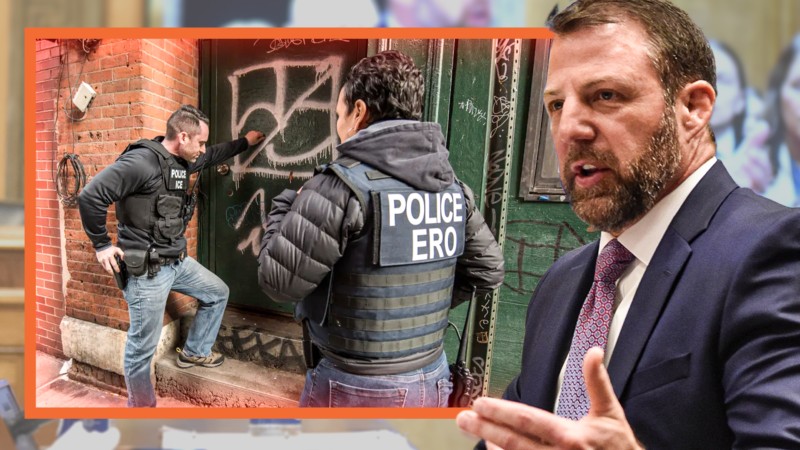
During his Wednesday confirmation hearing, Sen. Mullin (R-Okla.), the Department of Homeland Security (DHS) Secretary nominee, said he would reverse the agency's current policy allowing immigration officers to forcibly enter homes without a judicial warrant.
"A judicial warrant will be used to go into houses, into places of business, unless [agents] are pursuing someone that enters in that place," said Mullin.
The issue over immigration agents obtaining judicial warrants has been contentious ever since a whistleblower revealed a secretive Immigration and Customs Enforcement (ICE) memo signed by Acting Director Todd Lyons. The memo instructed immigration agents to forcibly enter homes without a judicial warrant, and asserted that certain kinds of administrative warrants grant officers the broad authority to enter homes to make arrests. The guidance was out of step with previous ICE training and ran counter to Fourth Amendment law.
Despite fierce pushback against the policy after agents were filmed using a battering ram to break into a Minnesota home with only an administrative warrant, the DHS under former Homeland Security Secretary Kristi Noem denied that the policy was unconstitutional. "Every illegal alien who DHS serves administrative warrants (known as I-205s) has had full due process and a final order of removal from an immigration judge," and "officers issuing these administrative warrants have also found probable cause," according to a DHS statement.
Except immigration judges are executive—not judiciary—officers. And without a signature from a true judicial officer to provide a meaningful check on executive power, administrative warrants used to forcibly enter homes fall short of what is required to meet what's required under the Fourth Amendment. Mullin is right to endorse reversing the DHS' unconstitutional policy, which would help protect Americans' constitutional rights. But there's no guarantee that the DHS under Mullin will operate more lawfully than under Noem.
Although Mullin stated that he would require agents to have a judicial warrant to enter homes and businesses, he also carved out an exception: "unless we are pursuing someone that enters that place."
The statement nods towards the hot pursuit doctrine, which exempts officers from the judicial warrant requirement to enter homes if they are pursuing a fleeing suspect. However, the narrow doctrine comes with some strict standards that Mullin did not address during his testimony, and that have generally been inapplicable to immigration enforcement operations.
"Law-enforcement officers do not have blanket authority to arrest anyone who runs from them," Dylan Moore, an attorney at the Institute for Justice, told Reason. "Without an actual risk of danger or evidence of a serious crime," he continued, "the hot-pursuit doctrine should not automatically justify officers' warrantless trespass onto private property."
"Courts are most likely to find that the hot-pursuit doctrine applies in cases where someone commit a serious crime—like a violent felony—and then runs away to avoid arrest, destroy evidence, or inflict harm," according to Moore. Immigration arrests, however, usually involve only civil infractions or criminal misdemeanors.
The Supreme Court addressed hot pursuit in situations involving minor offenses in Lange v. California (2021), stating that in such cases, "police officers do not usually face the kind of emergency that can justify a warrantless home entry." The Court ultimately ruled against allowing officers the blanket authority to enter homes without a warrant while pursuing individuals suspected of minor offenses unless a real emergency exists.
It remains to be seen just how far Mullin, if confirmed, would attempt to stretch the hot pursuit doctrine to cover immigration arrests. Given the Trump administration's comfort skirting constitutional and legal lines in the name of mass deportations, however, it's not outside the realm of possibility that Mullin's vague carveout for pursuit could open the door for future abuses by immigration officers. But, for now at least, a reversal of one of the DHS's more unconstitutional policies means Americans can stay secure in their houses a little while longer.
