

Cesar Chavez's Other Crimes
Accused of rape and sexual abuse, the late labor organizer's UFW mercilessly bilked its members and taxpayers for years.
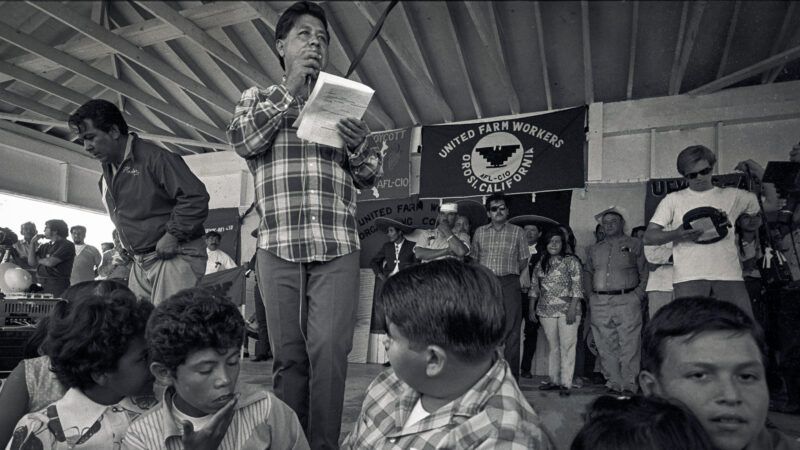
Cesar Chavez (1927–1993), the California-based labor icon who helped create the United Farm Workers of America (UFM) and led high-profile boycotts against table grapes and iceberg lettuce, has been accused of rape and sexual abuse in a major New York Times investigation. Two women told the Times that Chavez "sexually abused them for years when they were girls, from around 1972 to 1977," and 95-year-old Dolores Huerta, a co-founder of the UFW who had four children with Chavez's brother Richard, issued a statement denouncing César, saying he "manipulated and pressured" her into having sex on two occasions, including one in which she "was forced, against my will, and in an environment where I felt trapped." Both encounters, she says, resulted in children whose paternity was hidden and who were raised by "other families."
The response to the allegations has been swift. The union he co-founded has announced it "will not be taking part in any Cesar Chavez Day activities," a "federal commemorative holiday" proclaimed in 2014 and slated for March 31 this year. It is also creating an "external, confidential, independent channel for those who may have experienced harm caused by Cesar Chavez during the early days of the UFW's history." States such as California, which created its own Chavez holiday, are working to rename it, and colleges and communities featuring statues and buildings named after him are covering statues and discussing plans to remove references to him.

But long before this week's disturbing allegations came to light, Reason investigated a "network of nonprofit, tax-exempt organizations set up and run by Chavez and other UFW officials" that managed to pull in millions of taxpayer dollars while refusing virtually all requests for transparency and traditional accounting. The 1979 cover story "Who's Bankrolling the UFW?" stood apart from the widespread canonization of Cesar Chavez as a secular saint whose supporters "fought tearfully through…crowds for a chance to shake his hand or just touch him on the shoulder."
As Wikipedia notes, Chavez, born in Yuma, Arizona, "imbued his campaigns with Roman Catholic symbolism, including public processions, Masses, and fasts," making it easy for supporters to conflate him with a religious figure with an unimpeachable moral life and agenda. He often invoked Gandhi as an inspiration, to great effect, especially among the media, which rarely dug into the way that Chavez actually ran things.
The same was true for politicians, including California Gov. Jerry Brown, who once studied to be a Jesuit priest and was running the state when Chavez and the UFW created an organization called the National Farmworker Service Center (NFSC) that received almost $2 million in federal grants. Brown, wrote Patty Newman for Reason, "waived his right as governor to see and sign federal grants to anyone in the state of California. Thus he gave to Chavez—the man who nominated Brown for president at the 1976 Democratic convention—carte blanche approval of anything requested."
Digging into the NFSC's activities, Newman found that the group's credit union not only received a $349,115 taxpayer bailout but that it was gouging the very farm workers it supposedly existed to serve. "UFW's Farmworker Credit Union charges borrowers, not one percent per annum, but one percent per month (12 percent per year)," wrote Newman. "And 12 percent is certainly no bargain for the farmworkers, especially when most credit unions have been charging between 9 and 10 percent."
The Reason story led to national coverage of UFW- and Chavez-related activities, including a Chicago Tribune story that validated concerns that a federal grant was illegally being "used to build a microwave communications system to serve the union and another was being used to pay the salaries of union headquarters workers." The Justice Department used the story to open an investigation into the UFW in 1981 as well.
By most accounts, membership in the UFW peaked at around 80,000 in the 1970s before starting a long and mostly uninterrupted decline to fewer than 5,000. Part of the decline was surely due to the sorts of taxpayer grifts described by Reason's Newman, which meant the union was spending less and less of its time on basic organizing and negotiating better conditions for its members. And why would workers want to be part of a group that not only charged them dues but charged higher-than-market interest rates?
But a big part of the decline in membership is surely attributable to Chavez's imperious management style, which included more than financial impropriety and the newly revealed sexual improprieties. In a scorching 2009 review for the defunct Left Business Observer of a book called Beyond the Fields: César Chávez, the UFW, and Struggle for Justice in the 21st Century, economist Michael D. Yates writes that, "with the union's successes, Chávez began to think of himself as a holy person, Christ-like and above reproach." By the end of the 1970s, Chavez had become friendly with Charles Dederich, the controversial creator of the disreputable drug-rehab program Synanon, infamous for its use of a practice called "The Game," where members were subjected to constant psychological abuse.
"César took to the 'game' like Stalin to the secret police, and he used it for the same purpose—to consolidate his power in the union," wrote Yates. The UFW effectively became a cult of personality rather than an organization lobbying for better wages and conditions. Yates also has harsh words for Dolores Huerta. "Huerta has never repudiated Chávez's dictatorial, hateful, and ruinous behavior," wrote Yates. "She could have, and it might have made a difference. Instead, she was and still [in 2009] is a Chávez apologist. Shaw reports that she was unhappy with the treatment of women in the union. She says that women need to have power. She doesn't say for what. Had she been union president, I doubt things would have turned out much different."
At the conclusion of his piece, Yates, a longtime editor at the socialist Monthly Review and the author of Why Unions Matter, makes the most devastating analysis of Cesar Chavez and the UFW imaginable, especially from the left side of the political spectrum:
Under Chávez's autocratic leadership, the union dissolved the boycott staff, firing its leader and accusing him of being a communist; purged its staff, using the most disgusting means imaginable; refused to entertain any local union autonomy and democracy; denied the election of actual farm workers to the union board; ruined the careers, and in some cases, the jobs, of rank-and-file union dissidents; lost almost all of its collective bargaining agreements, and began a long and ugly descent into corruption.
Today, farm workers in California are no better off than they were before the union came on the scene.
That is a damning indictment of Chavez and his union, and one that existed years before The New York Times published its bombshell report.
Among the many lessons to be drawn from the Chavez story is this one: All saints, secular or religious, must be held accountable for the miracles they are reputed to perform. For centuries, the Catholic Church insisted that a "Devil's advocate" participate in the process of canonizing someone as a saint. The role of the advocate was to be openly skeptical of the candidate's character, biography, and especially, evidence for the miracles at the heart of sainthood.
Regardless of one's own ideology and heart's desire, we do best in matters of public policy and governance—and journalism—when we are especially tough on those we want to believe are too good for this world.
Related: In 2014, Reason's Zach Weissmueller reported on workers at California-based Gerawan Farms who tried to decertify representation by the UFW, which had won a union election in 1990 but never negotiated a completed contract.
"A group of Gerawan employees, less than eager to relinquish 3 percent of wages to an absent union, began petitioning for an election to decertify the union," explained Weissmueller. "More than 90 percent of employees don't want to be represented by the union," the worker who started the decertification process told the Los Angeles City Council. "I think the right thing is to support the workers, not the UFW." Eventually, the California Agricultural Labor Relations Board (ALRB) was forced by the state Supreme Court to count the votes in 2018, with the final tally being 197 in favor of the union and 1,100 against it.*
*CORRECTION: This story originally misstated the ultimate fate of Gerawan Farms.




