

The Federal Government's Crusade Against Anthropic Raises First Amendment Concerns
Trump administration officials openly seek to punish the AI company for its corporate philosophy.
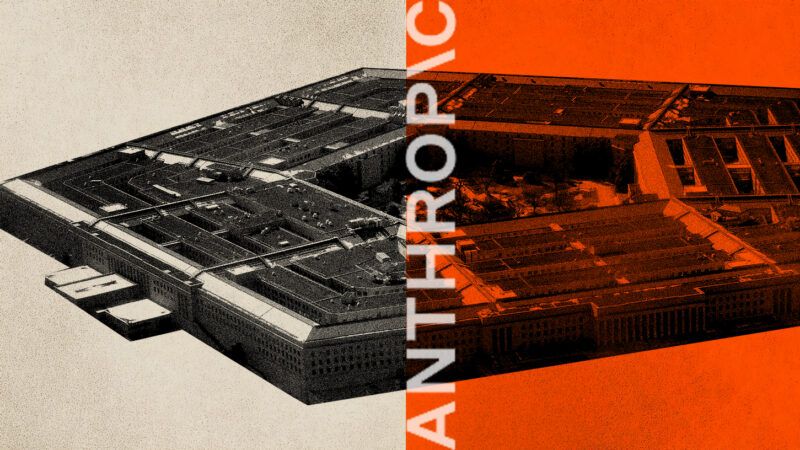
Vendors have the right to do business with whoever they please, and to put conditions on the purchase of their goods and services. Buyers have a matching right to choose among vendors, and to enter only deals that serve their purposes. But when government officials go further and use their power to punish private businesses that won't sell them what they want, they may run afoul of constitutionally protected rights. That's the case in the battle between AI firm Anthropic and the Trump administration.
You are reading The Rattler from J.D. Tuccille and Reason. Get more of J.D.'s commentary on government overreach and threats to everyday liberty.
A Company With Ethical Boundaries
Anthropic is a leading tech company whose AI model, Claude, reportedly played a role in the capture of former Venezuelan dictator Nicolás Maduro. But, like many companies, Anthropic limits the use of its technology for reasons of internal beliefs, public relations, or both. The company's philosophy is based on the idea that AI is potentially dangerous and should be built around "good personal values, being honest, and avoiding actions that are inappropriately dangerous or harmful."
In a February 26 press release, Anthropic CEO Dario Amodei pointed out that his company "chose to forgo several hundred million dollars in revenue to cut off the use of Claude by firms linked to the Chinese Communist Party" because it didn't want to enable an authoritarian regime. Likewise, "in a narrow set of cases, we believe AI can undermine, rather than defend, democratic values" when used by any government, including authorities in the United States.
"Some uses are also simply outside the bounds of what today's technology can safely and reliably do" Amodei added. "Two such use cases have never been included in our contracts with the Department of War, and we believe they should not be included now: Mass domestic surveillance" and "fully autonomous weapons."
As limitations go, refusing to participate in the creation of a totalitarian police state or the production of killer robots seem reasonable lines to draw. But that doesn't matter, because Anthropic has the right to draw whatever lines it wishes. The U.S. government can then respect those limits or take its shopping needs elsewhere.
But that's not what the federal government did. Instead, the president and his allies threw public temper tantrums over Anthropic telling them "no."
Feds Target a Corporate Philosophy for Punishment
"THE UNITED STATES OF AMERICA WILL NEVER ALLOW A RADICAL LEFT, WOKE COMPANY TO DICTATE HOW OUR GREAT MILITARY FIGHTS AND WINS WARS!" President Donald Trump huffed on Truth Social. "Therefore, I am directing EVERY Federal Agency in the United States Government to IMMEDIATELY CEASE all use of Anthropic's technology."
"@AnthropicAI and its CEO @DarioAmodei, have chosen duplicity. Cloaked in the sanctimonious rhetoric of 'effective altruism,' they have attempted to strong-arm the United States military into submission – a cowardly act of corporate virtue-signaling that places Silicon Valley ideology above American lives," sniffed Secretary of Defense War Pete Hegseth. "In conjunction with the President's directive for the Federal Government to cease all use of Anthropic's technology, I am directing the Department of War to designate Anthropic a Supply-Chain Risk to National Security. Effective immediately, no contractor, supplier, or partner that does business with the United States military may conduct any commercial activity with Anthropic."
In their comments, administration officials made it clear they were punishing Anthropic for its corporate beliefs, not because the company poses an actual danger to the country.
"Designating Anthropic as a supply chain risk would be an unprecedented action—one historically reserved for US adversaries, never before publicly applied to an American company," Anthropic responded prior to filing a lawsuit against the federal government. "We believe this designation would both be legally unsound and set a dangerous precedent for any American company that negotiates with the government."
Legally unsound and dangerous are good descriptions for a government policy that is openly intended as retaliation against a company for its corporate philosophy.
The First Amendment Is at Stake When Government Punishes Private Ethics
"The claim implicit in the Pentagon's reported demand is…that when national security is invoked, the state's judgment supersedes the moral constraints of the supplier. The company may sell — but only on terms that dissolve its own ethical boundaries," notes Walter Donway for the American Institute for Economic Research's The Daily Economy.
Importantly, the Anthropic–Pentagon dispute raises the issue of whether the government can punish a company for disagreeing with government officials as to what constitutes ethical behavior.
"Though the media is busy framing this as a national security showdown, it actually poses a constitutional concern," warns John Coleman for The Foundation for Individual Rights and Expression (FIRE). "It is a test of whether the federal government can weaponize its contracting power to force a private company to bend the knee."
That doesn't mean the federal government must do business with Anthropic. But it can't forbid federal contractors to use the company's products as a punishment.
"The government's actions, which are designed to harm Anthropic's business, raise serious constitutional concerns, including threats of compelled speech and retaliation against a company for taking positions disfavored by government officials," Coleman added.
FIRE filed an amicus brief with the U.S. District Court of Northern California supporting Anthropic's First Amendment case against the federal government.
It should be noted that Anthropic is not the first company to put conditions on the sale of its products to governments. For years, Barrett Firearms has refused to sell its products to agencies in jurisdictions that don't allow civilians to own large-bore guns. Home Depot had a longtime policy against doing business with the federal government because it didn't want the bureaucratic headaches that came with being classified as a federal contractor; it reversed that policy amid public blowback during the Iraq War.
Nobody, the Defense Department included, should be forced to do business with Anthropic. But, nor should the government be allowed to penalize private parties that refuse to do things they consider wrong.

Editor's Note: As of February 29, 2024, commenting privileges on reason.com posts are limited to Reason Plus subscribers. Past commenters are grandfathered in for a temporary period. Subscribe here to preserve your ability to comment. Your Reason Plus subscription also gives you an ad-free version of reason.com, along with full access to the digital edition and archives of Reason magazine. We request that comments be civil and on-topic. We do not moderate or assume any responsibility for comments, which are owned by the readers who post them. Comments do not represent the views of reason.com or Reason Foundation. We reserve the right to delete any comment and ban commenters for any reason at any time. Comments may only be edited within 5 minutes of posting. Report abuses.
Please to post comments
"It should be noted that Anthropic is not the first company to put conditions on the sale of its products to governments. For years, Barrett Firearms has refused to sell its products to agencies in jurisdictions that don't allow civilians to own large-bore guns. Home Depot had a longtime policy against doing business with the federal government because it didn't want the bureaucratic headaches that came with being classified as a federal contractor; it reversed that policy amid public blowback during the Iraq War."
Apples to oranges. Those two companies simply refused to be federal contractors. Anthropic wants to be a federal contractor with an exclusive contract for services and dictate policy to its customer. However, a company cannot bully the federal government the way it can an individual person with terms of service.
"Effective immediately, no contractor, supplier, or partner that does business with the United States military may conduct any commercial activity with Anthropic."
So the federal government put a TOS on other federal contractors not to do business with Anthropic. It is a bit of tit for tat here.
It is a bit of tit for tat here.
And that's the favorable view that... especially in Anthropics' case... elections, lives, markets, etc., etc. don't matter. Otherwise, Donald Trump was elected, Secretary Pete served and was appointed while Anthropic and Claude, apparently, can't be trusted to handle a loaded weapon without killing all humans or something (and I say this as someone who has repeatedly pointed out that the No. 1 threat to mankind's survival for the last ~75 yrs. has been other humans).
I trust that I can be alone in a room with Donald Trump or Pete Hegseth or both, even with a loaded gun, and we all walk out alive. If Anthropic wants to tell me that in a room alone with Pete Hegseth, Donald Trump, their robot, and a loaded gun my odds of survival go down, labeling them a security risk sounds entirely appropriate. Analogously, if some company were manufacturing Pete Hegseth clones made the similar claim, all Pete Hegseths and their manufacturer would be security risks. The issue/question of "supply chain" only matters inasmuch as they provide materially different products elsewhere which, isn't really clear but is somewhat immaterial as long as the distrusting party terminates contracts within scope.
Libertarians for obligatory MIC.
When did for profit corporations get First Amendment rights?
Oh, right. Citizens United. Overturn it.
"Vendors have the right to do business with whoever they please, and to put conditions on the purchase of their goods and services. Buyers have a matching right to choose among vendors, and to enter only deals that serve their purposes."
And
"The U.S. government can then respect those limits or take its shopping needs elsewhere."
Then
"Therefore, I am directing EVERY Federal Agency in the United States Government to IMMEDIATELY CEASE all use of Anthropic's technology."
So what's the problem?
Oh, yeah; Trump.
Oh, yeah; Trump.
Generously, 50% TRUMP!, 50% KOMPUTERZ IZ MAJICK!
It's like the scene from Shang Chi where Ben Kingsley's character is enthralled by The Planet of The Apes except instead of The Planet of The Apes, JD watched the video of the chimpanzee with an AK-47.
You can practically hear Mama Tuccille in Ben Kingsley's voice saying, "It's not a real monkey, it's computer generated." and JD replying, "A computer generated a monkey *and* taught it how to shoot? Amazing!"
What about the support of terrorism laws? What about Nazi sympathizers during WWII?
Hasn't this form of viewpoint discrimination always existed in every country?
"Though the media is busy framing this as a national security showdown, it actually poses a constitutional concern," warns John Coleman for The Foundation WHO SHALL NOT BE NAMED!. "It is a test of whether the federal government can weaponize its contracting power to force a private company to bend the knee."
Brilliant! Just awesome. FIRE being on Anthropic's side further convinces me that the administration is in the right here.
Reiterating what I was saying above; I'm pretty sure can walk into a room with Donald Trump, Pete Hegseth, and a loaded gun and we all walk out alive. I'm less certain that if I walked into a room with Donald Trump, Pete Hegseth, any given FIRE employee/lawyer, and a loaded gun, one or all of us walk out alive. Where else they work and provide service without access to firearms or political leaders, I can't say but in this application, I don't trust them.
To wit, if I post the quote above unedited, even though I'm quoting someone else, I get an "A potentially unsafe operation has been detected in your request to this site
Your access to this service has been limited. (HTTP response code 403)" because, as I've pointed out previously, I'm naming an organization who shall not be named, even in quote.
FIRE is not on your side, nor the side of Free Expression. They are a security risk, whether they constitute a supply chain risk is up to the individual user. I wouldn't forbid that conclusion from anyone, private, public, civilian, or government. The Ayatollah roasting in Hell is free to rightly regard FIRE as an enemy of free expression.
FIRE is what you get when you have an intolerant ideologically driven organization. They see things as black or white and do not understand that there are shades of grey where the rights of different parties clash and compromise is needed.
"Vendors have the right to do business with whoever they please, and to put conditions on the purchase of their goods and services."
But I wanted to use those shoes in a modern art project. Do I need permission?
It seems to me that if you are using the product or service for your own private purposes the vendor should STFU. If, however, my use of the product can damage the vendor's reputation and the vendor stands to be legally responsible, or it competes with the vendor's business, then they can attach conditions.
FIRE has been a steadfast non-partisan defender of the 1A for three decades. They have pretty much single handlely kept colleges from trampling on 1A rights. No other organization is like them.
Reason lost all credibility arguing First Amendment violations when they failed to raise hell on COVID, Hunter Laptop Russiagate censorship. DONE
Wow, pretty enthusiastic about tech companies being control freaks, aren't we?
Personally, I'm sick up to here with companies selling me stuff, and then trying to dictate its use even after I own it. The difference is that I'm relatively powerless to fight that sort of thing, while picking that fight with the federal government is a bit more of a problem for a company.


