

This Supreme Court Case Could Determine the Fate of More Than 1.3 Million Migrants
If Trump can end temporary protected status for Haitian and Syrian nationals, don't expect it to stop there.
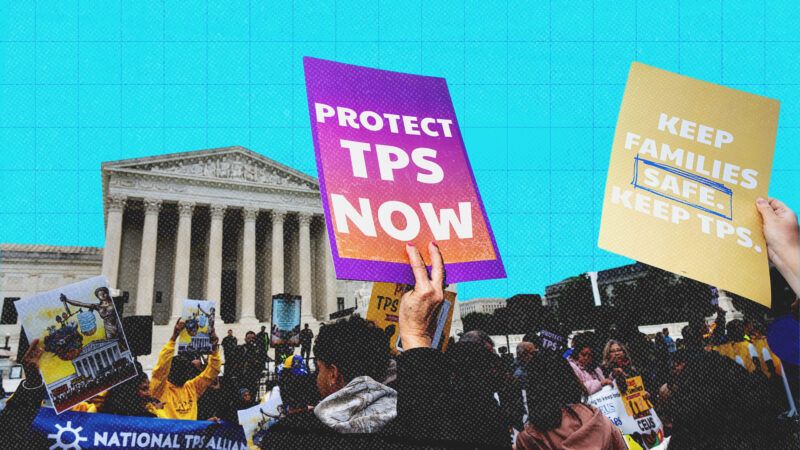
The Supreme Court heard arguments on Wednesday on challenges against the Trump administration's end of temporary protected status (TPS) for 350,000 Haitian and 6,000 Syrian nationals. The outcome could have wider implications for the nearly 1.3 million TPS recipients across 13 countries currently living in the United States.
Wednesday's arguments consolidated two cases accusing the Trump administration of violating federal law when it terminated TPS designation for both Haitians and Syrians without adequately consulting with other federal agencies, reports SCOTUSblog. Additionally, Haitian challengers argue that the decision to terminate Haiti's TPS violates the Equal Protection Clause of the 14th Amendment and discriminates against non-white immigrants.
The government, however, argues that the Department of Homeland Security's (DHS) decisions regarding TPS designation are unreviewable by the courts, a position challengers say would unlawfully insulate executive action from judicial review, according to SCOTUSblog. But even if reviewable, the government argues that the DHS appropriately considered advice from the State Department as required.
Created in 1990, the TPS program allows the secretary of Homeland Security to designate a foreign country for protected status when it is experiencing conditions that prevent the safe return of the country's nationals, including environmental disasters, armed conflicts, and other abnormal emergencies. The program allows individuals in the U.S. under TPS to stay in the country and work, but does not offer a direct path to a green card or citizenship.
Last June, then-Secretary of Homeland Security Kristi Noem announced the termination of protected status for Haiti, which has had TPS since January 2010, following a massively destructive earthquake killing more than 300,000 people. Noem determined that Haiti, which is experiencing an ongoing humanitarian crisis, no longer met the conditions for TPS, and such a designation was contrary to the U.S. national interest. But Noem's decision was blocked from taking effect after U.S. District Judge Ana Reyes in the District of Columbia ruled that Noem was "substantially likely" to have "preordained her termination and did so because of hostility to nonwhite immigrants."
"Secretary Noem has terminated every TPS country designation to have reached her desk," wrote Reyes, and noted that Noem failed to consult with other federal agencies before making her decision concerning Haiti, as required under federal law, and ignored economic considerations.
Noem also terminated TPS for Syria in September, which has been in place since March 2012, after thousands of Syrians died following the takeover of Syrian dictator Bashar al-Assad. But the termination of protected status was once again blocked from taking effect after a U.S. District Judge in the Southern District of New York, Katherine Polk Failla, found that the challengers were also likely to succeed on their claim that Noem violated federal law in terminating TPS for Syrians.
Following Wednesday's arguments, reporting by The New York Times suggested that the Court was closely divided over whether the DHS could immediately terminate TPS for Haiti and Syria. While Justices Sonia Sotomayor and Ketanji Brown Jackson suspected racial motivation behind the decision to end TPS for Haitian nationals, conservative justices were open to the argument that federal law prohibits the courts from second-guessing TPS decisions made by the DHS, according to the Times. Notably, the Court issued an unbinding, shadow docket opinion last October, allowing the termination of TPS for over 250,000 Venezuelans living in the United States.
The Court's majority opinion, which won't be published until June or July, may come down to the positions taken by Chief Justice John Roberts and Justice Amy Coney Barrett, reports the Times. Whatever the Court decides in this case will be a binding precedent on how, and if, the courts may review TPS determinations. The outcome not only potentially impacts all people currently living in the U.S. under TPS who could see their protections suddenly revoked, but also whether the U.S. will continue to provide a safe harbor for foreign nationals in need of humanitarian relief.




