
Virginia Democrats' Push for Mandatory Government Unions Is Not an 'Affordability' Agenda
The legislation would almost certainly lead to a higher cost of living in the form of substantial tax increases.
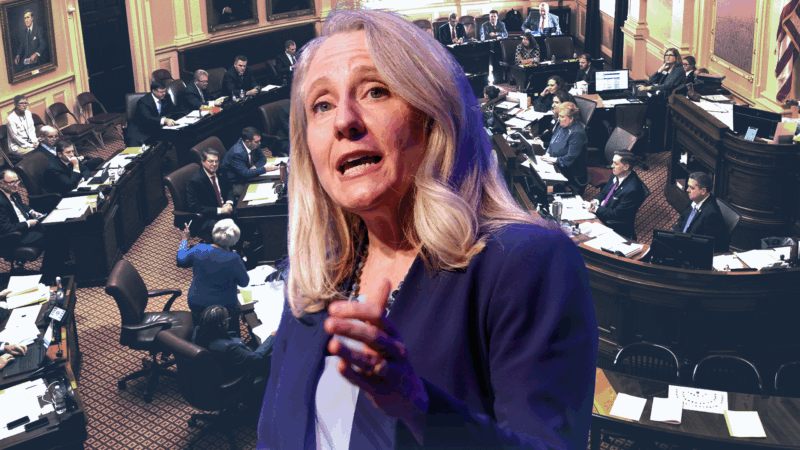
Like many recent politicians, Virginia's Democratic Gov. Abigail Spanberger has made "affordability" the linchpin of her gubernatorial agenda. Right on cue, state lawmakers recently passed Spanberger's 16-bill "affordability package," which is already receiving pushback as to whether it will actually lower costs.
But little attention has been paid so far to one of the most expensive pieces of proposed legislation currently percolating in Richmond: a likely repeal of Virginia's longtime ban on collective bargaining for government employees, which would replace it with a mandate to do just that.
Since a 1977 state supreme court decision, Virginia has been one of a handful of states that bans collective bargaining for local and state government employees. This law was substantially amended in 2021, when former Democratic Gov. Ralph Northam signed legislation creating an opt-in system for bargaining, in which local units of government could pass authorizing ordinances to allow them to collectively bargain with their employees.
Although this marked a substantial step forward for union interests, it still fell short of organized labor's ultimate goal: repealing Virginia's collective bargaining ban outright and mandating bargaining for state and local government employees statewide. (Since the 2021 law, at least 17 localities have opted into collective bargaining in the Commonwealth, according to the Center for American Progress).
In 2025, Virginia Democrats passed legislation for a statewide mandate, only to have it vetoed by former Republican Gov. Glenn Youngkin. Now, with Spanberger residing in the Executive Mansion, Democrats are making a renewed push to get the legislation across the finish line.
Under the terms of the recently-introduced S.B. 378, union certification can take place if a majority of government employees within a bargaining unit agree to be represented, while a union election can be triggered with a mere showing of 30 percent support. Once a union is recognized, the corresponding governmental unit must collectively bargain with it. The bill also creates a Public Employee Relations Board and imposes binding arbitration on governments that are unable to come to an agreement with a union.
While Spanberger has notably claimed that she will not sign legislation that repeals Virginia's right-to-work law for private sector workers, union interests claim that a collective bargaining mandate for government employees has the support of the governor if it gets to her desk (which appears likely given Virginia's Democratic-controlled state legislature).
The effort to mandate collective bargaining in Virginia may not seem related to "affordability" at first blush, but it would almost certainly presage a higher cost of living—in the form of substantial tax increases—for all Virginians.
Research suggests that mandatory collective bargaining increases state and local government spending by an annual average of $600 to more than $750 per person. This works out to an additional potential tax burden of between $2,300 to $3,000 per year for your average family of four.
Accordingly, S.B. 378's estimated fiscal impact is jarring. The cost to the state has been estimated to hover around $50 million annually, while the projected costs for localities range from $50,000 to a jaw-dropping $403 million over a two-year period.
Given this grim reality, the Virginia Association of Counties has come out strongly against the bill. Local government officials are even more outspoken.
"If this bill passes, it will be the single largest tax increase in Virginia history, because all of the responsibility for these payments and salaries will be on the localities, local taxpayers, property taxes, and everyone in communities," said Babur Lateef, a Northern Virginia Democrat and chairman at-large of the Prince William County School Board. "It will bankrupt local governments and bankrupt school divisions."
While Lateef says he personally supports collective bargaining, he believes the decision should reside with localities under the current opt-in approach.
"If your number one goal of being elected was to do something about affordability," he said, "this goes in the exact opposite direction, and you will be putting a burden on the Virginia taxpayer like we've never seen."
If the statewide mandate goes through, Virginia residents will pay the price.
