Virginia Democrats' Push for Mandatory Government Unions Is Not an 'Affordability' Agenda
The legislation would almost certainly lead to a higher cost of living in the form of substantial tax increases.
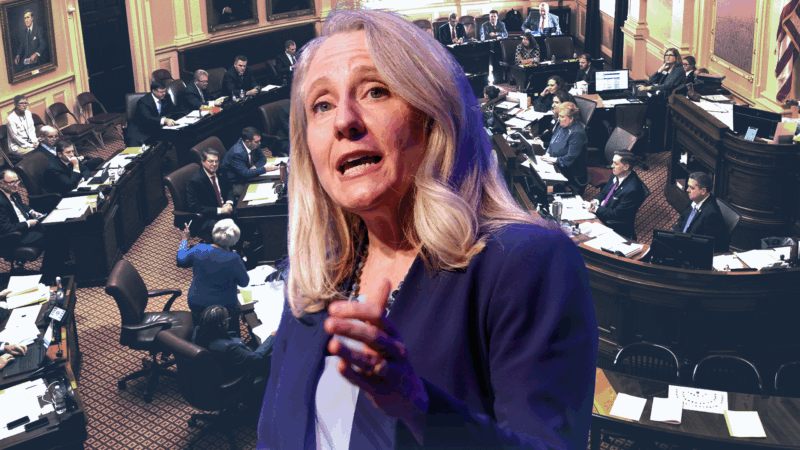
Like many recent politicians, Virginia's Democratic Gov. Abigail Spanberger has made "affordability" the linchpin of her gubernatorial agenda. Right on cue, state lawmakers recently passed Spanberger's 16-bill "affordability package," which is already receiving pushback as to whether it will actually lower costs.
But little attention has been paid so far to one of the most expensive pieces of proposed legislation currently percolating in Richmond: a likely repeal of Virginia's longtime ban on collective bargaining for government employees, which would replace it with a mandate to do just that.
Since a 1977 state supreme court decision, Virginia has been one of a handful of states that bans collective bargaining for local and state government employees. This law was substantially amended in 2021, when former Democratic Gov. Ralph Northam signed legislation creating an opt-in system for bargaining, in which local units of government could pass authorizing ordinances to allow them to collectively bargain with their employees.
Although this marked a substantial step forward for union interests, it still fell short of organized labor's ultimate goal: repealing Virginia's collective bargaining ban outright and mandating bargaining for state and local government employees statewide. (Since the 2021 law, at least 17 localities have opted into collective bargaining in the Commonwealth, according to the Center for American Progress).
In 2025, Virginia Democrats passed legislation for a statewide mandate, only to have it vetoed by former Republican Gov. Glenn Youngkin. Now, with Spanberger residing in the Executive Mansion, Democrats are making a renewed push to get the legislation across the finish line.
Under the terms of the recently-introduced S.B. 378, union certification can take place if a majority of government employees within a bargaining unit agree to be represented, while a union election can be triggered with a mere showing of 30 percent support. Once a union is recognized, the corresponding governmental unit must collectively bargain with it. The bill also creates a Public Employee Relations Board and imposes binding arbitration on governments that are unable to come to an agreement with a union.
While Spanberger has notably claimed that she will not sign legislation that repeals Virginia's right-to-work law for private sector workers, union interests claim that a collective bargaining mandate for government employees has the support of the governor if it gets to her desk (which appears likely given Virginia's Democratic-controlled state legislature).
The effort to mandate collective bargaining in Virginia may not seem related to "affordability" at first blush, but it would almost certainly presage a higher cost of living—in the form of substantial tax increases—for all Virginians.
Research suggests that mandatory collective bargaining increases state and local government spending by an annual average of $600 to more than $750 per person. This works out to an additional potential tax burden of between $2,300 to $3,000 per year for your average family of four.
Accordingly, S.B. 378's estimated fiscal impact is jarring. The cost to the state has been estimated to hover around $50 million annually, while the projected costs for localities range from $50,000 to a jaw-dropping $403 million over a two-year period.
Given this grim reality, the Virginia Association of Counties has come out strongly against the bill. Local government officials are even more outspoken.
"If this bill passes, it will be the single largest tax increase in Virginia history, because all of the responsibility for these payments and salaries will be on the localities, local taxpayers, property taxes, and everyone in communities," said Babur Lateef, a Northern Virginia Democrat and chairman at-large of the Prince William County School Board. "It will bankrupt local governments and bankrupt school divisions."
While Lateef says he personally supports collective bargaining, he believes the decision should reside with localities under the current opt-in approach.
"If your number one goal of being elected was to do something about affordability," he said, "this goes in the exact opposite direction, and you will be putting a burden on the Virginia taxpayer like we've never seen."
If the statewide mandate goes through, Virginia residents will pay the price.
Editor's Note: As of February 29, 2024, commenting privileges on reason.com posts are limited to Reason Plus subscribers. Past commenters are grandfathered in for a temporary period. Subscribe here to preserve your ability to comment. Your Reason Plus subscription also gives you an ad-free version of reason.com, along with full access to the digital edition and archives of Reason magazine. We request that comments be civil and on-topic. We do not moderate or assume any responsibility for comments, which are owned by the readers who post them. Comments do not represent the views of reason.com or Reason Foundation. We reserve the right to delete any comment and ban commenters for any reason at any time. Comments may only be edited within 5 minutes of posting. Report abuses.
Please to post comments
If only somebody told us Spanberger wasn't really a moderate.
(D–Va.) was unequivocal: "We need to not ever use the words socialist or socialism ever again,"
Soave
The other measure subject to yesterday's House vote, the 1991 AUMF, was the primary authorization through which the U.S. entered the Gulf War. It hasn't been invoked since that conflict, but as sponsor Rep. Abigail Spanberger (D–Va.) explained, "The fact that it hasn't been misused or hasn't been abused doesn't mean that that possibility doesn't exist at some point in the future."
Fiona
Rep. Abigail Spanberger (D–Va.), a moderate probably best known for her colorful analysis of her party's results in the 2020 election, could be the big loser in Virginia's redistricting battle. Yet another example of how gerrymandering is used to punish interesting politicians.
Boehm, of course.
Who could have guessed! Media never lies. Biden was a moderate too!
Meanwhile, Democrats are running Abigail Spanberger, a former congresswoman, for governor. Though she would also be the first female governor in the state's history, the rest of her identity and resume—a white person from a small town who worked for the CIA and is best known politically for getting angry at progressives—seems more like what you might expect from a Republican nominee.
Boehm, agian.
Forgive boehm. He is so dumb he ended up with a comms degree.
And the coup de grace to Boehm's 'I am not a progressive democrat' denial.
Abigail Spanberger Wins Virginia, Offers Democrats an Alternative to Mamdani's Socialism
"I don't care that much about what happens in the city of New York," Spanberger said on the campaign trail. Other Democrats should listen.
Reeeeason as been pushing Spanberger as the best kind of democrat for a long time. Not surprising given the new, more progressive, Reeeeason we all know.
She and Jared Polis are so dreamy, so moderate, so politically nonbinary, right?
Dont forget Ro Khanna!
Vote for fascists, get fascism.
This is why you can’t have chicks in charge.
Moderate adults-in-the-room!
Also, they block government laws which block child mutilation, so it's all swings and roundabouts.
It was pretty funny yesterday reading all the misinterpretation of Roberts ruling. Thinking tariffs were over.
Roberts in the majority ruling literally says tariffs can be delegated to the executive. He just says it couldn't under IEEPA. Solely because it didnt use the word tariff explicitly. He would have upheld a full embargo. This is the only change made yesterday, requiring the word in the law.
Kavanaugh had the most straight forward legal construction. Then Thomas obliterated gorsuch in his dissent going through the long history if tariffs and trade coming from article 2 starting under the fiest president. Page 90.
https://www.supremecourt.gov/opinions/25pdf/24-1287_4gcj.pdf
Unlike most of the maddow watchers I actually read it.
So what do we get? Here is Bessent.
I'd also like to take a moment to address today's Supreme Court ruling, and I would note, that I did not change a single word in my speech, post the ruling. President Trump will always put our national security and Americans first. And as I have said before, the president has multiple tools in his toolbox. Let's be clear about what today's ruling was, and what it wasn't. Despite the misplaced gloating from Democrats, ill-informed media outlets, and the very people who gutted our industrial base, the court did not rule against President Trump's tariffs. Six justices simply ruled that IEEPA (International Emergency Economic Powers Act) authority can not be used to raise even one dollar of revenue.
This administration will invoke alternative legal authorities to replace the IEEPA tariffs. We will be leveraging Section 232 and Section 301 tariff authorities that have been validated through thousands of legal challenges. Treasury's estimates show that the use of Section 122 authority combined with potentially enhanced Section 232, and Section 301 tariffs, will result in virtually unchanged tariff revenue in 2026.
What? No refunds?
There is no way to disperse the refunds.
Refunds werent even given to the J6ers who paid fines for a charge supreme court ruled 9-0 against.
Media is doing that thing again where it calls the victims if leftist murders far right.
https://legalinsurrection.com/2026/02/bbc-brands-slain-french-student-far-right-after-brutal-beating-by-suspected-leftists/
In this case 2 aides to the leftist political party were involved in the murder.
You see, they had it coming.
The antifa crowd that ganged up and beat this poor kid to death without provocation are 'suspected' leftists, but the guy protecting the women's rights group is 'far right' by default, no 'suspected' needed. Got it.
Counter proposal: Ban Public Sector Unions.
Disband them and void the contracts. Fire the members and rehire only as needed under a standard pay scale like the military uses.