

Don Lemon May Be a Hack, but That Does Not Make Him a Felon
The federal case against the former CNN anchor hinges on conduct that can plausibly be viewed as part of a journalist's work, combined with the obvious partiality of that work.
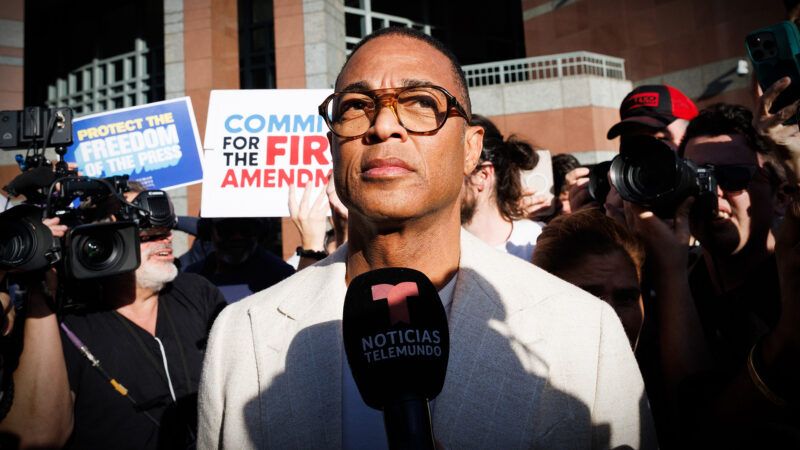
Don Lemon, the former CNN anchor who was arrested on federal civil rights charges last week, portrays his conduct during the January 18 protest that disrupted services at a church in St. Paul, Minnesota, as purely journalistic. The Justice Department, joined by his many critics, says he actively participated in the disruption, making him no less criminally liable than the seven protesters who were charged in the same case. If you break the law, Lemon's detractors note, the fact that you have a camera and a microphone does not shield you from prosecution.
Lemon indisputably was covering the protest for his YouTube show. The indictment against him concedes as much, repeatedly mentioning his "livestreaming" and noting his interviews with congregants and Jonathan Parnell, the pastor who was leading the service. But Lemon was unabashedly sympathetic to the protesters, their cause, and their illegal tactics. Lemon's own footage suggests he himself may have been guilty of trespassing. The indictment's allegations nevertheless fall short of making the case that his conduct met the elements of the two federal charges he faces.
Opponents of the Immigration and Customs Enforcement (ICE) crackdown in Minnesota targeted Cities Church because one of its pastors, David Easterwood, directs enforcement and removal operations at ICE's field office in St. Paul. The moral logic here is hard to follow. Easterwood was not even at the church that morning, and the idea that the entire congregation bore responsibility for his work is absurd on its face. Unfazed by such considerations, the 30 or so protesters interrupted the service with chanting and self-righteously harangued the worshipers, impelling many of them to leave.
Those tactics were morally indefensible and plainly illegal. When the protesters quietly entered the church and sat down, they were not breaking the law. But once they were asked to leave and refused to do so, they were violating Minnesota's trespassing statute, which makes it a misdemeanor to enter "the premises of another and, without claim of right, [refuse] to depart from the premises on demand of the lawful possessor." The demonstration also qualified as disorderly conduct, a misdemeanor that includes disrupting a lawful "assembly or meeting" when you have "reasonable grounds to know that it will, or will tend to, alarm, anger or disturb others or provoke an assault or breach of the peace."
The Washington Post, which reviewed video of the protest, reports that "the footage does not show [Lemon] participating in the chants that disrupted the service." But toward the end of Lemon's brief interview with Parnell, the pastor told him, "I have to take care of my church and my family, so I ask that you actually would also leave this building, unless you're here to worship." Lemon's response was cagey. "I always worship," he said. "I am a Christian."
After that exchange, according to the Post, Lemon remained in the church for another seven minutes. Since Parnell's request can plausibly be interpreted as a "demand" that Lemon "depart from the premises," notwithstanding the "unless you're here to worship" proviso, Lemon arguably was trespassing at that point. But that apparent misdemeanor is not enough to establish that Lemon violated 18 USC 248 and 18 USC 241, the two federal statutes cited in the indictment.
Section 248, which authorizes a sentence up to a year for a first offense, applies to someone who, "by force or threat of force or by physical obstruction, intentionally injures, intimidates, or interferes with" a person exercising his religious freedom at a place of worship. "It does not appear that Don Lemon did any of those things directly," notes First Amendment attorney Marc Randazza, although he was "part of a group that did."
As evidence that Lemon violated Section 248, the indictment cites his interview with Parnell, saying he and two other defendants—protester Jerome Richardson and Georgia Fort, a local reporter—"approached the pastor and largely surrounded him (to his front and both sides), stood in close proximity to the pastor in an attempt to oppress and intimidate him, and physically obstructed his freedom of movement while [Lemon] peppered him with questions to promote the operation's message."
If you watch the video of that encounter, you can see that Parnell voluntarily engaged with Lemon, expressing his understandable outrage at the people disrupting the service. Parnell may have been "largely surrounded" in the sense that three people were near him, but that would not have prevented him from simply walking away if that is what he wanted to do.
"The pastor seems to have voluntarily given that 49-second interview," Randazza notes. "His participation in it ratified Lemon's presence, whether he intended to or not."
While the indictment asserts that Lemon was trying to "oppress and intimidate" Parnell, that intent is by no means apparent in the video. And although the indictment says Lemon "physically obstructed" Parnell, that characterization is not consistent with the statute's definition of "physical obstruction," which entails "rendering impassable ingress to or egress from" a "place of religious worship."
The indictment also says Lemon "posted himself at the main door of the Church, where he confronted some congregants and physically obstructed them as they tried to exit the Church building to challenge them with 'facts' about U.S. immigration policy." That comes closer to the statute's definition of "physical obstruction," but it would qualify only if Lemon was actually blocking the exit. Here is how the Post describes what happened: "Seven minutes after he was asked to leave, Lemon exits the church building and begins interviewing people outside and at the entrance of the church."
It seems clear that at least some of the congregants were not keen on talking to Lemon, as illustrated by this interaction:
A parishioner tells Lemon he believes Trump's immigration operation is keeping Americans safe.
"Do you believe that?" Lemon asks. "Honestly, let me talk to you, just on the facts."
"You're not a journalist," the man responds, trying to walk away.
Lemon follows him, saying that "undocumented people and immigrants commit far less crime than American citizens."
"We're done here," the man says.
Lemon may have been preachy and annoyingly persistent, but that is not enough to make him guilty of violating Section 248. As with the Parnell interview, the conduct that the indictment portrays as criminal can plausibly be described as journalism, although Lemon's version of it is hardly a model for the profession.
The same goes for the indictment's claim that Lemon violated Section 241 by joining a conspiracy to "injure, oppress, threaten, or intimidate" the Cities Church worshipers "in the free exercise or enjoyment" of their religious freedom. That felony, which is punishable by up to 10 years in prison, requires proof that the defendant entered into an agreement with the specific intent of stopping people from exercising their constitutional or statutory rights.
Section 241 descends from the Enforcement Act of 1870, which Congress enacted in response to white supremacist violence aimed at preventing black people from voting, running for office, or serving on juries. That law made it a federal crime for two or more people to "band or conspire together" to "injure, oppress, threaten, or intimidate any citizen with intent to prevent or hinder his free exercise and enjoyment of any right or privilege granted or secured to him by the Constitution or laws of the United States."
As evidence that Lemon participated in such a conspiracy, the indictment notes that he covered an organizational meeting before the church protest, was careful not to divulge the protest's location ahead of time, and followed the activists to the church. While all of that is consistent with a Section 241 conspiracy, it is also consistent with Lemon's avowed purpose of reporting on the operation.
"These are resistance protesters," Lemon told his audience as the activists gathered in a parking lot. "They're planning an operation that we're going to follow them on. I can't tell you exactly what they're doing, but it's called Operation Pullup." The strategy, he explained, was to "surprise people, catch them off guard, and hold them to account. So that's what we're doing here, and then after we do this operation, you'll see it live."
Lemon was straddling a line here, and that last sentence can be interpreted as placing him among the protesters he ostensibly was covering. But in context, "what we're doing here" could mean waiting for the operation to begin, and "after we do this operation" likewise could refer to following the protesters and recording them.
However you interpret that ambiguous teaser, it implicitly endorsed the protest, and Lemon's subsequent comments made his approval even clearer. "When you violate people's due process, when you pull people off the street and you start dragging them and hurting them and not abiding by the Constitution, when you start doing all of that, people get upset and angry," he said during the protest. "That's the whole point of it. It is to disrupt, it's to make [people] uncomfortable, and that's what they're doing and that's what I believe when I say everyone has to be willing to sacrifice something."
After Lemon left the church, he noted that children had been alarmed by the protest, which is not surprising. According to the indictment, one of the defendants, William Kelly, "disrupted the service by chanting, 'This ain't God's house. This is the house
of the devil.'" Kelly also allegedly "screamed 'Nazi' in congregants' faces and asked child congregants, 'Do you know your parents are Nazis? They're going to burn in hell.'"
Far from objecting to such vituperation, Lemon suggested the congregants' discomfort was an acceptable cost of calling attention to the abuses associated with the Trump administration's deportation campaign. "I imagine it's uncomfortable and traumatic for the people here," he said. "That's what protesting is about."
Lemon also erroneously suggested that the protest was protected by the First Amendment. "There's a Constitution and a First Amendment [protecting] freedom of speech and freedom to assemble and protest," he told Parnell, as if that was somehow relevant to an unwelcome and deliberately disruptive protest on private property.
These comments belie Lemon's pose as an observer who was merely reporting on a newsworthy event. "I'm not gonna get in the middle of it," he said during the protest. "I'm not here as an activist. I'm here as a journalist." Last week, he said he was arrested for "something that I've been doing for the last 30 years, and that is covering the news." He plainly did more than "covering the news"; he repeatedly commented on the protest in a way that indicated his approval.
"As a lifelong journalist and free-press advocate, there is no question in my mind that Lemon had a right to cover the church protest," former New York Times Editor Jill Abramson writes. "But some of Lemon's reporting techniques gave me pause."
Lemon "wears his support for the protesters on his sleeve, punctuating his report with observations that struck me as more political than observational," Abramson notes. "No matter what a reporter's private opinions, they should keep a journalistic distance from what they are covering. Listening to Lemon's commentary during the church protest, I sometimes heard him preaching rather than reporting."
That assessment is, if anything, too kind to Lemon. But advocacy journalism, even when it is as morally and legally obtuse as Lemon's variety, is no less protected by the First Amendment than straight reporting that aspires to evenhandedness.
That protection is not a license to break the law, as Lemon seems to have done by remaining in the church after Parnell made it pretty clear that he was not welcome. But the conspiracy charge against Lemon goes far beyond that misdemeanor, not only in the penalties it carries but also in the sort of proof it requires.
Proving that charge "requires that the government establish, beyond a reasonable doubt, that defendants entered into an agreement to 'injure, oppress, threaten, or intimidate' someone to prevent or interfere with their exercise of Constitutional rights," notes Joyce Vance, who served as a U.S. attorney during the Obama administration. "In addition to proving there was an agreement, the government has to establish that each defendant knew the unlawful purpose of the agreement and joined in it willfully, which means with the intent to further the unlawful purpose. Good luck with proving that, beyond a reasonable doubt, to the satisfaction of every juror, for someone who narrated on video as he was there that he was present as a journalist to cover the news."
The government's case infers a conspiracy based on conduct that can plausibly be viewed as part of a journalist's work, combined with the obvious partiality of that work. That does not seem like enough to establish the agreement required by Section 241, let alone a specific intent to interfere with the exercise of constitutional or statutory rights.
Randazza, the First Amendment lawyer, has little sympathy for Lemon, whom he calls "a hack worthy of no respect." But he thinks charging Lemon with federal crimes was a "really stupid decision."
Randazza worries that "charging Lemon makes him a First Amendment martyr." But he also thinks the case raises legitimate free speech concerns.
"It is a close call," Randazza says, but "if it were up to me, I would not use my discretion to prosecute an enemy journalist—not even if I might win….My point is not that Lemon is innocent; my point is that we should give breathing room to the First Amendment."




